🎁 FREE GIFT: FULL ROSENSHINE CPD PACK!
To celebrate 50 consecutive weeks of ⚗️DistillED, I’ve put together something quite cool…
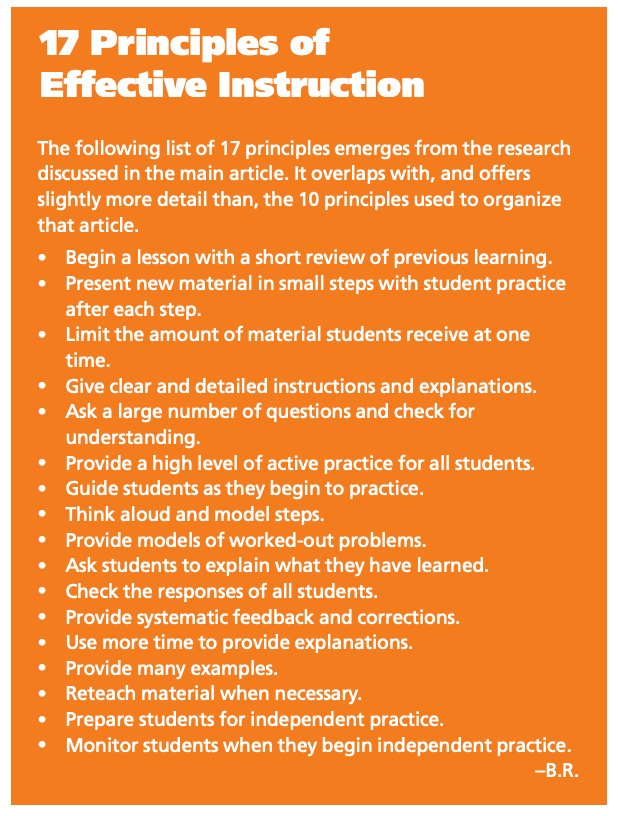
Over the past year, Rosenshine’s Principles of Instruction has been one of the most requested topics from teachers and school leaders. So I’ve put together a complete, ready-to-run CPD pack to help schools explore and implement all 10 principles.
The download includes:
→ 10 CPD PowerPoints (ready for 30–45 min sessions)
→ 10 strategy checklists (practical classroom actions)
→ 10 planning templates (put principles into action )
→ Covers all 10 of Rosenshine’s Principles of Instruction
Everything you need to run ten focused CPD sessions — one for each principle.
👉 REPOST and comment ROSENSHINE and I’ll DM you the link. Cheers!
⏰ Available until Sunday 22 March!
How can feedback drive successful teacher adaptations?
This new Education Endowment Foundation (EEF) resource - ‘Check.Adapt’ - offers a concise, usuable resource to reflect on decisions in the classroom.
Read more here: https://t.co/zT0QcQiUzY
Science deserves to be taught as a way of thinking, rather than just a list of facts.
We’ve just released 2 interactive lessons where learners step into the shoes of Dr. Ignaz Semmelweis in 1846 to learn scientific thinking:
- How to observe patterns in real data
- How to make testable guesses (hypotheses)
- Why failed ideas are not mistakes, but clues
- How to tell correlation from causation
- How evidence can be right and still rejected
- Why identity & beliefs can block good science
- How wrong assumptions distort explanations
- The difference between not knowing and knowing something false
- How to separate your ego from the evidence (The Semmelweis Reflex)
- Why great thinkers hold beliefs loosely
- How to actively look for evidence that could prove you wrong (Feynman rule)
Link to access the lessons 👇
Last week, the government published an update on the Working lives of teachers and leaders (DfE, 2025) across England 🏴
Here's my summary so you don't have to plough through the 39 pages... https://t.co/6Gb02Zg6u8
I made a simulation of the classic radioactive decay dice experiment. Might be useful as an extension to the real activity or it could be used as a substitute for the actual experiment if not enough dice were available. I hope you find it useful.
https://t.co/HfdtSPhJ5F
If you need a Christmas resource for a lesson over the coming weeks, these may be handy. Lots of festive puzzles and some quizzes too. None are mine but gathered over the years. Hope you find them useful 🎅🎄
https://t.co/TLAKjFKa6H
Every time I hear someone say that ‘building relationships is how we get children to behave’ I’m amazed how often they then don’t define what
A) they mean by a relationship
B) how to actually build this mysterious thing.
This leads to multiple errors, eg trying to get kids to ‘like’ you and so on.
Part of the problem is that a lot of research into this appears to be dependent on correlation, not causation. Typically you see great behaviour and good relationships together, so people assume the latter causes the former.
But a good relationship is the outcome of good behaviour management, not the other way around. It’s a product, not a cause.
Why? Because a ‘relationship’ is simply a description of two things- How two or more people typically
1. Behave and
2. Value one another.
So if you want to ‘build a relationship’ you teach students how to act with one another, with you, with school peers, and so one. Simultaneously you teach them that they matter to you, and that their safety and success matters.
These things are far more important than ‘do you know what football team they support?’ You’re not their mate. The relationship you want- and they need- is adult to child, student to teacher. Demonstrated high regard AND standards.
Oh, one more major thing: boundaries. Students need to know there are limits of acceptable conduct, with penalties for crossing them. Any discussion about behaviour, or school behaviour system, that doesn’t have these, will eventually be pointless. No community survives without them, so why should classrooms and schools be different?
When I first introduced retrieval practice, my students resisted. They still preferred checking their notes or copying from a partner because it felt easier (habits are hard to break). So I took a step-by-step approach to show them why retrieval works using a gym analogy. 🧵
@Mouhssin_Ismail@adamboxer1 Call it what you want.
Good teachers will always use retrieval as a form of confidence building/memory storage at the beginning of the lesson. It is an essential component in linking prior content to new learning