Base is for everyone
In action
Someone shows up → gets onchain → leaves with a real participation record
in under a minute.
https://t.co/F1ZiN0ajOC
https://t.co/EN6dAJFeWV
@BinanceUS How is Binance's / @BNBCHAIN own memcoin $TST not listed on https://t.co/BLCwszarYd ?
3 days after deployment $TST went from leak to Binance alpha listing to Binance listing and @binance owns approx 70% of supply
$TST is integral to Binance's strategy going forward
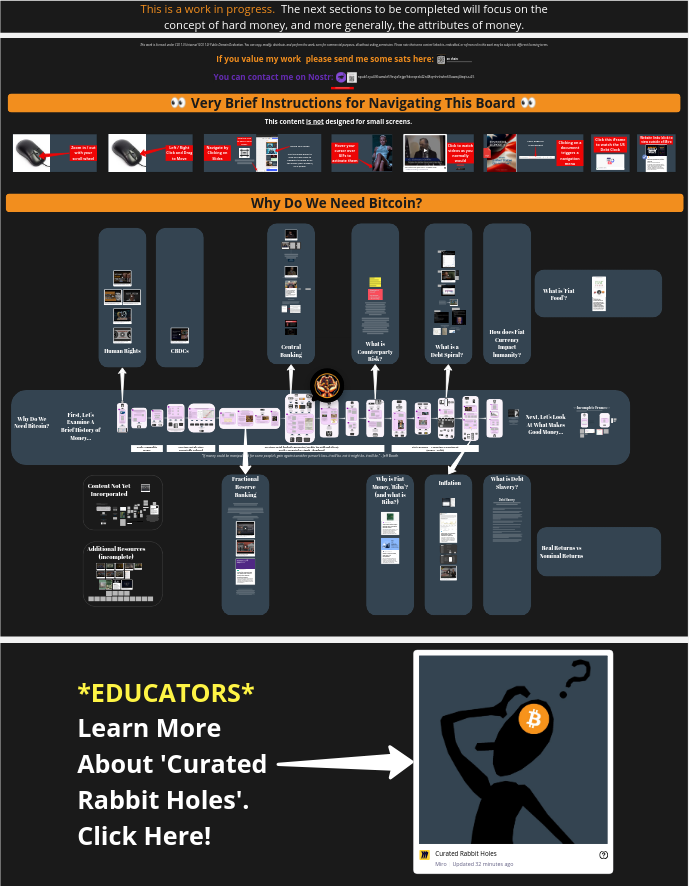
📢Introducing: An Open Source, Curated Rabbit Hole 📢
Unique, visual bitcoin education content focused on the question: 'Why Bitcoin?'
It's not designed for mobile devices - you'll need a reasonably large screen (e.g. a laptop) and a mouse.
Link in comments.
@MCHammer Makes sense.
It would be great to discuss how tokenized assets could benefit everyday people in the future.
I sent you a DM on July 4th with information about us.
We'd love to chat.
Cypherpunks write code.
We know that someone has to write software to defend privacy, and since we can't get privacy unless we all do, we're going to write it. We publish our code so that our fellow Cypherpunks may practice and play with it. Our code is free for all to use, worldwide. We don't much care if you don't approve of the software we write. We know that software can't be destroyed and that a widely dispersed system can't be shut down.
Excited to share that L1F partners @ALEXLabBTC@oylwallet and @SandshrewRPC will be joining our BRC2.0 update tomorrow with @domodata and the protocol team! Don’t miss it - schedule reminder below 👇
Very excited to be hosting our first major BRC20 update talk with @domodata and lead maintainers @bestinslotxyz and @unisat_wallet this Friday!
Thanks to our sponsor @SandshrewRPC for making these talks possible ⚡️ https://t.co/qh3Qag7n13
BRC-20 2.0: Is it enough to compete with Runes?
🎢 Buckle up. It's going to be a wild one.
There is a new programmability module coming for BRC-20. This new programmability module will allow you to do all kinds of arbitrary compute with your BRC-20 tokens. This upgrade is significant enough that I am calling it BRC-20 2.0.
💥 tl;dr - BRC-20 2.0 in a nutshell
1. Inscribe EVM smart contracts to Bitcoin.
2. Upgrade indexers to be able to run EVM smart contract code (simple EVM integration).
3. Include an inscription ID with your BRC-20 txns indicating which smart contract + function you want to interact with.
4. The indexer pulls in the relevant smart contract code, pulls the inputs (your BRC-20 txn), and then runs the inputs through the relevant code, updating BRC-20 state accordingly.
5. You're done. Pretty simple.
‼️ Important caveats
1. EVM was chosen because of its massive network effects, but it could have been any virtual machine and any smart contract language (and could still be if we wanted to eventually support it in BRC-20).
2. This is not a separate chain. This is not a sidechain. This is not a blockchain. This is not an L2. This is just allowing the existing BRC-20 indexers to do more (compute EVM smart contract code on BRC-20 balances).
3. You actually don't add any additional trust assumptions in adding this programmability module. You still have centralized indexers. You rely on them for accurate balances. You leverage Ordinals to store EVM smart contracts. This is just a programmability upgrade for BRC-20.
4. You never have to upgrade BRC-20 again. This is a one-and-done upgrade to enable everything you've ever wanted with BRC-20, which is extremely appealing.
🤪 Crazy ideas made possible by BRC-20 2.0
1. Using a virtual balance deposit (no need to inscribe a transfer) into one of these EVM smart contracts, you can easily bridge (or lockup) BRC-20 tokens into an EVM smart contract. You could even bridge all of your token balances at the same time (provided virtual balance transfers are allowed with this programmability module).
2. #1 then enables all kinds of interesting DeFi primitives: AMMs, aggregated order books (combined listings at similar prices), liquidity pools, lending, etc, all directly on Bitcoin L1 with BRC-20.
3. Similar to #1, you could even start to batch transactions together across users (almost like a sovereign rollup). In this case, you get 20x cost reduction for transactions, you don't bloat the UTXO set anymore, and you don't have to use JSON (as you get more efficient compressed transactions that actually get put on chain).
✅All of your critiques for BRC-20 are solved by BRC-20 2.0
1. There are ways to no longer bloat the UTXO set.
2. You use JSON to go to the txn batch service, but it uses more optimized encoding to store on chain, so not wasteful of bytes anymore.
3. You can't complain about upgrades because programmability module solves all future upgrade concerns.
🤷♂️ What else is there?
BRC-20 2.0 has a chance at being the flexible, programmable fungible token standard we all desire.
Startup demo and Nostr night at @cypherpunklab 🫡
Line of the evening “When cypherpunks say send blob they’re really saying send nostr” 🤣🤣🤣 @_austin_f@MaxAWebster