Cantik ih kalimatnya:
"Mekarlah seindah-indahnya. Bukan untuk menjadi bunga yang paling dipandang, tetapi untuk menjadi bunga yang paling tulus merayakan hidupnya."
Hasil MBTIku ekstrovert, tapi entah kenapa pekerjaanku memaksa bertemu manusia banyak hampir tiap waktu, weekend pengennya mengurung diri di rumah karena energi udah habis seminggu🥲
Physical function after 65 can tell us something important about long-term health.
Researchers followed 13,423 adults aged 65 and older for about seven years. Compared with the lowest-performing group, the highest performers had a 59% lower risk of death on the 8-foot up-and-go test, 50% lower risk on one-leg balance, 45% lower risk on the 30-second chair stand, and 42% lower risk on the 2-minute step test. Those with the highest overall fitness scores had 61% lower mortality.
This was an observational study, so these tests do not prove that improving a score will extend life. They may also reflect underlying health that influences both physical performance and survival.
The practical point is that declining balance, mobility, leg strength, or endurance should not automatically be dismissed as normal aging. These are measurable aspects of physical function worth maintaining and, when they noticeably worsen, worth addressing through appropriate exercise and medical evaluation.
May all the happiness this world can offer find its way to you. Live well, though I have too often disappointed you, and may your days be gentler than those we once knew
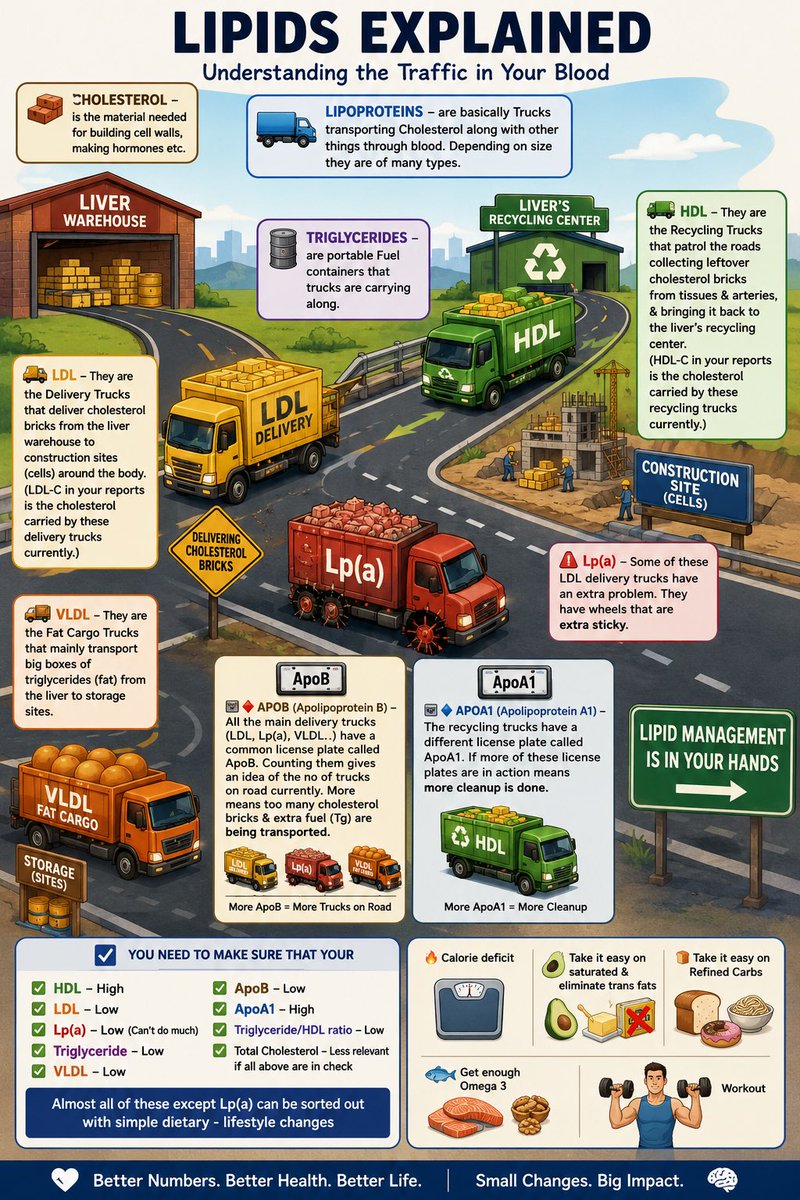
Lipids Explained
🧱 Cholesterol - is the material needed for building cell walls, making hormones etc
🛻 Lipoproteins - are basically Trucks transporting Cholesterol along with other things through blood. Depending on size they are of many types.
⛽ Triglycerides - are portable Fuel containers that trucks are carrying along.
🚛 HDL - They are the Recycling Trucks that patrol the roads collecting leftover cholesterol bricks from tissues & arteries, & bringing it back to the liver��s recycling center.
(HDL-C in your reports is the cholesterol carried by these recycling trucks currently.)
🚚 LDL - They are the Delivery Trucks that deliver cholesterol bricks from the liver warehouse to construction sites (cells) around the body.
(LDL-C in your reports is the cholesterol carried by these delivery trucks currently.)
🚨 Lp(a) - Some of these LDL delivery trucks have an extra problem. They have wheels that are extra sticky, making it more likely to contribute to plaque formation & blood clotting.
🚛📦 VLDL - They are the Fat Cargo Trucks that mainly transport big boxes of triglycerides (fat) from the liver to storage sites.
🪪♦️ApoB (Apolipoprotein B) - All the main delivery trucks (LDL, Lp(a), VLDL..) have a common license plate called ApoB. Counting them gives an idea of the no of trucks on road currently. More means too many cholesterol bricks & extra fuel (Tg) are being transported
🪪🔹ApoA1 (Apolipoprotein A1) - The recycling trucks have a different license plate called ApoA1. If more of these license plates are in action means more cleanup is done.
🔵 You need to make sure that your
✅ HDL - High ✅ LDL - Low ✅ Lp(a) - Low (Can’t do much) ✅ Triglyceride - Low ✅ VLDL - Low ✅ ApoB - Low ✅ ApoA1 - High ✅ Triglyceride/HDL ratio - Low ✅ Total Cholesterol - Less relevant if all above are in check
Almost all of these except Lp(a) can be sorted out with simple dietary - lifestyle changes
- Calorie deficit
- Take it easy on saturated & eliminate trans fats
- Take it easy on Refined Carbs
- More fiber
- Get enough Omega 3
- Workout
Protein does not become muscle just because you ate it.
After a meal, amino acids arrive in the blood and muscle has to accept them and build them into contractile protein. That building is only half the ledger. Muscle protein is broken down continuously as well, and net change is the difference between the two. Most short studies, including the ones below, measure only the building side.
When researchers cut the daily step count of ten healthy 72-year-olds by around three-quarters for two weeks, the after-meal building response fell by roughly a quarter. Fasted rates did not change. Leg fat-free mass dropped almost 4 percent in a fortnight, alongside worse insulin sensitivity and higher inflammatory markers.
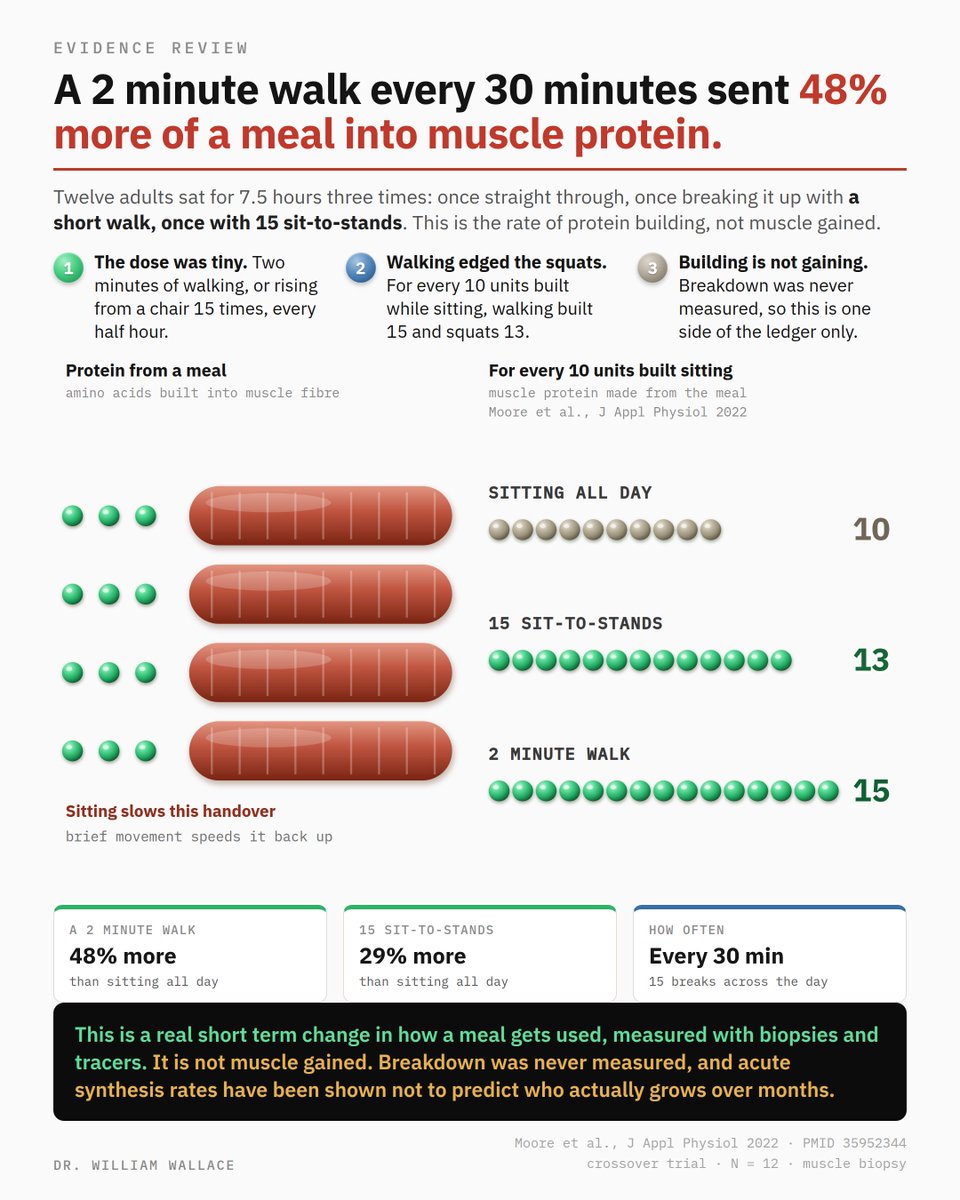
A Toronto group then ran the experiment forwards. Twelve adults sat for seven and a half hours on three separate days, eating identical meals labelled with tracers so the amino acids could be followed into muscle. One day was uninterrupted sitting. On the others, every thirty minutes they either walked for two minutes or rose from a chair fifteen times. Muscle was biopsied directly.
For every ten units of muscle protein built during the sitting day, the sit-to-stand day built thirteen and the walking day built fifteen. Two minutes of walking, taken fifteen times across a working day, changed where a meal's protein ended up.
In 23 untrained men, acute post-exercise building rates rose 235 percent after a first training session, then showed essentially no relationship with the hypertrophy those same men achieved over the following sixteen weeks. The correlations were near zero. Quadriceps volume grew 7.9 percent on average, with individuals ranging from slightly negative to nearly 25 percent, and the acute measurement predicted none of that spread.
So these trials describe how a meal gets handled on the day, which is a real and useful thing to know. They do not identify who builds muscle over months, and they never measured breakdown.
Prolonged sitting appears to blunt what a meal does. Interrupting it costs two minutes.
Moore et al., J Appl Physiol 2022 · PMID 35952344
Breen et al., J Clin Endocrinol Metab 2013 · PMID 23589526
Mitchell et al., PLoS One 2014 · PMID 24586775
Exercise Is Brain Medicine
Exercise activates three routes to BDNF
Neural activity
Increased cerebral blood flow
Signals released by muscle and liver
BDNF supports synaptic plasticity learning and memory
One striking finding
In cell culture brain endothelial cells produced 50 times more BDNF than cortical neurons
Your muscles blood vessels and brain communicate every time you move
Exercise belongs at the center of Alzheimer’s prevention
Two years of aerobic exercise made the hearts of out-of-shape 50-year-olds behave like hearts up to 20 years younger.
Researchers randomized 61 sedentary adults, average age 53, to two years of real training or gentle yoga, then measured heart stiffness the hard way: a catheter threaded straight into the heart. The trained group's fitness rose 18% and the main chamber went from stiff to elastic, taking in more blood at lower pressure. "20 years younger" describes the size of the stiffness improvement, not a literal age, but the effect was real.
The heart stiffening long blamed on age is partly the cost of sitting, and in middle age it's still reversible.
Thank you for standing by me through every high and every low. You've been my comfort. I don't think I'll ever be able to repay everything you've done for me, but I'll spend a lifetime being grateful for you. 🤍