⚡ The NSA says that the AI security center is necessary to stay ahead of the evolving threat landscape. Cyberattacks are becoming increasingly sophisticated, and traditional security measures are often not enough to protect against them.
The center will use artificial intelligence to develop new ways to detect and prevent cyberattacks, including those that are launched by nation-states.
In a world where data is king, AI reigns supreme.
The quest to harness its full potential is an exciting challenge that will shape our world in ways we can't even imagine. 🌐🧠
_
#ArtificialIntelligence#technology
Diffusion Models - The Magic Behind Stable Diffusion and MidJourney
Watching an AI model generating a photorealistic image from a text prompt feels like magic. Image generation models like Stable Diffusion and MidJourney have made us all prompt artists.
Here is how the magic happens. Stable Diffusion is a latent diffusion model. Deep learning-based diffusion models use neural networks to iteratively add and then remove noise from data, such as images, to generate new samples.
Essentially you start with a clean, target image and add noise in a series of steps - you go from a complex high-dimensional space of an image vector to a "noisy" space. You then "reconstruct" the image using a neural network trained to go from the noisy vector back to the image. As the model removes noise iteratively, it learns the essential features of the image and learns how to "reconstruct" the image and this is where the generative aspect comes into play.
The process of adding and removing noise allows for exploration of the data space and the noise acts like a form or regularization, preventing the model from overfitting and generalizing. Reconstructing or reversing the noise process helps the model generate similar data.
Once trained, you can start with random noise and end up with a generated image that has the characteristics of the training set.
Stabe Diffusion is a latent diffusion model. It largely operates in a low-dimension space by compressing the image into a much smaller lower-dimensional representation called the latent space. This makes for great efficiency and speed as you are dealing with a simplified version of the data
You start with a text prompt that is converted into a high-dimensional encoding using a Transformer-based encoder. This encoder maps a sequence of input tokens to a sequence of latent text embeddings, which are then used to condition the latent space for image generation.
These embeddings are then used to condition the latent space of the diffusion model in a process called latent space conditioning. Essentially the text embedding is used to modify or "condition" the initial random noise in the latent space and guides the diffusion model on what features to focus on and what the final image should be like. The diffusion process then iteratively refines this conditioned latent space, gradually transforming the random noise into a coherent image.
This allows for customization based on the text prompt and efficiency as we are operating in a low-dimensional space
This is of course an oversimplification of the process and there is a lot more detail to this process but hopefully should give a high-level understanding of the process by which text prompts get converted into beautiful images!
✨ With this, India joins an elite club of countries to achieve a soft landing on the Moon, after the US, the former Soviet Union and China. #ISROMissions#Chandrayaan3
It currently supports frameworks like Angular, Flutter, Next.js, React, Svelte and Vue, and languages like JavaScript and Dart, with support for Python, Go and others in the works. 🧑💻
🌐🔍 Kevin Murphy, says: "We believe that foundation models have the potential to change the way observational data is analyzed and help us to better understand our planet, And by open sourcing such models and making them available to the world, we hope to multiply their impact."
🛰️💡 This remarkable endeavor doesn't just widen access to NASA's treasure trove of earth science data; it's a bold step towards accelerated climate insights and geospatial intelligence.
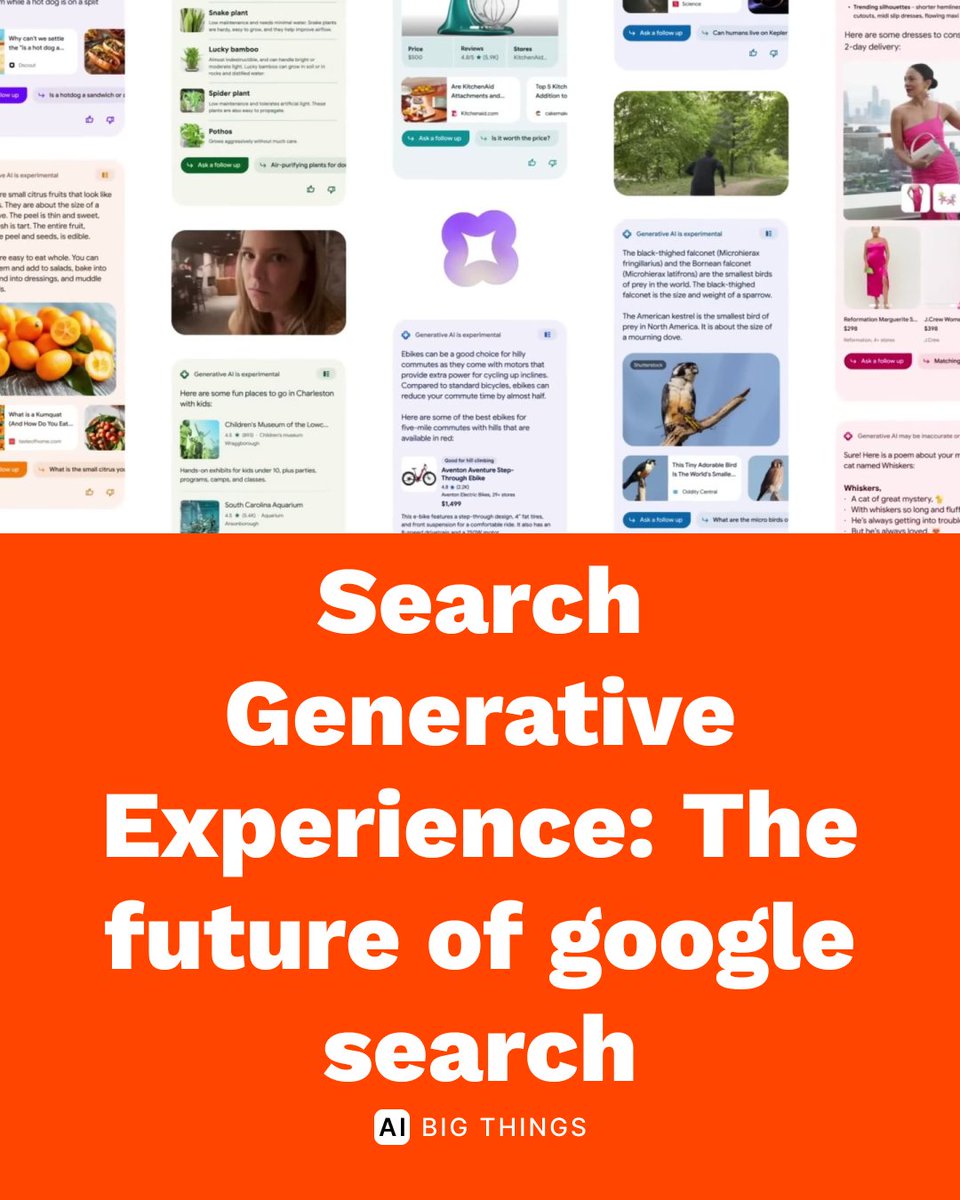
Google has announced a major new update to its search engine, called SGE (Search Generative Experience). SGE is powered by generative AI, which means it can understand natural language queries and generate informative and relevant results.
#GenerativeAI