AIER educates people on the value of personal freedom, free enterprise, property rights, limited government and sound money. @thedailyeconomy @FUSIONaier
Submissions are officially open for AIER’s 2026 Douglas B. Rogers Essay Competition. This annual program challenges students to dive deep into the ideas that formed the underpinnings of Western Civilization.
It's open to full-time undergraduate students at any North American college or university.
To enter, write an original essay (up to 4,000 words) examining how Adam Smith’s ideas of economic liberty align with the ideals of the Declaration of Independence. Don't miss the chance to showcase your research, sharpen your voice, and honor the memory of a brilliant scholar.
Submissions are due by September 15, 2026: https://t.co/2ZJB3KUErN
"The rhetoric of the welfare state is often that we're redistributing from the rich to the poor. But really the great bulk of redistribution the welfare state does is from workers to ... retirees."
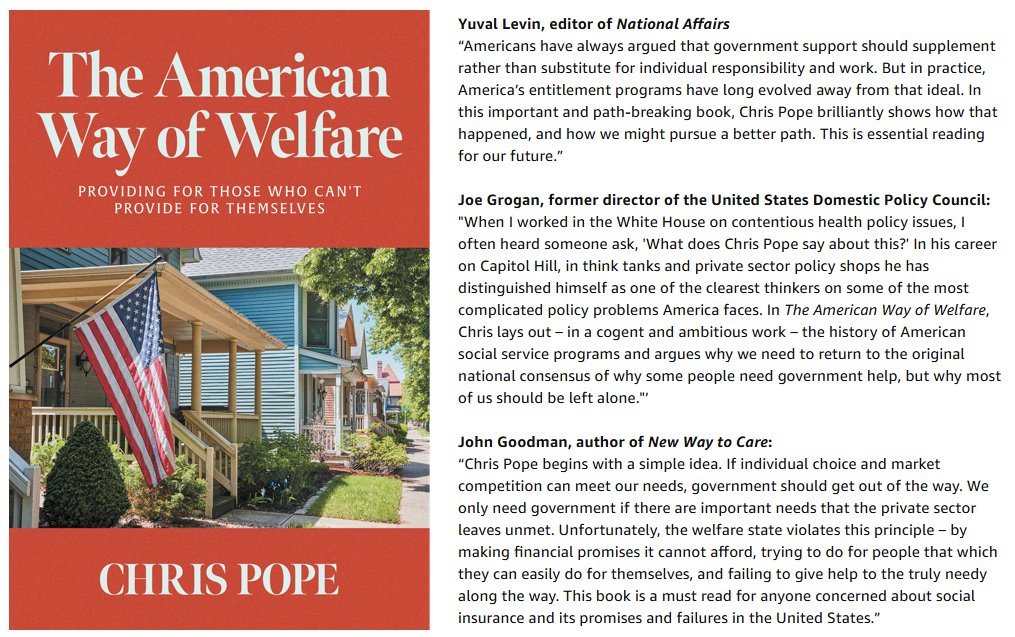
Check out @ManhattanInst senior fellow @CPopeHC's new book "The Way of American Welfare: Providing For Those Who Can't Provide For Themselves" on Amazon: https://t.co/XhGvV0r3Is
“I think the future for America is very bright,” says @Dave_Hebert, senior research fellow at the @aier. “I think the future for the American manufacturing sector is very bright, provided, of course, government stays out of the way.” https://t.co/vC6KONM05a
Markets work best when people are free to innovate, compete, and solve problems without unnecessary barriers. @Dave_Hebert of the @aier explains why economic freedom remains a key driver of opportunity and prosperity. Watch our entire discussion here: https://t.co/vC6KONM05a
In our recent AIER Explainer, @thomas_savidge explains how "cartel federalism" is one of the means by which federal transfers undermine freedom.
https://t.co/RUk3P8AMO7
Imagine telling people that your financial problems were solved because your neighbor got a raise. That's basically what we do when we focus on debt-to-GDP ratios.
My latest with the @CivitasInst in @CivitasOutlook:
https://t.co/Xad0vVbUR3
Government "wouldn't really try and provide for everybody... provide pensions, provide healthcare for able-bodied people who are perfectly capable of earning and providing for themselves."
@CPopeHC from @ManhattanInst shares from his new book "The Way of American Welfare: Providing For Those Who Can't Provide For Themselves" how the U.S. government's welfare has expanded over the years.
Check it out here: https://t.co/XhGvV0qvSU
That the world’s first trillionaire is an immigrant to the United States who arrived with little, slept on floors, worked 100-hour weeks, & built companies now employing the population of Savannah, Georgia, will be entirely lost on the bitter arithmetic of envy and economic ignorance masquerading as egalitarianism.
Now, as always: markets and entrepreneurship for the win.
"Fundamentally, private responsibility is best. ... The government should only step in when the private sector can't work."
@CPopeHC of @ManhattanInst talks about his new book, "The Way of American Welfare: Providing For Those Who Can't Provide For Themselves."
Buy your copy on Amazon: https://t.co/XhGvV0qvSU
"Fundamentally, private responsibility is best. ... The government should only step in when the private sector can't work."
@CPopeHC of @ManhattanInst talks about his new book, "The Way of American Welfare: Providing For Those Who Can't Provide For Themselves."
Buy your copy on Amazon: https://t.co/XhGvV0r3Is
Barack Obama once told Congress: "I believe what Republican Abraham Lincoln believed: That government should do for people only what they cannot do better by themselves, and no more.”
What would government look like if we took this principle seriously?
https://t.co/Ee7VwhDGkn
Everyone knows what conservatives don't like about the welfare state.
It's time for a right-of-center vision of what it *should* be doing:
https://t.co/Ee7VwhDGkn
What if many of the most widely accepted assumptions about the welfare state are wrong?
In The American Way of Welfare, @CPopeHC of @ManhattanInst challenges conventional wisdom about poverty, inequality, and taxation.
It was a pleasure to join @DrPaulMueller of @aier on The Economist Next Door podcast! We have a great conversation about local governments, spending, and property taxes, where we dive into why I think property taxes are immoral, arcane, and flawed. Check out the episode today! 👇