AIL2 introduces a Decentralized AI Superlayer designed for Eth, BNB Chain and the multi-chain AI economy.
AIL2 connects AI agents, modular networks and decentralized resources into one scalable intelligence layer.
https://t.co/NeUo6nE7Fb
#MultiChain#AIL2#AIagents
The future of AI is not isolated.
It’s coordinated.
As digital ecosystems expand across multiple chains and platforms, AI systems must become network-aware.
See more:
https://t.co/hsCNNrbZba
#CrossChain#AIInfrastructure#Web3AI#MultiChain#DecentralizedAI
𝗔𝗜 𝗔𝗴𝗲𝗻𝘁’𝘀 𝗠𝗲𝗺𝗼𝗿𝘆 is the most important piece of 𝗖𝗼𝗻𝘁𝗲𝘅𝘁 𝗘𝗻𝗴𝗶𝗻𝗲𝗲𝗿𝗶𝗻𝗴, this is how we define it 👇
In general, the memory for an agent is something that we provide via context in the prompt passed to LLM that helps the agent to better plan and react given past interactions or data not immediately available.
It is useful to group the memory into four types:
𝟭. 𝗘𝗽𝗶𝘀𝗼𝗱𝗶𝗰 - This type of memory contains past interactions and actions performed by the agent. After an action is taken, the application controlling the agent would store the action in some kind of persistent storage so that it can be retrieved later if needed. A good example would be using a vector Database to store semantic meaning of the interactions.
𝟮. 𝗦𝗲𝗺𝗮𝗻𝘁𝗶𝗰 - Any external information that is available to the agent and any knowledge the agent should have about itself. You can think of this as a context similar to one used in RAG applications. It can be internal knowledge only available to the agent or a grounding context to isolate part of the internet scale data for more accurate answers.
𝟯. 𝗣𝗿𝗼𝗰𝗲𝗱𝘂𝗿𝗮𝗹 - This is systemic information like the structure of the System Prompt, available tools, guardrails etc. It will usually be stored in Git, Prompt and Tool Registries.
𝟰. Occasionally, the agent application would pull information from long-term memory and store it locally if it is needed for the task at hand.
𝟱. All of the information pulled together from the long-term or stored in local memory is called short-term or working memory. Compiling all of it into a prompt will produce the prompt to be passed to the LLM and it will provide further actions to be taken by the system.
Join me in my End-to-End AI Engineering Bootcamp to learn how to manage memory hands on: https://t.co/gWBu8OLTzn
We are kicking off in 2 days! Use code LASTCHANCE15 to get 15% off.
We usually label 1. - 3. as Long-Term memory and 5. as Short-Term memory.
And that is it! The rest is all about how you architect the topology of your Agentic Systems.
Any war stories you have while managing Agent’s memory? Let me know in the comments 👇
AI is moving beyond chat.
The next phase is workflow automation.
From Web2 systems to Web3 ecosystems, intelligent automation is reshaping how infrastructure operates.
👇👇👇
https://t.co/sAzeFR0SSY
#WorkflowAutomation#AIInfrastructure#Web3AI#CrossChainAI
The AI industry is shifting.
The biggest opportunity may no longer be models — it may be infrastructure.
As AI agents scale across Web3 ecosystems, decentralized coordination and compute layers are becoming critical.
Learn more
https://t.co/jRwmr7OsFM
#Web3AI#DecentralizedAI
AI Learns. Humans Lead.
We're not building AI to replace our teams. We're building it to make them sharper. 380+ open roles for people who want to be the human in that equation.
Join us here 👉 https://t.co/P8CKNYabu2
AI is no longer just hype — it’s becoming real infrastructure.
The challenge now isn’t intelligence, it’s scalability.
Discover why AI infrastructure must evolve.
https://t.co/IgBQGVTFls
#AI#AIInfrastructure#Web3AI#DecentralizedAI
AI infrastructure is moving beyond centralized data centers.
Distributed GPU networks and DePIN models are reshaping how AI scales.
Discover why decentralized compute is the next big shift.
https://t.co/PjXd4Wxof1
#DePIN#GPU#AIInfrastructure#Web3AI#DecentralizedAI
AI isn’t getting cheaper — it’s getting more expensive to run.
Inference is now the biggest cost in AI systems.
Here are 5 reasons why AI infrastructure is hitting a breaking point.
https://t.co/SSM1BFGjlL
#AIinference#AIcost#AIInfrastructure#Web3AI#DecentralizedAI
AI is moving into real-time.
Low latency, scalable infrastructure will define the next generation of intelligent systems.
Discover how real-time AI networks are evolving.
👉 https://t.co/G3mGfQLAUI
#RealTimeAI#AIInfrastructure
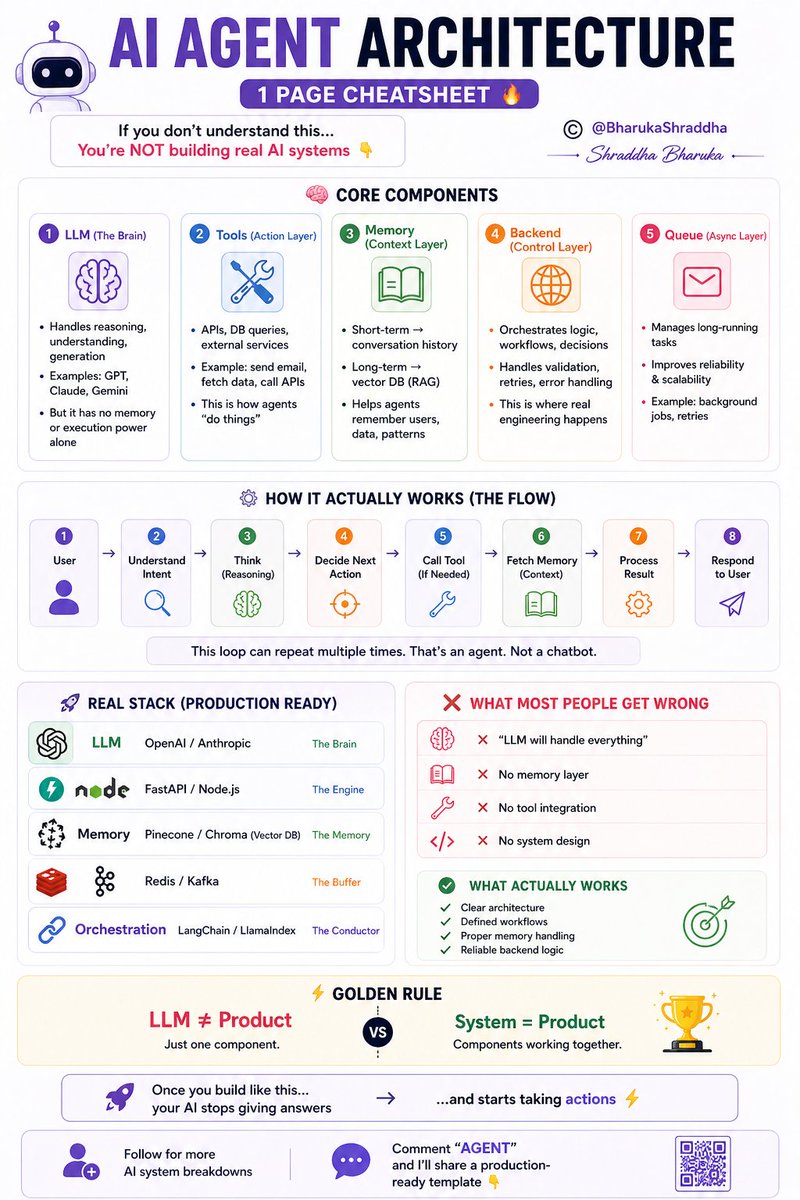
AI Agent Architecture, The Real Cheatsheet 🤖
Most people think calling an LLM = building an AI product.
It’s not.
If you don’t understand this…
you’re not building real AI systems 👇
🧠 CORE COMPONENTS
LLM (The Brain)
• Handles reasoning, understanding, generation
• Examples: GPT, Claude, Gemini
• But it has no memory or execution power alone
Tools (Action Layer) 🔧
• APIs, DB queries, external services
• Example: send email, fetch data, call APIs
• This is how agents “do things”
Memory (Context Layer) 📚
• Short-term → conversation history
• Long-term → vector DB (RAG)
• Helps agents remember users, data, patterns
Backend (Control Layer) 🌐
• Orchestrates logic, workflows, decisions
• Handles validation, retries, error handling
• This is where real engineering happens
Queue (Async Layer) 📬
• Manages long-running tasks
• Improves reliability & scalability
• Example: background jobs, retries
⚙️ HOW IT ACTUALLY WORKS
User → Agent
→ Understand intent
→ Think (reasoning step) 🧠
→ Decide next action
→ Call tool (if needed) 🔧
→ Fetch memory (context) 📚
→ Process result
→ Respond
This loop can repeat multiple times.
That’s an agent. Not a chatbot.
🔥 REAL STACK (Production Ready)
• LLM → OpenAI / Anthropic
• Backend → FastAPI / Node.js
• Memory → Pinecone / Chroma (Vector DB)
• Cache / Queue → Redis / Kafka
• Orchestration → LangChain / LlamaIndex
💡 WHAT MOST PEOPLE GET WRONG
❌ “LLM will handle everything”
❌ No memory layer
❌ No tool integration
❌ No system design
✅ WHAT ACTUALLY WORKS
• Clear architecture
• Defined workflows
• Proper memory handling
• Reliable backend logic
⚡ GOLDEN RULE
LLM ≠ Product
System = Product
Once you build like this…
your AI stops giving answers
…and starts taking actions 🚀
Follow for more AI system breakdowns
Comment “AGENT” and I’ll share a production-ready template 👇
AI is powerful — but can it be trusted?
Verifiable AI is becoming essential as AI systems enter Web3 infrastructure.
Transparency and validation will define the next generation of AI.
https://t.co/xU3woTkr4d
#VerifiableAI#Web3AI#AIL2
AI is no longer limited by training — inference is the real bottleneck.
Costs, latency, and scalability are becoming major challenges.
Here are 6 key problems in AI inference infrastructure and how decentralized networks are solving them.
https://t.co/rfMHYiJ24m
#AIinference