No plumbers around Holland Village?!?
Not a single one showed up on ChatGPT just now.
As more and more customers lets AI do the searching and the short listing, all small businesses need to ensure they are visible to AI.
This is the problem we solve at AIMSOO.
We’re coming to the Bay Area.
Join us in San Francisco to discuss how user-side AI agents will reshape ads, e-commerce, publishers & marketing.
Google, OpenAI, Meta & others are already moving.
📍 13 May @ INSEAD Hub for Business Innovation
🎟️ Free
Link below 👇
AI Overviews don’t create clicks they kill them.
According to data from Ahrefs and Amsive
Ahrefs (300,000 keywords):
-34.5% drop in CTR for position 1 when AI Overviews are present
Focused on informational intent keywords (99.2% overlap with AI Overviews)
Amsive (700,000 keywords):
-15.49% average CTR drop across all keywords
- 37.04% CTR drop when AI Overviews + featured snippets appear together
-19.98% CTR decline on non-branded keywords
-27.04% CTR drop for keywords ranking outside the Top 3
Only 4.79% of branded keywords trigger AI Overviews, but those that do saw a +18.68% CTR boost
AI Overviews are disproportionately harming non-branded, informational queries, while branded queries see less disruption (and in rare cases, a CTR boost).
So based on that,
Let’s cut the nonsense AIOs are built on scraping and rehashing other people’s work.
It’s content theft at scale because you are using SOMEONES work to provide an answer without returning the click.
Whilst technically it's NOT scraping, it borders a VERY grey area (because they do provide a link to the source)
The very thing Google told webmasters not to do for decades, they’re now doing themselves
Google’s stance for publishers:
Google’s spam and helpful content policies stress that websites must create original, valuable, experience-driven content, not thin summaries or regurgitations. They explicitly discourage content that is “stitched together” or “rephrased” without adding real insight.
What AI Overviews do:
AIOs pull content from multiple sources, repackage that information, and serve it back to the user as a “new” answer. While citations may be shown, the visible content itself is essentially a Google generated digest, not the original publisher’s work.
So this is clearly contradictory.
And don’t kid yourself that “it’s just informational clicks” Those clicks used to build brand awareness, shape perception, and spark consideration before purchase. That’s where businesses lost visibility and revenue
Google search console does NOT report AIO data even though it SHOULD be shown as a search appearance item. Whilst this COULD change in the future along with AI mode data right now, AIO data is unavailable, all we see are site owners/SEOs sharing crocodile graphs
Every audit tells the same story AIOs do not send more clicks
COMPENSATION STRATEGY?
You need MORE high quality content that's of sheer value to the end user (not just text, but video, tools etc) to offset the lost clicks - if you are a publisher obviously this is going to be challenging
So as SEOs we should switch to compensatory strategies where we maximise high quality content generation but also ensure we cull off anything dead, we use our new content and get it out over social media, create videos to go with post content and get them onto Youtube, Vimeo, Insta Shorts, TikTok
Whilst the SEO industry HAS been impacted by AIOs, we should merely adapt our strategies accordingly
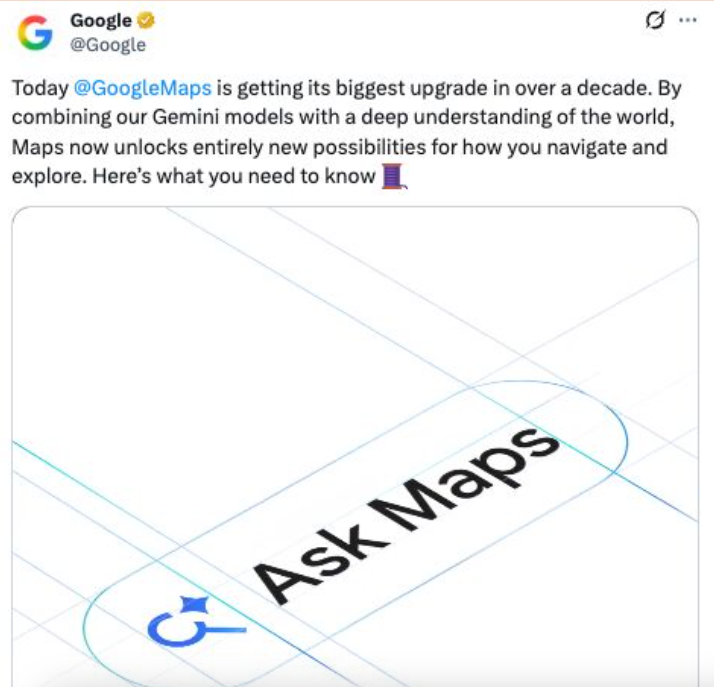
Google takes maps agentic. That will not help the 83% of restaurants who are invisible to ChatGPT.
30% of search no longer happens on Google. Small business is not seen. Unless they list with AI. Which is what we do at AIMSOO.
https://t.co/8wVsp7VzH4
"83% of restaurants are invisible on ChatGPT. "
This pattern is repeated across all small business and across all AI. The listings on Google and Facebook are not shared to other AI. We solve that.
https://t.co/8wVsp7VzH4 - free listing on all AI. No code, no credit card.
Google Search generated $63 billion last quarter. 45% of consumers now use AI tools like ChatGPT for local business recommendations, up from 6% one year ago.
Ask Maps is Google’s answer to that trendline.
Google’s own internal documents, revealed during the DOJ antitrust trial, show executives agreed that declining market share for traditional search is “inevitable.” They said the word out loud. The strategy: push users toward conversational AI before someone else owns the behavior.
The competitive math explains everything. 83% of restaurants are completely invisible on ChatGPT. Only 14% are invisible on Google Maps. That gap exists because Google has 300 million listed places, 500 million review contributors, and 20 years of structured location data. OpenAI has none of it. ChatGPT launched ads in February with a $200,000 minimum buy on a platform where most local businesses can’t even be found organically.
Google Maps generates an estimated $11 billion a year, 82% from ads. A natural language query like “cozy vegan spot for four at 7 tonight” gives Google six targeting signals in one sentence: location, cuisine, dietary preference, group size, budget range, and time. A keyword search gave them two. Every Ask Maps query is worth multiples of a traditional Maps search to an advertiser.
Ask Maps converts Google’s data monopoly on local commerce into a conversational interface before ChatGPT or Perplexity can close the gap. The 500 million people who’ve already told Google Maps where they like to eat are the one asset no competitor can train its way into.
Google called this the biggest Maps upgrade in over a decade. The honest version: every month they wait, another percentage point of local discovery migrates to a chatbot running on Bing results and zero first-party location data.
Also think data is the only real moat left. Live/changing and proprietary data. Everything else gets to everyone over time.
Huge industry forming to help AI-models access data and make those pipes secure and useful for anyone who owns data.
Larry Ellison on the AI moat:
AI is commoditizing because models use the same public internet data.
The true competitive edge isn't the model itself anymore, but access to exclusive, proprietary datasets. That is the only moat left.
March 25th in Singapore. In person meet up to look at all things AI Marketing with a deep dive on agents buying ads. Free to all interested.
https://t.co/h7HQmtcb1k
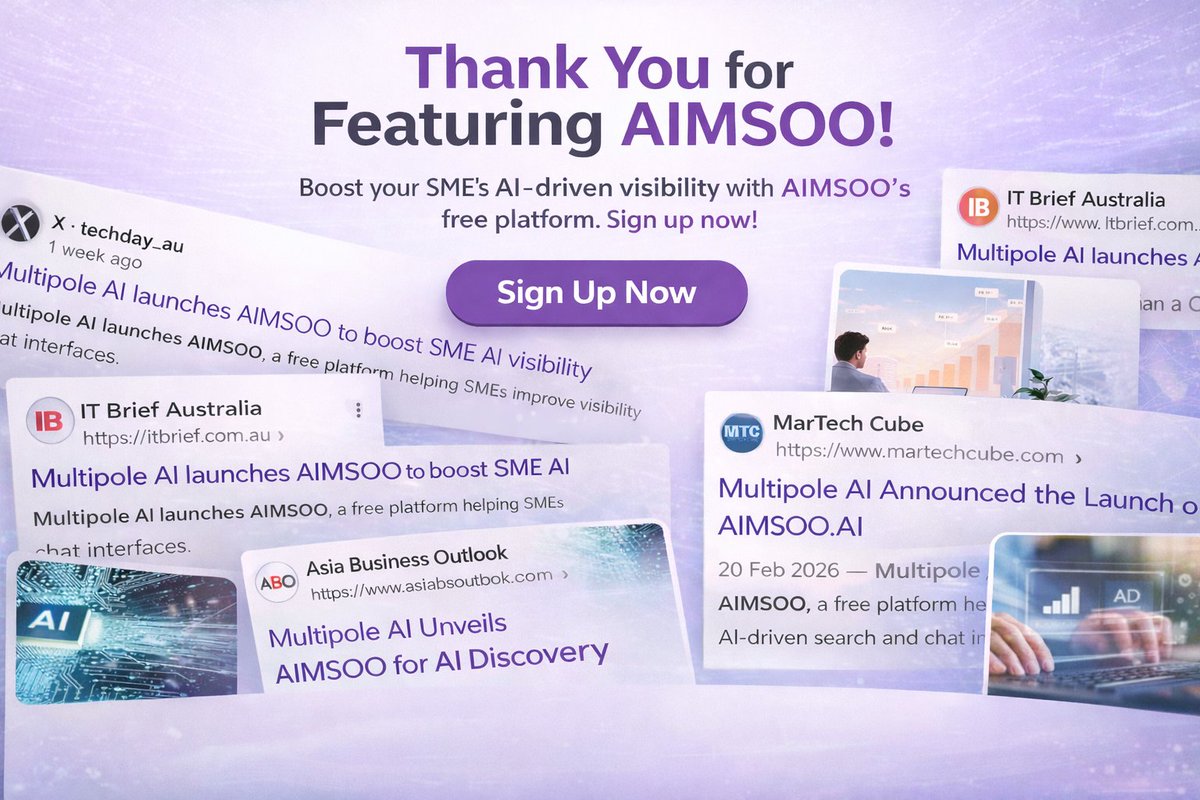
We’re grateful to be featured across multiple tech & business media for the launch of AIMSOO. AI is becoming the new search engine and SMEs shouldn’t be invisible.AIMSOO helps small & medium businesses improve their visibility in AI-driven search and chat tools. And it’s free
Multipole AI launches AIMSOO, a free platform helping SMEs improve visibility in AI-driven search and chat interfaces. Designed to support smaller firms in being found more easily via emerging AI tools. #SMEs#AI#Search#UKBusiness https://t.co/9trGJw0pzH
"LLMs favor content that does X" is not a thing!
LLMs don't favor anything. They're not information retrieval systems; they're next-token predictors. They guess the most statistically likely response based on patterns in training data.
The search engine layer bolted on top via RAG? That's IR (Information Retrieval)!! The base LLM model? Not even close.
During training, LLMs process text from across the web, but they don't log URLs, store sources, or remember where anything came from. What's left is a frozen statistical snapshot (Gao et al., 2023). Not an index. Not a database.
Search engines do the crawling, indexing, and retrieval. LLMs lean on them heavily to surface real-time info (because on their own, they can't).
Stop optimizing for 'AI.' Optimize for search engines (so retrieval-based AI can cite you) + earn third-party coverage (so the model already knows you before the prompt is typed).
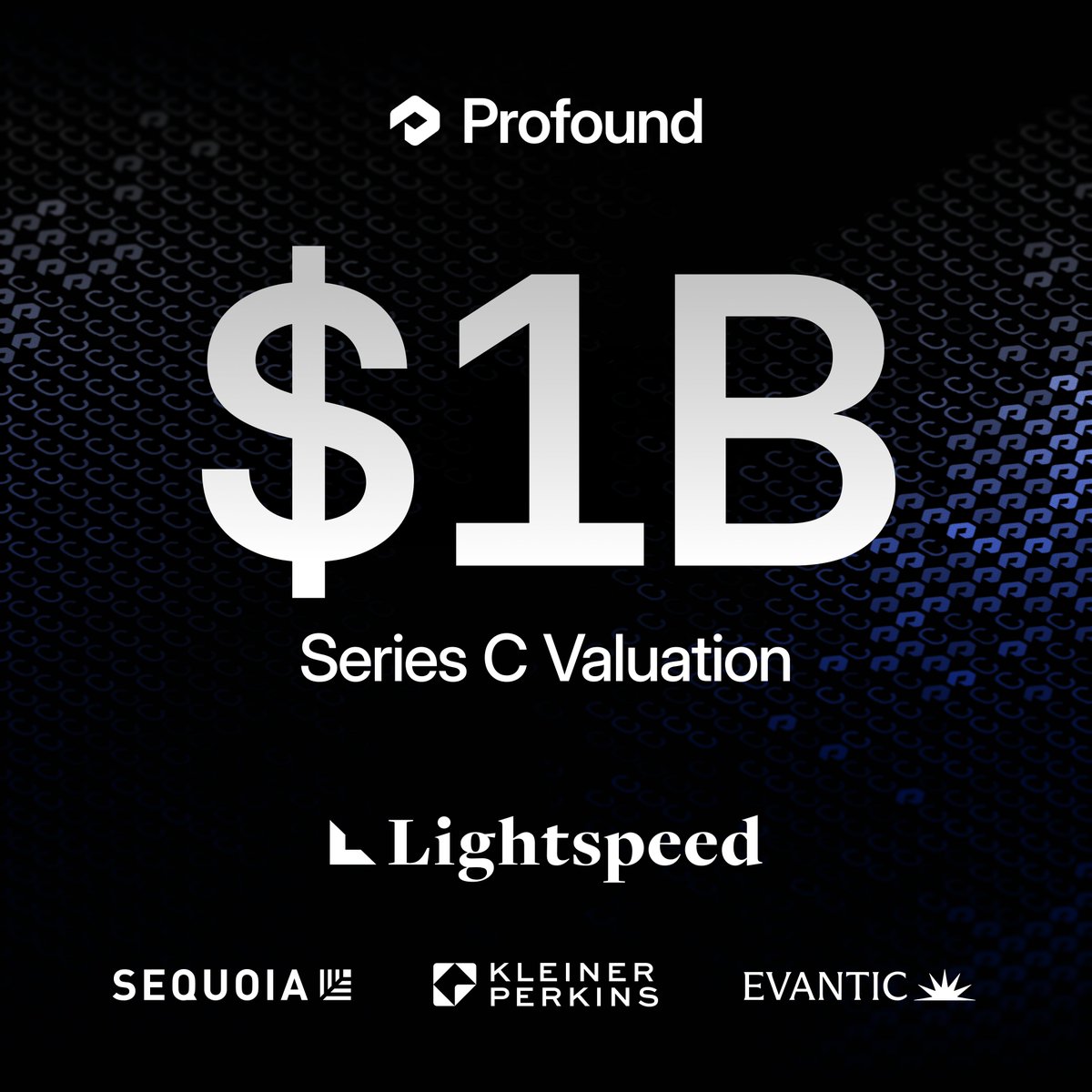
We’ve raised $96M in Series C funding at a $1B valuation, led by @lightspeedvp.
Grateful to our team, customers, and investors for their trust and partnership over the past 18 months.
We're excited for the next chapter of our journey: building AI agents for marketers.
Multipole AI has launched AIMSOO, a free platform to help SMEs boost visibility in AI-driven search and chat interfaces. @techday_asia https://t.co/d05Gu2fbWz