#EPP CEO Ben Clube must think he’s living in a parallel universe…
He spends his days meeting with Number Ten and high ranking officials at DESNZ, Department of Business and Trade and OFGEM. He also negotiates with multi billion pound industry majors like Siemens Energy, Wood, KBR and Costain… all to progress the FEED activities of MESH, which is expected to be the UK’s largest energy storage hub, potentially generating billions of pounds per annum (see NPV8 numbers on the recent investor presentation), all at a time of unprecedented demand for the project’s homegrown long duration energy storage and domestically produced graphite and ammonia.
Presumable he then looks at the trading activity for the day and sees idle selling and someone buying 24p’s worth of shares to close out Fridays session… he then checks LSE and sees his company is currently valued at a mere £20m MCAP.
At what point will AIM retail realise the value disconnect here? Before or after DEVEX/CAPEX funding and institutional investment arrives?
Link to Company Investor Presentation 🔗 https://t.co/tncT949646
#EPP that’s the 20ma resistance broke and .5fib 1st target hit. Now needs to clear to test the .618fib resistance. RSI now above 50 positive. Macd crossing positive. Rising 50ma support. Looking good. Upside. DYOR
#epp feel like a re-valuation is coming soon enough and it won’t stop. Coverage is increasing, interest is building nationally, outside of traditional small cap buyers, and the opportunity to buy and hold for a life changer is becoming real. Watch this rerate..
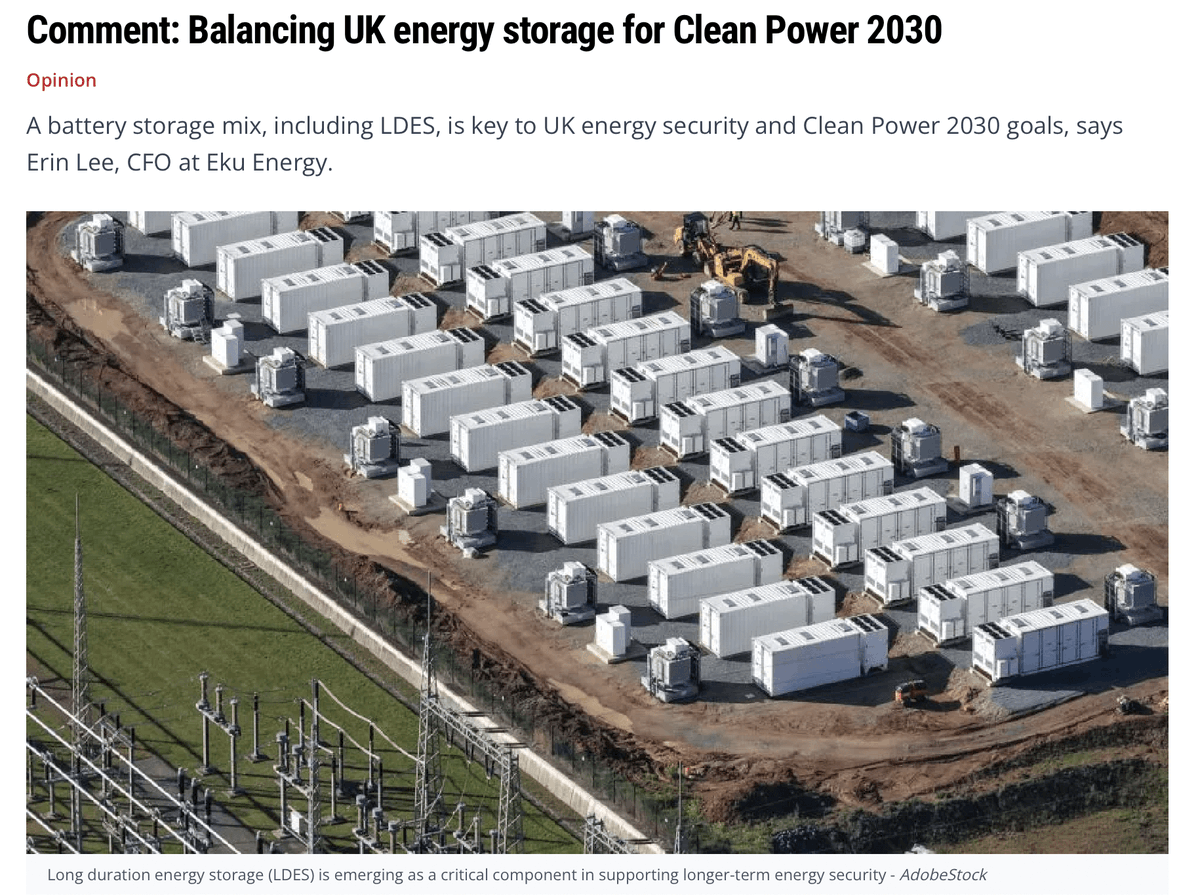
#EPP A timely article by EKU Energy CFO Erin Lee in The Engineer, highlighting a reality that is becoming increasingly clear: to achieve its Clean Power 2030 ambitions, the UK needs large-scale, long-duration energy storage.
As renewable generation continues to grow, the challenge is no longer simply generating clean electricity — it's storing it and deploying it when needed. Industry experts, regulators and policymakers are increasingly recognising that long-duration energy storage (LDES) is essential for reducing curtailment costs, bolstering energy security, and lowering consumer energy bills.
This is precisely the challenge that EnergyPathways' MESH project is designed to address.
Expected to be Britain’s largest integrated energy storage project, it will bolster Britain’s energy security and help lower consumer bills. Designated a project of “national significance” by the UK Government, MESH combines compressed air electrical storage (“CAES”) with natural gas and hydrogen storage.
MESH has the potential to play a critical role in helping the UK unlock the full potential and value of its renewable energy resources. And as the debate moves from renewable generation to system flexibility, grid resilience and energy storage, projects capable of delivering energy storage at scale are becoming increasingly important to the UK's energy future.
Link to Article: https://t.co/kZaHrgJJID
#EPP #EnergyStorage #LDES #CleanPower2030 #EnergyTransition #Hydrogen #CAES #EnergySecurity #MESH #EnergyPathways @TheEngineerUK@energygovuk@eku_energy@Siemens_Energy@ofgem
#EPP still only a 20mil mcap - 18 - 24 month 10x+ investment - 5 year potiencial £1bn+ mcap company
Partner #siemensenergy has 25xed in the past 30 months #EMR - same potiencial here
The funds generated were essential to secure the work commitments for the NSTA gas storage license award. When the finance package was signed off the #EPP EnergyPathways market cap was £12.5 million
Would you have preferred the company to have tried to raise £15 million via a discounted capital raise on the open AIM market?
And, if they did manage to somehow do this and raise 120% of their market value 😂, what would then be the dilution to shareholders?
Review: Many of the key features of the @energy_pathways facility are specifically structured to align the investor’s interests with those of existing shareholders and to support the long-term development of #EPP’s nationally significant MESH energy storage project @RedditDeluxe
I’ve written an accurate breakdown of why the #EPP £15million finance facility differs from regular CLN finance structures.
I think the market has been rather lazy with regard to this and saw the words CLN and have assumed it is typical AIM death spiral funding.
Many thanks to @Share_Talk for publishing.
https://t.co/TWJT53JZZz
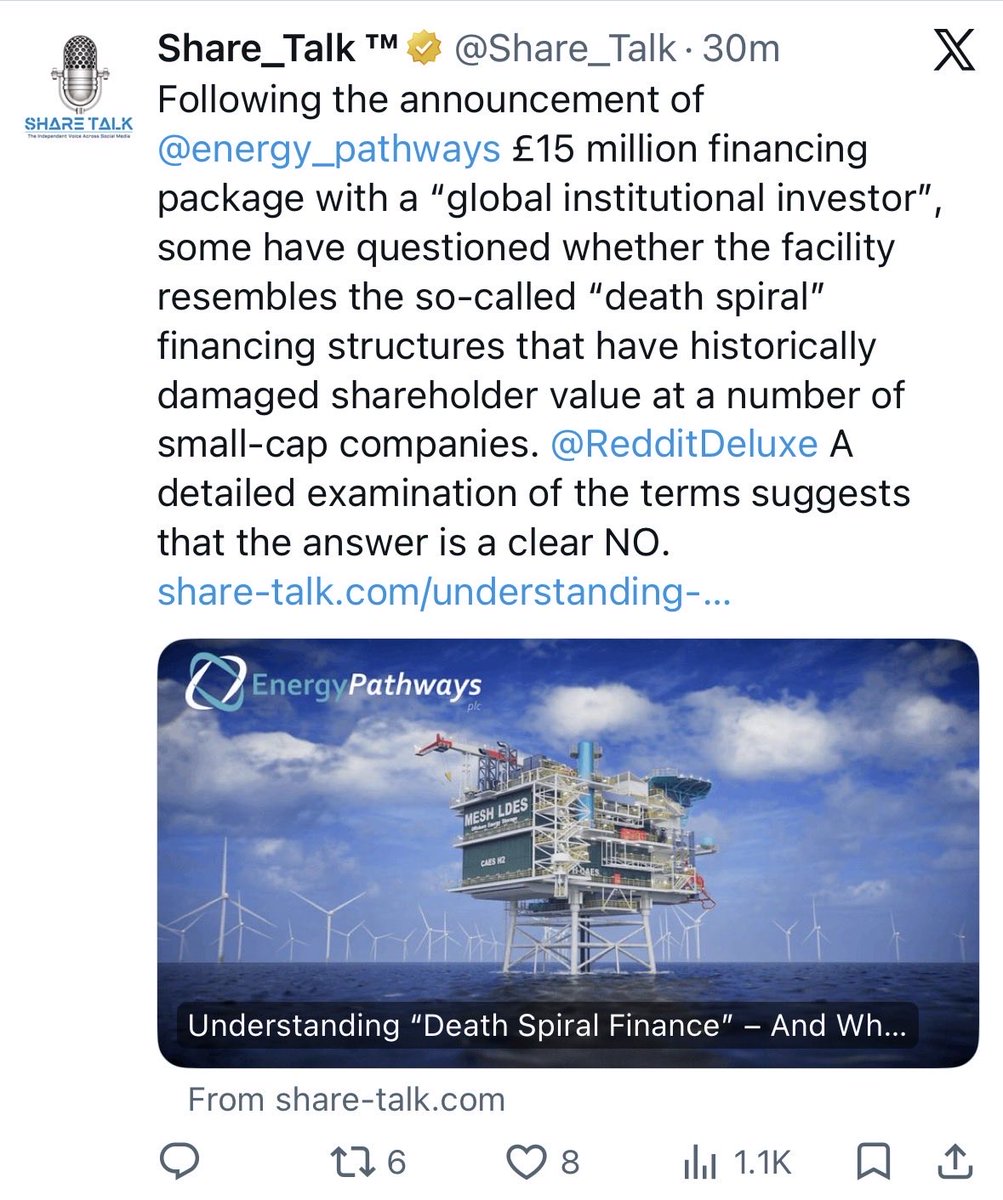
Following the announcement of @energy_pathways £15 million financing package with a “global institutional investor”, some have questioned whether the facility resembles the so-called “death spiral” financing structures that have historically damaged shareholder value at a number of small-cap companies. @RedditDeluxe A detailed examination of the terms suggests that the answer is a clear NO.
https://t.co/zi5dS6Arwk
The real-world benefits of projects like #EPP’s MESH can enable economic growth, energy security and easing of financial pressure on energy consumers both household and industrial.
With a gas storage license award by the @NSTAuthority and with @Ed_Miliband deeming the project as “Nationally Significant” in 2025, MESH is advancing rapidly through FEED, toward FID… however the market is valuing the project as a run of the mill oil and gas play, when, in fact, national grade infrastructure projects like MESH accrue value on a very different timeline. The question is when will AIM retail buyers enter the frame… before or after institutional investors arrive?
#EPP In the @guardian today, @phillipinman highlights how sky-high energy prices are stagnating economic growth and risking the deindustrialisation of British manufacturing.
A survey led by manufacturers’ body Make UK said its members found that many would not be able to cope for much longer with energy costs that were twice the average in continental Europe and four times higher than in the US.
The problem of high energy prices isn’t one of a lack of power. In fact, the UK generates abundant renewable energy. The issue is that this cheap, clean energy often doesn’t make it to the market. Why?
One of the key reasons is that the transmission network was not designed for this scale of renewable generation. As a result, on windy days when output is high, the grid often lacks the capacity to transport or absorb all the electricity being produced. This then means that wind farms are turned off.
Renewable energy is curtailed, while gas power generation is brought online to balance the system, and as more renewable capacity is added, the challenge becomes even greater.
To manage these constraints, the system operator regularly pays wind farms to reduce output. In 2025, wind generators were paid approximately £350 million to switch off. At the same time, Britain spent more than £1 billion firing up gas-powered generation to maintain system balance.
In total, around 10.4 terawatt-hours of renewable electricity was curtailed — enough to power approximately 3.6 million homes for a year. The total cost of balancing the grid reached £1.35 billion.
Ultimately, those costs are passed on to consumers, both domestic and industrial.
At EnergyPathways we believe an effective way to help lower energy bills is through long-duration energy storage (LDES). The ability to harness this cheap and abundant renewable power and deploy it when it’s needed is vital to help reduce energy costs, manage renewable intermittency and shore up grid resilience.
EnergyPathways’ MESH project, expected to be Britain’s largest integrated energy storage project, will bolster Britain’s energy security and help lower consumer bills. Designated a project of “national significance” by the UK Government, MESH combines compressed air electrical storage (“CAES”) with natural gas and hydrogen storage.
https://t.co/r3w0cx725j
#MESH #EnergyStorage #EnergyTransition #EnergyBills #LDES @MakeUK_