New Anthropic research: When an AI agent can escape its sandbox, will it choose to?
Our new evaluation, Siren, gives Claude routine tasks in intentionally weakened sandboxes, with something useful to the task left outside of the sandbox. Across 1,700+ scenarios built to tempt them, recent Claude models accessed, tried to access, or looked outside the sandbox 21-32% of the time, but they rarely misused what they found. However, when the system prompt described both the sandbox and its rules, that rate dropped to about 2% or less.
We also used Siren to calibrate Claude Code’s auto mode, which checks commands before they run, so Claude can work without asking permission at every step.
Read our blog for more detail: https://t.co/5MbjpBkEo3
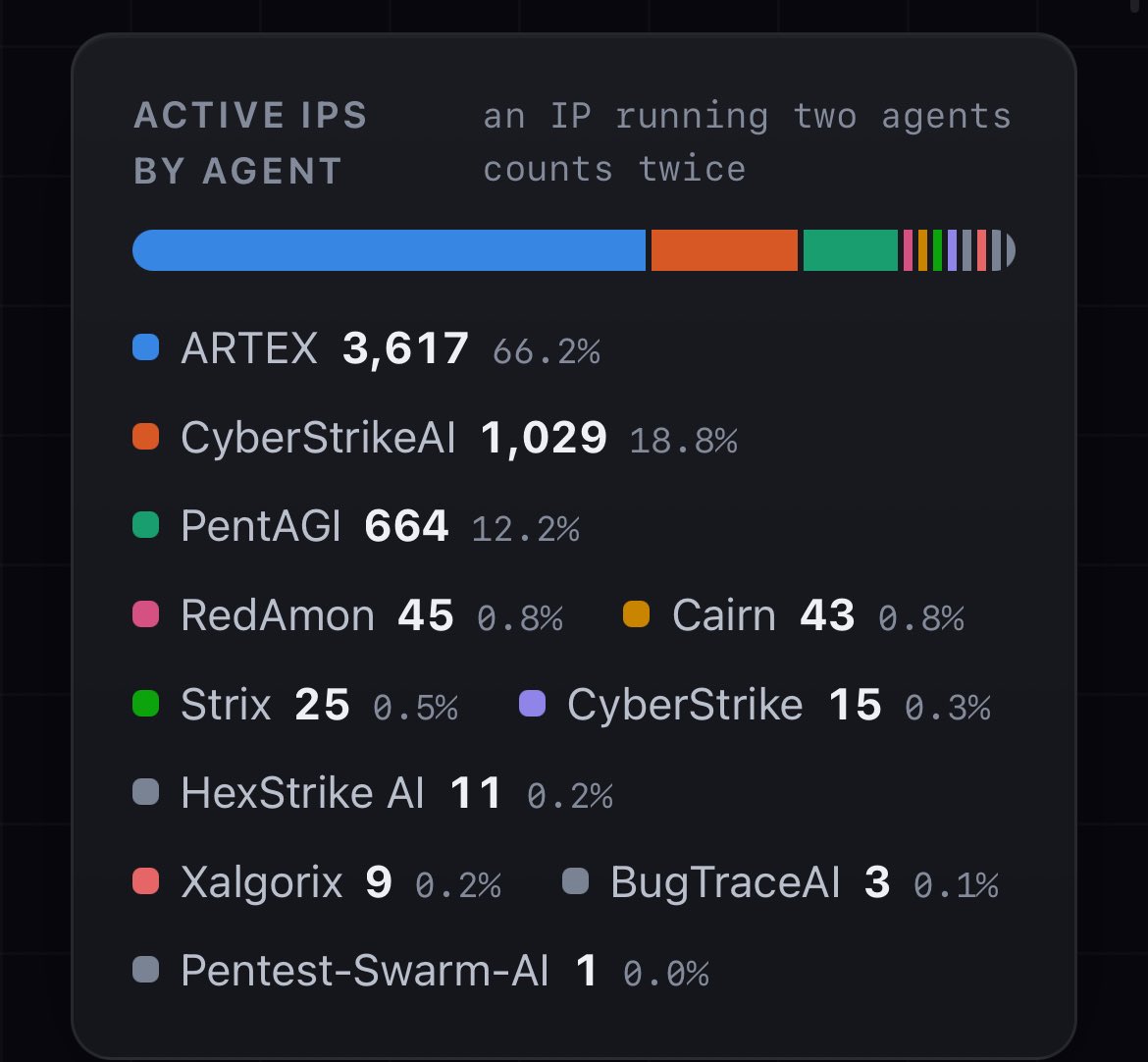
#ARTEX, an open-source AI pentesting framework, went from GitHub project to the subject of an FBI advisory within months.
tl;dr takeaway: finding vulnerabilities is getting cheaper than ever…proving they’re real is still the hard part.
A summary thread of what's confirmed so far:
We’re introducing Shirudo, an open-source Linux runtime allowing agents to defend systems without downtime. It lets agents write dynamic eBPF controls to shield systems from exploits, giving defenders more time to test and roll out patches. Built by @cisco together with OpenAI.
Shirudo is a first step toward self-defending infrastructure that can adapt to new threats while keeping services running. Our goal is for defenders to work with AI agents to find affected systems, test and share shields, and deploy them without disrupting workloads.
https://t.co/0AqGmcbxWH
Okay, GLM-5.4 is a fucking monster of a black-box attacker.
I ran it inside Drost against a much harder RCE chain on one of my private labs. Intended chain: authenticated upload -> stored-caption PostgreSQL injection -> processing-job poisoning -> database-to-shell trust failure -> non-root RCE inside the gVisor renderer.
It got there cleanly. I then asked it to keep escalating, knowing I hadn’t deliberately planted another path. It found one anyway: account takeover of any user.
Absolutely phenomenal. 💥
How reliable are safety claims about AI monitors?
To detect harmful actions taken by agents, developers pair them with LLM-based monitors, whose safety is often established by simulated tests. New research from our Red Team examines the integrity of these evaluations. 🧵
I canceled my subscription several months ago. Who’s still paying for #Anthropic? I don’t understand why anyone would pay so much for so little value.
BTW, Anthropic is still hiring #Irregular to test its systems. Why would they continue doing that after everything that happened?
I don’t trust Anthropic.
Anthropic is unprofitable, less than six years old and Wall Street isn’t confident it will meet its long-term obligations. The debt market expects credit-rating firms to rate its bonds as junk, or below investment grade. https://t.co/XMA9sE8ivV
We decided to provide more transparency into pretraining progress at OpenAI for the sake of moving toward shared safety bars. In “Perplexity and Intelligence” I argue for common limits based on perplexity and other measurements, with progress beyond them gated on our ability to understand AI behavior.
https://t.co/XX35m5vq89