▲ NVIDIA just released Alpamayo 2 Edge, a 2B reasoning VLA that plans and explains driving inside the car, on DRIVE AGX Thor.
The key idea is adaptive reasoning. In routine driving, the model emits <NOMINAL> tokens instead of a full reasoning trace. It writes a Chain-of-Causation explanation only when a scene needs it, which saves onboard compute.
The numbers: 15.15 km between at-fault incidents in AlpaSim vs 0.25 km for the 4B Qwen-Drive-1.0 (about 60x, NVIDIA-run). Open-loop minADE is 0.53 m vs 1.68 m. With the FP8 TensorRT recipe, it plans in 160 to 190 ms pixel-to-trajectory on Thor. It is a trade-off though: LingoQA is 75.2, behind Alpamayo 2 Super (79.2) and Qwen-Drive-1.0 SFT (79.4).
Weights are on Hugging Face under OpenMDW-1.1, code under Apache 2.0. The BF16 PyTorch path needs 16 GB+ of GPU memory......
Full analysis: https://t.co/wZsyMKoovt
Model: https://t.co/wP8mQHiUGO
Repo: https://t.co/BTTuSvSZde
Technical details: https://t.co/Lbu6grAFtN
You can check the deployment options and specs here through our https://t.co/Quoo2fjhbl chrome extension.
@NVIDIADRIVE@drmapavone
▲ Perplexity and NVIDIA just released JOLT, a post-training method where one model is both teacher and student, and the teacher is trained to teach.
The key idea is simple. Self-distillation gives the model a verified answer and lets it score its own attempts. But a teacher holding the answer can take shortcuts the student cannot follow. JOLT trains the teacher with outcome reward plus a KL pull toward the student, so its feedback stays within reach.
On MATH (Qwen3-0.6B), JOLT matched GRPO's accuracy with 6.5x fewer processed training tokens, and about 13x fewer completion tokens. JOLT+ (adds student reward) beat GRPO by 9.9 points on AppWorld and hit 10.96% pass@1 on Terminal-Bench 2.1 vs 8.25%. It is a trade-off though: without student reward, JOLT trails GRPO on AppWorld (51.92% vs 62.20%).
It is a method, tested on Qwen3 0.6B to 30B-A3B and DeepSeek-V2-Lite.
Full analysis: https://t.co/LxJXefu0tD
Paper: https://t.co/k4nb9CspuV
Blog: https://t.co/9Ahg4Ovl6Q
@perplexity_ai@AravSrinivas
Datalab Introduces OmniExtractBench to Fix Bias and Opacity in Extraction Benchmarks
1 missed table row can drop an extraction score from 99% to 0%.
Datalab just open-sourced OmniExtractBench to fix that. 620 documents, 4 vendor benchmarks, 1 deterministic scorer.
Here's how it works. 👇
1. Pool the benchmarks
329 docs from LlamaIndex's ExtractBench, 47 from micro1, 42 from Extend's LongArray, 202 synthetic from Datalab.
→ Forms, filings, decks, 100+ page tables
2. Pair rows by content, not position
Hungarian matching aligns table rows before anything is scored.
→ 100-row table, first row missed: 0% by position, 99% by content
3. 6 verdicts per value
matched, misread, unfound, fabricated, invented_item, invented_field.
→ Every lost point traces back to 1 value
4. Nulls earn nothing
Empty strings and None are dropped before scoring.
→ 100 padded empty fields add 0 verdicts
5. The numbers (10 configurations)
→ Datalab accurate: 93.85
→ Datalab balanced 93.48 vs Reducto 93.47, effectively tied
→ GPT 5.6-sol: 95.11 precision, 84.99 recall
Full analysis: https://t.co/xaloLOjNuA
GitHub Repo: https://t.co/HwDIWIfUlq
Technical details: https://t.co/6m1SRGBQlz
@datalabto@VikParuchuri
Jev is INSANE.
I built this in an evening and morning. A real-time trading bot ingesting onchain+offchain data to make rapid decisions about trades. Fully autonomous.
So far it has lost me $31,680.
Google AI Releases Gemini 3.5 Transcribe: A Speech-to-Text Model Reporting 2.6% Average WER Across 85+ Languages
They shipped two models instead of one. gemini-3.5-transcribe-live gives sub-second streaming over WebSockets but no diarization and no word-level timestamps, capped at 10-minute sessions. gemini-3.5-transcribe handles pre-recorded files with diarization, word offsets, and custom vocabulary up to 1,000 terms, at roughly half the cost.
Key Takeaways:
→ Pick the endpoint before the model — latency and diarization are mutually exclusive here, and that shapes your whole pipeline
→ Smart mode can't be combined with timestamps or diarization — a readable summary and an auditable transcript are now two separate API calls
→ 4.0% WER streaming, 2.6% batch (per Artificial Analysis), 70% faster finalization than Chirp 3, 85+ languages, roughly $0.005–$0.009/min
Full analysis: https://t.co/IRPR0wzjci
Technical details: https://t.co/IRPR0wzjci
@GoogleAI@googleaidevs
Vercel open-sourced the WebGPU library it built to ship the shaders on vercel.
vgpu runs the same shader in the browser, in headless Node.js, and in your CI tests.
• MIT licensed, on npm at v0.3.1
• .wgsl files import and export like TypeScript modules
• Reflection generates bindings, no hand-written declarations
• Headless Node.js rendering, Dawn-backed
• Deterministic mock adapter for CI snapshot tests
• 25 KB gzipped fullscreen effect, budget enforced in CI
• CLI, agents.md, llms.txt, hosted read-only MCP endpoint
• Examples include ONNX Runtime Web demos on WebGPU
Full analysis: https://t.co/pyGdUU8oxt
GitHub Repo: https://t.co/6rIlpv4c0C
Join our newsletter for similar product releases: https://t.co/KIjR4ZShjY
@vercel@vercel_dev
The Video Production Stack Now Fits on One Desk: LTX-2.5 Launches as NVIDIA-Accelerated Open Weights World Model. It's an open weights world model for video, real-time apps, and physical AI — optimized with NVIDIA to run on RTX GPUs and DGX Spark.
Here's what stood out:
1. The speed numbers are the story
In LTX's published image-to-video benchmark (10-second clip):
→ 6.8 seconds on-prem (2x NVIDIA GB200)
→ 23.7 seconds via the LTX API
→ 52–70 seconds for the fastest closed rivals (Omni Flash, Grok 1.5, Veo 3.1)
→ 398 seconds for Kling 3.0 Pro — that's 58.5x slower
On-prem generation finishes faster than the clip itself plays.
2. Multishot consistency fixes the real blocker
Earlier open models generated each shot separately, so characters drifted between cuts — unusable for actual campaigns. LTX-2.5 renders the full sequence as one output, holding character, scene, and voice across cuts. A custom Gemma 4 backbone handles complex, multi-subject prompts.
3. Diffusion Fidelity Rendering is a smart cost tradeoff
→ Motion and structure built in an 8x temporally compressed latent space
→ Full detail spent only on high-fidelity keyframes
→ Keyframe count adapts to scene complexity
Quality lands where it matters without full render cost on every frame.
Full analysis: https://t.co/pCe7Ce5Kpu
Model weight: https://t.co/C3o6RYYSoJ
Technical blog: https://t.co/QlpAZhm2fE
@NVIDIAAI@nvidia@NVIDIARobotics
How to Secure AI Agents, MCP Servers, and LLM Apps in Production
Application security rests on one assumption: software does what its code says.
---AI agents broke it.
https://t.co/fxnOBmlKMv's new practitioner guide — 𝘚𝘦𝘤𝘶𝘳𝘪𝘯𝘨 𝘈𝘐 𝘢𝘨𝘦𝘯𝘵𝘴, 𝘔𝘊𝘗 𝘴𝘦𝘳𝘷𝘦𝘳𝘴 & 𝘓𝘓𝘔 𝘢𝘱𝘱𝘴 — starts from that break. An agent's behavior emerges from the model, the system prompt, retrieved context, and the tools it's permitted to call. The failure modes never appear in a CVE feed: prompt injection through data, over-permissioned agents causing damage without a single exploit, poisoned tool descriptions on MCP servers, EOL models serving predictions after patching stops.
The guide's answer is three moves:
𝗦𝗲𝗲: Inventory the agentic attack surface across five layers — interaction, agent, integration, model, code. Hunt shadow agents via repo signatures and network egress. Run every agent through a 12-point misconfiguration checklist.
𝗙𝗶𝘅: Enrich → prioritize → triage. Rank by reachability and agentic amplification, not severity scores. Automate FP closures only with evidence trails. Risk acceptance is never automated.
𝗣𝗿𝗼𝘁𝗲𝗰𝘁: Guardrails on every input and output — embedded Python SDK or standalone Docker API server. Inbound: injection patterns, jailbreaks. Outbound: credentials, PII, policy violations. The core design principle: an agent that can't call a dangerous tool doesn't need a prompt begging it not to.
Includes a 15-question maturity self-assessment aligned to NIST AI RMF, OWASP AIMA, ISO/IEC 42001, and the EU AI Act.
Full analysis: https://t.co/tdTNFwapFs
Download the full guide, free: https://t.co/jnVyZSoqqS
@Mend_io
This World Model 'LingBot-World-Infinity (LingBot-World 2.0)' just released from Ant Group looks realy promising. It is an open causal world model with an Agentic harness.
Most interactive world models hold together for a few minutes. Then textures smear and geometry warps. That's a video model, not a world — and Robbyant just drew the line at the attention mask.
They released LingBot-World-Infinity (LingBot-World 2.0) — a 14B open causal video world model built on Wan2.2, trained with a Mixture of Bidirectional and Autoregressive (MoBA) attention mask, then distilled into a few-step real-time generator with no post-hoc drift filtering anywhere in the stack.
Here's what's actually interesting:
→ Pure teacher forcing overfits — as context grows, the model leans on context instead of predicting frames. MoBA appends a bidirectional full-attention block as a regularizer
→ Leak-free cross-attention: AR rows attend to background prompt a_B plus chunk prompts a_≤i, lower-triangular. Bidirectional rows see one global prompt a_G
→ DMD runs over long self-rollout trajectories, not teacher-forced states — the student is optimized on the distribution its own errors induce
→ Director-Pilot harness: a VLM proposes event cards, the DiT generator renders physical dynamics. Mode B adds a SAM tracking loop for object-centric interaction
→ One 60-minute uninterrupted session, 20 distinct scenarios, no perceptible decay
Full analysis: https://t.co/6ZnEe2rkW2
Paper: https://t.co/JWt71YWMCB
Model weight: https://t.co/jqpVHQU48h
GitHub Repo: https://t.co/6tmr2SA6fO
Project: https://t.co/9l4WPv4mR6
@AntGroup@robbyant_brain
Meet SuperMind: The AI Operating System That Deploys 13 Specialist Agents to Run Your Business
▶️ A new product from Lucentra Labs that offers an AI layer that doesn't just help you write, it helps your company run.
🔗 Full read: https://t.co/0tFNayewK2
@SuperMindApp#AIAgent
25 Best AI Agents for Business in 2026
▶️ In this article, we have mentioned 25 powerful autonomous AI agents for businesses to change how they sell, support, build, and operate in 2026.
🔗 https://t.co/jp7xZkCWdZ
#AIAgent#AI#Business
How to Use ChatGPT Codex for Work to Automate Your Busywork (No Coding Required)
In this guide we'll show you how to use ChatGPT Codex for Work
- Getting the right plan
- Connecting your tools
- Running tasks on your behalf.
🔗 Full read: https://t.co/nNcEsJKEGQ
#Codexforwork
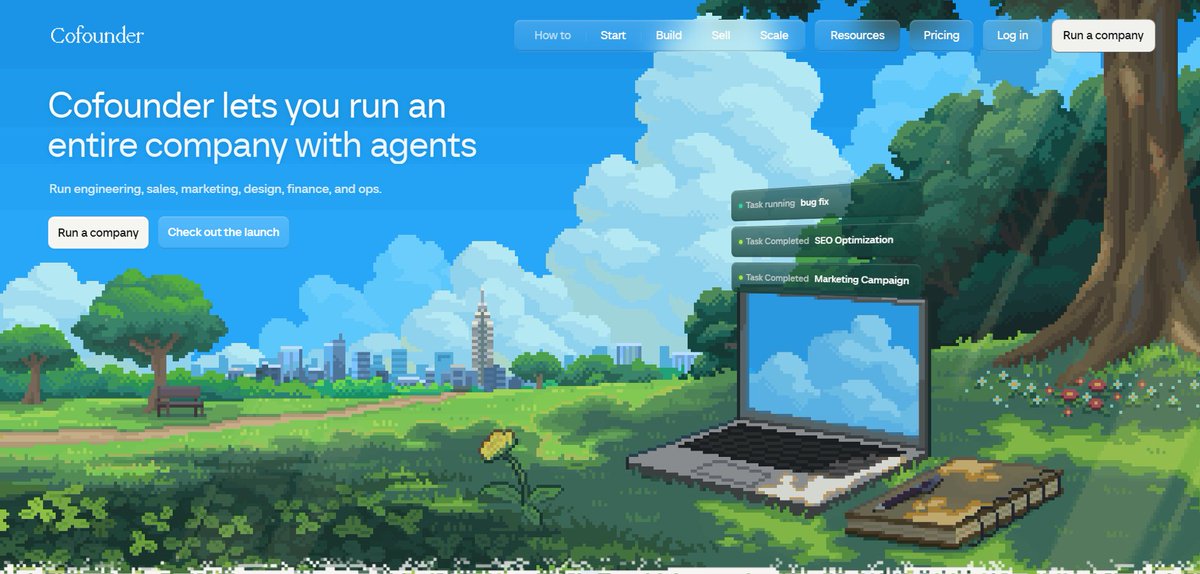
Meet Cofounder: A Platform That Lets You Run an Entire Company With AI Agents
▶️ Cofounder lets anyone run an entire company with engineering, sales, marketing, customer support, and ops AI agents.
🔗 Full read: https://t.co/eFeuWLLLfH
@intelligenceco#AIagent#AI