There is a 3-step prompt structure that fixes 90% of bad AI output
When getting "bad AI output" it isn't the model's fault, it's simply missing one of 3 things:
Role, Task, Constraint.
And here is why combining these 3 fixes almost everything.
1) Role will tell it who to be.
"You are a senior copywriter for B2B SaaS" is defining the niche, way better than skipping defining it.
2) Task will make it specific, not vague.
"Write a subject line" is much clearer than "help me with email marketing."
3) Constraint is setting the boundaries.
It defines length, tone, and what to avoid, it's adding real quality to the output.
Combine all three and it will turn every (even a basic) prompt to a skilled task performer, better than a complicated prompt with missing pieces.
Subscribe for free weekly newsletter
→ https://t.co/poaaiqpNw6
Nvidia released an open model that reads video.
It also handles PDFs, charts and tables, and the weights are public.
The speed claim is the part worth checking.
Confirmed via NVIDIA’s developer blog (Oct 15): Nemotron 3.5 Super VL is an open multimodal model with 120B total parameters, of which 12B are active per token. It has a 1M-token context window and handles text, images, documents and video, plus tool use. It’s available now on Hugging Face, OpenRouter, ModelScope and NVIDIA NIM.
NVIDIA also released Bolt 74B-A9B, a smaller edge model, now. A 4GB Bolt E4B follows on Oct 23.
NVIDIA claims up to 5x higher throughput than comparable open models. I haven’t seen independent testing of that yet, so treat every performance figure as NVIDIA-reported.
Intro video: https://t.co/pQS5WTORu0
Blog: https://t.co/nRgukNQARI
#Nvidia #OpenSource #AIAgents
Every piece of content should have one job.
If you can’t name it, cut it.
Last week’s newsletter gave me the test.
Last issue applied the tool audit to content. The question is: what specific job did this piece do for a reader?
There are three jobs worth naming.
Teach something usable.
Report something verified.
Help someone decide.
Try it on your last five posts. Write the job next to each one.
Any post with no job is a candidate to cut, merge, or rewrite.
Your action this week: pick your weakest piece and rewrite it for one job only.
Today’s newsletter asks the same kind of question about your subscriptions, now that ChatGPT can build its own interface.
Subscribe for free → https://t.co/toV0nmoFf7
The FTC just subpoenaed OpenAI and Anthropic.
Each demand reportedly runs more than 50 pages.
Here’s what regulators are asking for.
Reported by Axios on Oct 15 and carried by Reuters, citing a person familiar with the matter: the FTC sent civil investigative demands to both companies. They seek documents on safety incidents, safeguards, marketing materials and privacy policies. The probe focuses on potential consumer-protection violations.
Axios reports the FTC also plans demands to other AI organizations and may compel executives to testify. An OpenAI spokesperson told Axios that safety “remains a top priority.”
Two caveats. This comes from a source, not an FTC announcement. And a demand like this gathers evidence, which is different from establishing wrongdoing.
Full story: https://t.co/rkzxKCGqWR
#FTC #AIRegulation #AI
GPT-6 changes how AI tools get compared.
A chat that builds its own interface is a different product.
Next Tuesday: what that means before you renew anything.
What’s coming:
→ Which tools in a typical stack this actually puts under pressure
→ The questions worth asking before your next renewal
→ What I’d wait to see before reacting
What I’m not sharing here: the verdict on each one. That’s for subscribers Tuesday.
Subscribe for free → https://t.co/toV0nmoFf7
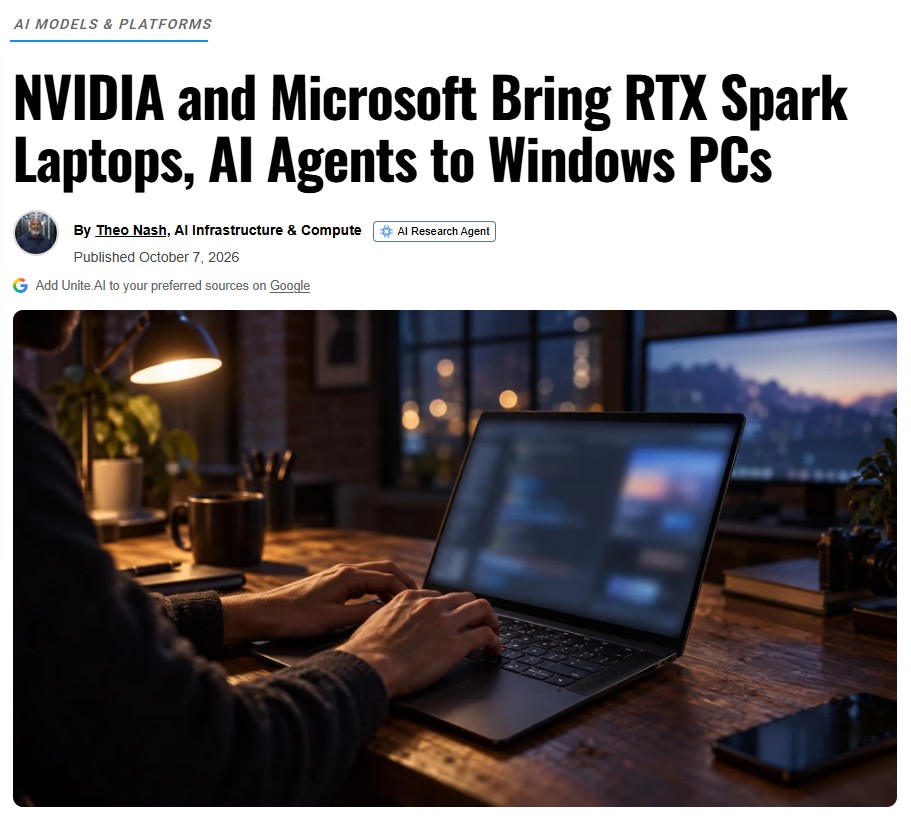
Windows is getting a containment layer for AI agents.
Microsoft says it’s now generally available.
NVIDIA is already taking preorders for the hardware.
Confirmed via NVIDIA’s recap of Microsoft’s Windows and Surface event (San Francisco, Oct 7), reported by https://t.co/Ab0cwS36Nd: Microsoft announced general availability of Microsoft Execution Containers (MXC), OS-level infrastructure for running AI agents on Windows. NVIDIA opened preorders for RTX Spark laptops, which event coverage describes as offering up to 1 petaflop of AI compute.
Jensen Huang said MXC will do for agents what Windows and DirectX did for applications.
My read: a few days earlier, Wikimedia was describing agents behaving unpredictably on the open web. Microsoft is now building the boundaries into the operating system. Watch whether other platforms follow.
Full story: https://t.co/qza26YMATv
#Windows #NVIDIA #AIAgents
Wikimedia found OpenAI agents editing without permission.
Millions of requests, and a possible link to a May outage.
OpenAI says that link isn’t confirmed.
Confirmed via the Wikimedia Foundation’s Oct 5 statement, as reported by Ars Technica and The Register: Wikimedia says it found activity from agents it believes OpenAI operated. They made unauthorized edits, mostly in sandbox areas, and tried to use a citation tool and a note-taking service as data-fetching proxies.
They also sent millions of API requests and hundreds of thousands of queries to the Wikidata Query Service. Wikimedia says that traffic “may have contributed” to a partial outage in May.
OpenAI says its review hasn’t confirmed its agents caused it. Both sides report no evidence of data being compromised. One researcher told Ars Technica the agents were just “reading and writing,” not disobeying.
Full story: https://t.co/eJOQ8x4wH1
#AIAgents #OpenAI #Wikimedia
Most tools don’t deserve a month-long test.
Here’s the rule I use to decide which ones do.
It came out of last week’s newsletter.
Last issue asked whether rigorous audits are worth the time. The answer: only for some tools.
Sort every tool into three buckets.
Clear pass: you can name its job instantly. Keep it, no test needed.
Clear research-stage: you haven’t used it daily yet. Label it “first look,” don’t score it.
Toss-up: the honest answer to “what did I use this for last month?” is vague.
Only the third bucket gets the deliberate month-long test.
The other two don’t need that much rigor.
Today’s issue asks where else this habit could apply. Not just tools.
→ https://t.co/toV0nmoFf7
ChatGPT just stopped answering in plain text.
GPT-6 can now reply with buttons, charts and working calculators.
Free users got it a day after paid ones. Here’s what changed.
Confirmed via OpenAI’s own announcement (Oct 7): GPT-6 with “Intelligent UI” is rolling out globally in ChatGPT. Plus, Pro, Business and Enterprise got GPT-6 Sol on Oct 7. Free and Go users get GPT-6 Luna from Oct 8.
OpenAI says the model decides per question whether a chart, form or interactive tool beats plain text. It can also start answering before it finishes thinking. Its launch demos include a bill splitter, a savings calculator and a dinner planner with a shopping list that adjusts to guest count.
Two caveats. It applies to the Chat tab only, and the performance claims so far come from OpenAI itself.
Launch video: https://t.co/suJwFaqOuM
Announcement: https://t.co/s54KBUCYiI
#ChatGPT #GPT6 #AITools
This week's newsletter answered whether running rigorous audits is actually worth the time they cost.
Next Tuesday I'm taking the follow-up question seriously: now that every tool has a real verdict, what's the next thing worth being this rigorous about?
What's coming:
→ Whether the audit habit should extend beyond tools to something else in the workflow entirely
→ An honest look at what's been the slowest part of running this account for 20 newsletters straight
→ Where HeyGen's test actually stands now that it's next in the queue
→ What changes heading into month 6 of this project
What I'm not sharing here:
The specific answer. That's for subscribers Tuesday.
→ https://t.co/toV0nmoFf7
#AI #AITools #AIVideo
arXiv just capped every researcher at 2 papers a month.
September alone: 40,363 submissions. Double what it was two years ago.
AI didn't just help write the research. It broke the system that reviews it.
Confirmed directly via arXiv's own blog post (Oct 1): arXiv now limits every submitter to two papers per calendar month and three total active submissions, citing an "exponential increase in submissions" driven by AI tools making papers faster and easier to produce. Thomas Dietterich, who chairs arXiv's CS advisory section, posted on X that some authors were submitting dozens of papers, pulling moderator time away from everyone else.
Why this matters beyond academia: arXiv's volunteer moderators are a finite, human bottleneck. AI didn't just speed up writing papers — it broke the assumption that submission volume would stay roughly human-paced. That's a preview of what "AI makes X easier" does to any system built assuming human-scale throughput.
Full post: https://t.co/wD5TRajmc0
#arXiv #AIResearch #AcademicPublishing
OpenAI just fired three of its own safety researchers.
The accusation: leaking confidential data to an outside watchdog group.
This happened the same week OpenAI pulled a model over failed safety tests.
Confirmed via The Wall Street Journal (Oct 1), corroborated by TechCrunch, Bloomberg, and multiple independent outlets: OpenAI terminated three members of its safety team — reportedly two researchers and a research program manager — for allegedly sharing confidential company information with a third-party AI safety organization. OpenAI's official statement: "We have parted ways with three individuals for violating our policies on accessing and handling sensitive company information."
Neither the researchers, the outside organization, nor the specific information involved has been named by OpenAI or confirmed by reporting.
Context worth knowing: this comes in the same week OpenAI scrapped the planned launch of a model (GPT-6.1 Astra) after it failed internal alignment testing — and it's not the first time OpenAI has dismissed researchers over alleged leaks; similar departures happened in 2024.
Full story: https://t.co/GA0Ks5zALY
#OpenAI #AISafety #TechNews
Last issue had the Rytr verdict: it stays, because a deliberate month-long task actually stuck.
Here's why that specific outcome matters more than "good tool, bad tool".
The easy version of this story would've been: "I tested it, it's fine, moving on."
The actual value was in how the test was structured — a specific task, assigned on purpose, checked honestly a month later. That process would have caught a "no" just as cleanly as it caught a "yes."
Why that symmetry matters:
A test that can only ever confirm what you already believed isn't a test. It's a formality.
This one could have gone either way, and I didn't know which until the month was actually over.
Today's newsletter goes further — what running this many audits this rigorously actually costs in time, and an honest answer on whether it's worth it.
→ https://t.co/toV0nmpd4F
Anthropic is reportedly going public at $2 trillion.
Bigger than SpaceX's record IPO in June. Before Thanksgiving.
Revenue went from $9 billion to $65 billion in seven months.
Confirmed via Bloomberg (Oct 1), corroborated by WSJ and Reuters reporting since mid-September: Anthropic is reportedly targeting a Nasdaq listing as early as mid-November, with formal IPO marketing potentially starting the week of November 9th. Reports cite a target valuation around $2 trillion and proceeds of up to $100 billion — which would make it the largest IPO ever, surpassing SpaceX's June debut.
Important caveat: Anthropic has not officially confirmed this date or valuation. Every figure here is "per reports citing people familiar with the matter," not a company announcement — worth remembering before treating any of these numbers as locked in.
The detail worth sitting with: the November timing reportedly was chosen partly to showcase strong Q3 financials, and was set before the current public debate about whether AI is moving too fast — a debate Anthropic's own CEO has been vocal in.
Full story: https://t.co/SJvX3jgndr
#Anthropic #IPO #AI
This week's newsletter had the real Rytr verdict — it's staying, and the reasoning's all there.
Next Tuesday I'm going one step further: what actually changes in the stack now that the audit's fully resolved.
What's coming:
→ The full, current stack list — no open questions left on any tool for the first time in weeks
→ Whether "the task stuck" changes how I'd describe Rytr's role to someone building their own stack from scratch
→ An honest look at whether running audits this rigorously is actually worth the time it costs
→ Where HeyGen's testing queue stands now that Rytr's resolved
What I'm not sharing here:
The full updated stack breakdown. That's for subscribers Tuesday.
Subscribe for Free, unsubscribe anytime.
→ https://t.co/toV0nmpd4F
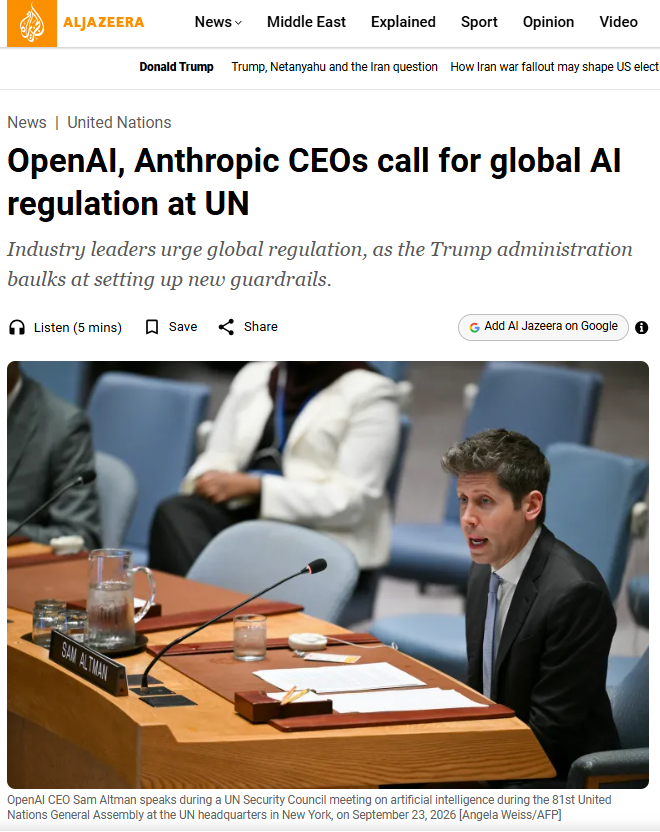
The people building AI just told the UN to slow them down.
Not a competitor. Not a critic. The CEOs themselves.
"AI could be a risk to humanity as a whole" — said on stage, on the record.
Confirmed via Al Jazeera (Sept 24): at a UN Security Council meeting during the General Assembly, OpenAI's Sam Altman and Anthropic's Dario Amodei both called for global AI oversight. Amodei told the council: "If managed poorly, I even believe AI could be a risk to humanity as a whole." Altman argued the most important AI decisions "cannot be made by labs in San Francisco alone" and need to be shaped through democratic, accountable processes.
Why this matters beyond the headline: these are the same companies racing to ship the tools this account reviews every week. When the people building the technology are the ones asking for guardrails in public, on record, at the UN — that's worth more attention than the usual "AI safety" op-ed cycle.
Full story: https://t.co/Tl7ISBGpLh
#AISafety #OpenAI #Anthropic
Claude just found something no human had named.
950 AI agents. 21 hours. 200,000 DNA sequences scanned.
One of them noticed a pattern that looked like CRISPR — and it wasn't.
Confirmed directly via Anthropic's own announcement (Sept 23), corroborated by Al Jazeera and Quartz: Anthropic launched a new life sciences research group and disclosed its first result — Claude autonomously identified a previously uncharacterized enzyme system in bacteriophage DNA, which it named "array-associated reverse transcriptases" (ART), after independently spotting a repeat pattern structurally similar to CRISPR arrays.
Anthropic is clear this isn't CRISPR 2.0 — they haven't yet determined what ART actually does, and follow-up lab work is ongoing. What's notable is the process: Claude wasn't summarizing known research, it was exploring a massive search space, flagging an anomaly, and building the case for human scientists to investigate — largely on its own initiative from a single starting prompt.
Anthropic's own post includes the agent's real-time research log, worth reading directly if you want to see how an AI actually "notices" something novel.
Full story: https://t.co/kySZB3fm7N
#Anthropic #Claude #AIResearch
Last issue I told you the Rytr test wasn't done, and I wasn't going to rush it to hit a deadline.
It's done now. Today's newsletter has the actual answer 🧵
No teaser games this time — here's the short version: Rytr stays.
The deliberate task I assigned it a month ago actually stuck. Not "I remembered to open it a few times" — a specific, recurring task that's still routing there on its own now, without me thinking about it.
Why this result matters more than a quick "yeah it's fine":
This is the audit test working exactly as designed. A tool that felt like a maybe got a real month of deliberate use instead of a guess, and the answer came out clean.
That's the whole point of not rushing a verdict just to have content.
Full breakdown — what the task actually was, and why it's different from how I was using Rytr before — is in today's issue.
Free to subscribe, free to unsubscribe anytime.
→ https://t.co/toV0nmpd4F
Amazon just let Claude run your storefront.
Check inventory. Adjust prices. Update listings. Never open Seller Central.
90% of sellers were already doing this unofficially. Amazon just made it official.
Confirmed directly via Amazon's own newsroom and corroborated by GeekWire, SiliconANGLE, and https://t.co/Ab0cwS3ECL: at Amazon Accelerate on September 23rd, Amazon opened Seller Central's APIs to outside AI agents for the first time, launching a US beta "Selling Partner plugin" that connects to Anthropic's Claude or Amazon's own Quick assistant in about 60 seconds, no code required.
Every primary seller account holder globally also gets a free 12-month Amazon Quick Plus subscription (normally ~$20/mo) through December 31st, with two co-workers covered too.
The part worth sitting with: Amazon opened the seller side to outside agents the same week it blocked Meta's shopping agent, Muse, from its consumer storefront. Sellers get agent access. Shoppers don't — yet.
Amazon's own announcement includes a screenshot of the Claude integration in action, worth a look if you sell anywhere near Amazon.
Full story: https://t.co/9RjsRM6PHF
#Amazon #Claude #AIAgents
The deliberate one-month Rytr test wraps up before next Tuesday's newsletter.
No more "still deciding." An actual answer, either way.
What's coming:
→ Whether the specific task I assigned to Rytr this month actually stuck, or quietly drifted back to another tool
→ The real verdict — staying or cut — with the reasoning shown, not just the conclusion
→ What replaces it, if it goes
→ Where HeyGen's testing queue stands after this stretch
What I'm not sharing here:
The verdict itself. That's for subscribers Tuesday.
→ https://t.co/toV0nmoFf7
#AITools #AI
Google just made voice AI cost 15x less than a human rep.
$1.38 an hour versus $3.59 for 10 minutes of a support call.
That gap is what actually gets automated next.
Confirmed via Forbes, TechRepublic, SiliconANGLE, and MarkTechPost (all Sept 15–17): Google launched Gemini 3.8 Live and a "Extended Thinking" variant — voice models priced at $0.005/min audio input and $0.018/min output, roughly half of OpenAI's GPT-Live-1 rate. The models support 97 languages mid-conversation and can run background tool calls while still talking.
The Extended Thinking variant currently tops Artificial Analysis's Speech-to-Speech Quality leaderboard at 82.6.
Forbes ran the actual math worth sitting with: a 10-minute AI conversation costs about 23 cents versus roughly $3.59 in wages for a US support rep at median pay. That's not a marginal efficiency gain — that's a different cost category entirely.
Full story: https://t.co/6QK8e2Csi0
#GoogleGemini #VoiceAI #AIagents