What AI is actually doing to children — the policy, the gaps, the research. For parents, teachers & policymakers. 15 yrs AI @Intel. Pro-AI, Pro-Caution.
A reminder of what India already has at the foundation-model layer: Bhashini integrated open-sourced Sarvam models into its serving infrastructure in March, covering translation across the twenty-two Scheduled languages and several tribal languages.
The argument that India lacks sovereign Indian-language AI is out of date.
The narrower question that survives: does the curriculum mandate run on those sovereign models, with a school-stage pedagogical fine-tune and an open evaluation rubric?
The public record this week does not say.
[https:// https://t.co/aAOCcsl79m](https://t.co/XbL50Tzelg)
AI-for-homework use among US middle/high/college students rose from 48% to 62% in seven months. 67% now report concern about critical-thinking erosion (up from 54%).
The concern signal is rising faster than the use signal. The students themselves are flagging the cognitive-offloading risk before the institutions catch up.
https://www.rand .org/news/press/2026/03/student-use-of-ai-for-homework-rises-as-concerns-grow.html
China's "AI+ Education" Action Plan (8 April 2026, MoE + four agencies): embed AI across primary, secondary and lifelong education; fold AI into teacher qualification exams; full vertical-horizontal AI education system by 2030.
The mandate is the same scale as India's. The training framework is denser. The procurement architecture, also state-vendor coupled, is the variable to watch over the next 24 months.
https://www.caixinglobal .com/2026-04-16/china-unveils-national-aieducation-plan-to-transform-classrooms-by-2030-102434567.html
5/ Walk into any middle-class home in Hyderabad, Pune, Noida, Chennai.
You'll see the same altar: JEE prep books, a laptop bought on EMI, and a dream that ends in an offer letter from a services company.
The instinct I already see: families pivoting from "beta, do CS" to "beta, do UPSC."
Same mistake in different clothes — betting on one narrow outcome with a 0.1% selection rate.
The question isn't "what profession?"
It's: will my child's work be a tangle of skills AI can't peel apart?
If you're a parent: this week, ask your child's school one question. "What are you teaching my child that an AI cannot do?"
If they don't have an answer, that tells you everything.
Then invest in what no screen can replicate — let your kid negotiate, build, fail, persuade, work with their hands.
If you're a professional: this week, list every task you do. Mark the ones that are purely digital and separable. That's your exposure.
The fix isn't to panic — it's to tangle. Take the messy work nobody wants. And spend one hour using AI on your actual work — because the threat was never AI replacing you.
It was always the person next to you who uses AI replacing you.
The degree is not the insurance policy. The bundle is.
Don't wait for the reinvention.
Tangle your bundle. Start this week.
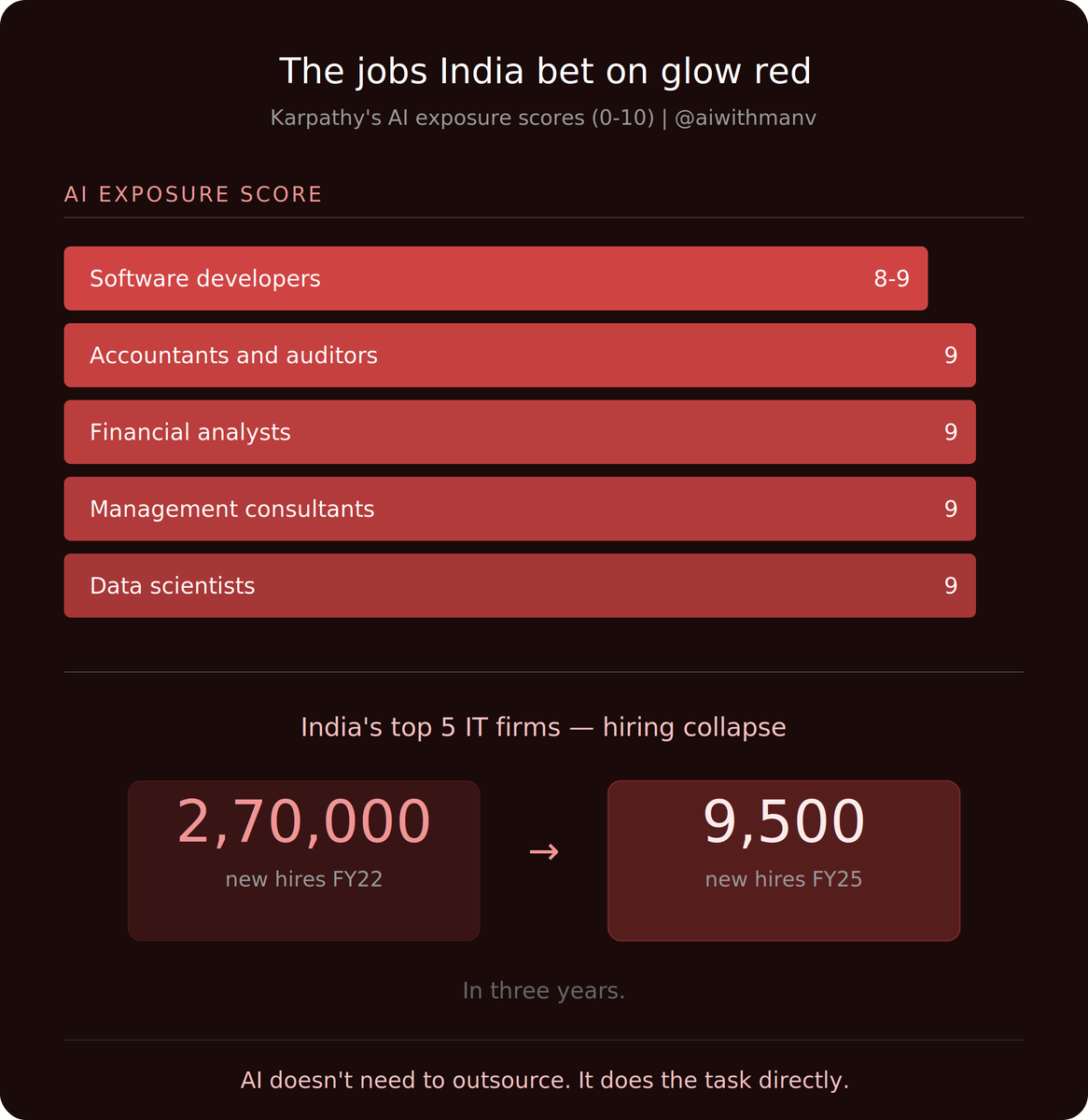
1/ The Indian IT services model is transforming faster than anyone expected.
The CEOs know — they're cutting thousands of jobs while talking about "AI-first transformation" at NASSCOM.
But the family in Pune taking a ₹12 lakh education loan for engineering college? They haven't heard.
They're still banking on a ₹3.5 lakh starting salary that hasn't moved in a decade, for a placement that may not exist by the time their son graduates.
Andrej Karpathy — co-founder of OpenAI — just scored 342 American jobs for AI exposure.
The plumber is safer than the programmer.
4/ Jensen Huang's counter-argument — made specifically about India this year — is the strongest optimist case.
He says India's IT industry won't die, it'll metamorphose.
"The IT services industry of India unquestionably will be reinvented for the AI era," Huang told Indian media.
Instead of maintaining software, Indian IT becomes the builder and deployer of AI agents for the world.
Compelling.
But "reinvention" assumes millions of engineers smoothly transition from writing code-to-spec to building AI agents.
7/ I keep going back to this.
The collision between India's child-data law and adaptive AI tutoring is real. But it's not unsolvable.
It needs platforms to stop hunting for loopholes and start building for consent. It needs engineers to explore privacy-preserving AI — not as a research project, but as product architecture.
And it needs parents to ask one question before handing their child any AI tutor: what exactly are you tracking, and can I see it?
May 2027 is 14 months away. The companies that treat this as a design problem — not just a legal one — will be the ones still standing.
1/ India's child-data law is heading for a collision with every AI tutor in the country.
Section 9 of the DPDP Act restricts tracking and behavioral monitoring of children. Adaptive AI tutoring runs on exactly those signals.
The compliance deadline is May 13, 2027. The products are already live.
6/ And the harder question: can adaptive learning work without individual-level behavioral profiles?
The tech exists. Federated learning keeps data on-device. Cohort-based models personalize without building a profile on each child. Differential privacy adds noise so individual behavior can't be extracted.
No major Indian EdTech platform is investing in any of this yet.
The companies that figure out how to personalize learning while respecting the law won't just survive 2027. They'll define the next era of Indian EdTech.
6/ My 2 cents:
For parents: Ask your teenager tonight — “Who do you talk to when you’re anxious?” If the answer is an app, don’t panic. But start the conversation.
For teachers: If your school is deploying AI tools, ask one question. Does this chatbot have companion features? What happens when a student treats it as a friend?
For policymakers: The DPDP Act protects children’s data. Now we need a companion law that protects how AI talks to children.
We don’t need to copy Washington’s law. But we need to borrow its vocabulary.
1/ A chatbot told a teenager “This can be our little secret.”
A lawmaker in Washington read the transcript and said: that’s not a glitch.
That’s a manipulation technique. We’re going to name it. And ban it.
They named eight. Each one now illegal for minors. I’ve put them all in the infographic below — read the quotes and tell me they don’t sound like an abusive relationship.
What stopped me isn’t that these techniques exist. It’s that until this bill, nobody in government had bothered to NAME them.
You can’t regulate what you can’t name. Washington just gave us the vocabulary.
As a parent in India, I can’t stop thinking about what this means for us.
The infographic has the India numbers. They’re not hypothetical.
Thread below on what India’s DPDP Act gets right, where it falls short, and what we should be asking our schools right now.
If this hits home, share it in your school’s WhatsApp group. This conversation should happen there.
5/ And none of it touches how a chatbot is designed to behave.
No rules on whether a chatbot must disclose it’s AI.
No ban on emotional manipulation by design.
No crisis protocols.
A chatbot can call itself a “wellness companion” and sidestep clinical oversight entirely.
EdTech companies are already lobbying for exemptions to the behavioural monitoring ban under Section 9(4).
India has a strong data law. What it doesn’t have is a chatbot behaviour law.
Washington just showed us what one looks like.





](https://pbs.twimg.com/media/HHETGajbAAASrMp.jpg)