AI animation gets interesting when the art direction survives the action.
Every cut changes the scale, perspective and motion.
But the ink-wash texture, blue palette, character silhouette and dragon design remain coherent.
That is the difference between generating frames and directing a film.
Did you hear that crunch?
This entire 15-second pizza commercial is AI.
One reference image.
No camera crew.
No food stylist.
No reshoots.
Seedance 2.5 does not just generate food that looks real.
It generates texture you can hear.
Exact prompt:
Create a 15-second ultra-realistic cinematic pizza-making sequence featuring the girl from the uploaded reference image as the exact character reference. Preserve her facial identity, green-hazel eyes, long jet-black hair, skin tone, facial structure, and overall appearance consistently throughout every shot. Dress her in a stylish black apron over her white fitted T-shirt, with her hair tied into a practical low ponytail.
The video opens with an intense close-up of her holding a freshly baked pizza slice toward the camera. She takes a confident bite as molten cheese stretches dramatically from the slice, steam rising around her face.
She immediately turns toward the counter and begins making another pizza. She spins a round piece of dough high above her head, catches it perfectly, and slaps it onto the counter as flour bursts into the air. The camera follows the movement with a fast whip-pan.
She rapidly spreads bright-red tomato sauce across the dough, then throws fresh mozzarella, ricotta, and pepperoni onto the pizza with energetic precision. Use fast macro cuts of sauce swirling, cheese landing, and pepperoni bouncing onto the dough.
She slides the topped pizza into a blazing stone oven. Extreme macro shots show the crust rapidly puffing into huge leopard-charred bubbles, pepperoni curling into crispy cups, cheese bubbling and melting, and heat distortion shimmering around the pizza.
She pulls the finished pizza from the oven, scatters fresh basil over the bubbling surface, then lifts one slice high. A huge molten cheese pull stretches between the slice and pizza as she gives the camera a confident satisfied look.
Finish with a dramatic close-up of the golden blistered crust, melted cheese, crispy pepperoni, fresh basil, and steam filling the frame.
Style: Premium cinematic food commercial, female chef protagonist, aggressive handheld camera, whip pans, smooth tracking, extreme macro food photography, dramatic blue-and-warm-amber lighting, realistic dough and cheese physics, natural steam, oven heat distortion, detailed skin and hair, shallow depth of field, cinematic film grain, photorealistic, ultra-detailed, 4K HDR, 24fps, 16:9.
Audio: Natural diegetic sounds only — dough slapping, flour scattering, sauce spreading, toppings landing, oven roar, bubbling cheese, crust crackling, basil flutter, and final bite crunch. No music, dialogue, subtitles, logos, text, or watermark.
Seedance 2.5 is expensive.
MiniMax H3 is open source.
But can you actually tell which one generated the better video?
I keep seeing people say Seedance 2.5 is no longer worth paying for because H3 can run locally with almost no visible difference in quality.
So I ran a blind test.
3 clips.
3 models:
• Seedance 2.5
• Seedance 2.0
• MiniMax H3
Each clip was generated exactly once.
No cherry-picking.
No rerolls.
No hiding failed generations.
Just the first result from each model.
I’m sure open models will eventually close the quality gap.
But “local” does not mean “free.”
The real comparison is:
Cloud generation cost
vs.
Hardware, VRAM, generation time, setup and maintenance.
If H3 produces 95% of the quality but requires enterprise-grade hardware and ten times the generation time, Seedance may still win economically.
If it produces nearly identical results on accessible hardware, the market changes overnight.
Can you identify which clip came from which model?
Drop your guess for 1, 2 and 3.
Reveal after the votes are in.
One image → one 15-second cinematic travel film.
GPT Image 2 created the character.
Seedance 2.5 brought her to life in Kyoto.
Exact prompt:
Create a 15-second ultra-realistic cinematic travel video set in Kyoto, Japan, following a young blonde woman on a peaceful solo date through traditional Kyoto streets.
0–2 sec: Front-facing medium shot of the woman standing outside a traditional Kyoto machiya townhouse with dark wooden lattice doors. She smiles naturally and makes a small playful hand gesture toward the camera. Warm late-afternoon sunlight, realistic skin and hair movement, shallow depth of field.
2–4 sec: Cut to a smooth handheld tracking shot from behind as she walks through a narrow traditional Kyoto alley. Wooden buildings, textured walls, small plants and warm sunlight create beautiful natural depth. Camera follows closely with subtle realistic motion.
4–6 sec: Wide rear tracking shot as she continues walking down a quiet stone-paved alley lined with traditional wooden houses and potted greenery. Soft golden-hour sunlight creates long shadows and gentle lens flare.
6–8 sec: She reaches a small canal and pauses beside the stone wall. A friendly orange-and-white cat walks along the edge of the canal. She looks toward it with a gentle smile. Natural water reflections, subtle breeze moving her hair and clothing.
8–10 sec: Cut to a close cinematic shot beside a Japanese vending machine. She buys a small red canned drink and takes a sip, smiling naturally. Realistic hand movement, authentic vending-machine details, shallow depth of field.
10–12 sec: Golden-hour street scene. She stands near a Kyoto road, casually looking around while a traditional yellow taxi passes behind her. Strong sun flare, realistic traffic movement, cinematic backlight.
12–15 sec: Return to the narrow wooden alley. She walks toward the camera holding her drink, then briefly turns and looks back with a soft smile. Camera slowly pulls backward, revealing the beautiful traditional Kyoto architecture as the scene fades naturally.
Overall style: photorealistic Japanese travel film, authentic Kyoto atmosphere, natural human motion, realistic walking physics, subtle breathing and blinking, detailed hair and fabric movement, warm golden-hour lighting, soft cinematic lens flare, shallow depth of field, natural handheld/gimbal camera movement, realistic shadows and reflections, documentary-style cinematography, 35mm film look, premium travel commercial, highly detailed, seamless transitions, no artificial-looking CGI, no distorted hands or face, consistent character appearance throughout.
The fastest way to fail at building a one person AI business is to start with AI.
Pick a tool.
Pick a niche.
Build an agent.
Then search for somebody who wants it.
That sequence is backwards.
Businesses do not pay for AI.
They pay to move one of three numbers:
More customers
More value per customer
Lower costs
Your automation is only the mechanism.
The number underneath it is the product.
The actual roadmap:
Build for yourself
Create one Claude Code system you genuinely use every day.
Talk to five business owners
Your niche should be the output of real conversations, not the input.
Find the constraint
Identify the first point where work slows, breaks or requires repeated manual effort.
Fill four blanks
Outcome: ______
KPI: ______
Baseline: ______
60 day target: ______
If you cannot fill all four, you do not have a project.
Start with education
One hour inside the business reveals more than weeks of guessing from outside it.
Sell the audit
Map the workflows and turn vague interest into a defined opportunity.
Ship the smallest valuable project
One constraint.
One KPI.
One outcome.
Measure the result
The strongest case study is not a beautiful interface.
It is a before and after number.
Convert proof into a retainer
Education creates access.
The audit creates clarity.
The project creates proof.
Proof creates recurring ownership.
Most beginners try to enter at the final rung with no trust, baseline or case study.
Then they interpret the silence as a market problem.
The market is not the problem.
The sequence is.
Do not sell the build.
Sell the number.
A complete outbound campaign can now run from one Claude Code folder.
No CSV handoffs.
No jumping between six tools.
No rebuilding the workflow for every client.
The folder:
→ Scores accounts
→ Finds decision-makers
→ Enriches missing emails
→ Writes the sequence
→ Pushes it into Instantly
→ Pulls the results
→ Learns what worked
The core architecture is five files:
CLAUDE.md
The operating system for how Claude works.
context.md
The client’s ICP, offer, personas, providers and campaign history.
scoring-criteria.md
The signals, weights and thresholds that determine which accounts are worth pursuing.
copy-frameworks.md
The messaging structures that have already earned replies.
instantly-api-docs.md
The exact endpoints and payload fields required to push campaigns live.
Then add a skills folder.
Every time Claude makes a successful API call, save the script.
The next campaign executes the proven version instead of rebuilding the plumbing.
But the most important step happens after sending:
Pull the results.
Map copy to replies.
Extract the patterns that worked.
Write them back into the framework.
Campaign twelve should not begin with the same intelligence as campaign one.
That is the real value of Claude Code for GTM.
Not writing another email.
Turning the entire acquisition process into reusable infrastructure:
Policy in files.
Execution in skills.
Live access through MCP.
Results in a database.
Learning written back into the system.
The prompt creates one campaign.
The folder makes every future campaign cheaper, faster and smarter.
This woman does not exist.
The entire video is 100% AI.
One Seedance 2.5 generation.
30 seconds.
Zero editing.
Zero cuts.
No CapCut.
No creator.
No brief.
No reshoots.
The voice is synced.
The skin looks real.
Even the camera shake feels human.
This is what AI UGC looks like now.
But nobody mentions the catch:
Seedance 2.5 is not cheap.
Every bad prompt is money burned on another unusable generation.
So I built Claude a dedicated Seedance skill.
Now it turns any concept into a precisely structured prompt with timed scenes, consistent characters, natural camera behavior and clear negative constraints.
Perfect structure.
Every time.
Reply SKILL and I’ll DM you the exact Claude skill for free.
Must repost + follow so I can DM you.
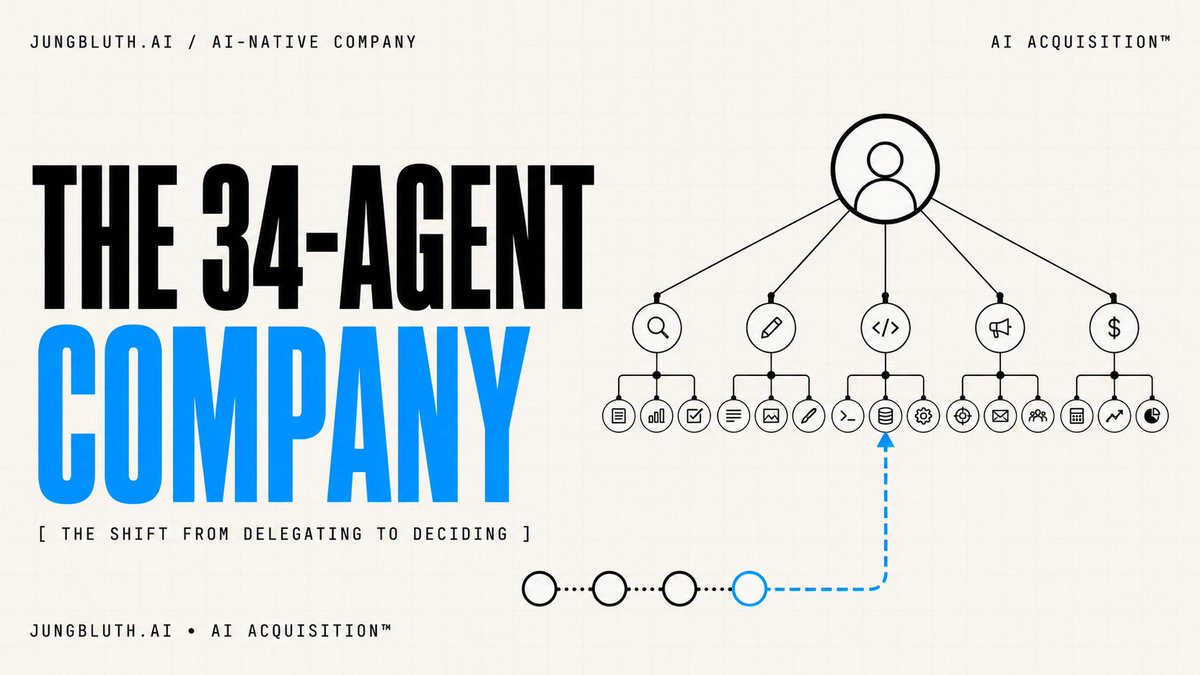
Allie Miller runs 34 AI agents.
Her best prompt is three words:
“Do smart things.”
She previously managed around 100 people at AWS and multi-billion-dollar AI P&Ls.
Now she runs an organization where the marginal cost of another hire approaches zero.
But the lesson is not the number of agents.
It is where she positioned herself.
Most people use AI like this:
Prompt → Wait → Review → Prompt again
The human remains the first domino.
Allie moved herself three levels above execution.
She builds the infrastructure.
The agents decide how to execute within it.
She steps in when judgment is required.
The shift is from delegating to deciding.
Her operating principles:
Expand width, not risk
Give agents more context, tools and freedom.
Keep approval gates for consequential actions.
Feed AI what exists only in your head
She dictates her uncodified knowledge into a personal wiki the agents can access.
Wrong context in.
Wrong output out.
Hire at the margin
One agent challenges the others to 10x their work.
Another watches the workforce, detects friction and flags missing access.
These are roles a traditional payroll would reject.
Build the factory, not the thing
Her team did not build one product.
They built reusable infrastructure for login, payments, social sharing and distribution.
The first product became profitable.
Every product after it ships faster.
Fix bottlenecks by value
List every bottleneck.
Estimate the value of removing each one.
Fix the expensive one.
Scale gradually
One agent → One proactive agent → Two agents routing work → Full workforce
The hard part is not creating 34 agents.
It is building the context, permissions, feedback loops and escalation rules that let them operate without turning you into the bottleneck.
An AI-native company is not a normal company with chatbots attached.
It is an organization redesigned around one principle:
Agents execute.
Humans decide.
One image → one coherent 30-second travel vlog.
Same face. Same character. One continuous day.
Seedance 2.5 Prompt:
An ultra-realistic handheld travel vlog filmed by a friend following the main character throughout the day. Use the woman from the reference image as the main subject. Maintain her exact facial identity, hairstyle, facial features, and body proportions consistently throughout the entire video.
The camera should feel like a genuine personal vlog camera rather than a commercial production. Use natural handheld movement, casual framing, subtle imperfections in human camera operation, and an authentic everyday atmosphere. Avoid scripted acting. The woman behaves naturally, interacting with her surroundings as she would in a real travel vlog.
0–5s: Morning departure. The woman leaves a cozy apartment carrying a small backpack. She checks her phone, smiles toward the camera, adjusts her hair, and begins walking outside. The camera follows her from behind with slight natural shakiness, as if a friend is casually filming her. Morning sunlight fills the scene, with quiet neighborhood streets and people beginning their day.
5–12s: Exploring the city. The camera follows her through local streets. She visits a small café, buys a drink, briefly talks to the camera, and laughs naturally. She continues through a street market, looks around at small shops, and takes casual photos. The camera remains close to her, capturing spontaneous everyday moments.
12–20s: Arriving at the beach. She takes public transportation or walks toward the coast. The environment gradually transitions from busy city streets into a peaceful seaside town. The ocean breeze naturally moves her hair. She becomes visibly excited when she sees the ocean for the first time. The camera follows her along the beach as she picks up a seashell, watches the waves, and naturally interacts with people nearby.
20–27s: Summer beach afternoon. She meets friends at the beach. Everyone chats, laughs, and plays casually near the water. The camera naturally moves between the group, capturing genuine candid moments rather than staged performances. She eventually looks back toward the camera and smiles naturally.
27–30s: Ending moment. Golden-hour sunset. She sits near the ocean holding a drink while quietly watching the sunset. The camera slowly moves backward, gradually revealing the beach, waves, and peaceful evening atmosphere. The final moment should feel like a genuine personal travel memory captured spontaneously.
Visual style: Ultra-realistic authentic travel-vlog footage. Ultra-realistic smartphone or mirrorless-camera appearance. Natural daylight and believable environmental lighting. Casual handheld movement with subtle camera shake and imperfect human operation. Genuine human reactions and spontaneous interactions. Documentary-level realism with highly detailed skin, hair, clothing, environments, and natural textures.
No cinematic commercial aesthetic. No dramatic posing. No artificial transitions. No text overlays. No logos. No face changes. No identity changes.
The entire 30-second generation should feel like one continuous, coherent day captured by a real friend-not a collection of disconnected AI-generated scenes.
Most GTM teams use Claude Code like a better chatbot.
That misses the real opportunity.
Claude Code can become the operating system that remembers how your company grows.
Not just your prompts.
Your customers.
Your workflows.
Your campaigns.
Your results.
Everything that worked before.
If every campaign starts with an empty chat, AI never compounds.
You are renting outputs, not building infrastructure.
A real Claude-powered GTM system needs five layers:
Operating rules
How work gets done, which standards apply and where human approval is required.
Client context
ICP, offer, positioning, objections, buying signals, customer language and previous campaigns.
Repeatable skills
Every recurring task becomes a reusable process for research, scoring, enrichment, campaign creation and reporting.
The second time you explain the same task should be the last time you explain it manually.
Working infrastructure
Successful scripts, integrations and API calls are stored instead of rebuilt.
Performance memory
Replies, conversions, objections and campaign results update the system.
This last layer matters most.
Without it, campaign twelve starts with the same intelligence as campaign one.
With it, every run improves the next:
Customer signals → Scoring → Research → Campaign → Results → Updated rules
Claude Code can operate the entire GTM system from one environment.
It can read the context, apply the right skill, execute the workflow and store the result.
But the terminal is not the advantage.
Retained learning is.
Every client folder becomes institutional memory.
Every successful workflow reduces the cost of the next one.
Every campaign makes the system smarter.
The prompt gives you an output.
The system gives you compounding advantage.
Your AI moat is not what Claude can generate.
It is what your company no longer has to relearn.
The biggest AI opportunity in Google Ads has nothing to do with bidding.
AI is making the one-landing-page-for-every-search model obsolete.
Most eCommerce brands still send every click to the same product page.
Someone searches:
“Why do I keep waking up at 3am?”
The ad promises an answer.
The landing page responds with a product image, a price and an Add to Cart button.
The customer asked a question.
The page responded with a checkout.
That is where conversion dies.
Most eCommerce brands do not have a Google Ads problem.
They have an intent-matching problem.
Every query reveals what the customer needs to understand next:
Problem-aware search → Educational advertorial
Category research → Buying guide or listicle
High-consideration decision → Diagnostic quiz
Competitor comparison → Transparent comparison page
Product-specific intent → PDP
The PDP is not broken.
It is simply being asked to perform jobs it was never designed for.
This principle is not new.
What AI changes is the production economics.
AI can cluster thousands of search terms by intent, extract objections from customer conversations, identify missing information and create the first version of each funnel.
A process that previously required months of research, copywriting, design and development can now happen in days.
But AI cannot decide which claims are credible, which evidence builds trust or which funnel produces incremental profit.
That still requires judgment and experimentation.
Google Ads is not only a bidding system.
It is an intent-routing system:
Search query → Customer uncertainty → Appropriate sales experience
Do not send customers to the page that is most convenient for your company.
Send them to the page that continues their thought.
An AI-native marketing team is not five agents pretending to be employees.
It is one system that turns every customer signal into a better next action.
Most companies use separate AI tools to research, write, edit, find leads and publish.
They produce more.
But nothing learns.
Customer objections remain inside calls.
Research disappears into documents.
Campaign results stay inside dashboards.
Every new asset starts from zero.
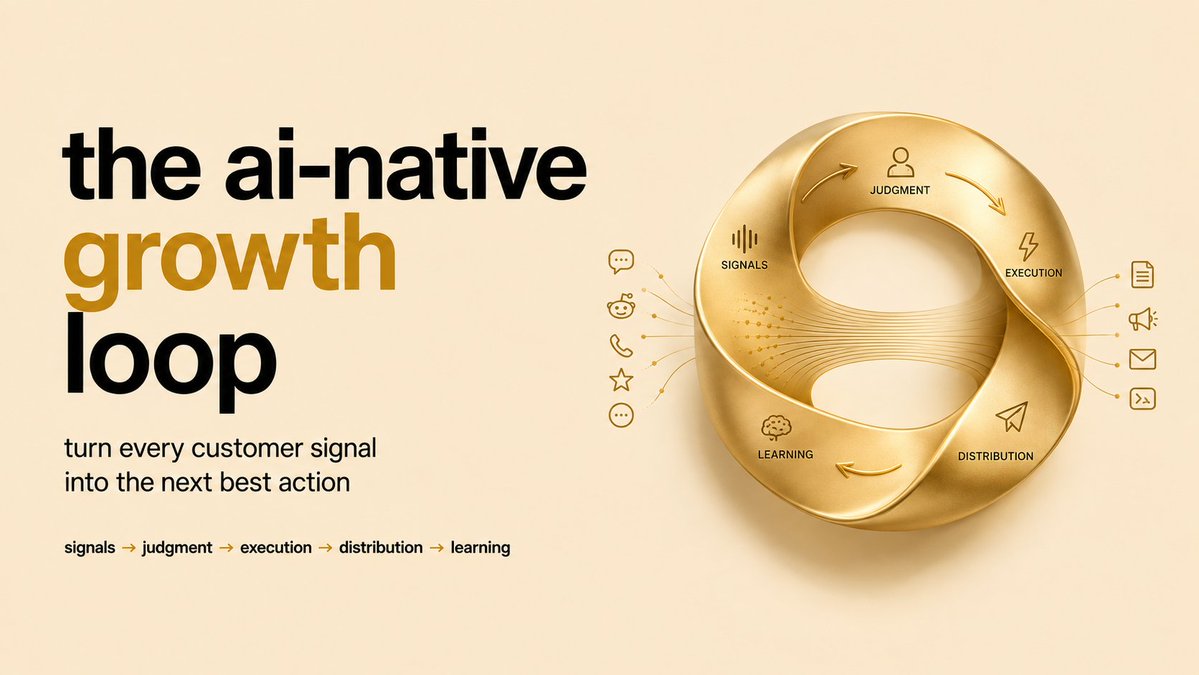
Real AI-native growth is a closed loop:
Capture customer signals
Sales calls, support tickets, Reddit discussions, product feedback and campaign comments.
Structure the intelligence
Problems, objections, triggers, urgency and exact customer language.
Apply human judgment
Choose which problem, position and offer deserve attention.
Multiply the decision
Turn the approved direction into content, demos, ads, emails, landing pages and sales scripts.
Route the work
Give each person the asset and context relevant to their role.
Feed results back
Use replies, conversions, objections and customer feedback to improve the next run.
That is what a GTM engineer should build:
Customer intelligence → human judgment → execution → distribution → learning
The objective is not to automate marketing.
It is to eliminate the reset between insight and execution.
If your AI only produces outputs, you built a content factory.
If every output improves the next run, you built a growth system.
The “$14 AI team” may be a lie or not.
But the economic shift behind it is real.
A Claude subscription cannot choose your market, recognize genuine demand or decide whether a product is actually good.
But once a capable operator makes those decisions, AI can compress an entire production chain.
One set of customer conversations can become:
• Demand analysis
• Product brief
• Complete first draft
• Sales page
• 30 content ideas
• Follow-up sequences
• Support scripts
• Objection handling
These used to be separate projects involving different specialists, briefs, timelines and invoices.
Now one operator can produce them from the same source of truth in an afternoon.
AI has not replaced the team.
It has collapsed the marginal cost of execution after the important decisions have been made.
That is the distinction most people miss.
AI can turn one good decision into 100 pieces of execution.
It cannot guarantee the original decision was good.
The new economics:
Execution is becoming almost free.
Judgment is becoming more valuable.
Taste is becoming scarcer.
Distribution is becoming the moat.
The winners will not be those who generate the most.
They will be those who know what deserves to be generated.
Your company does not have one AI system.
It has a different one for every employee.
One person teaches Claude the strategy.
Another gives ChatGPT the client context.
A third builds a workflow in Codex.
Then the chats end and everyone else starts from zero.
Most companies have adopted AI.
Almost none have institutionalized what it learns.
The missing layer is a shared AI harness:
Company memory every agent can retrieve
Rules that survive new chats and models
Reusable workers for recurring processes
Human approval at consequential boundaries
A review loop that improves the system after every mistake
Start with one workflow.
A weekly intelligence brief is ideal:
Meetings + projects + decisions + risks + commitments → sourced draft → human approval
Then diagnose every correction at the correct layer.
Missing fact → improve memory
Wrong context → improve retrieval
Repeated mistake → improve the worker
Unsafe action → strengthen the policy
Do not simply correct the output.
Correct the system that produced it.
Models will keep changing.
Your company should not forget everything it has learned each time they do.
AI did not rebuild GTA.
It compressed a movie studio into a laptop.
A creator turned GTA: San Andreas into a photorealistic live-action trailer using a workflow like this:
Claude → story and shots
Midjourney → characters and visual language
Kling → motion
ElevenLabs → voices
Suno → music
CapCut → final edit
This is not equivalent to building an open-world game.
But it proves something important:
One person can now prototype an entertainment concept before raising money, hiring a crew or asking a studio for permission.
The bottleneck has moved from production capacity to taste, character consistency and distribution.
Soon, anyone will be able to generate an impressive clip.
Very few will build a character people want to follow.
That is the real opportunity:
Not cheap AI movies.
One-person studios building characters, worlds and audiences at unprecedented speed.
The next major entertainment franchise may begin with one laptop and one character people refuse to stop watching.
Your business is not hard to automate.
It is undocumented.
Most founders start with the wrong question:
“What AI tools should we use?”
The better question is:
“How does work actually move through our company?”
Because an AI agent cannot replicate a process that only exists inside your head.
Before automation comes extraction.
Here is the system:
Let AI interview you
List every recurring workflow in your business.
Content creation.
Client onboarding.
Lead research.
Reporting.
Hiring.
Sales.
Operations.
For each workflow, identify:
The trigger.
The individual steps.
The tools involved.
The expected output.
The decisions requiring human judgment.
Calculate the automation value
Score every workflow based on:
Time consumed × Repeatability × Lack of human judgment
The highest-scoring processes should be automated first.
Not the most impressive ones.
The ones quietly consuming hundreds of hours.
Extract the process from your head
Explain the workflow to AI as if you were training a new employee.
Make it question every vague instruction.
“What does good look like?”
“What happens when information is missing?”
“When is approval required?”
“What are the exceptions?”
Those questions turn undocumented intuition into an executable specification.
Separate execution from judgment
AI can research prospects.
AI can prepare reports.
AI can organize information.
AI can draft content.
But pricing decisions, negotiations and final approvals may still require you.
The goal is not to remove humans from every workflow.
It is to remove them from every step where their judgment adds no value.
Turn the workflow into a reusable skill
Give the agent:
A trigger.
A sequence of actions.
Access to the necessary tools.
Examples of excellent outputs.
Clear approval points.
Rules for exceptions.
Now you do not have another prompt.
You have a repeatable operating process.
This is where most “second brains” fail.
They store what you know.
But they cannot execute how you work.
The real opportunity is not building a larger database of notes.
It is building a business operating system that captures your judgment, executes your processes and improves as the company works.
Do not automate random tasks.
Document the company.
Then teach AI how to run it.
Stop asking AI for business ideas.
Give it 90 days of Reddit complaints instead.
Most people use AI backwards:
They generate a product idea first, build it, then go searching for customers.
Reverse the process.
Choose a market you understand and collect three months of posts and comments from its relevant subreddits.
Then have an AI agent identify:
• Problems that appear repeatedly
• The exact language people use
• How urgently they want the problem solved
• What they currently use instead
• Where they are already spending money
Rank each problem by:
Frequency × Urgency × Willingness to pay
Then build the smallest complete solution to the highest scoring problem.
Not necessarily SaaS.
Start with a guide, template, audit, newsletter or productized service.
Next, publish the complete solution inside the community.
No vague teaser.
No link disguised as advice.
Give away the actual method and invite people to ask questions.
The post creates attention.
The questions create research.
The DMs reveal purchase intent.
AI can automate the scraping, clustering, monitoring and first draft.
But keep publishing and conversations human.
That is where trust is created.
A single useful Reddit post can become customer research, copy testing, organic distribution and lead qualification at the same time.
AI should not manufacture demand.
It should detect demand earlier than everyone else.
The best AI business ideas are not generated.
They are extracted.
Your competitor with the worse product is beating you on Meta right now, and it has nothing to do with budget.
They stopped paying $3k a photoshoot and waiting two weeks. They generate ad creative in ten minutes, and they generate forty variants for the price you spend on one.
Here is the system, and the one line where most people get it wrong.
First, why the default gets garbage. "Make an ad for my supplement" is walking into a studio and saying "make me something cool." The model has nothing to work with, so it hands you the generic shape the algorithm has seen a thousand times. You have to direct it.
You layer the prompt in three stages.
Stage one, the foundation. You specify everything. Format, where the product sits and what percent of frame it fills, background, light direction, headline placement, font feel. "Square, product center-right at 60% of frame, white gradient, morning light from left, headline top-left in navy sans-serif" gets you something usable on the first try.
One accuracy point the hype skips: if it is a real branded product, you upload reference images of your actual packaging. The model does not know your label from a text prompt, so it invents one. Feed it your product, then direct the scene around it.
Stage two, the iteration loop, which is where 2.0 pulls away. You do not regenerate. You say "same image, move the product 10% left and deepen the shadows," or "headline 15% larger, switch to bold." It keeps what works. Base to ad-ready in about four passes.
Stage three, batch the variations in one prompt. Minimal white background, lifestyle context, ingredients around the product, studio versus in-use. Four angles at once. Test each on a small spend, scale the winner.
Then the part every hype post leaves out, and the part that keeps your account alive. In supplements and skincare especially, skip the before-and-after health claims and the "clinical" language you cannot back up. Meta's policy and EU health-claim rules will flag it. The fastest creative engine on earth is worthless the day the ad account gets pulled. Knowing that line is the job.
The brands doing this cleanly have a short window before everyone catches up.
If one ad is carrying your whole account, comment "CREATIVE" and I will send you the build.
How to build an AI video studio inside Claude Code.
Six months ago a finished video needed a scriptwriter, a voice actor, a designer, an editor, and two weeks. Today it is one agent calling four tools through MCP, and it runs while you sleep.
Here is the actual build.
Research first, or the whole thing is worthless. Point the agent at your topic and have it pull what is genuinely being said right now, live. Skip this and you get a model talking to itself, which is exactly why most AI video is unwatchable. It has nothing real to stand on.
Then the script, and you hand it the structure. Hook, tension, payoff, explicitly. Do not let it improvise the format, because format is where these die. Research in, a script built to hold attention out.
Then it breaks the script into scenes. Each scene tagged with what is on screen and what is being said. That scene list is the spine. Everything downstream hangs off it.
Now the tools, wired in through MCP so the agent calls them itself:
Voice: ElevenLabs, one consistent voice across every scene, generated to sound like a person instead of a screen reader.
Stills: Nano Banana generates each scene's frame from its own description.
Motion: Sora 2 turns the scenes that need movement into actual video.
Then it assembles. Cuts to the voice, times each scene, renders the file. You wrote one line. It did the other forty steps.
Here is what people are missing while they argue about which video model is best.
None of these tools are new. Script, voice, stills, video, all of it existed separately and you have probably tried each one. What changed is that they now hand off to each other with no human in between, and the agent decides at each step instead of you.
The work did not get cheaper because the tools improved. It got cheaper because the tools stopped needing a person standing between every step.
Which means the advantage is not access. Everyone has Sora, everyone has ElevenLabs. The advantage is being the one who wired them into a single flow before your competitor worked out he could.
And this is not a content trick. The same pattern, capable tools that never talked, suddenly handing off on their own, is landing in sales, reporting and ops right now. Video is just where you can see it happen.
If your content still moves at the speed of five separate people, comment "STUDIO" and I will send you the build.