College degrees won’t matter in the AI economy.
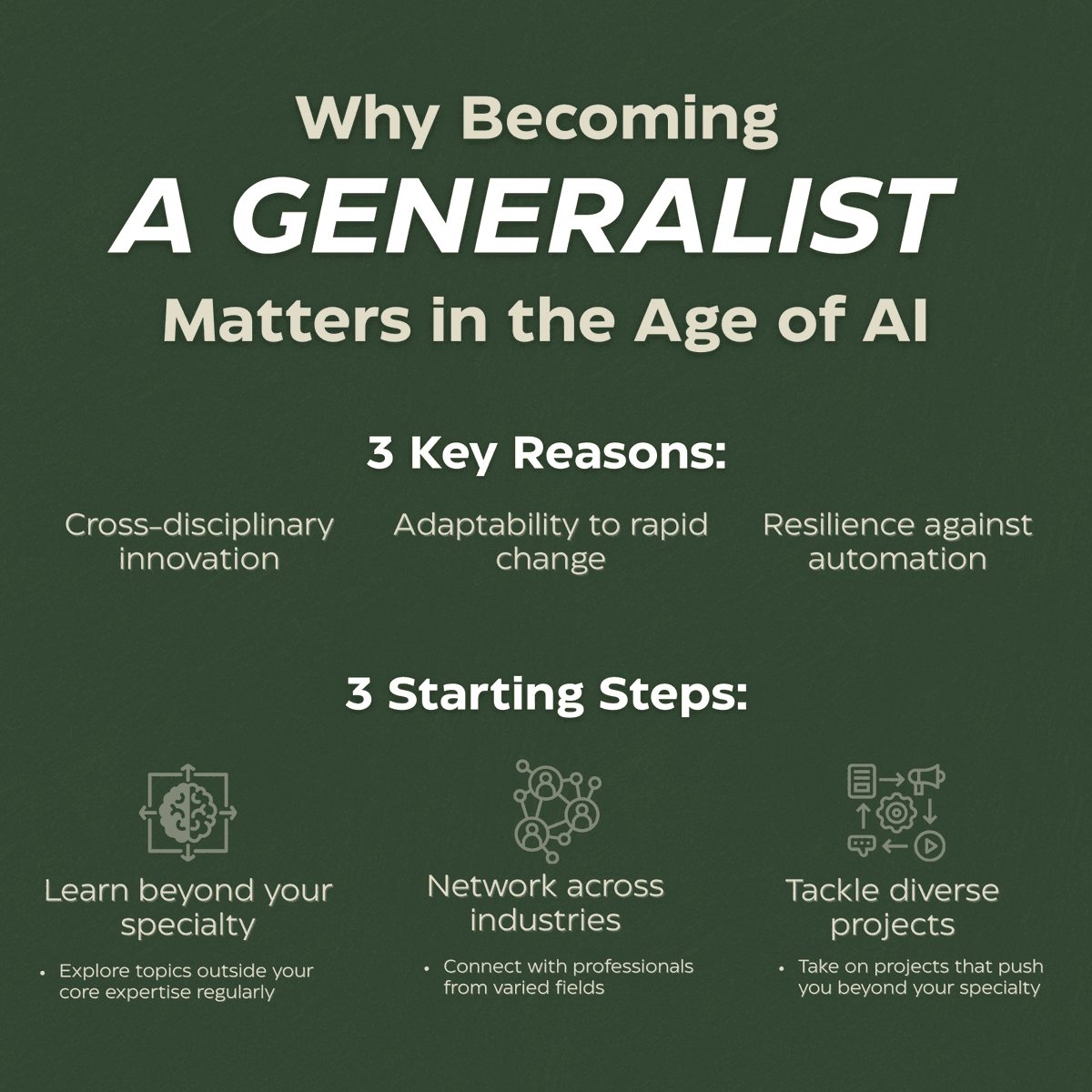
Being a high-agency generalist will.
Don’t specialize—build a toolkit for navigating complex systems.
Markets reward those who steer AI swarms toward meaningful solutions.
Your ancestors would trade places in a heartbeat.
Being a founder is way harder than anyone expects.
I always compare it to having a kid.
Everyone warns you that it's a lot of work, and you nod along and think yeah I can handle it. Then it hits you, and it feels like a truck ran you over out of nowhere.
Every problem that makes it all the way up to me is the one nobody else in the company could solve. That's what my days look like now.
But I also think this might be a once-in-a-lifetime moment. We're watching AI go from research demos to running actual business operations. The infrastructure for all of that is being built right now, and the window to build it won't stay open forever. It could easily take 30 years for something this big to come around again. I didn't want to sit that out.
If you're building something right now, what made you jump?
Every AI company on earth has the same bottleneck. None of them talk about it. Here's the number that should worry every tech investor:
A single hyperscale data centre uses 30,000 to 40,000 tonnes of copper. There are over 100 under construction right now. And that's before the next wave of AI infrastructure even breaks ground.
Add EVs. Add grid upgrades. Add defense systems. Add robotics.
The world needs roughly 50% more copper within the next decade than we produce today. And we haven't sanctioned a new major copper mine in over 10 years.
Not because there's no copper in the ground. Because it takes 15+ years to discover, permit and build a mine.
Demand accelerates in years. Supply responds in decades.
Where does the copper come from?
$PNPN $PNPNF
The number of push-ups you can do predicts your risk of heart disease.
Harvard researchers tracked 1,104 men for a decade to measure it.
The finding is real, but the reason is not what it looks like.
Here's what your number actually reveals:
This startup raised over $450 million to build apps with AI.
Microsoft backed it. Its valuation passed $1 billion.
In 2025 it collapsed, after reports the "AI" was mostly human engineers.
Here's what was hiding behind the curtain:
"The moment the idea is admitted into society that property is not as sacred as the laws of God, and that there is not a force of law and public justice to protect it, anarchy and tyranny commence."
John Adams wrote this in 1787 in "A Defence of the Constitutions of Government of the United States of America."
He was making an argument that most people today would consider obvious. That property rights are foundational. That without legal protection for what people own, everything else unravels. The economy, civil order, and the trust between citizens and their government.
What makes this quote worth reading again, 239 years later, is how those protections can be dismantled.
I've spent my career on both sides of property law in Texas.
I started out representing the construction industry. General contractors, architects, engineers. I saw how the system worked from the inside. Now I exclusively represent property owners, and I see the same system from the other side.
Every legislative session, new bills are introduced that affect property owners' rights to recover costs of repair. Some of these bills are well-intentioned. Some are driven by industry lobbying. Most of them get zero media coverage. The average property owner, even sophisticated institutional owners, never hears about them until the law has already changed.
Our firm tracks every piece of legislation that could affect our clients' ability to hold contractors and insurers accountable. We do this because the alternative is finding out too late that a right you relied on quietly disappeared.
Adams wasn't warning about dramatic seizures of property or government takeovers. He was warning about exactly this. Slow, steady, legislative erosion. Bill by bill. Session by session. Until the protections that property owners assumed were permanent are gone.
The Founders built property rights into the foundation of this country for a reason. They understood that everything else depends on it.
A 1950s private eye who wakes up in 1970s Los Angeles and shrugs at all of it.
A 1937 detective who pulls one thread into a horror he can't stop.
Two neo-noirs on the man who still wants the truth in a town that doesn't.
The Long Goodbye (1973) and Chinatown (1974).
Ship one agent doing one thing this week. Most teams can't do it. They'd rather spend six months planning a multi-agent architecture.
I've been writing software for 20 years and the thing I keep coming back to, especially with agentic systems, is that doing something simple is genuinely harder than doing something complex.
I don't think many engineers grasp that unless they've been doing this for a while.
I see teams overengineering all the time. They design these incredibly sophisticated multi-agent pipelines before they've even deployed a single agent into production. And then they're stuck because every time they want to change something, it cascades through the whole system and becomes a maintenance problem.
The other part that catches people off guard about agentic systems is that you will need to iterate. They're way more iterative than regular software development. You can write the most detailed PRD in the world, and you're still going to find yourself adjusting constantly after deployment. Customers send unexpected inputs, edge cases pop up, and prompts need tuning. That's just the nature of these systems.
The teams I see shipping fastest have a few things in common:
1. They start with one agent doing one thing this week instead of designing for the quarter.
2. They keep humans in the loop from day one because it genuinely makes the system better.
3. They make failures loud and obvious early so they can learn from them.
4. They only add more agents when they have real evidence they need them.
I've started telling our enterprise customers the same thing. Ship the simplest version first. You'll learn more from one week in production than six months of architecture planning.
Everyone's chasing AI stocks at 40x revenue. Meanwhile small-cap miners with real ounces in the ground are trading at fractions of NAV. Here's why that gap can't hold:
When AI was trading at 10x, it was a reasonable growth bet. At 30-40x sales, you're paying for perfection. One earnings miss and the floor drops.
Now look at the other side.
Small-cap miners sitting on verified resources. Copper. Nickel. PGEs. Metals the world literally cannot build the future without. Trading at 0.3x to 0.5x their net asset value.
The market is pricing AI as if supply is infinite and mining as if demand is zero.
Both assumptions are wrong.
The next decade of wealth creation isn't going to look like the last one. The question is whether you notice the rotation before or after it happens.
Full conversation: https://t.co/icf4kdliTS
$PNPN $PNPNF
Brad Pitt is 62.
He just spent two years training like an athlete to play an F1 driver.
But the reason he looks this good has almost nothing to do with that training.
Here are the 6 things he did:
In early 2023, four MIT grads launched a tool that helps people write code.
They had no sales team and spent almost nothing on marketing.
Two years later, it became the fastest software company ever to reach $100M in yearly sales.
Here's how they pulled it off:
You can't build a simple agent system. You can only choose where the complexity lives
This is something I've learned over 20 years of building software, but it hits differently with agentic systems. Every architectural decision is really a decision about where you're willing to pay the complexity tax.
I see teams put it in the wrong place all the time. They build elaborate multi-agent orchestration layers with sophisticated handoffs and routing logic. Then they need to change something and it takes weeks because every adjustment cascades through the whole pipeline.
The teams that move fastest do the opposite. They keep the orchestration simple and push the complexity into their tooling, their observability, and their testing. Places where it actually works for you instead of against you.
With agents, this matters even more because you're iterating constantly. The system behaves differently with real users than it did in testing. Prompts need tuning. Edge cases show up. If your complexity is sitting in the orchestration layer, every one of those adjustments becomes painful.
Simple orchestration, smart tooling. That's the pattern I keep seeing win.
Senior dogs that pace at 3am. Stare at walls. Stop recognizing their family.
Most owners call it "just getting old."
There's a name for what's actually happening.
And a 2018 clinical trial showed one specific intervention can help:
Most new CEOs arrive to prove they are the smartest person in the building.
Satya Nadella did the opposite.
A thread on how he turned Microsoft around by killing one mindset:
Four broke men hired to haul nitroglycerin over mountain roads. One jolt and it detonates.
A French master made it in 1953. An American obsessive remade it in 1977.
Two films about what fear does to a man with nothing to lose.
The Wages of Fear (1953) and Sorcerer (1977).
The Texas Supreme Court just redrew the map on appraisal in property insurance. If you handle first-party claims in Texas, this one matters.
I've been asked to join the ACCC Pop-Up Dialogue on June 18th to break down what In re ACE American Insurance Company means in practice.
Most agent projects I see are negative ROI. Not because the agents don't work. Because they never make it to production.
We run most of our agents on GPT-4o mini. The models are fine. What actually kills enterprise agent projects is the trust gap. Governance they can't meet, data exposure they can't control, no observability layer. The org just won't let it go live.
We work with PepsiCo, the Department of Defense, DocuSign. Every one of them went through the same realization that building is actually the easy part and all the real work goes into making the system trustworthy enough to deploy.
If you can't observe it, you can't trust it. I keep saying it because I keep watching it play out.
Jennifer Garner is 54 and just overhauled her training.
After years of chasing strength, she realised she'd ignored the one thing that actually predicts how long you live.
Here's what she changed, and the full routine behind it:
Are we over-vaccinating our pets?
40 years of immunology research says yes. But not in the way most pet parents think.
Here's what's actually going wrong, and how to fix it:
A founder raised $94 million for his first company. It sold for about $30 million.
For his next one, he took no investors at all.
Today it makes over $200 million a year with around 40 people.
It's the strongest case against venture capital I've seen: