@sleethestak@krishnanrohit I’ve been here for 16 years and it was absolutely not worse before @elonmusk.
X is the commercialised, angry, small-minded and confusing wasteland left behind after he broke Twitter.
P.S. I am not a developer. Every line of those repos was generated by a mix of Claude and Gemini models. These aren’t products in any sense, just a snapshot of where my experiments have led me and an example of Gemma4 models doing real world work.
Or this one. Be warned, it’s very much a working draft of an experimental prototype so please do not expect a polished repo. The https://t.co/XlBsZYKjRz is a bit bonkers.
The tool works though.
It’s a browser based Presentation Generator that turns markdown files of slide text into on brand slide decks.
The Gemma 12b model chooses from 6 pre-made backgrounds and edits the text to make it fit the slides. Then the chat UI with a preview canvas enables editing through prompts or direct in-line comments.
Then the system creates the deck in html and exposes it in a lightweight editor which will export the deck in PDF or PPTX.
https://t.co/k0pLlmMMhU
Like this idiosyncratic iOS app.
A multifunctional control surface exposing a raspberry pi5 based home server - a knowledge base providing persistent shared memory across devices.
The Beacon app has a Chat UI with Haiku4.5 (API) and Gemma4 e4b (on device) - plus a file explorer, lightweight markdown editor, and VTT via whisperkit.
I added a workflow so that each morning, over my first coffee, Gemma4 e4b reads my notepad, my task list, my calendar and our last 3 daily activity logs, and then helps me plan my day.
https://t.co/TLgpCG8bvn
I’ve been fiddling about with local models since about 10s after discovering it was possible. I’ve learned a lot about harnessing small models, but nothing I built really stuck. Those workflows sort of worked. They were kind of helpful.
The Gemma 4 models feel genuinely different. More predictable. More capable. More inclined to follow instructions.
The e4b and 12b models are now built into tools I work with daily. For example…
Introducing Sakana Fugu: A full multi-agent orchestration system accessible via a single model API.
Our ‘Fugu Ultra’ model matches the performance of Fable and Mythos, delivering frontier capability without the risk of export controls.
Try it: https://t.co/hhO6qTawgb 🐡
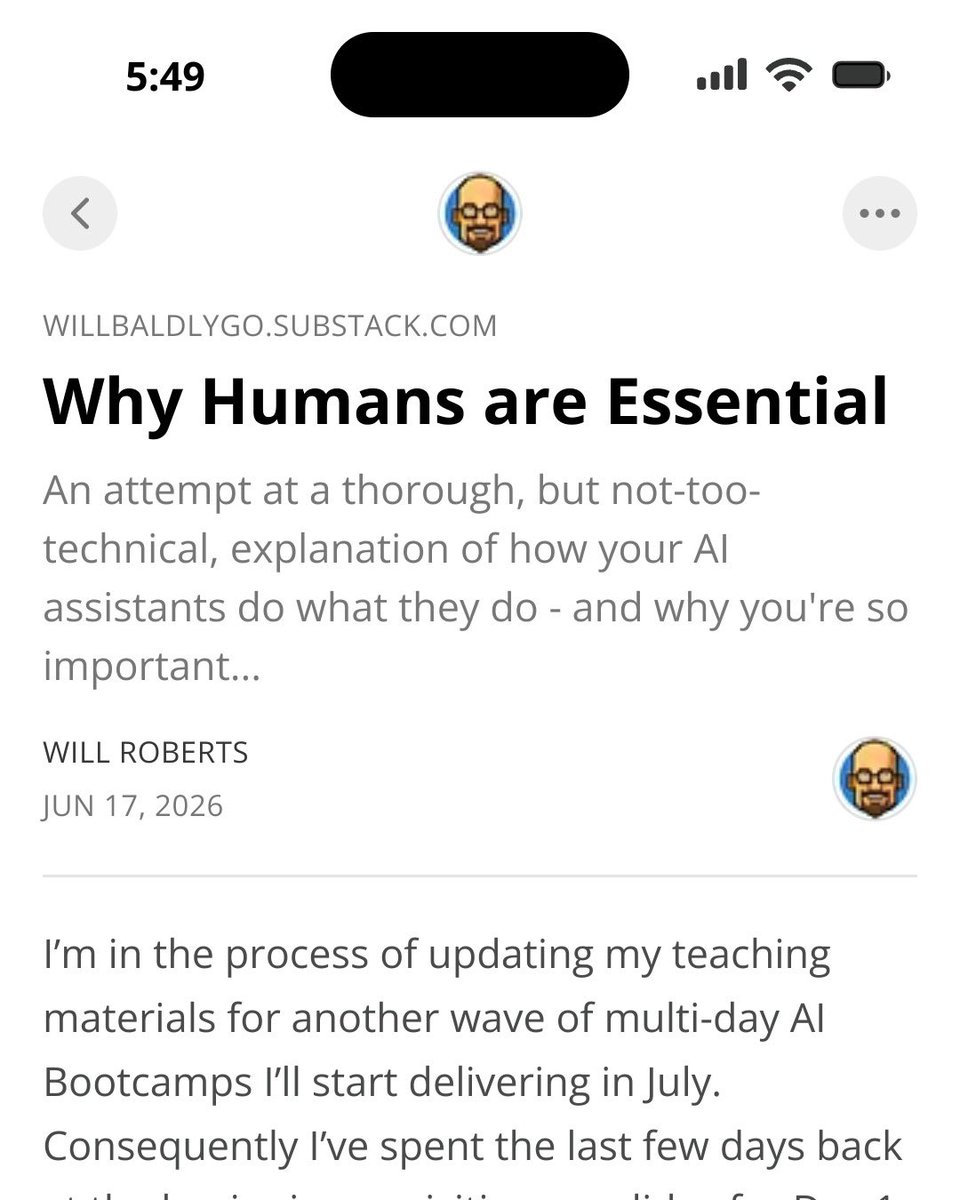
Do you wonder what AI really is but are too afraid to ask?
Do you know how your chatbot is turning your prompts into useful responses?
Do you know what AI lacks and why that makes you so essential?
Then this blog is for you: https://t.co/YRXh5cEke1
🤔 AI tools are not like microwaves…
I make a point of helping my AI Bootcamp learners gain as deep an understanding as possible of what’s actually happening behind the scenes when they prompt their preferred AI Chatbot.
It’s a lot to take in, and you may argue that it’s not really necessary to teach people exactly how a microwave heats food in order to teach them how to warm up leftovers.
But AI systems are not like Microwaves.
Microwaves are deterministic.
If you tell one to defrost your food for 10 minutes it will always spend the next 10 minutes defrosting your food.
AI is probabilistic.
It will *probably* defrost your food for 10 minutes. But once in a while it might just decide the weird toaster oven setting you’ve never tried is a better option, and 10 minutes later you’re looking at charcoal and frantically wafting a tea towel at your smoke alarm 🔥🚨
If you don’t understand how AI works, how can you learn to predict what it will or won’t be good at, or to understand how to write prompts that get results?
Learn what you need to know below ⬇️
I totally agree! ⬇️
Fable looks totally amazing, but it’s a sledgehammer to crack a walnut for most daily use cases, and my tests suggest it is a token furnace.
Whereas DiffusionGemma is a real shift in LLM architecture, with significant efficiency gains.
I’ve been getting great results with the recent @googlegemma models and I can’t wait to try this new one.
Maybe the biggest AI release this week was not Claude Fable 5.
It might be DiffusionGemma.
Not because it is the smartest model.
Because it points to something much bigger: dramatically faster AI from software, not just bigger hardware.
Most LLMs still generate text like a typewriter: one token after another.
DiffusionGemma takes a different path. It uses text diffusion to generate blocks of text in parallel, then refines them.
Google says this can deliver up to 4x faster text generation on GPUs.
That is not a small optimization.
In our early testing, the speedup was even more dramatic.
On a workload where a comparable Gemma 4 31B request took about 35 seconds, DiffusionGemma came back in about 5 seconds.
Roughly 7x faster in that case.
This is the kind of change that makes private AI feel different.
And the implication is easy to understate.
A 4x faster model is not just “the answer arrives sooner.”
It also means the same hardware can handle roughly 4x more requests.
At 7x, the same box starts to feel like a small cluster.
That changes latency, cost, capacity, and product design.
There are trade-offs.
DiffusionGemma is experimental. In our testing, it was not as reliable as standard Gemma 4 models on instruction following and structured response contracts.
So no, I would not treat it as the default private agent runner yet.
But that is not the point.
The point is the direction of travel.
My read: diffusion-style generation, parallel decoding, and related approaches are going to spread across model families.
If this becomes a 10x-class software improvement over time, it is not a bear case for AI hardware.
It is the opposite.
It blows open the floodgates.
Cheaper inference. Lower latency. More private deployment. More usage from the same infrastructure.
AI becomes much more accessible.
They’re not professors or architects, but some jobs call for a plumber or a machine operator.
These smaller models make for excellent technical specialists...
https://t.co/Ca0S19R81G
Are local models ‘hot garbage’ or are you looking at them all wrong? 🤔
I skulk around a few local LLM themed subreddits and am always surprised by the people who seem to go there just to say local models are useless.
I think they'd be less frustrated and more able to build useful things with local models if they shifted how they understood them...
Link below.
I’ve never liked Word. It’s bloated with features that leave you spending half your time trying to edit table layouts, or faff with indent markers etc.
2 somewhat unexpected consequences of months spent experimenting with AI coding agents is that I don’t use Word anymore and I’ve started seeing everything as software.
I keep all my research and work documents in markdown.
I’ve created a skill that means my AI agents can just wrap a lightweight text editor around the text so I can open it in my web browser. It styles it in line with my company brand, can save it locally, and can export it as a well formatted docx, pptx or pdf.
I don’t open Word, I just ask for an editable, html version of a markdown file.
This also creates an opening for local models. A proprietary model was required to make the skill and the first couple of examples, but I’m seeing good results using Gemma4 e4b and the new 12b model.
Sources: Anthropic is planning to release a public version of Mythos tomorrow
- Will have substantial guardrails and not be as cyber permissive as what Project Glasswing partners can access
- Will be dramatically better at long-horizon, multi-turn tasks https://t.co/cqq3Y5CVb0
I found myself forever switching between the AI apps on my phone. Each could remember some of what I needed it to know. Each had some of the tools I needed.
So I built one of my own.
Beacon is not a product. It’s so tied to my specific needs I doubt anyone could use it straight out of the box. But that’s what I love about it.
If you’re curious about how AI can help you build the software you need around the way you work, read on…
My latest blog, about my first homemade iPhone app. Beacon gives me a means of quickly recording new ideas in a space all my agents can access. It provides tools for retrieving and interrogating a shared knowledge base. It’s a place to interact with an AI model attached to a persistent shared memory. AI that knows what I’ve been up to.
It’s not a product, it’s far too idiosyncratic for that. But it is a reflection of the direction my philosophy, techniques and tool kit for interacting with AI has been leading me lately.
https://t.co/d6fXkNfJBS
The app is tightly coupled to a specific backend infrastructure and many features won't run out of the box without a similar setup. It's not a product, it's an experiment.
But the DIY architecture design philosophy, and on-device AI integration may be of interest to others building similar tools.
Or just as a source of amusement for those who actually know how to write code.
https://t.co/TLgpCG7DFP
Beacon is a multifunctional control surface exposing a raspberry pi5 based home server. This knowledge base provides persistent shared memory across devices. Beacon provides a ChatUI with Haiku4.5 (API) and Gemma4 e4b (on device), file explorer, lightweight markdown editor, and VTT via whisperkit.
My latest blog, about my first homemade iPhone app. Beacon gives me a means of quickly recording new ideas in a space all my agents can access. It provides tools for retrieving and interrogating a shared knowledge base. It’s a place to interact with an AI model attached to a persistent shared memory. AI that knows what I’ve been up to.
It’s not a product, it’s far too idiosyncratic for that. But it is a reflection of the direction my philosophy, techniques and tool kit for interacting with AI has been leading me lately.
https://t.co/d6fXkNfJBS