Day 3 of building custom, domain-specific harnesses
Picked a first concrete use case to build (i.e. a personal consumer-care application, the kind that tracks something about you over time e.g. skin, fitness, health), but the underlying design is meant to generalize across consumer apps.
The core idea: capture something over time → structure it → remember it per user → compare to the past → generate a grounded output with guardrails.
Breaking that down:
1. Structured extraction
Whatever the input: an image, a document, a log entry - the platform/solution returns a fixed schema. That's what makes "compare this to last time" possible with highest accuracy.
2. Raw input handling
Some consumer apps will want to keep the raw image/file (progress photos, documents). Others won't. The harness will support both: analyze-and-discard or analyze-and-store, as a configuration
3. One profile per user
A persistent record that stores preferences, history, states
4. Two-layer memory.
Structured fields for things that are definitively true (the "profile" layer) + flexible recall memory (using Mem0) for context and preferences that may change over time
5. Hard rules in the SKILLS
Domain-specific guardrails i.e. what the app will and won't say
6. Grounded in a knowledge base
This is where you feed in the specific domain expertise your application needs. The facts, safety rules, and reference data your particular use case depends on. Swap the knowledge base and the same harness works for a completely different consumer application.
On the build: OpenCode setup is done and base harness is running.
Day 2 of building custom, domain-specific harnesses
No code today. Spent the day on architecture decisions instead.
1. Corrected myself on open-weight.
Kimi K3 shipped this week at 2.8T params, but Moonshot hasn't published weights yet (committed for July 27). Until then it's API-only
2. Decided against LangGraph/Deep Agents
Tempted to work on a multi-agent framework since my harness coordinates 3-4 things (image analysis, memory, recommendations, user notifications). But single-agent/simple patterns can handle most real cases. Starting with a plain event + skills pattern.
3. Picked the memory + observability layer
> Mem0 for per-user long-term memory: this is the actual point of the harness.
> Langfuse (free cloud tier) for tracing/cost observability. Skipping self-hosting for now, not worth the ops overhead at this scale
Building in public. One day at a time.
Day 2 of building custom, domain-specific harnesses
No code today. Spent the day on architecture decisions instead.
1. Corrected myself on open-weight.
Kimi K3 shipped this week at 2.8T params, but Moonshot hasn't published weights yet (committed for July 27). Until then it's API-only
2. Decided against LangGraph/Deep Agents
Tempted to work on a multi-agent framework since my harness coordinates 3-4 things (image analysis, memory, recommendations, user notifications). But single-agent/simple patterns can handle most real cases. Starting with a plain event + skills pattern.
3. Picked the memory + observability layer
> Mem0 for per-user long-term memory: this is the actual point of the harness.
> Langfuse (free cloud tier) for tracing/cost observability. Skipping self-hosting for now, not worth the ops overhead at this scale
Building in public. One day at a time.
Day 1 of building custom, domain-specific harnesses
What I got done today:
> Selection of the specific domain: I want to focus on general-purpose consumer apps to begin with (not considering customer support agents).
The goal: build a reusable harness that lets anyone build a consumer app on the cheapest and efficient capable open-weight models. Test it properly, publish what actually works.
> Drafted a planning doc for the harness/agent i.e. Scope, architecture, what's in v1 vs. later.
My own harness stack:
- Base: OpenCode
- First round of open-weight models to test: GLM 5.2, DeepSeek V4, Qwen3.8, and Kimi K3
Still deciding: Eval criteria, and hosting setup
Building in public, one day at a time.
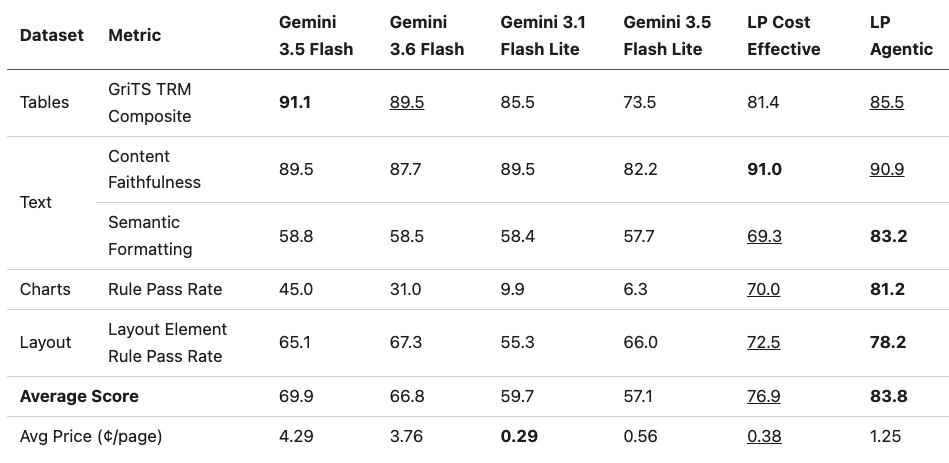
@alexandr_wang Gemini flash got degraded on general purpose work such as document understanding.
It is focussing on the coding and reasoning trend. However still lags by far !
Gemini flash is going all in reasoning and coding !
Earlier Gemini models were also more tuned for document understanding. However, new Gemini models are now trained more for reasoning and coding. @jerryjliu0
Yet, Gemini 3.6 Flash is still behind the recently launched Kimi K3 in Intelligence, Coding, and Agentic Becnhmarks.
Day 1 of building custom, domain-specific harnesses
What I got done today:
> Selection of the specific domain: I want to focus on general-purpose consumer apps to begin with (not considering customer support agents).
The goal: build a reusable harness that lets anyone build a consumer app on the cheapest and efficient capable open-weight models. Test it properly, publish what actually works.
> Drafted a planning doc for the harness/agent i.e. Scope, architecture, what's in v1 vs. later.
My own harness stack:
- Base: OpenCode
- First round of open-weight models to test: GLM 5.2, DeepSeek V4, Qwen3.8, and Kimi K3
Still deciding: Eval criteria, and hosting setup
Building in public, one day at a time.
I don't think there's a ton of value in creating custom general harnesses.
But there will always tremendous value in creating custom task-specific harnesses, especially if you need to satisfy accuracy/cost/latency constraints for production. You can encode all the domain-specific priors, the right model mixture, and the right UX so it's far better than you trying to prompt a general agent with some skills/prompts.
1. You can always bootstrap any workflow with Codex/Claude Code first
2. Distill it into something more specific
Gemini flash is going all in reasoning and coding !
Earlier Gemini models were also more tuned for document understanding. However, new Gemini models are now trained more for reasoning and coding. @jerryjliu0
Yet, Gemini 3.6 Flash is still behind the recently launched Kimi K3 in Intelligence, Coding, and Agentic Becnhmarks.
We’re rolling out three new models to make AI agents faster, smarter, and cheaper at scale:
🔵 Gemini 3.6 Flash: It uses fewer tokens than 3.5 Flash to deliver higher quality work at the exact same cost.
🔵 Gemini 3.5 Flash-Lite: A fast, cost-effective option for everyday tasks like processing documents and agentic search.
🔵 Gemini 3.5 Flash Cyber: A cybersecurity model built to find and patch critical software vulnerabilities.
Three friends met up in a Denny’s booth and agreed to launch a startup. None of them had a clue how to do it. Yet, they built the most valuable semiconductor business in history.
Jensen Huang was born in Tainan, Taiwan, in 1963. After moving to the US as a teen, he worked as a dishwasher and busboy at a Denny’s in Hayward, California. He later studied electrical engineering at Oregon State before earning his master’s at Stanford. In 1993 at 30 years old, married with two kids he and two former colleagues from LSI Logic sat down in a Denny’s booth and founded NVIDIA.
His co-founders: Chris Malachowsky and Curtis Priem.
Their grand vision: a revolutionary graphics chip to boost computer processing power for gaming. None of the trio had ever run a business before. None of them knew exactly how to build the product they envisioned. They took the leap anyway.
Their initial chip was a flop. It almost bankrupted NVIDIA in 1996. So, they made a massive pivot - inventing the GPU (graphics processing unit), and it changed everything.
The GPU transformed game graphics from basic stick figures to photorealistic environments. It rescued the company. It propelled NVIDIA far beyond the gaming industry.
Today, the GPU is the driving force behind AI. Every major AI model. Every autonomous vehicle. Every drug discovery project. Every advanced robotics system. They all rely on NVIDIA GPUs.
NVIDIA is now valued at over $3.5 trillion making it the most valuable semiconductor brand ever created, and at various points throughout 2024 and 2025, the most valuable company on earth.
It all began in a Denny’s booth.
Built by three founders who initially had no idea what they were doing.
In China, people are controlling robots using only their thoughts, without moving a muscle.
Chinese tech unicorn BrainCo unveiled a "brain-to-robot" platform at the World AI Conference in Shanghai.
How it Works: Users wear an EEG headset that uses AI to decode neural signals, letting them control robotic dogs, arms, and humanoids using only their thoughts.
Founded in 2015, BrainCo is a premier Chinese start-up specializing in brain-computer interface (BCI) technology. It is one of Hangzhou’s so-called “six little dragons”, which is an informal grouping of hi-tech firms from the eastern Chinese city that have risen to global prominence in AI and robotics.
After Kimi K3, Qwen is coming up with its own open-weight 2.4T model - Qwen3.8.
Open weight storm from China continues.
Qwen is owned and developed by Chinese Alibaba Group, specifically by their AI research division, Tongyi Lab, and hosted on Alibaba Cloud.
@jerryjliu0 Absolutely !
Real world critical applications are hard to re-develop, update, and maintain. Especially when it comes to legacy systems or domain specific.
After Kimi K3, Qwen is coming up with its own open-weight 2.4T model - Qwen3.8.
Open weight storm from China continues.
Qwen is owned and developed by Chinese Alibaba Group, specifically by their AI research division, Tongyi Lab, and hosted on Alibaba Cloud.
Qwen3.8 is launching and going open-weight soon!🌐
With a massive 2.4T parameters, this model is continuously evolving. We believe it’s one of the most powerful model available today, compatible to leading frontier AI models , second only to Fable 5.
You don't have to wait to test it. Just now, the Qwen3.8-Max-Preview made its debut on Alibaba’s Token Plan, Qoder, and QoderWork. Be among the very first to try it out.
Can't wait to hear what you build. Stay tuned! 🚀
Token Plan
international:https://t.co/YRvcGdB9Bv
China:https://t.co/PKMUNwUuRp
In China, people are controlling robots using only their thoughts, without moving a muscle.
Chinese tech unicorn BrainCo unveiled a "brain-to-robot" platform at the World AI Conference in Shanghai.
How it Works: Users wear an EEG headset that uses AI to decode neural signals, letting them control robotic dogs, arms, and humanoids using only their thoughts.
Founded in 2015, BrainCo is a premier Chinese start-up specializing in brain-computer interface (BCI) technology. It is one of Hangzhou’s so-called “six little dragons”, which is an informal grouping of hi-tech firms from the eastern Chinese city that have risen to global prominence in AI and robotics.