Decisions worth defending are decisions worth proving.
Full essay → https://t.co/g5E54bu7aV
@DrugInfoAssn 2026 → Poster Session II, Tuesday June 16, Abstract 116114, Pennsylvania Convention Center.
Come find me at the poster.
#DIA2026#ClinicalTrials#RegulatoryAffairs #ArtificialIntelligence #FormalVerification
A signature on a clinical decision is not paperwork.
It is a human staking their license, their reputation, and their judgment on the answer being right.
Most AI in regulated industries asks that human to attest to a confidence score they cannot reconstruct.
🧵
AI can predict.
Only humans can judge.
The architecture exists so the judgment is informed by evidence the human can reconstruct.
The human is the defensibility.
I'm excited to attend #654: India Town Hall: India’s Evolving Regulatory Landscape - Policy Reforms and Digital Systems Accelerating Innovation at @DrugInfoAssn 2026 Global Annual Meeting #diaglobal2026 https://t.co/eXf2ECMakF @sched
AI can assemble the evidence. Only the human can judge it. The certificate is what makes the judgment defensible.
We'll be working through these questions at #DIA2026 in Philadelphia.
Provably right, not probably right.
ARCH (working paper): https://t.co/hj7OyD3QX1
When an AI system touches a clinical trial decision, someone has to answer one question: prove it was right.
A proof certificate is that proof. It doesn't replace the human. It backs them.
Here's what it actually is 🧵
A pathway to portability → bind the certificate to the CDISC USDM as a native extension, so it's expressed in a standard regulators already consume.
That binding pathway was contributed by Jessica Stuyvenberg, the ARCH Framework, a working paper now open for review.
I don't have all the answers. The framework ships with six open questions, on purpose.
It's an invitation to set a validation standard before regulators impose one retroactively.
RA, clinical ops, AI governance.
I'd rather you argue with it than agree.
👇
https://t.co/qNS6s6RV13
Every AI tool in clinical trials can tell you how confident it is.
None can prove what they actually verified.
A confidence interval is a guess with a decimal point. A proof certificate either checks out or it fails.
Published the framework for the second kind this morning. 🧵
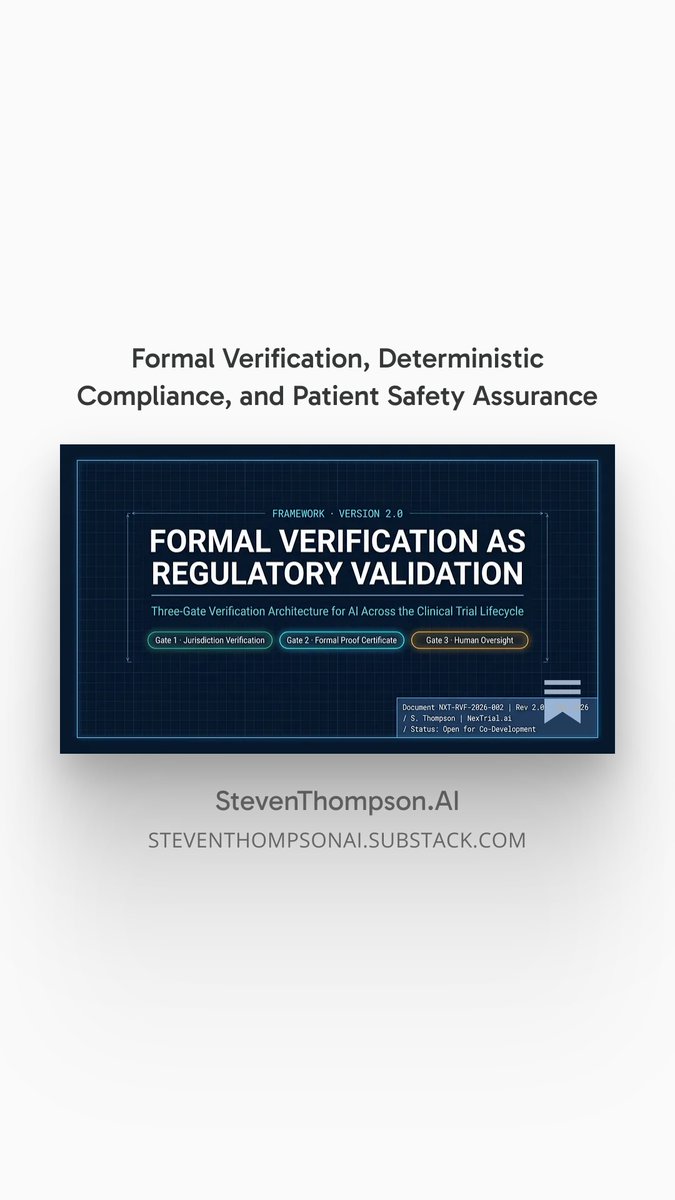
Three gates. Every trial document and every trial decision passes through all three:
1️⃣ Regulatory compliance → checked against the jurisdiction that governs the site
2️⃣ Formal proof → structure verified in <100ms
3️⃣ Human decision → always
The output isn't a recommendation you trust. It's a receipt you can check.
Não é uma conclusão. Deixamos seis questões em aberto de propósito.
Se você é de assuntos regulatórios ou de IA, quero que discorde, não que concorde.
Link 👇
https://t.co/jJnp8YV1DJ
Toda ferramenta de IA em ensaios clínicos te diz o quão confiante ela está.
Nenhuma consegue provar que estava certa.
Um score de confiança é um chute com vírgula. Um certificado de prova verifica, ou falha. Não existe meio-termo.
A gente publicou o framework do seguo tipo. 🧵
E não foi traduzido de um documento gringo.
Foi escrito a partir do Brasil: CFM 2.454, Lei 14.874, LGPD, a estrutura CEP/CONEP. A taxonomia de risco mapeia direto sobre as quatro classes da RDC 751.
Aceito para apresentação no @DrugInfoAssn 2026, em Filadélfia. Base brasileira, padrão global.