I’m not a hero. I’m just an ordinary guy who gives a damn about the people who are investing & want to make sure they get a fair shake. | Founder @tocefinancial
c.1900 #NewYork Rustic #CountryCottage on 3.93 #Acres $180,000. Boasts outbuildings. and a very large, flat yard with many perennial gardens and fruit trees. So peaceful.
https://t.co/MQW7Mf5ze1
Today is my 36th bday
Instead of putting all the pressure on the day of my birthday, I decided to change it up and celebrate over the last 2 days
On Friday my gf and I drove 1.5 hours to the desert and did a bike ride with my twin brother
Yesterday a group of friends hiked 3 hours to a frozen lake at 11,500 ft of elevation with shovels and hockey skates.
We played hockey for 3 hours and then came to my house for a pizza party
Life couldn’t be better.
Work on what you’re passionate about.
Go outside. Surround yourself with amazing humans (online and offline).
36 feels old on paper, but I feel like I’m just hitting my stride
I used 506(b) to raise money from my friends. 7 unaccredited homies $5k each. I couldn’t believe they all had $5k saved! lol.
One of them gave me a 0% APR credit card with $5000 limit. We maxed it on biz expenses in order to make his contribution.
Most private raises in the search world run under Rule 506(b). To qualify the investors, most just have to check a box saying they're accredited, and that's the extent of the diligence for the issuing company.
But there's a catch:
> You can't advertise the raise.
And by advertise, I mean you effectively can't make any public statements about your equity raise (yes, even that passive social post not "soliciting" but…still "soliciting" investors).
But there's a different rule under Reg D, Rule 506(c), that actually does let you advertise.
But it has a catch too:
> It comes with a wall of paperwork.
What many of you may not know, however, is that last year, in March 2025, the SEC knocked down a huge chunk of that wall.
But first, let's discuss how the two rules differ. Then what changed.
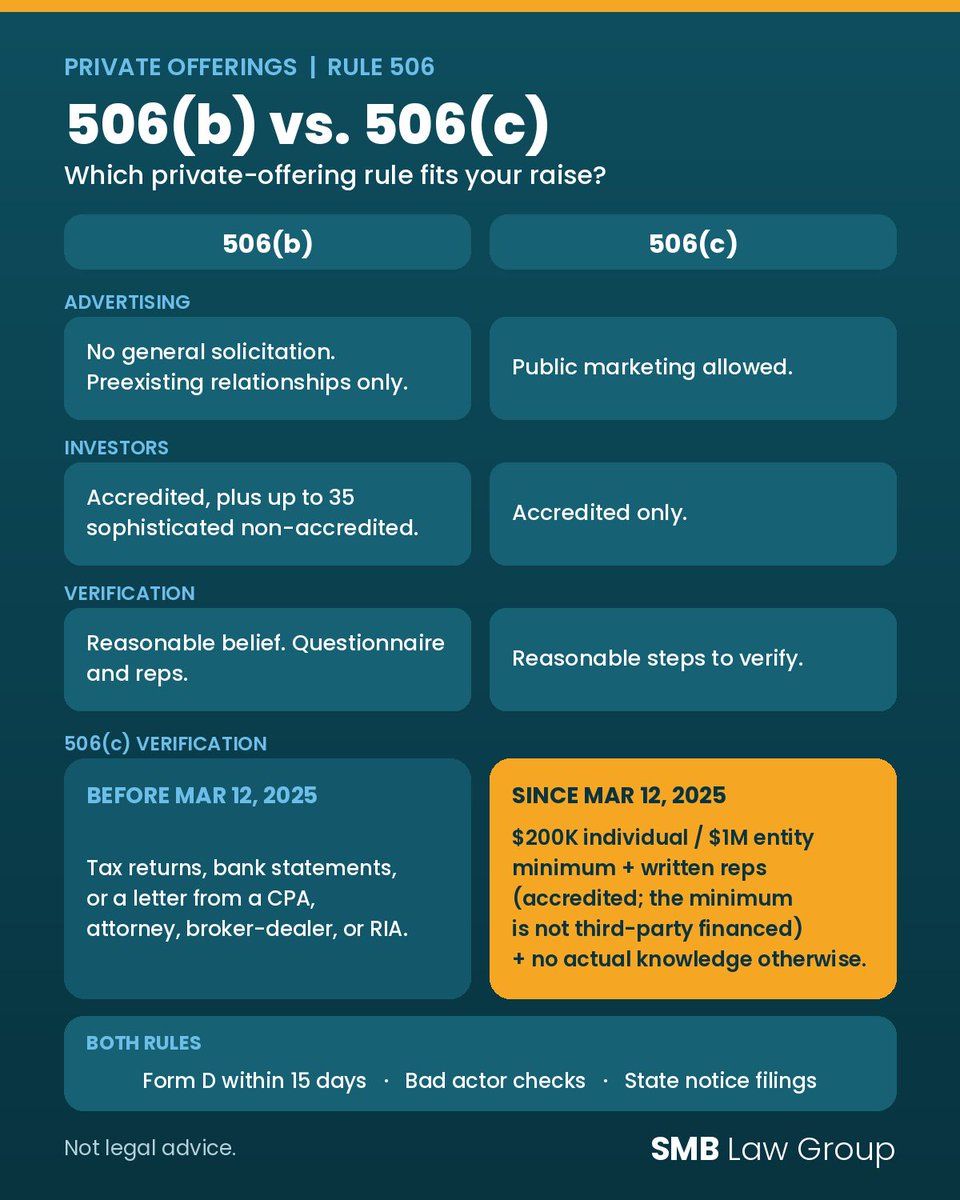
506(b): The default
This is how most search and SMB deals raise equity.
It means there is no general solicitation. You raise from people you have a preexisting, substantive relationship with.
No X or LinkedIn posts, podcasts, or newsletter pitches about the deal.
You can still involve up to 35 non-accredited investors, as long as they're sophisticated. But once there's even a single non-accredited investor, you owe the investors extensive disclosure.
For larger raises, the cost and headache of doing that may make sense.
For search deals? It almost never does.
That's why most issuers limit their raises to only accredited investors.
And one of the primary perks of 506(b) is the issuer's obligation to verify accredited investor status is very light. You just need a "reasonable belief" that an investor is accredited, which, in practice, means you simply collect an investor questionnaire where they self-certify accredited investor status and include a rep to that effect in the subscription agreement.
506(c): The public option
Contrast that with 506(c), which is how a lot of syndicated real estate equity raises are done.
506(c) came out of the JOBS Act, passed in 2012, and took effect in September 2013. It relaxed the prior Reg D rules barring all general solicitation.
Since then, companies raising under 506(c) are allowed to publicly market the offering.
But there's a catch:
> Every buyer has to be accredited, no exceptions, AND you have to take "reasonable steps to verify" it.
Under 506(c), a questionnaire alone doesn't do the job.
In practice, that has meant reviewing tax returns or bank statements, or getting a verification letter from the investor's CPA, attorney, broker-dealer, or registered investment adviser.
Investors hated handing that over. So for the last decade a lot of raises stayed quiet under 506(b), even when the sponsor had an audience that could have filled the round.
So what changed last year?
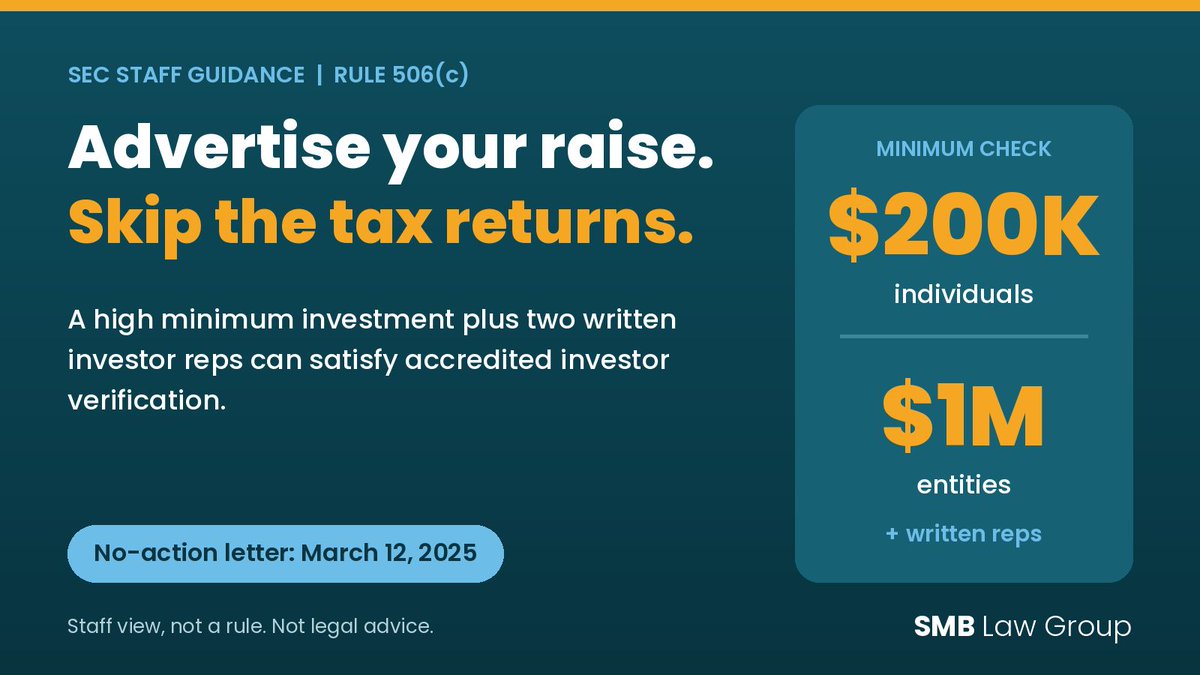
On March 12, 2025, the SEC's Division of Corporation Finance issued a no-action letter to Latham & Watkins and published new C&DIs 256.35 and 256.36.
Under that new guidance, SEC staff agreed that a high minimum investment, along with written reps, can satisfy 506(c)'s verification requirement.
All of the following conditions have to be true:
1. Minimum investment of $200,000 for individuals or $1,000,000 for entities.
2. A written rep that the investor is accredited.
3. A written rep that the minimum isn't financed by a third party for the specific purpose of making this investment.
4. You have no actual knowledge of facts suggesting either rep is untrue.
So for investors writing big checks, verification under 506(c) now looks a lot like the 506(b) process you already run. A questionnaire, reps in the docs, but no financial records!
The details that matter for deal people
> A binding commitment to fund the minimum in installments counts. This is huge for fund formation, where investors may commit $200,000+ (or $1,000,000+ for entities) but don't want to fund it all at once.
> The no-financing rep only covers the minimum to qualify. Dollars above it aren't part of that test, so they can technically be financed by a third party.
> Also, per the request letter the staff relied on, a general-purpose credit facility or financing that predates the offering doesn't by itself block the rep.
> If you're investing through an LLC that's accredited only because all of its owners are, the minimum is $1,000,000 in the aggregate for the LLC, or $200,000 per owner if it has fewer than five individual owners, and the reps cover each owner.
So when should you switch from 506(b) to 506(c)?
Based on how the rules apply, 506(c) still only makes sense if you're doing a large enough raise where your investor base writes $200K+ checks and you want to talk about the deal publicly, on podcasts, in posts, in your newsletter.
So in my world of M&A, only if you're raising a fund or raising for a sponsor deal (fundless sponsor, traditional search, etc).
In most other cases, 506(b) still makes sense. Especially if you're going to take smaller checks.
Most self-funded search investments are under $200K, and when they're larger than $200K, that's almost always because a fund is investing, and for an entity investor the minimum is $1,000,000, not $200K.
Under 506(c), every investor below those minimums still needs the old-school verification methods.
Also know that once you've generally solicited, you can't just flip back to 506(b) for that offering.
Some notes of caution
"No actual knowledge" carries a lot of weight in this new guidance. If an investor tells you, or you otherwise learn, they're borrowing to make the investment, you can't ignore it.
Self-certification is still not, by itself, enough for 506(c). The large minimum investment is what the new guidance hinges on.
Also, this all stems from staff guidance, not a rule. The letter says it has "no legal force or effect" and that different facts could lead to a different conclusion.
What does that mean in practice?
The staff could change its position at any time. Remember, elections have consequences…
And finally, under both 506(b) and 506(c), Form D is still required within 15 days of your first sale, you have to conduct bad actor checks and make state notice filings, and antifraud liability still applies to everything you say about the deal.
The takeaway
506(b) is still the right home for most self-funded search (and even small sponsor) raises.
But if you can get your raise done for minimum checks of $200K+ and you have an audience you want to raise from, the reason to stay quiet is mostly gone.
All that said, all of this post is for education purposes only and none of this is legal or investment advice. Talk to your securities counsel before you go public with a raise.
@Saliimthedream@Internetinvite Nobody wants to acknowledge that you were clutch in the morning round and got your team into the finals.
I hope next year they have the final on the next morning. What’s the rush?