@ChrisG_CXG Hope your Dad has a good recovery, my Dad had a heart attack, operation to put in stents and a stroke all in 3 days in Fuerteventura when we flew back he had 6 weeks in the stroke unit in Abingdon. If you can get him into somewhere like that they are amazing places.
Every phone call I've taken this week has broken my heart a little bit more.
So much unnecessary suffering.
Please spread this information, as far and wide as you can.
You may save a life.
🙏
A hedgehog *out in the open* in the day is in serious trouble and needs urgent help.
Always.
No exceptions.
Any size.
Any time.
Hedgehogs are nocturnal prey animals, they have no defences in the daytime, it's deadly dangerous for them.
They are designed to hunt at night, to navigate and catch insects in the dark, occupying a specific ecological niche.
They are not adapted to withstand high temperatures, and their shape means they rapidly dehydrate during daylight hours.
They are nocturnal animals.
So they don't come out in the day simply because they're hungry, or lost, or disturbed, or to move nests, or are pregnant, or for any other trivial reason.
They come out in the day because it's warmer than the night and they are feeling cold.
Deadly cold.
They're feeling cold because they're so sick they're starting to die, and hypothermia is a stage of dying. Blood has been redirected to the vital organs, keeping them alive as long as possible, leaving the limbs feeling cold.
If you see a hedgehog like this, out in the open, in the day time, no matter how 'well' he looks, it is an emergency.
Every minute counts.
DO NOT put them in a box and keep them, feeding them, not calling a rescue for advice for 3 days until their agony and infection is too much for them to bear and they stop moving.
DO NOT feed them then move them under a bush because you think they shouldn't be in the sun, leaving them, utterly defenceless, to be predated alive there.
DO NOT take them to a vet, none of whom are trained in wildlife and will simply put to sleep even viable wild animals.
Please take them to a rescue (never a vet) URGENTLY.
Just Google 'hedgehog rescue near me' to find a list.
More info: https://t.co/I1vcAnWv1t
One of the many myths about hedgehogs which I find particulary annoying is "hedgehogs get their name from living under hedges and grunting like a hog".
This is not only utter nonsense, it's very dangerous misinformation which has caused the death of so many poor sick hedgehogs, who could otherwise have been saved.
Yet I've seen this utter rubbish published on websites of organisations you'd think you could trust to get their facts right.
Especially when it comes to such a precious endangered animal.
Hedgehogs don't grunt.
They don't snort.
They don't make any sound at all.
Just like us, their breathing is completely silent if they are healthy.
Hedgehogs hunt for food.
They certainly don't announce their presence to their prey by grunting and snorting as they approach.
They are silent, and they hunt via scent and sound.
They listen intently, all the time.
Their hearing is so incredibly acute they can hear the scurry of insects legs under an inch of soil.
Hedgehogs don't come out to hunt in the rain, not because they don't like getting wet, but because the sound of the rain drowns out the sounds of their prey, making hunting imposssible.
And hedgehogs are solitary animals.
Being solitary means they don't socialise with their own kind, or any other species, so they have no need for a vocabulary, or any verbal communication.
The only time you are likely to hear a hedgehog making a sound is the huffing a female hedgehog makes when being courted by a male during mating season.
So if you hear a hedgehog snorting or grunting, or making ANY audible breathing sounds, what you are hearing is a very sick hedgehog whose breathing is compromised and who needs urgent treatment from a rescue (never a vet).
When a hedgehog is sick, particularly with lungworm, the fluid in the lungs means the air moving in and out makes a bubbling sound.
And as the airways become inflamed and swollen, the flow is impeded, making the passage of air noisy.
The clip below is of Arthur, recently returned from his hibernation. As you can hear, his breathing has a bubbly, creaky sound. Not too bad, as yet, but bad enough to need treatment - which is probably why he's returned, to book himself into the hospital here.🥰
@remmy_308 Thank you, it's been incredibly tough as Dad also had a heart attack and a stroke too. He's coming home from hospital next week and has made amazing progress. He was happy too that they are back 🦔
Got tired of waiting for X to do the simple thing and give me access to my old account (thedogman_918) so I've decided to just start again!
Any RT for old followers would be appreciated 👍
Pumpkins:
Halloween is one night.
Tonight.
If you have to waste a food item (and I strongly suggest you don't), please put it out for one night, then safely dispose of it.
Please DO NOT put it out for the wildlife.
Once you've handled it, cut it, left it out in the open, unrefrigerated, it will not be hygienic or safe for anyone to eat.
Pumpkins are a low-acid vegetable, so once they are cut and left at room temperature, pathogens will rapidly grow on the flesh, producing mould spores.
Our precious wildlife do not have any magical properties that protect them against food poisoning.
Additionally, this time of year there are baby hedgehogs around, born too late to find natural food, desperate to eat anything to stop the pain of starvation.
Pumpkin has a laxative affect so it would be particularly cruel to leave it out for starving wildlife to eat in desperation, causing them to lose precious fluids that may make the difference between life and death.
So no matter what you read elsewhere, please DO NOT put your discarded decoration out for the birds or any other wildlife.
Please DO NOT compost them either, as a composting pumpkin can produce highly toxic tremorgenic mycotoxins, which will be deadly if the compost bin is not properly secured and is accessible to wildlife (or pets).
Many hedgehogs, seeking the warmth of a compost bin, die this way every year.
Once you've used the pumpkin as decoration it's waste, fit only for the bin.
Please help get this vital message spread far and wide, to save precious lives and prevent suffering.
@CopMoustache Glad you get to go in style, I handed my warrant card over to my Sgt and he cut it up in front of me - I was quite upset with his insensitivity!
Sometimes words alone aren't enough.
The calls just keep coming, the suffering continues, and this needs to be made abundantly clear:
ANY hedgehog out in the open in the day is seriously ill and needs to be taken *to a rescue*, never a vet, urgently.
You CAN NOT just keep them.
I take phone calls every single day from people who have seen a hedgehog out in the day (mostly babies this time of year) and have taken them in and 'cared for' them, and are ringing me 2 or 3 days later asking why they aren't moving any more, or are crying.
Typically, a lady who called this morning saw a baby hedgehog out in the day yesterday, covered in flies.
She said she picked the fly eggs off and kept this baby in a nice warm box but is worried today that he seems sluggish.
That's because he was already deathly ill and in terrible pain when she found him.
The flies knew he was close to death so they laid their eggs on him, so that when the maggots hatched they'd have a nice fresh meal.
And, as I explained to this lady, that's exactly what they would be doing now - the eggs she didn't see, in his ears, eyes, nose, mouth and genitals - would be eating him alive now, from the inside.
He would be in agony.
Flies are capable of forcing inside the as yet unopened eyelids of babies and laying eggs there. The damage the maggots do when they hatch is catastrophic.
It really is critical that there is no ambiguity about this:
If you see a hedgehog out in the open in the day, grab her, then ring a good rescue who will ask all the right questions and triage the situation, and give you advice.
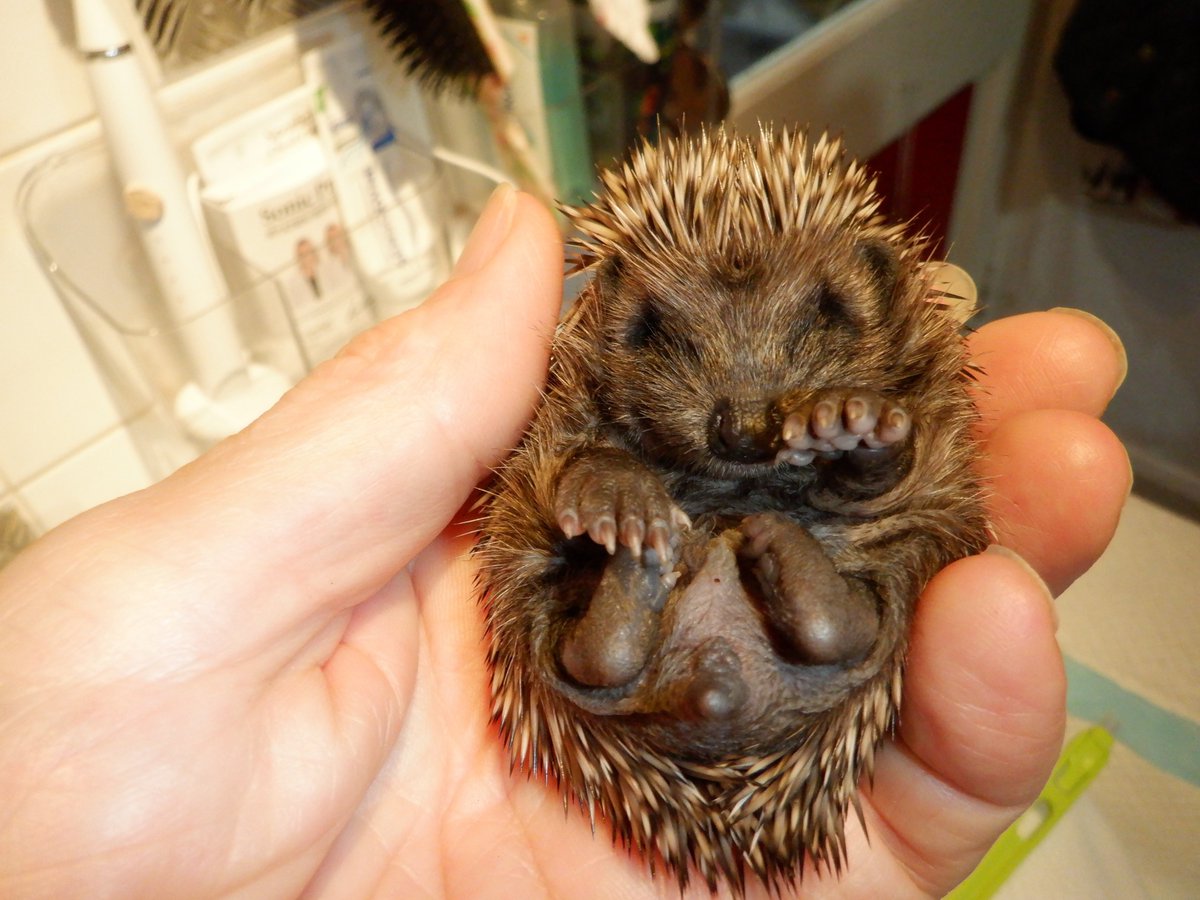
Below are two images of the same baby hedgehog, ten minutes apart.
The photo is as she was admitted, looking cute and fine, with all the visible fly eggs picked off.
The video is the same baby after I'd applied a substance that irritates maggots and makes them come out from inside their victim's bodily orifices.
The substance is very toxic and must be very carefully and sparingly applied by a knowledgeable and experienced rescue.
This little girl was treated successfully and is now thriving; growing so well she may even be able to be released back to the wild to hibernate this year.
She's a lucky one, as she was brought to the right place. Many aren't this lucky and die horribly.
I beg you, please be their ambulance, not their jailor.
Did you know…?
🦔
Exactly when #hedgehogs hibernate is dependent on the weather & other factors - usually the first start to hibernate when temperatures drop & remain low.
But it's complex! Click to learn more 👇
https://t.co/29u5kg1rAx
#FridayFact
Have you seen a #hedgehog you're worried about?
📞🦔🩹
Follow the simple steps on our website & call us on 01584 890801 or your local independent hedgehog rescue as soon as possible.
https://t.co/Qd9aQ4At6t
Don't delay - acting now can make a difference!
#WildlifeWednesday