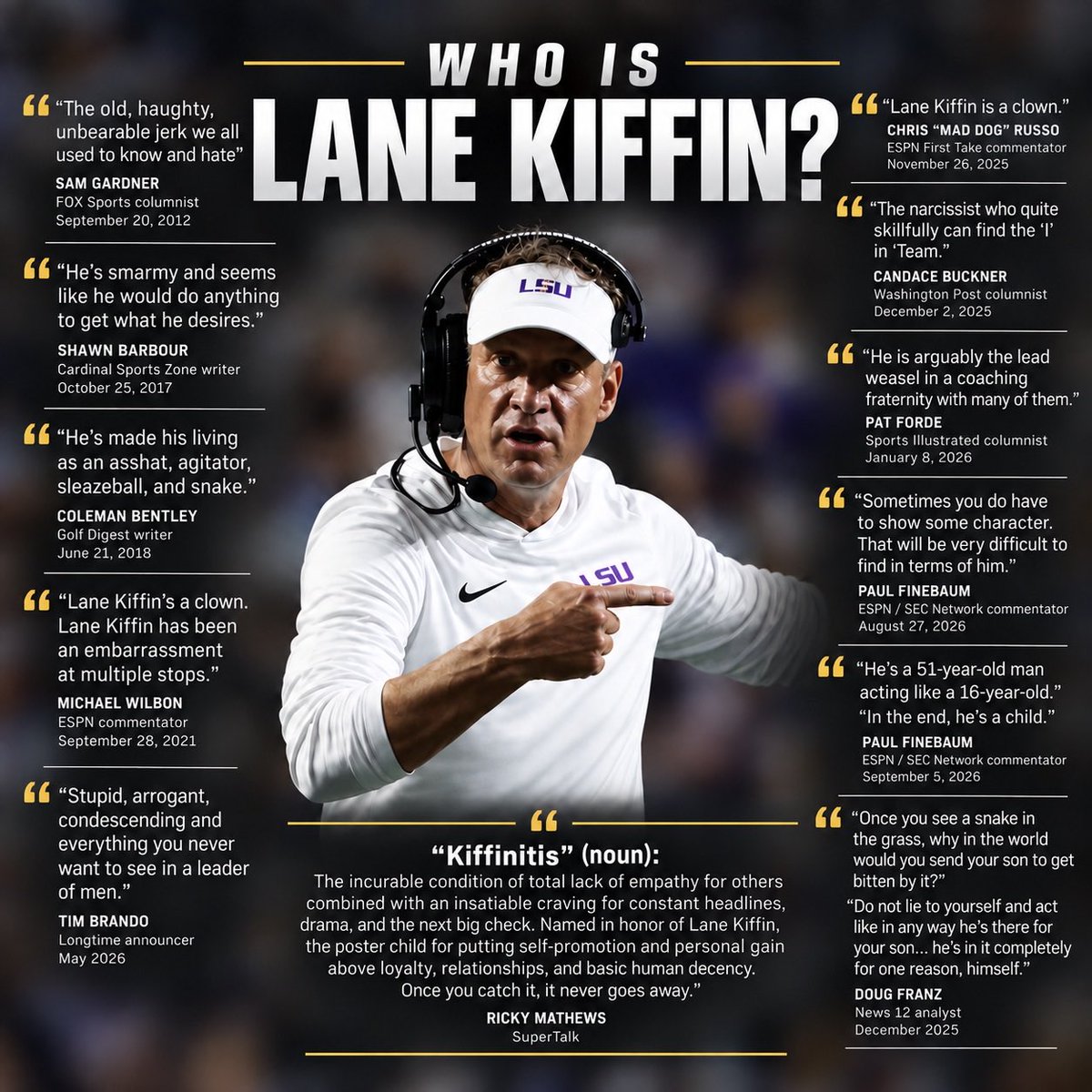
There will be a lot of talk this week about Lane Kiffin returning to Ole Miss.
With that being said, let’s take a look at who Lane Kiffin really is. I think this will give people a quick insight into how he is viewed.
The 80’s were sooooo much better than this upside down world we currently inhabit.
It wasn’t a perfect decade, of course.
But people actually lived in reality, instead of being glued to screens 80% of the time.
Movies were better, music was better. People knew the difference between men and women.
So much better in many ways.
I once made a serious effort to build a following on X.
Eventually, the lack of genuine engagement wore me down, and I said screw it.
But I’m giving it another shot—with one rule:
No phony engagement.
I’d rather have five real conversations than 5,000 meaningless impressions.
THE FORMERLY LIVING
Now on Kindle Unlimited.
They formerly lived.
They don’t anymore.
Yet somehow, they’re still coming.
They won’t stop.
And some of them are fast.
THE FORMERLY LIVING
If you own a car made after 2020, you need to read this right now.
Your car knows how fast you brake. Where you drive. What time you get home. And depending on the brand, it may be recording your conversations, your weight, and even your facial expressions.
Mozilla reviewed 25 major car brands for privacy. Every single one failed. Cars are officially the worst product category Mozilla has ever tested, worse than smart speakers, worse than doorbell cameras.
Here are 6 moves to lock your car down 🧵
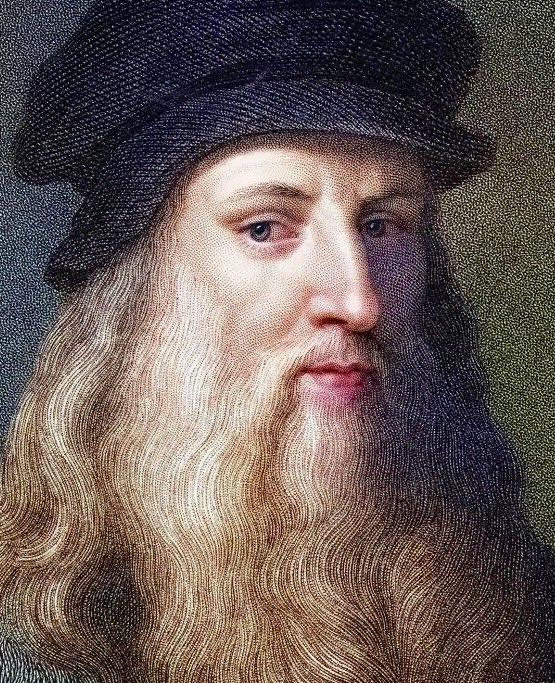
Leonardo da Vinci was not a Renaissance man.
That phrase — the universal man, the polymath — does not begin to describe what he actually was. It normalizes something that should not be normalized.
The scope of what he did is nothing short of crazy. He was insane. In the best possible sense.
1. The paintings first – because that is where most people stop, and stopping there is already extraordinary. The Mona Lisa. The Last Supper. The Virgin of the Rocks. Each one a revolution in light, shadow, atmosphere, and psychological depth that changed painting permanently. He invented sfumato – which is why the Mona Lisa looks alive in a way no painting before it did. He did this while also doing everything else on this list. The painting was the side project.
2. The anatomy. He dissected somewhere between thirty and one hundred human corpses – illegally, at night, in hospitals that tolerated him because the quality of his drawings was too good to refuse. Anatomical drawings not surpassed for three hundred years. He drew the chambers of the heart, the structure of the spine, the muscles of the face, the development of the foetus in the womb. He understood the function of the heart’s valves five hundred years before modern cardiology confirmed it. He also mapped the brain, the eye, and the reproductive system with the same precision. With candles, in cold rooms, with decomposing corpses. For fun.
3. The engineering. A flying machine, 1485. A parachute. A hang glider. An armored vehicle. A rapid-fire crossbow. A solar power concentrator. A robotic knight. A submarine. The armored vehicle is a tank. The rapid-fire crossbow is a machine gun. He invented both in 1482. Nobody built them for four hundred years. He was building the centuries ahead with fifteenth century materials and calling it sketching.
4. The geology and the rest. He understood two centuries early that the earth was ancient and the sea had covered the mountains. His drawings of fluid dynamics were not improved upon until the twentieth century. He did geology, fluid mechanics, botany, and cartography simultaneously – in his spare time, while painting and designing war machines.
5. The music. He arrived at the court of Ludovico Sforza not as a painter but as a military engineer – and brought a lute he had made himself, in the shape of a horse’s skull, in silver, because why not. The court was impressed. He got the job. The painting came later.
6. He left approximately 13,000 pages of notes, drawings, observations, calculations, and ideas – written in mirror script, right to left, in a script that required a mirror to read. Why mirror script? Possibly because he was left-handed and it prevented smudging. Possibly because he didn’t want people reading over his shoulder. Or because he just liked it so. The notebooks contain everything: anatomy, engineering, geology, botany, cartography, philosophy, observations on the nature of light, the movement of water, the growth of plants, jokes, shopping lists, notes to himself about books to find and people to ask. And the observation that "the sun does not move" – written quietly, in a notebook, a century before Galileo got in trouble for saying it publicly. He knew. He wrote it down. He moved on to the next thing.
7. He died in 1519, reportedly in the arms of the King of France. He left the Mona Lisa unfinished – sixteen years of work and still not satisfied with it. Most engineering projects unbuilt. The notebooks unpublished. What he finished changed painting permanently. What he left unfinished would have changed everything else. He reportedly said at the end of his life that he had offended God and mankind by failing to work as hard as he should have. The man who designed the tank, painted the Mona Lisa, and understood the heart’s valves felt he had underperformed. That tells you everything about the difference between genius and the rest of us.
I have 8 ID cards to show that I am a US citizen. How many do you have?
Combat medic. Paramedic. Veteran. Every one of those titles came with a card I had to earn and prove. Voting should be no different.
Full story 👇
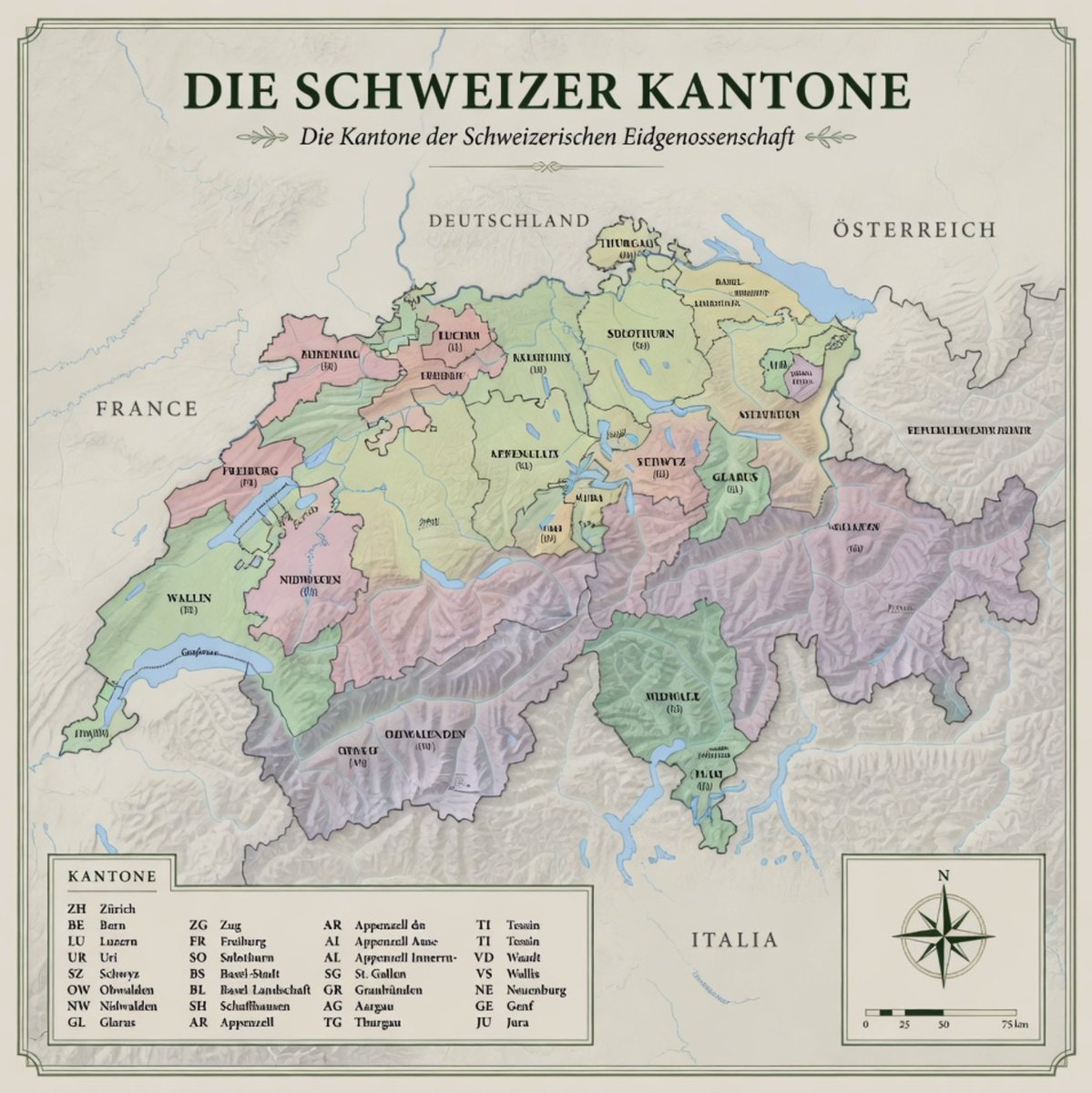
Switzerland has 26 cantons, each with its own constitution, tax rates, and laws, and the result is one of the wealthiest, most stable countries on earth. That is not a coincidence.
You want to understand why Swiss GDP per capita sits around $92,000 while the EU average hovers near $37,000? Start here. Cantons compete for residents and businesses the same way firms compete for customers. Zug kept its corporate tax rate at roughly 11.9%, attracted commodity traders and crypto firms, and watched its population and tax revenues grow. Cantons that taxed aggressively lost mobile capital and productive citizens to neighbors with lighter burdens. This is Tiebout competition working in real life, not a textbook diagram.
The federal government in Bern handles defense, monetary policy, and some foreign affairs. Everything else defaults downward. Cantons set income taxes. Communes set property levies. Citizens in Appenzell Innerrhoden voted on local laws by a show of hands in the Landsgemeinde, an open-air assembly, until 1990 for most matters. The feedback loop between decision-makers and the people paying for those decisions stays tight. That tightness disciplines spending in ways no central auditor ever will.
Free market thinkers have stressed this for generations: political units must be small enough that exit is credible. When the cost of leaving a bad jurisdiction drops, politicians face real consequences for bad policy. Switzerland kept that cost low by design. A business or family in Basel-Stadt dissatisfied with cantonal policy drives forty minutes to Baselland. No visa. No language barrier. No bureaucratic labyrinth. Just a move.
The EU spent decades building the opposite architecture, consolidating regulatory power in Brussels and eliminating the jurisdictional diversity that forces governments to stay honest. Switzerland refused to join. Its per-capita wealth, its low public debt, and its functional civil society arrived because the Swiss preserved the one institutional feature every centralized state destroys first: the credible right to leave.
So all this begs the question: so where did all the money go?
It obviously wasn’t spent on materials.
It would appear that a number of people and / or entities became extremely wealthy through the long, fruitless process of building 3.4 miles of subway tunnel.
This is yet another example of the multiplying effect of government run projects: cost overruns, inefficiency, and extreme lack of accountability.
Congress projected Medicare would cost $12B by 1990. Actual: $110B. Trust fund insolvent: 2033. Improper payments last year: $94B. This is what ignoring the 10th Amendment buys you. Thread 👇