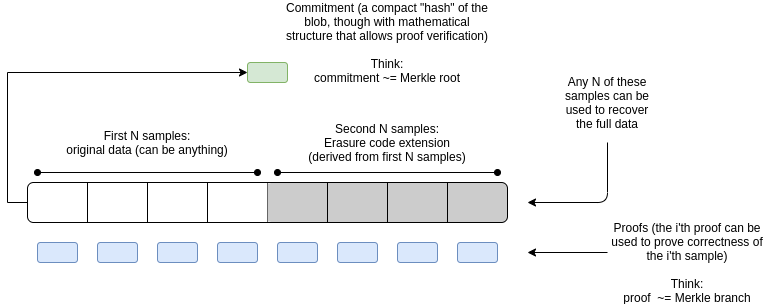
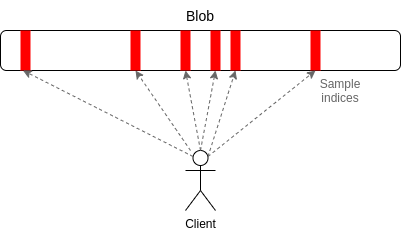
PeerDAS in Fusaka is significant because it literally is sharding.
Ethereum is coming to consensus on blocks without requiring any single node to see more than a tiny fraction of the data. And this is robust to 51% attacks - it's client-side probabilistic verification, not validator voting.
Sharding has been a dream for Ethereum since 2015 , and data availability sampling since 2017 ( https://t.co/Fa0jKFgObW ), and now we have it.
That said, there are three ways that the sharding in Fusaka is incomplete:
* We can process O(c^2) transactions (where c is the per-node compute) on L2s, but not on the ethereum L1. If we want to scaling to benefit the ethereum L1 as well, beyond what we can get by constant-factor upgrades like BAL and ePBS, we need mature ZK-EVMs.
* The proposer/builder bottleneck. Today, the builder needs to have the whole data and build the whole block. It would be amazing to have distributed block building.
* We don't have a sharded mempool. We still need that.
But even still, this is a fundamental step forward in blockchain design. The next two years will give us time to refine the PeerDAS mechanism, carefully increase its scale while we continue to ensure its stability, use it to scale L2s, and then when ZK-EVMs are mature, turn it inwards to scale ethereum L1 gas as well.
Big congrats to the Ethereum researchers and core devs who worked hard for years to make this happen.
PeerDAS in Fusaka is significant because it literally is sharding.
Ethereum is coming to consensus on blocks without requiring any single node to see more than a tiny fraction of the data. And this is robust to 51% attacks - it's client-side probabilistic verification, not validator voting.
Sharding has been a dream for Ethereum since 2015 , and data availability sampling since 2017 ( https://t.co/Fa0jKFgObW ), and now we have it.
That said, there are three ways that the sharding in Fusaka is incomplete:
* We can process O(c^2) transactions (where c is the per-node compute) on L2s, but not on the ethereum L1. If we want to scaling to benefit the ethereum L1 as well, beyond what we can get by constant-factor upgrades like BAL and ePBS, we need mature ZK-EVMs.
* The proposer/builder bottleneck. Today, the builder needs to have the whole data and build the whole block. It would be amazing to have distributed block building.
* We don't have a sharded mempool. We still need that.
But even still, this is a fundamental step forward in blockchain design. The next two years will give us time to refine the PeerDAS mechanism, carefully increase its scale while we continue to ensure its stability, use it to scale L2s, and then when ZK-EVMs are mature, turn it inwards to scale ethereum L1 gas as well.
Big congrats to the Ethereum researchers and core devs who worked hard for years to make this happen.
@0xkydo This was really well written. What would be ideal for your stakeholders is a dashboard of the best potential opportunities and their associated risks, rewards, and where they are in terms of development (poc, production, etc).
⚙️We reject the excessive ATM-driven model.
Excessive ATM issuance of DATs erodes per-share economics for newcomers, creates persistent overhang, and exposes investors to a multiplier effect of ETH drawdowns and mNAV compression. Vehicles that issued heavily into premiums now face structural headwinds that can take entire cycles to absorb. ETHM avoided that path and is focused on long-duration compounding. 👇
⚙️Regulatory and corporate readiness.
The 43-day shutdown slowed SEC review for our full public listing, but related workstreams (financials, controls, governance) are front-loaded so ETHM can move quickly once comments arrive. 👇
@pbrody is a crown jewel of the @ethereum community. Privacy enabling technology like zero knowledge proofs will enable enterprises do deploy production environments on Ethereum.
0/ I believe that 2026 will be the golden year for Ethereum privacy.
That's especially true when it comes to enterprises.
Here’s how the Ethereum ecosystem is leading the way and why that matters for institutions.
A guest thread by @pbrody from @EYnews and @EntEthAlliance.
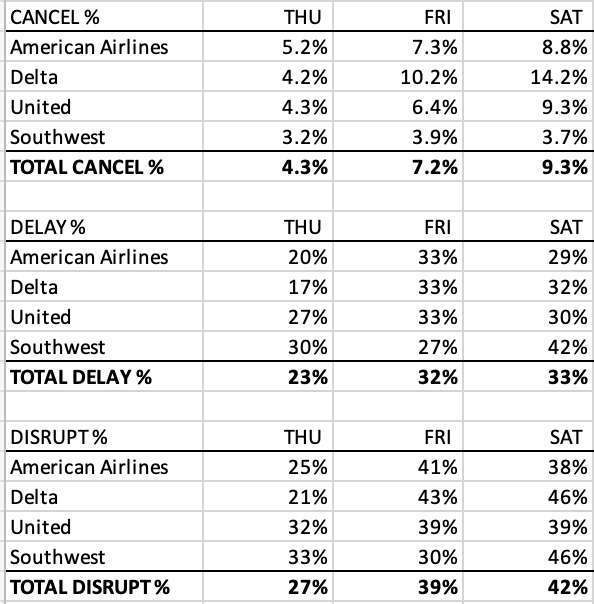
Major 4 carriers just crossed 2,000 flights cancelled (9%) and 7,000 delayed (33%) today.
Total 42% disrupted.
AA 38%
DL 46%
UA 39%
WN 46%
Will definitely hit 50% today.
Delta has canceled a staggering 14%. WN only 3.7% – but eventually their time will run out.
Big week for @0xIntuition.
At the core is the $TRUST token, which powers this market for verifiable information — the foundation of a new category called Information Finance (InfoFi).
$TRUST turns information into an asset class, enabling anyone (human or AI) to publish, verify, and exchange knowledge under economic consensus.
Monthly transaction count for Ethereum L1 & L2s.
L2s expand @ethereum's reach & network effect.
The combined throughput of the L1 & L2s is at an all-time high, with ~800m transactions processed in October.
@ethereum hosts the majority of stable coins, real world assets, developers, and institutions. https://t.co/KW4XdRJEwh is a great resource for those looking to learn.
$ethm @TheEtherMachine
@ethereum ecosystem continues to be the largest magnet to software developers in the world for blockchain technology. Follow the developers and follow the money. @TheEtherMachine was created to explain this to Wall St and Main St.
🌐Jovay joins hands🤝 with @ethereum to build the next era of Layer 2.
This is not just a step into the Ethereum ecosystem — it’s the beginning of a broader future.✨
Let’s build the next chapter together!
#Ethereum#Layer2#Jovay#RWA#Web3