THE LIE OF 'RENEWABLE' ENERGY
Oct 9, 2026 · Jonathan Cohler
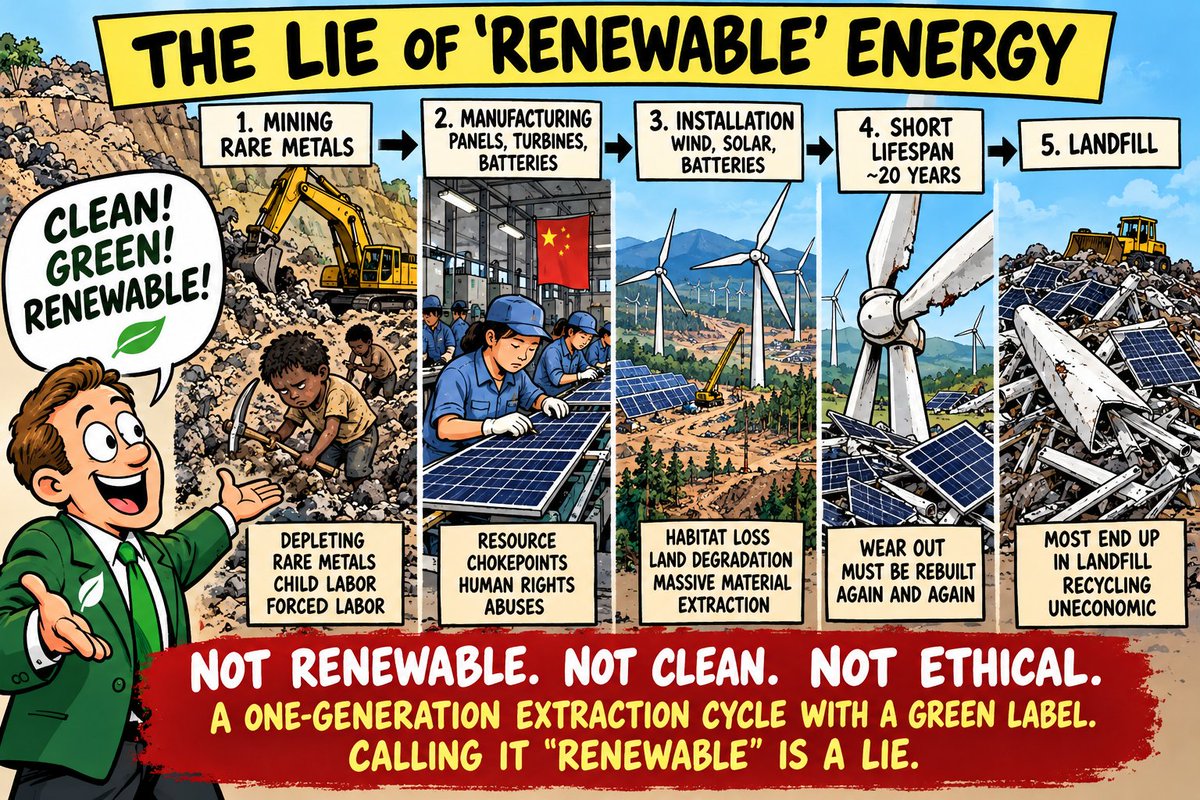
They are not 'renewable.' The materials run out fast. The supply chains run on child labor and forced labor. The equipment runs on fossil fuels. The whole system is a one-generation extraction cycle with a green label slapped on top. Calling it 'renewable' is a lie.
Nothing about this is 'renewable.'
Nothing about this is 'clean.'
Nothing about this is 'ethical.'
Calling it any of these things is a lie.
INTRODUCTION
Say the word 'renewable' and a normal person hears 'this does not run out.' That is the lie.
The sunlight does not run out. The wind does not run out. The machines that catch them are made of metals, and the choke-point metals run out fast. Dysprosium, within this generation. Silver, meaningfully drawn down across several build cycles. Tellurium, already at a hard cap for the thin-film technology that uses it. Neodymium and lithium reserves are not immediately exhausted, but the Chinese separation and conversion chokepoints already bind the chain.
A big wind turbine needs a magnet. That magnet needs a metal called dysprosium. The world mines about 2,000 tons of dysprosium a year, roughly 87 percent from China and 11 percent from Myanmar. The separation step that turns ore into usable metal is almost entirely Chinese, and that choke point already governs global allocation. Studies put cumulative demand through 2050 at 176,000 to 318,000 tons, which crosses China's current stated dysprosium reserve somewhere between 2032 and 2049. Global reserves outside Myanmar sit around 800,000 tons in that literature; the whole stock is not drained, but the Chinese slice is. A separate China-demand study puts electric vehicle motors at 41 to 56 percent of cumulative dysprosium demand through 2050 and wind at 18 to 24 percent. EVs are the bigger pull.
A solar panel needs silver. One big push to replace power plants with solar uses up roughly a fifth of the known silver reserves. The panels wear out in 25 years and have to be built again. Thrifting and recycling stretch the supply. At the stated buildout the silver draw is still a serious fraction of global reserves across several decades of maintenance.
One kind of thin solar panel uses a metal called tellurium. The world only produces enough tellurium each year to make a tiny slice of the solar panels being built. That kind of panel cannot scale. Full stop.
A share of Congo's cobalt is dug out by hand in artisanal pits. The artisanal fraction of Congolese supply has fallen from about 20 percent in the mid-2010s to a few percent today, but it is where the child labor sits. UNICEF estimated in 2014 that about 40,000 children worked in all mines across southern Congo. A 2024 Congolese government report identified 16,845 children specifically in the cobalt chain between 2019 and 2022, most between 12 and 17. People die in collapsed pits. Amnesty International, the BBC, the Washington Post, and NBC have all documented it.
China produced about 93 percent of the world's polysilicon in 2024. Xinjiang's share of world polysilicon output has run from the mid-20s to about 45 percent depending on year. Forced labor of Uyghur Muslims in Xinjiang's polysilicon production is documented by the US government, the UK government, Sheffield Hallam University, and the Associated Press, and triggers US import restrictions under the UFLPA.
When the turbines wear out in 20 years, the blades mostly get buried in US landfills. Europe runs them through cement kilns, where the glass becomes raw material and the resin burns as kiln fuel. The panels get crushed; most go to landfill because recycling costs more than the recovered material is worth. The batteries get thrown out at low recycling rates.
The sunlight is free. The wind is free. The machinery is a strip mine with a 20-year expiration date, drawing on a cobalt supply chain with a small but documented artisanal fraction worked in part by children, shipped on diesel freighters, and dumped in a hole.
The numbers behind the TRUTH
For anyone who wants to check the math. Mining and reserve figures from USGS, buildout figures from IEA, dysprosium demand scenarios from the published 2022-to-2050 cumulative-demand paper and a separate China-demand study, cobalt supply breakdown from the Cobalt Institute, labor figures from UNICEF, Amnesty International, and the Congolese government's 2024 cobalt-chain report, polysilicon figures from Bernreuter Research and Sheffield Hallam University, forced-labor findings from the US (UFLPA) and UK government.
THE METALS
Neodymium. World rare earth oxide mine output was about 390,000 tons in 2024. Praseodymium-neodymium oxide supply was roughly 90,000 tons, approximately balanced with magnet demand. Nd oxide prices fell from about $134/kg in 2022 to about $56/kg in 2024. The constraint shows up at scale and by turbine type: direct-drive permanent-magnet turbines use roughly 180 kg Nd/MW; geared turbines use 12 to 50 kg/MW. Most onshore wind is geared. The pressure point is scaled offshore direct-drive, plus EV motors (the larger growth term), plus electronics, plus defense, all drawing on the same stream. Refining and separation of neodymium is almost entirely controlled by China.
Dysprosium. Production is roughly 1,000 to 2,000 tons a year. Over 1988 to 2021 the mine split was about 87 percent China and 11 percent Myanmar; separation is near-total Chinese control. Dy is a small fraction of rare earth deposits and the heavy rare earth that gives NdFeB magnets their high-temperature performance for offshore service. The 2022-to-2050 cumulative demand range of 176,000 to 318,000 tons crosses China's current stated dysprosium reserve in 2032, 2034, 2038, or 2040 under the static case, moving to 2038 to 2049 if that reserve grows at 2 percent a year. USGS does not publish a dysprosium reserve; the Chinese figure comes from the referenced literature. Global reserves outside Myanmar sit around 800,000 tons in that same literature; the cumulative range does not drain that stock, but it does drain the Chinese share. A separate study of China's own dysprosium demand puts electric vehicles at 41 to 56 percent of cumulative demand and wind at 18 to 24 percent. Dy-reduced and Dy-free magnet research exists; it is not yet the volume product.
Terbium. About 400 tons a year of production. Loadings in magnets are a fraction of Dy loadings. Not a one-buildout exhaustion story, but another concentrated supply with no non-Chinese refining at scale.
What binds first. Dysprosium at scaled EV motor and permanent-magnet wind production is the first heavy rare earth to bind hard. Cumulative demand to 2050 crosses China's current stated dysprosium reserve in the 2032-to-2040 window under the static-reserve case, moving to 2038-to-2049 if that reserve grows at 2 percent a year, if magnet chemistries stay Dy-rich. Global reserves outside Myanmar (~800,000 tons) are not drained by that cumulative range, but the China-concentrated share is. Terbium is a concentrated supply with no non-Chinese refining at scale; lower loadings than dysprosium mean a longer exhaustion timeline, and the geopolitical dependency is identical. Neodymium reserves are not immediately exhausted, but the Chinese refining chokepoint can close overnight, and reserves held in uneconomic grades do not substitute for refined metal on any useful timescale.
SOLAR
Silver. Crystalline silicon cells use about 10 tons of silver per gigawatt, down from about 50 tons/GW roughly fifteen years ago through aggressive thrifting. World silver mine production was 25,300 tons in 2024. USGS reserves are 610,000 tons. Photovoltaics took roughly 6,000 tons in 2024, around a quarter of mine output. A 12,400 GW scaled buildout at 10 tons/GW requires about 124,000 tons of silver, roughly a fifth of known reserves. One buildout. Then rebuild every 25 years. Compounded against industrial, electronics, and jewelry demand, the pressure is real; the reserves are not immediately exhausted.
Tellurium. Cadmium telluride thin film is roughly 5 percent of the module market. Modern CdTe cells use about 15 tons Te/GW. World refinery output is around 1,000 tons a year, already a hard cap on how much CdTe can be built annually. CdTe cannot scale to carry the whole market.
Indium. Byproduct of zinc refining with roughly 900 tons a year of output. A constraint on CIGS thin film and on transparent conductors, not on the dominant silicon PV path.
Polysilicon. Not a scarcity problem. An energy problem (silicon purification is coal-fired in Xinjiang) and a labor problem (documented forced labor in that same region). Covered below.
Copper, Aluminum, and the Grid
The IEA figure of about 80 million kilometers of new transmission and distribution by 2040 is real. High-voltage overhead transmission conductors are predominantly aluminum (ACSR, AAC, AAAC). Copper dominates in distribution cabling, generator windings, EV motors, and building wiring. USGS copper reserves are about 980 million tons; mine production was about 23 million tons a year in 2024 and 2025.
Ore grades have fallen over the last century. Industry shorthand puts the drop from about 2 percent copper in 1900 to about 0.5 percent today; this is a sector-wide approximation, not a USGS global time series, and the decline is real but uneven across deposits. Lower grade means more rock, more diesel, more water, and more energy per ton. The scaling cost of continued extraction is where the system actually binds, not a single reserve-exhaustion number.
STORAGE
The wind does not blow all the time. The sun sets every night. Any intermittent-generation system needs firming.
Lithium mine production reached about 222,000 tons in 2024 and an estimated 290,000 tons in 2025. USGS reserves are around 37 million tons. The resource is not immediately scarce. The pressure is on refining, cell manufacturing, and the pace of capacity growth.
Backing one day of US electricity (about 11 TWh) entirely with lithium-ion batteries is impractical. That is a design choice. Pumped hydro, long-duration flow batteries, compressed air, hydrogen, and massive overbuild with curtailment are the alternatives. Each carries its own materials bill and its own siting problem. A grid-scale firming solution matched to a wind-and-solar-dominant system at full load, through winter and dark weeks, at any defensible cost, does not exist today.
THE CHILDREN
More than 70 percent of the world's cobalt comes from the Democratic Republic of Congo. The artisanal share of Congolese production has fallen from about 20 percent in the mid-2010s to a few percent today, but it is where the child labor sits. Children work in unregulated pits with no safety gear and die in collapsed workings for a few dollars a day.
UNICEF's 2014 estimate counted about 40,000 children working in all mines across southern Congo, not cobalt alone. A 2024 Congolese government report identified 16,845 children specifically in the cobalt chain from 2019 to 2022, most between the ages of 12 and 17. Amnesty International, the Washington Post, Sky News, the BBC, and NBC have documented the artisanal cobalt labor conditions. Siddharth Kara's 2023 book Cobalt Red lays out the artisanal system in detail.
The cobalt goes to trading houses, then to Chinese refineries, then into the batteries that power electric cars and store wind and solar electricity. Industrial Congolese cobalt and artisanal cobalt enter the same refining chain. Chain-of-custody auditing has improved but cannot fully segregate the artisanal fraction once it enters the mixed smelter stream.
China produced about 93 percent of the world's polysilicon in 2024. Xinjiang's share of world polysilicon output has run from the mid-20s to about 45 percent depending on year. Documented forced labor of Uyghur Muslims in Xinjiang's polysilicon production has been confirmed by the US government (UFLPA), the UK government, Sheffield Hallam University, and the Associated Press. Panels built with Xinjiang polysilicon are blocked at US borders unless importers can prove otherwise.
Lithium in the Atacama Desert is drawn as brine at rates documented to lower water tables and depress freshwater availability for indigenous Atacameño communities who have farmed that land for a thousand years. The water conflict is real and the communities are losing ground. The lithium goes to batteries.
Nickel in Indonesia and the Philippines is clearing rainforest and running rivers red with laterite tailings. Workers die in refineries that would not pass a safety inspection anywhere in the West.
Rare earth mining in Baotou, Inner Mongolia has produced a radioactive sludge lake miles across. Farmers downwind report elevated cancer rates. Livestock die. Crops fail. Baotou (the Bayan Obo deposit) is the main source of light rare earths including neodymium. The heavy rare earths that permanent-magnet offshore wind depends on, dysprosium and terbium, come from southern Chinese ionic clay deposits and from Myanmar, with their own documented environmental harms.
The industry is built on this. Not as an unfortunate side effect. As a structural dependency. Separated dysprosium and terbium at volume have no non-Chinese substitute at current prices and current refining capacity; Lynas has begun separated heavy-REE output but at tons per quarter, not at scale. Polysilicon has non-Xinjiang alternatives, both non-Xinjiang Chinese capacity and non-Chinese capacity (Wacker and others), and the market is adjusting under US import restrictions, though Xinjiang still carries a large share. Cobalt has partial alternatives (Indonesia supplied about 14 percent of mined cobalt in 2025), but the artisanal Congolese stream still enters the same mixed refining chain.
THE WASTE
Solar panels last 25 years. Wind turbine blades last 20 years. Lithium batteries last 10 to 15 years.
Wind blades are fiberglass and epoxy and cannot be melted down. US practice is landfill: blades are cut with diamond saws and buried in enormous landfills in Wyoming, Iowa, Texas, and elsewhere. Europe has moved to commercial cement-kiln co-processing, where the glass becomes raw material and the resin burns as kiln fuel. China's Solid Waste Law bans landfilling blade composites; the modeled routes are incineration, cement-kiln co-processing, pyrolysis, and mechanical recycling, but recycling capacity is still underdeveloped and not industrialized.
Crystalline silicon panels contain lead in their solder and connectors. Cadmium telluride panels contain cadmium. For most panels the recycling cost exceeds the value of recovered materials. Most get crushed and landfilled, and the toxins can leach into soil.
Less than 5 percent of consumer lithium batteries get recycled. EV pack recycling rates are higher where infrastructure exists, but still far from closed-loop. In 20 years the first wave of this equipment is waste. In 40 years the second wave. The piles of debris are already starting to appear.
The Supreme Court of Canada said: “Permitting an effective voice for unpopular and minority views—views political parties may not embrace—is essential to deliberative democracy. The goal should be to bring the views of all citizens into the political arena for consideration, be they accepted or rejected at the end of the day. Free speech in the public square may not be curtailed merely because one might find the message unappetizing or the messenger distasteful.”
Think about what that means.
Unpopular and minority views are not inconveniences that democracy must merely tolerate. They are essential to democracy itself.
That does not mean every idea must be accepted. Ideas may be challenged or rejected. But citizens must be permitted to raise them, and their arguments should be answered on their merits.
Freedom of expression is easy to defend when the speaker is popular, the message is comfortable and everyone in the room agrees. Its real value is revealed when the message is difficult, the speaker is disliked and the opinion challenges those who hold power.
The judges also addressed the right to persuade:
“The ability to engage in effective speech in the public square means nothing if it does not include the ability to attempt to persuade one’s fellow citizens through debate and discussion.”
In other words, meaningful political expression is not permission to speak quietly among people who already agree with you. It is the ability to enter the public square, question prevailing beliefs, advocate for change and attempt to persuade others.
Canadians pay some of the highest cell-phone prices in the world. And in return, we get some of the worst customer service.
Prediction: Canada's cell phone monopolists will convince Mark Carney to ban this competition, "in the name of telephone sovereignty".
I'm a Canadian who travels, works and vacations in the U.S. because I recognize that 98% of Canada's problems are self inflicted and existed long before Trump and his administration.
It's actually nice going there to get a break from hearing about Trump 24/7. 🤷🏻♀️
Also, it's close and it's warm. ☀️
@FoodProfessor Canada has fallen with poor management of Carney
Even with low dollar with Carney it's still cheaper to buy American food that is if you can even afford to eat.
35% are getting turned away at food banks because there is so many.
A Canadian woman with a prior fraud finding cleared vetting for NATO headquarters — only to later be arrested on espionage allegations.
Public Safety Minister Gary Anandasangaree admits Canada's screening system needs work.
https://t.co/FKS356cNpV
🚨 BREAKING NEWS 🚨
Liberals just DEFEATED a Conservative motion calling for the recovery of $34 MILLION in taxpayer money paid to ineligible Green Slush Fund projects.
After repeatedly trying to silence Conservatives at committee, instead of addressing our motion the Liberals voted to SHUT DOWN the meeting.
$34 MILLION of YOUR money.
Conservatives demanded it back. Liberals voted NO.
“Higher taxes will not reduce the deficit, except for a brief interval. They will simply increase government spending. That is the lesson taught by past experiences.”
— Milton Friedman
Washington man charged in Tumbler Ridge massacre plot. FBI filing shows guns decorated in trans-flag colors.
Federal prosecutors say James Cody Bryant, 30, of Bellingham spent months on Discord helping the Tumbler Ridge shooter plan the February massacre. He allegedly gave tactical advice, sent money, agreed to rebroadcast a livestream, and promised not to “snitch.”
Photos in the filing show the shooter’s guns decorated in trans-flag colors. This news was hidden by Canadian authorities.
Both are males who identify as female.
https://t.co/Bzld4AX9mD
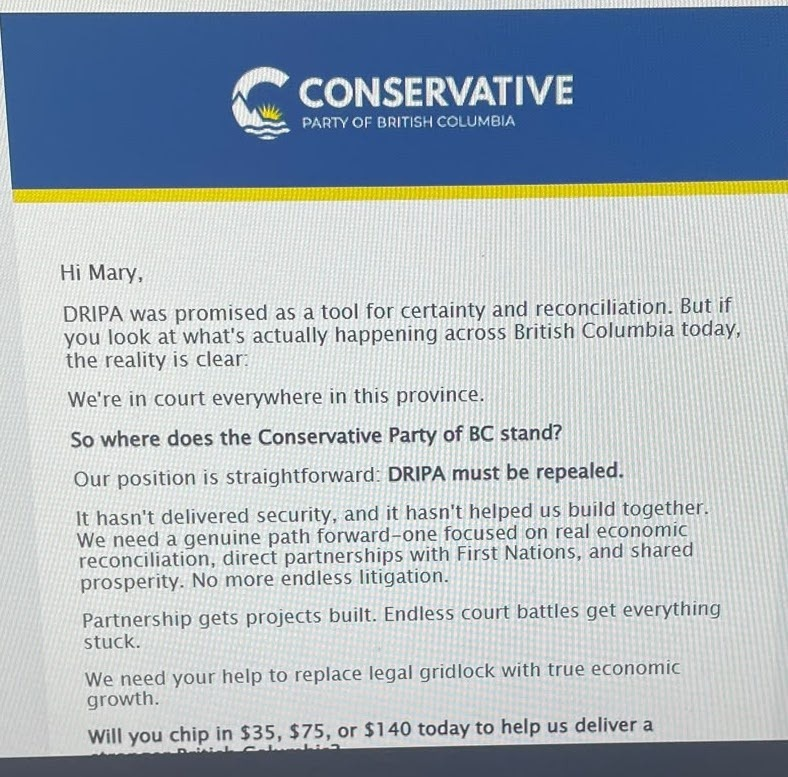
Just days ago, when they were sending their flyers to print, the BC Conservative party made no mention of DRIPA. Not a word.
After immense pressure from @One_BCHQ, suddenly the BCCons promise to repeal DRIPA. This is why OneBC must be in the Legislature.
Without us, BCCons will out-NDP the NDP.
Milton, Ontario:
A mayoral candidate forum was held last Saturday at the Muslim Association of Milton. The event was advertised as “all are welcome” but non-Muslims who attended were surprised when they were told they had to move seats. Seating was segregated by gender in accordance with Sharia Law even though the meeting was held outside of the temple and open to the public.
I'm sorry, but no. I wouldn’t have wanted these people anywhere near my kids when they were in school. "Anti-Palestinian racism" teaches that Zionism is racism. It's Judenstaatrein, a mutation of Judenrein, and my parents' generation killed Nazis. So, no thanks.
@AndrewLawton@TamaraJansenMP What did you expect? Why are there 0 lawsuits in 11yrs?
#feckless
The Fraser Health Authority took over the Irene Thomas Hospice in Delta, British Columbia, because the Delta Hospice Society refused to provide Medical Assistance in Dying (MAiD). https://t.co/jrnqr62FJl