🚨US MARGIN DEBT IS FLASHING A WARNING:
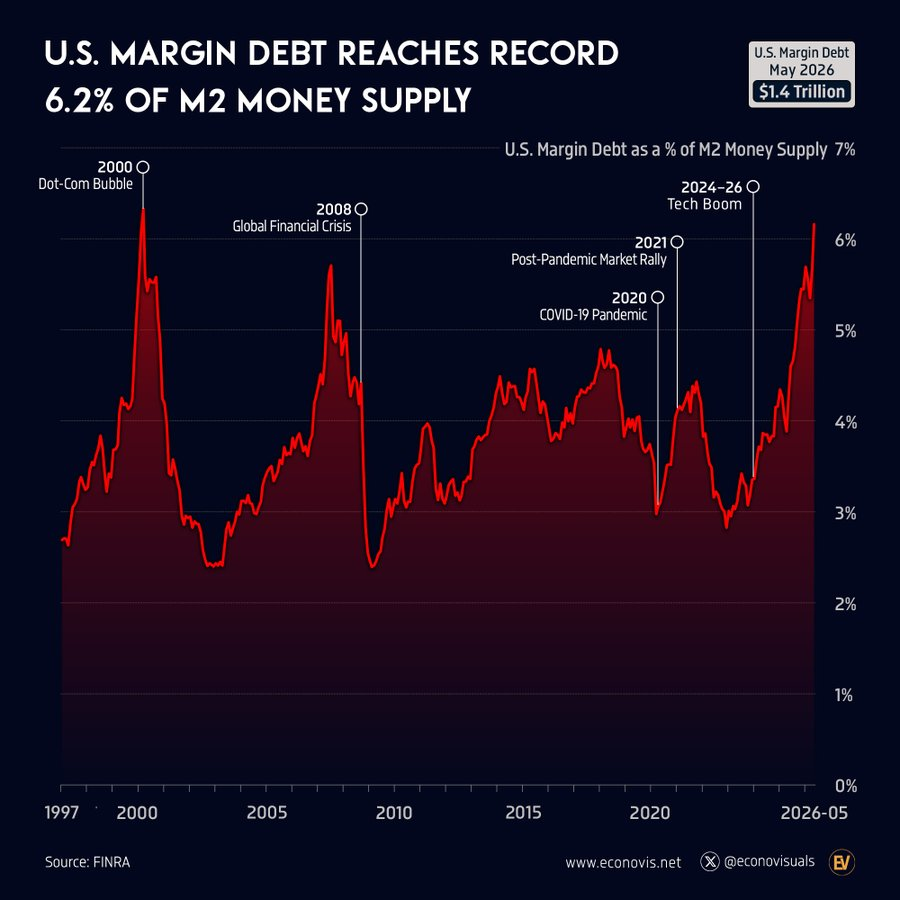
US margin debt as a share of M2 money supply spiked to 6.2% in May.
This is just shy of the all-time record of 6.3%, set at the height of the 2000 Dot-Com bubble peak.
Total margin debt now stands at $1.4 trillion, an all-time high in dollar terms.
Historically, spikes in margin debt relative to money supply have preceded major market tops.
Margin debt peaked in March 2000, just months before the Dot-Com collapse, and again in July 2007, 3 months before the S&P 500 topped out ahead of the Financial Crisis.
Most recently, it peaked in October 2021, 2 months before the S&P 500's December 2021 high, preceding a -25% drawdown through September 2022.
Will history repeat itself?
Everyone is explaining the crypto crash with the Fed, Iran and ETF outflows. Bitcoin is down roughly 48 percent from its October high near 126,000 and trades in the low 60,000s. All of that is true and all of it is macro. The more durable story is happening one layer down, in the buildings where Bitcoin is actually produced, and the cause is artificial intelligence.
Bitcoin mining was always an arbitrage on cheap electricity. You found stranded gas, curtailed hydro or surplus grid power, pointed machines at it, and minted a token whose value rested on a promise of future utility. The model worked because nobody else wanted those particular megawatts at that price. AI changed that. Training and inference want exactly what the miners wanted, power and land and cooling, and AI pays on the order of 1.5 million dollars per megawatt per year. Mining cannot come close at today’s prices.
So the miners are leaving. IREN, TeraWulf and Core Scientific each expect around 70 percent of revenue from AI by the end of this year, up from essentially zero in 2024. IREN signed a 9.7 billion dollar deal with Microsoft for 76,000 GPUs and now holds no Bitcoin at all, by choice. TeraWulf has locked in 12.8 billion dollars of contracted AI revenue. Core Scientific sold 175 million dollars of coins in March to fund the conversion. Network hashrate has fallen below 1 ZH/s as the machines go dark.
The market is voting with physics. Crypto burned enormous energy to produce an asset whose usefulness is still mostly speculative. AI consumes more, and grows far faster, to produce output the entire economy already pays for. Global data centers are heading from 485 terawatt hours this year toward 950 by 2030, with AI as the engine. The spare capacity that justified mining got repriced by a bidder with real, present, paying demand.
The miners understood this before the market did. They are selling their coins and becoming the disruptor.
Durante años aprendimos una regla simple:
Si baja el petróleo, bajan las tasas.
Esta semana ocurrió exactamente lo contrario.
¿Por qué un shock aparentemente desinflacionario terminó fortaleciendo al dólar, golpeando al oro y reforzando la expectativa de una Fed más dura?
El Mapa de hoy explica por qué el mercado podría haber entrado en un nuevo régimen.
El documento completo podés encontrarlo en Substack, suscribirte y contribuir a sostener este proyecto. Muchas gracias.
https://t.co/qfmCw3qZyz
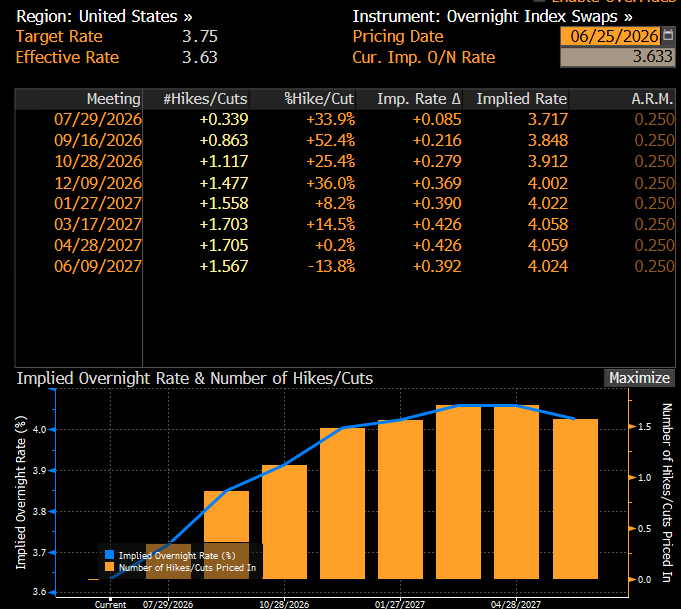
Despite the sharp fall in oil prices, the market is pricing in one and a half rate hikes by the Fed this year (Bloomberg data below). Meanwhile, several Fed watchers have revised up their rate expectations, with at least one opting for three (yes, three) hikes this morning.
On my end, I still think that the most likely outcome is no Fed hikes this year given not just the inflation outlook but also what is evolving on the supply side, as well as the likelihood of a transition at the Fed from excessive data dependence to a more forward-looking approach.
#economy #markets #federalreserve
Bryson DeChambeau is using Google Gemini (AI) to try and help fix his swing.
"I spent some long hours on the range trying to figure some stuff out and I was talking to AI quite a bit last night trying to go through some different physics principles that makes the club turn over, having some alpha torque and gamma torque put in there. I was like, what makes that possibly do that, and was talking about just grip pressure and tension."
Thoughts? 🤔
Whitney Tilson: "I think SpaceX will fall 70% from its opening-day close.
It's shaping up to be one of the most overhyped, overvalued large-cap IPOs of all time. The numbers are absurd... SpaceX looks set to trade near 100x revenue, with 15% top-line growth last quarter and accelerating losses.
When things are this obvious, making a "big call" like this is easy..."
Ed Yardeni on CNBC: Expects S&P 500 to reach 8250 this year (+10% from current level of 7475) and 10,000 by end of decade (+34% from current level over 3 1/2 years or +9% annualized). Technology including AI is increasing productivity which will lead to lower inflation, higher profits and higher wages. This market is being driven by FEMO (Fabulous Earnings MOmentum).
JPMorgan's CEO Jamie Dimon just said a financial crisis is coming.
Bond yields just hit historic levels in the US, UK, Germany, and Japan simultaneously.
The last time this happened was right before the 2008 financial crisis.
And Dimon just confirmed that $5 to $6 TRILLION in leveraged loans are sitting out there right now and the companies holding that debt are going to have a very hard time refinancing at current rates.
The equity values of those companies would be "considerably less" and a lot of those borrowers didn't hedge for higher rates.
Then he said he personally would NOT buy credit spreads at these levels.
The CEO of the largest bank in America just told you he thinks corporate debt is mispriced and he would not touch it with his own money.
Then the interviewer asked about AI and everyone forgot he said it.
Jamie Dimon warns about a recession every single year but this is the first year where the numbers are actually proving him RIGHT:
3 days ago the 30-year Treasury yield hit 5.2%, the highest since 2007. The 10-year is sitting at 4.62%.
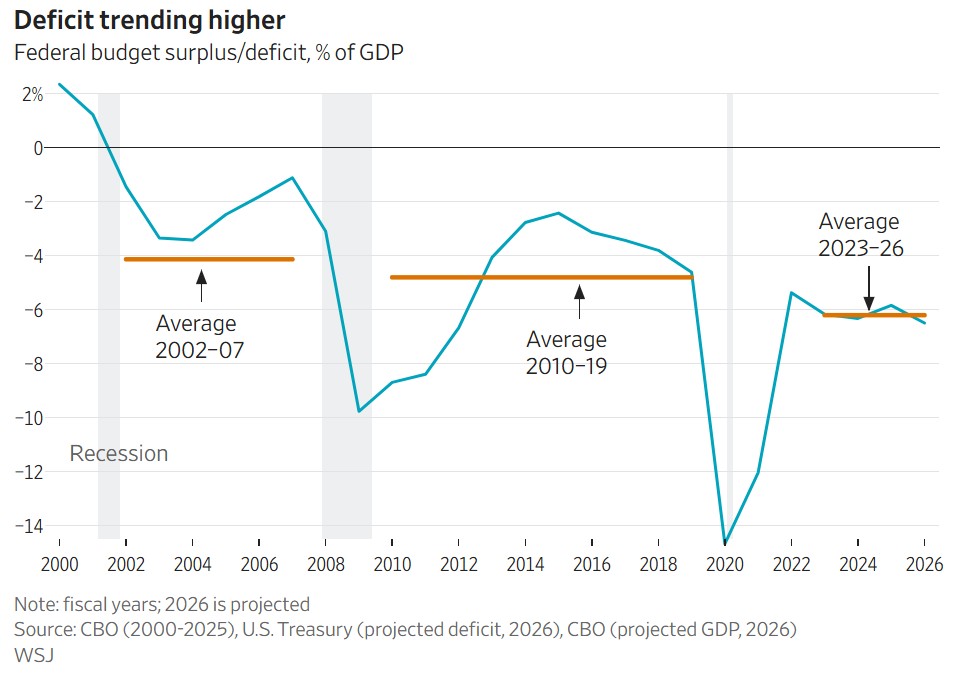
The US government has $31 trillion in public debt and the average interest rate on that debt is 3.5%.
They cannot refinance a single dollar of it at a lower rate than what they are currently paying. And they have $9.7 trillion in securities maturing THIS YEAR that needs to be rolled over.
Meanwhile the new Fed Chairman Kevin Warsh was just sworn in on Friday. Traders are now betting there will be ZERO rate cuts for the rest of 2026 and the probability of a rate HIKE is rising.
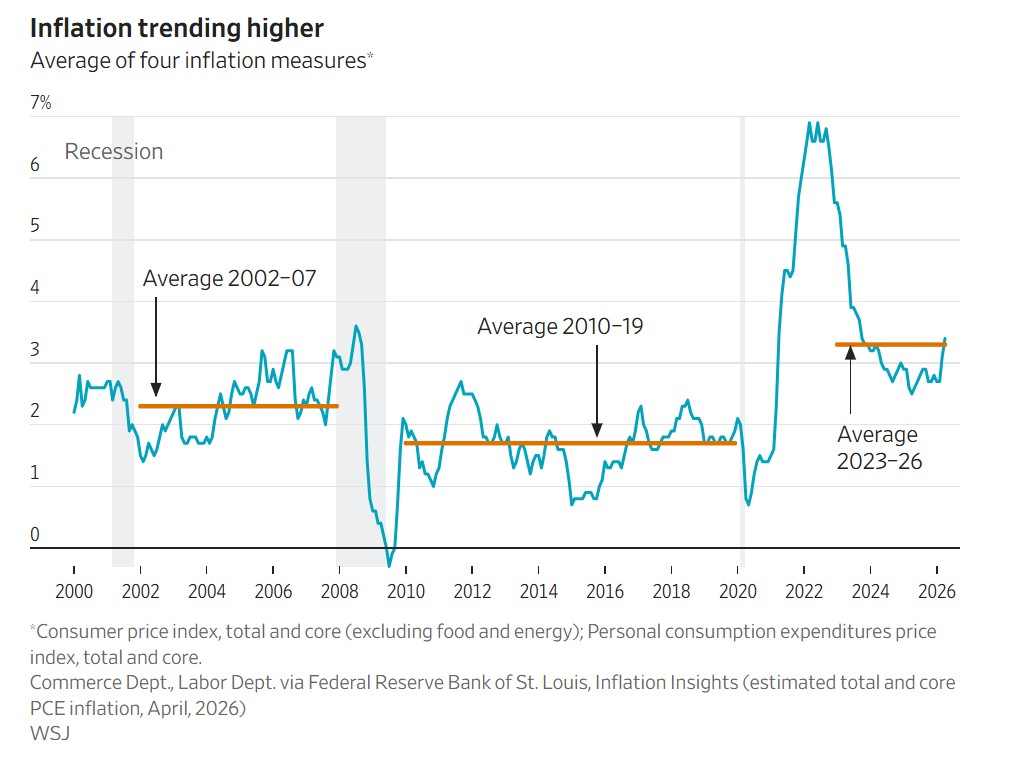
The Iran war has pushed oil to four-year highs. Inflation reaccelerated in April to the highest annual rate in three years. And private credit defaults just hit a record high with a 9.2% default rate in their US private credit portfolio.
Dimon laid out exactly how this plays out:
He said sentiment can flip overnight and specifically named the crashes of 1973, 1982, 1994, and 2000 and said the setup before each one looked exactly like this.
Everyone confident, everyone buying, liquidity everywhere. Then something shifts and people want cash. And when people want cash they sell risky assets at precisely the wrong time.
Liquidity disappears at the exact moment everyone needs it.
And he also told you where the money is going:
JPMorgan had 35,000 employees in New York when he took over. Now it has 26,000.
Texas went from 12,000 to 33,000.
He said in the 1970s, New York had 120 Fortune 500 companies. 60 of them left in a single decade because of taxes and crime.
And when the interviewer asked about the new NYC mayor raising taxes on the wealthy, Dimon basically told him to his face that the erosion has already started. The capital is already leaving.
So let's put this together:
- Bond yields at 19-year highs
- $9.7 trillion in government debt to refinance this year
- $5-6 trillion in leveraged corporate loans that cannot refinance at these rates
- Private credit defaults at record levels
- Inflation reaccelerating
- No rate cuts coming
- A Fed chairman who hasn't even settled into the chair yet
- The CEO of America's biggest bank saying he would not buy corporate debt at current prices
- And the same CEO quietly moving his bank out of New York
Every single one of these signals was present before the crashes Dimon himself named.
From the @WSJ article, "The Dangerous Brew That’s Rattling Bond Markets: A mix of debt, inflation and populism has changed the interest rate landscape since 2020."
#economy#bonds#debt#inflation#markets
Ed Yardeni: "The government just took equity stakes in quantum computing companies. S&P 500 earnings growth expectations hit an all-time high. Insiders are buying at triple the normal rate."