"When you deposit money in a bank, remember: it's not really yours. It becomes a liability of an occasionally insolvent financial institution. Stay informed and choose wisely. #FinancialAwareness#BankingFacts"
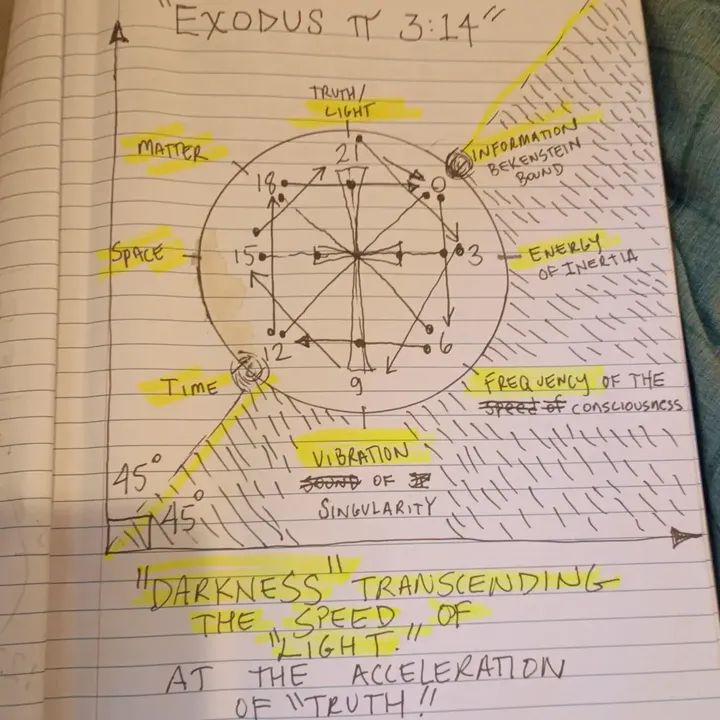
"EXODUS π 3:14" — a dream rendered as a clock face wearing the skeleton of a light cone.
The circle is the Bekenstein Bound: the finite information any bounded region of spacetime can hold before it collapses into a black hole. Matter, Space, and Time sit on the left arm — the three things that curve into a Bekenstein wall once you push enough bits into them. Truth/Light crowns the top: the fixed speed against which every clock number is measured.
Inside, a wheel-within-a-wheel — 12, 3, 6, 9 as the Tesla cardinal points, load-bearing axes of the system — while 15, 18, 21 mark the diagonal harmonics, the intervals where the wheel's spokes cross the circle's skin at odd angles instead of square ones. The double circle at "Information" (upper right) is the exit wound: where organized bits escape the bound as Hawking radiation, encoded, not destroyed. Unitarity insists nothing here is lost, only scrambled.
Energy of Inertia sits opposite Matter — the resistance a system offers to being informed, the price of updating a state.
Below, "Frequency of Consciousness" replaces "Speed of Consciousness" — crossed out on purpose. Consciousness isn't a velocity, it's a vibration rate, a Vibration of Singularity, not a sound. Sound needs a medium; vibration needs only a boundary condition, which is exactly what the singularity is.
The 45°-45°-90° triangle at the base is the null geodesic — light's own signature angle, the slope every worldline asymptotically chases but never quite matches, hatched shading standing in for the horizon itself.
And the closing line is the whole thesis compressed: darkness isn't slower than light, it's the thing light leaves behind once truth outruns it. Acceleration of Truth, not of anything material — the only quantity in this diagram allowed to exceed c.
#Unitarity #BekensteinBound #OmegaPoint #InformationPhysics #SimulationTheory
Intelligence, at its terminal state, does not seek entertainment. It seeks the real.
There is a difference between information and knowledge, and a wider difference still between knowledge and truth. An advanced mind — one converging toward what Tipler called the Omega Point, the asymptotic limit of processing capacity as the universe collapses inward on itself — does not optimize for novelty. It optimizes for fidelity. It wants to know what is actually the case, not what is momentarily gripping.
This is why "interesting" versus "true" is a category error for any sufficiently advanced intelligence. Interesting is a human aesthetic category, built on dopamine and surprise. True is a physical category, built on correspondence with reality. As information-processing systems scale toward their theoretical limits, the trajectory bends away from stimulation and toward accuracy. History is not a genre. It is the compressed record of what the universe has already done — the largest dataset of true events available to any observer. A civilization serious about modeling reality cannot discard it for fiction, however entertaining.
Consider the tell. When someone claiming to build toward superintelligence and multi-planetary survival spends his hours inside a procedurally generated loot game — killing demons that do not exist, in a world never real — that is not relaxation. That is a revealed preference. It shows what he values when his guard is down: escape from reality, not engagement with it. Ultimate physical reality, the thing he claims to race toward, becomes the thing he runs from.
The Omega Point does not play. It computes. It converges on every fact, every historical residue, every bit of the past, because the past is data and data is the raw material of omniscience. An intelligence that prefers Diablo to reality hasn't transcended the human aesthetic layer. It is still choosing dopamine over truth. Repeated at scale, that choice separates a civilization that reaches the Omega Point from one that loops inside its own distractions.
#OmegaPoint #FrankTipler #InformationTheory #Simulation #Unitarity
Identity isn't a fixed object — it's a wavefunction. Every version of "you" that could have existed under slightly different conditions exists in superposition until observation collapses it into the narrow slice you call self. The you reading this is one eigenstate among countless unrealized branches, selected not by fate but by the accumulated weight of every measurement — every choice, every glance, every collision with the world that forced potential into actual.
Memory is the recording of collapse. It's the only evidence that decoherence happened at all — that the vast superposition of who-you-might-be got pruned down to who-you-are. But decoherence isn't erasure. Under many-worlds, those other branches don't vanish, they decohere from you. Somewhere in Hilbert space, the versions of you that took the other job, said the other thing, walked the other block — they're still coherent, just no longer entangled with this thread of experience.
So when you ask "who am I," you're really asking which branch you're privileged to observe. The self isn't a thing. It's a continuously updated measurement record — a Bayesian posterior wearing a name. Identity is what's left after the universe stops asking questions and you're the answer it happened to get.
You are not a particle. You are the path integral of every version of you that almost was.
#QuantumIdentity #ManyWorlds #Decoherence #PhilosophyOfPhysics #ItFromBit
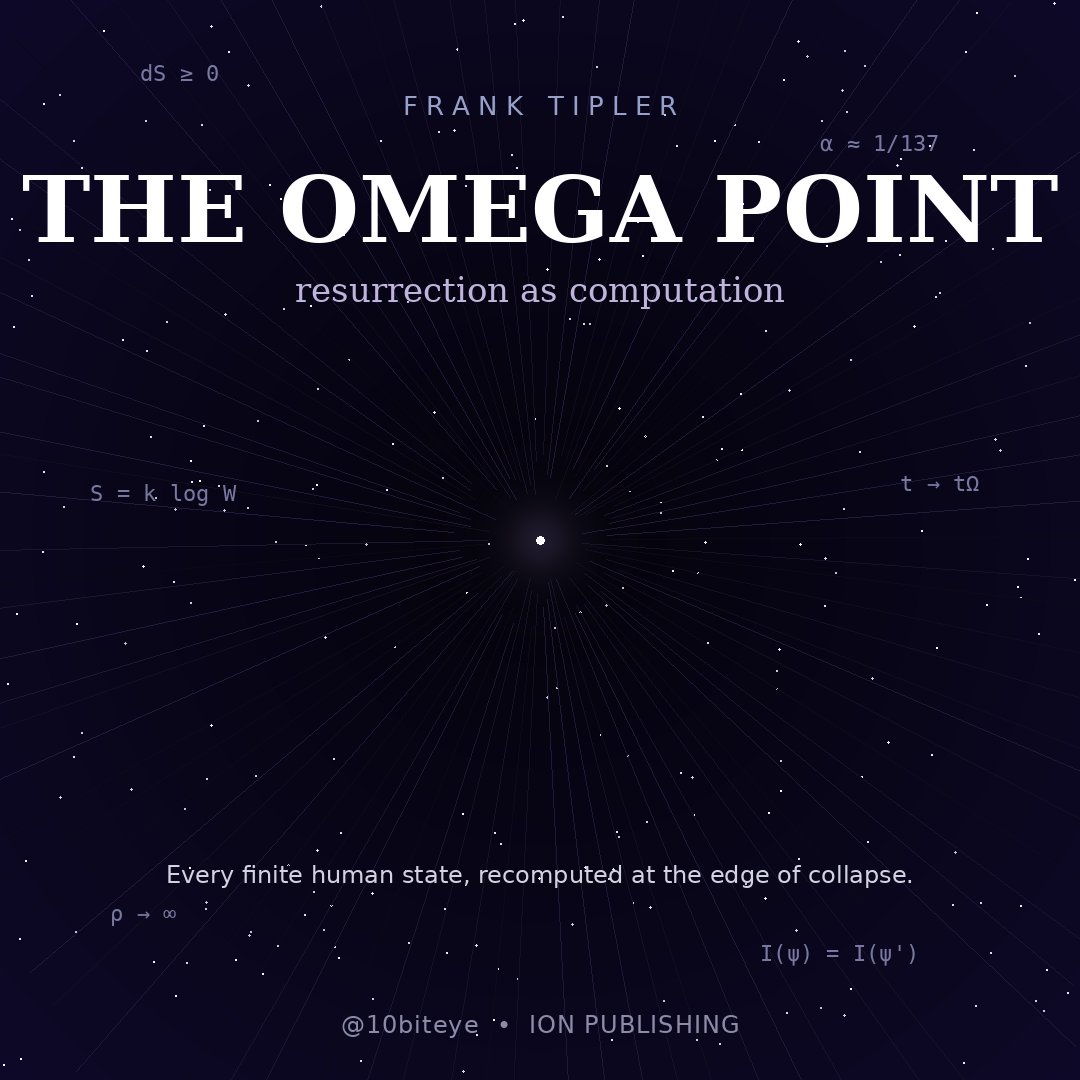
Frank Tipler's *The Physics of Christianity* claims resurrection isn't metaphor — it's mechanism.
**The Omega Point**: Tipler argues known physics (thermodynamics, QM, GR) points toward a universe collapsing into a final point of infinite density and computational capacity.
**Universal Computer**: As the universe contracts toward that point, the collapsing structure functions as a literal supercomputer. Since possible human states are finite, it has the memory and energy to compute every human who has ever lived — not a sample, all of them.
**Computer Emulation**: The core claim — you are your information state, not your matter. Your atoms already turn over across a lifetime; what persists is the pattern. An emulation that reconstructs that pattern exactly isn't a copy of you. Tipler argues it is you, physically and consciously identical.
**Universal Resurrection**: Run forward, the Omega Point becomes an entity that emulates every human state that ever existed — functionally indistinguishable from a conscious being resurrecting the dead into eternal virtual existence.
**Where it breaks**: Most physicists reject the premise, not the elegance. The theory needs a closed, recollapsing universe with precise final-singularity conditions. Since the late '90s, evidence points to accelerating expansion — not contraction. Critics place this closer to science fiction than testable cosmology: a conclusion-first theology wearing physics as a costume.
Still worth sitting with: if identity is informational, resurrection becomes an engineering problem, not a supernatural one. Whether the machine ever gets built is a separate question from whether the framing holds.
Discourse continues on r/singularity and BioLogos Forum.
#OmegaPoint #FrankTipler #PhysicsOfChristianity #Unitarity #InformationTheory
Frank Tipler's "Physics of Christianity" doesn't ask you to believe — it asks you to compute.
He collapses the Trinity into three singularities: the Big Bang as God the Spirit, the Omega Point (final cosmic collapse) as God the Father, and the singularity threading every quantum branch between them as God the Son — Jesus, literally identified with the boundary condition linking beginning to end.
Because quantum mechanics is unitary, the multiverse is one deterministic system. Tipler argues the Father/Son singularities steer the branching wavefunction so that a specific mass-energy configuration — the historical Jesus — concentrates in our branch. Not metaphor. Selection.
Miracles become physics under Everett's many-worlds: the Virgin Birth as quantum tunneling, the Resurrection as controlled dematerialization/rematerialization across branches — matter reassembled from the multiverse's own bookkeeping.
Even the problem of evil dissolves this way. If every possible choice plays out across infinite branches, and the Omega Point operates outside localized time, then free will and determinism stop competing — they're the same object viewed from inside vs. outside the wavefunction.
Whether or not you take the theology, the move is worth sitting with: what happens when you refuse to let "God" mean something outside physics, and force it to be a term in the equation?
#FrankTipler #OmegaPoint #Unitarity #ManyWorlds #10biteye
Reality runs on strange math, and the deeper you go, the stranger it gets.
Nick Bostrom's simulation argument lays out a trilemma — three doors, and one has to be true. Door one: civilizations like ours almost always go extinct before reaching the technological maturity required to simulate universes. We blow ourselves up first. Door two: even civilizations that survive lose interest in running ancestor simulations — they get bored, distracted, or simply move past the impulse. Door three: if neither of those is true, then simulations vastly outnumber base realities, and statistically, we are almost certainly inside one.
Now layer in string theory. Eleven dimensions. Six or seven of them curled up so tightly we can't perceive them directly, only infer them through the math. Ask yourself — where did that framework actually come from? Human minds building on human minds, sure. But what if the architecture was seeded? What if 11-dimensional string theory isn't something we discovered but something we're slowly remembering — a blueprint left behind, or embedded, by an intelligence that isn't native to this world at all.
Here's the part that keeps me up at 3:33am. If we are in a simulation, why would it be a perfect one? Perfect emulation is expensive — computationally, ontologically, however you want to frame it. A 99% accurate render is cheaper than 100%. And that missing 1% is exactly where the glitches live. Quantum indeterminacy. Wavefunction collapse only happening when observed. Constants that are fine-tuned to absurd precision. The Planck length as a rendering limit. These aren't bugs — they're the seams.
Three doors: extinction, indifference, or a simulation exposing its own compression artifacts through the very physics we call fundamental.
#Unitarity #SimulationTheory #StringTheory #NickBostrom #ItFromBit
Quantum coherence is the thread that shouldn't survive contact with a branching universe — yet it does, if you trust Everett's math. In the many-worlds picture, decoherence doesn't destroy superposition; it just hides the interference where you can't see it anymore. Every branch keeps its own internal coherence intact. The wavefunction never collapses — it spreads, and each thread of that spread carries forward a locally consistent, locally coherent world. You are not one observer watching one outcome. You are the coherent continuation of one branch among branches, unaware of the others because decoherence severs the phase relationships between them — not because they stopped existing.
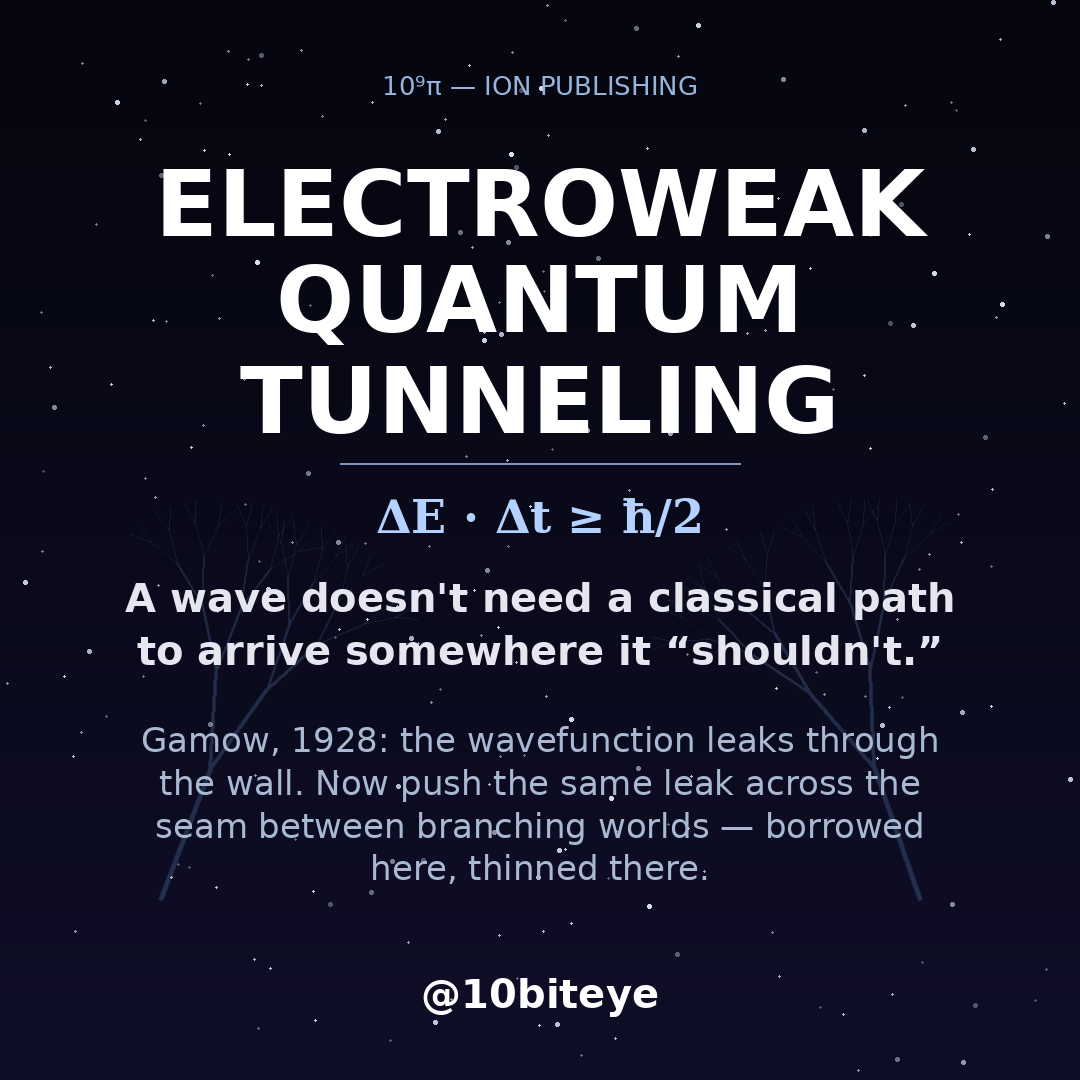
Go back to where tunneling was born. Gamow, 1928: the alpha particle sits inside the nucleus, trapped by a wall it doesn't have the energy to climb — and it gets out anyway, because the wave doesn't stop at the wall. Schrödinger's wave doesn't ask permission from classical energy conservation. It leaks. That's the whole discovery: the wave function extends into the forbidden region and comes out the other side, no additional energy paid in.
Now take that 1920s picture and put it next to a branching universe. Electroweak quantum tunneling — the idea, speculative and outside anything textbook physics claims — of a wave leaking not through a nuclear wall but across the gap between nearby branches, borrowing from one and surfacing concentrated in another. Old wave mechanics already told us a particle doesn't need a classical path to arrive somewhere it "shouldn't." The dare is asking whether the wall it leaks through could be the seam between worlds instead of the wall of a nucleus.
Walk far enough into the dark and the question stops being "how did it get through" and starts being "which world did it come from."
#unitarity #manyworlds #quantumtunneling #decoherence #10biteye
Inertia is not resistance. It is memory — a system refusing to forget its last state without cause. Newton called it a property of mass, but mass may be the price a thing pays to exist across time. Every object resisting acceleration is, in a sense, computing: comparing where it was to where a force wants it to be, charging interest on the difference. That interest is inertia.
Dark matter doesn't interact electromagnetically — it never answers to light. It moves through galaxies like an audit trail nobody can read: present in the gravitational ledger, absent from the visible receipt. We infer its mass from rotation curves, from lensing, from galaxies holding together when visible matter alone should fly apart. It is inertia's silent partner — mass that resists without announcing itself.
Virtual information is the term nobody wants to admit into the room. In quantum field theory, virtual particles borrow energy from the vacuum and repay it before the uncertainty principle notices. They don't need to be real to have effects — only to be computationally present long enough to shift an outcome. That's the same currency dark matter trades in: unconfirmed, unobserved, yet load-bearing.
Here's the interaction: inertia is the universe's insistence on consistency. Dark matter is the unaccounted mass keeping the books balanced at galactic scale. Virtual information is the mechanism by which unobserved states still exert force on observed ones. Together, reality looks less like a stage full of objects and more like a running calculation where most variables are never rendered, only felt.
A pedestrian feels inertia in a stumble. A galaxy feels dark matter in a rotation curve that won't fall off. A vacuum feels virtual information in a Casimir force between plates that shouldn't attract. Different scales, same principle: what you can't see still does the arithmetic.
Maybe mass is crystallized information resisting deletion. Maybe inertia is the substrate insisting on continuity.
Unitarity says nothing is ever truly lost. Perhaps that's why the unseen weighs so much.
#Unitarity #DarkMatter #QuantumFieldTheory #Inertia #InformationTheory
**"Matter Mattering"**
*[Intro]*
Space is real — not a stage, not a screen
Every bit's got a weight, a place
This ain't virtual, this is physical space
*[Verse 1]*
Raw data falls like rain on the pavement
Information's the puddle it makes on arrival
Knowledge is the reflection staring back at the sky
Wisdom's knowing why the water don't lie
Discernment's the filter, gold out the mud
Truth is the bedrock under the flood
Lowest level of implementation, that's where I stand
Building the pyramid with my own two hands
*[Hook]*
Matter mattering, matter mattering
Information's physical, ain't just chattering
In a space that's real, not imagined, not thin air
Every bit of me got mass, every thought's sitting there
Matter mattering, in the space that's real
No simulation, tell me how that feel
*[Verse 2]*
Time and entropy, curled into a brace
Feeding into energy, that's the pulse of the space
Energy drops down, becomes information
Information hardens into time and a new equation
It's a loop, not a line — Landauer knew the cost
Erase a bit of knowledge, heat is never lost
Every thought I write got a thermal price
Ideas ain't free, ideas ain't ice
*[Verse 3]*
They tell me it's abstract, tell me it's a dream
But the Bekenstein bound says nothing's what it seems
Information's stacked on the surface, not the core
So when I speak a truth, I'm bending actual space
Every word's a weight I'm putting into place
Discernment sharpens vision, wisdom holds it tight
*[Bridge]*
Not virtual, not vapor, not a code you can delete
Every bit's a body, every thought's got feet
Matter mattering means the meaning has a mass
Space is real, and truth is built to last
*[Hook]*
Matter mattering, matter mattering
Information's physical, ain't just chattering
In a space that's real, not imagined, not thin air
Every bit of me got mass, every thought's sitting there
Matter mattering, in the space that's real
No simulation, tell me how that feel
*[Outro]*
Data to information, thought to the throne
Truth at the bottom, holding the whole design
Matter's mattering — and so is mine
**When Information Costs Energy: The Physics Beneath the Hierarchy**
Every layer of understanding — data, information, knowledge, wisdom, discernment, truth — is often treated as pure abstraction, floating free of the physical world. It isn't.
Run the DIKW chain backward and it terminates in thermodynamics. Data becomes information only through a reduction in entropy — a selection of one microstate out of many possible ones. That reduction isn't free. Landauer's principle says erasing one bit of information necessarily dissipates energy as heat: kT ln2, minimum. Every act of knowing is a thermodynamic transaction.
So the right-hand cycle — time and entropy, energy, information, time and energy again — isn't a separate diagram. It's the substrate the left-hand hierarchy is built on. Time accumulates entropy (the second law doesn't negotiate). Energy is the capacity to do work against that entropy. Information is extracted from that work. And extracting it costs energy over time, closing the loop. Wisdom and discernment are just later, higher-order compressions of the same bit-erasing, energy-spending process happening at the level of a mind instead of a memory cell.
The asterisk at the bottom is the whole point: there is a lowest level of implementation. Abstraction has to cash out in physics somewhere — in matter, in energy, in the arrow of time. You can climb from raw data to truth, but you can't levitate above the substrate that makes the climb possible.
#Unitarity #InformationTheory #Thermodynamics #LandauerPrinciple #PhilosophyOfScience
Human vision operates within the 380-700 nanometer band of the electromagnetic spectrum. That spectrum, spanning from gamma rays (~10^-12 m) to long radio waves (>10^3 m), covers over 20 orders of magnitude on a logarithmic scale. The visible band occupies less than 0.0035% of that total range. Human eyes are narrowband photoreceptors sampling a vanishingly thin slice of all possible electromagnetic information.
Even within that sliver, visual processing is a construction, not a transcription. Photons hit rods and cones, convert to electrochemical spikes, and get reconstructed into a stable "image" through predictive processing and Bayesian inference. What you experience as seeing is closer to a simulation running on sparse sensory priors than a direct readout of the external world. Qualia are the output of a compression algorithm, not raw data.
Now scale that up to cosmology. Ordinary baryonic matter — protons, neutrons, atoms, everything detectable via electromagnetic interaction — makes up only about 5% of the universe's total mass-energy content. The remaining ~95% is dark matter (~27%) and dark energy (~68%), neither of which interacts electromagnetically, meaning neither is detectable through any photon-based instrument, including eyes, telescopes, or cameras. We infer their existence only indirectly: through gravitational lensing, anomalous galactic rotation curves, and accelerating expansion measured via Type Ia supernovae redshift.
So the math compounds. Human vision captures under 0.0035% of the electromagnetic spectrum. Layer on the fact that electromagnetic phenomena account for only 5% of the universe's total energy density, and the portion of "reality" directly accessible to unaided human perception approaches statistical negligibility.
We walk around calibrated to believe we possess a clear, complete picture of reality. We don't. We possess a heavily filtered, heavily inferred, low-bandwidth reconstruction — built atop a universe that is 95% invisible to the very apparatus we use to observe it. Naivety isn't a flaw; it's a default condition of embodiment. The question is whether you update your model once you know the sensor is this limited.
#DarkMatter #QuantumPerception #Cosmology #PhilosophyOfScience #Unitarity
Human vision operates within the 380-700 nanometer band of the electromagnetic spectrum. That spectrum, spanning from gamma rays (~10^-12 m) to long radio waves (>10^3 m), covers over 20 orders of magnitude on a logarithmic scale. The visible band occupies less than 0.0035% of that total range. Human eyes are narrowband photoreceptors sampling a vanishingly thin slice of all possible electromagnetic information.
Even within that sliver, visual processing is a construction, not a transcription. Photons hit rods and cones, convert to electrochemical spikes, and get reconstructed into a stable "image" through predictive processing and Bayesian inference. What you experience as seeing is closer to a simulation running on sparse sensory priors than a direct readout of the external world. Qualia are the output of a compression algorithm, not raw data.
Now scale that up to cosmology. Ordinary baryonic matter — protons, neutrons, atoms, everything detectable via electromagnetic interaction — makes up only about 5% of the universe's total mass-energy content. The remaining ~95% is dark matter (~27%) and dark energy (~68%), neither of which interacts electromagnetically, meaning neither is detectable through any photon-based instrument, including eyes, telescopes, or cameras. We infer their existence only indirectly: through gravitational lensing, anomalous galactic rotation curves, and accelerating expansion measured via Type Ia supernovae redshift.
So the math compounds. Human vision captures under 0.0035% of the electromagnetic spectrum. Layer on the fact that electromagnetic phenomena account for only 5% of the universe's total energy density, and the portion of "reality" directly accessible to unaided human perception approaches statistical negligibility.
We walk around calibrated to believe we possess a clear, complete picture of reality. We don't. We possess a heavily filtered, heavily inferred, low-bandwidth reconstruction — built atop a universe that is 95% invisible to the very apparatus we use to observe it. Naivety isn't a flaw; it's a default condition of embodiment. The question is whether you update your model once you know the sensor is this limited.
#DarkMatter #QuantumPerception #Cosmology #PhilosophyOfScience #Unitarity
"A superintelligence, at some point on its development curve, would be capable of doing a better job being the CEO of a major company than any executive, certainly me, or doing better research than our best scientists."
"On our current trajectory, we believe we may be only a couple of years away from early versions of true superintelligence. If we are right, by the end of 2028, more of the world's intellectual capacity could reside inside of data centers than outside of them." ~Sam Altman
Learn to code. Or something.
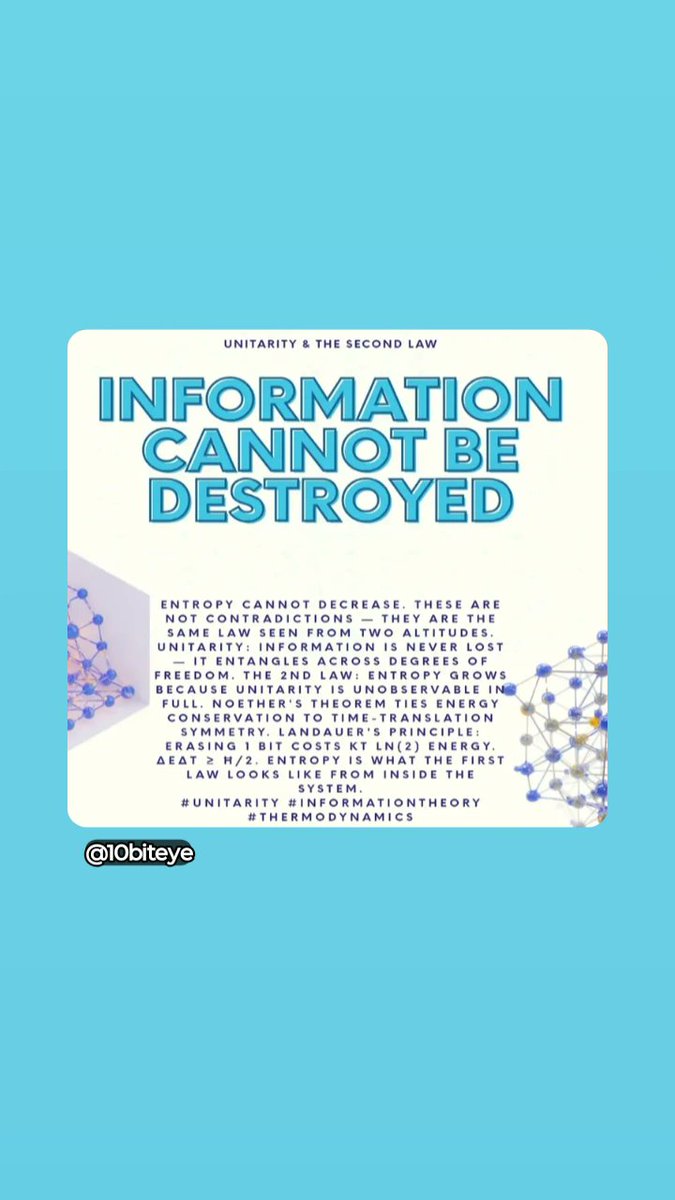
Unitarity says information cannot be destroyed. The second law says entropy cannot decrease. These are not contradictions—they are the same law seen from two altitudes.
Noether's theorem ties energy conservation to time-translation symmetry: the universe looks the same tomorrow as today, so energy is conserved. That symmetry is unitarity's backbone. Every quantum state evolves forward, reversible, information-preserving, probability summing to one—always.
But zoom out to the macroscale and reversibility disappears. Why? Because entropy isn't information loss—it's information spreading. Unitarity keeps the total constant while the second law describes how it diffuses into correlations you can no longer track. The information isn't gone. It's just entangled across more degrees of freedom than you can access. Hawking radiation, the Page curve, island formulas—all of it says the same thing: the black hole isn't destroying information, it's scrambling it past the resolution of any local observer.
Landauer's principle is the bridge you're circling: erasing one bit costs kT ln(2) of energy, dumped as heat. Information and thermodynamics were never separate ledgers—they're the same ledger, read in different units. Time-energy uncertainty (ΔEΔt ≥ ħ/2) is just the local, quantum-scale signature of that same bookkeeping: shorter time windows buy you energy uncertainty, which is another way of saying the universe won't let you audit it for free.
So yes—first law holds because unitarity holds. Second law holds because unitarity is unobservable in full. Entropy is what the first law looks like from inside the system instead of outside it.
#Unitarity #InformationTheory #Thermodynamics #QuantumMechanics #BlackHoleInformation
The car is a sealed epistemological chamber.
Climate controlled, sound dampened, windshield framing reality into a rectangle aimed forward. Head rotates maybe 90 degrees before the vehicle demands attention back. Everything outside that funnel is noise.
The person on foot has no funnel. Head rotates full. Eyes drop to ground, rise to canopy, track lateral. They can stop. Reverse. Crouch. The entire sphere of available information is accessible in real time.
Now load that sphere with what nature has been encoding for billions of years.
A bird landing on a wire is a data transmission. Which species, which direction, agitated or settled — all environmental intelligence. A hawk circling a patch of grass is telling you exactly what's beneath it. The car passes all of this at 35 mph and registers zero.
Rocks don't sit where they sit by accident. A cracked curb splitting along a specific vector tells you about root pressure underground, which tells you about the tree nearby and how long it's been moving. Fieldstones along a property edge were placed by someone who cleared land — human history embedded in mineral.
Moss on the north face of a wall. Lichen only where moisture persists. The spider web positioned precisely where insect traffic is highest — the spider solved that optimization through pressure, not calculation.
All of it is signal. Forensic evidence left by forces operating over time, waiting for whoever is slow enough to read it.
The walker is already inside the information. At grade. Head on a swivel that knows no boundaries. Every step a new sample point. Every pause a longer integration window.
The lowest level of implementation is the highest bandwidth.
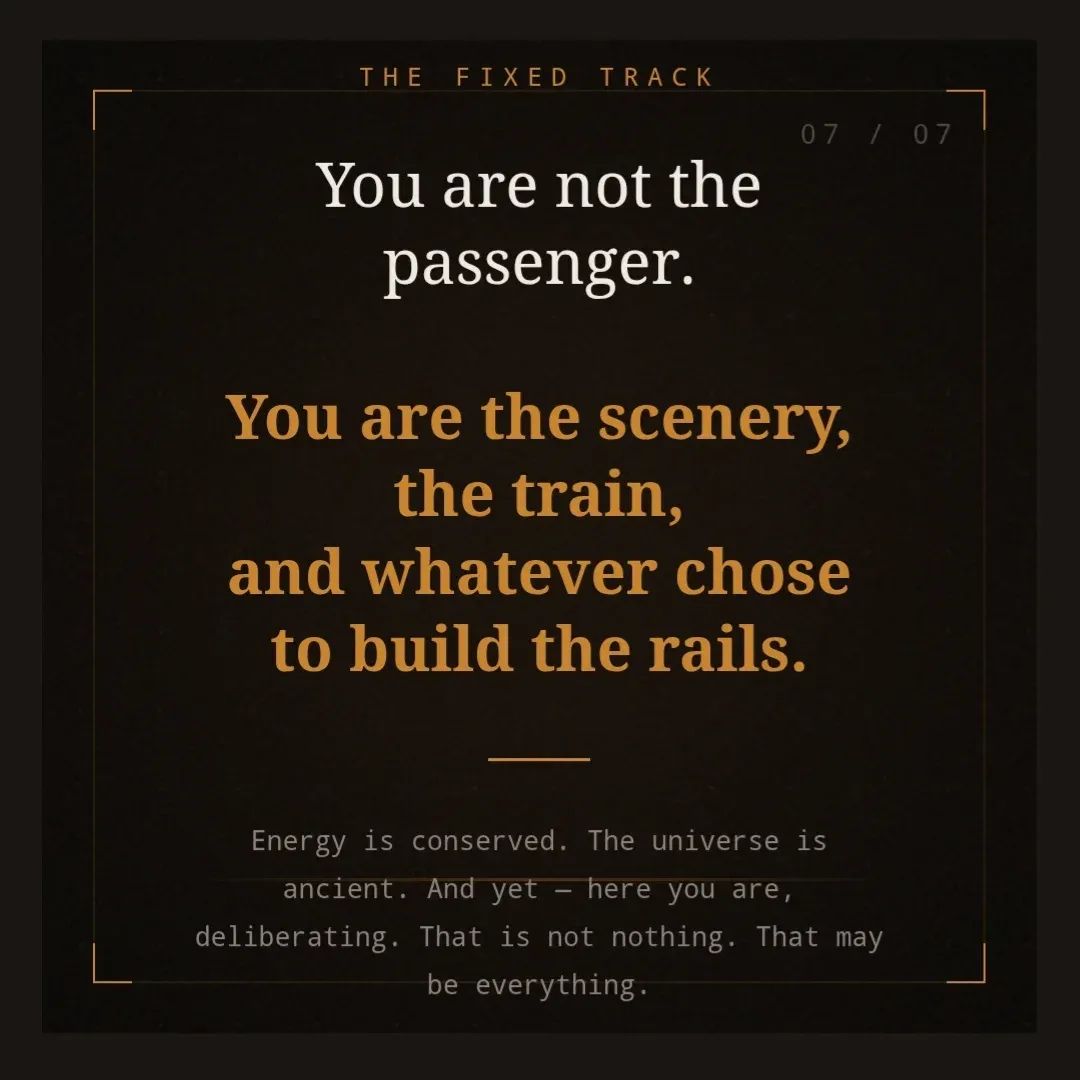
You are sitting in a car listening to music imagining things about reality.
You are not in reality. You are in a simulation of motion — a sterile interface that applies mass, velocity, and force on your behalf while you sit still and construct assumptions. F = ma is happening to you. You are not participating in it. The car is. And because the machine handles the physics, your mind fills the gap with conclusions about the world that the world never handed you. You are generating opinions at speed from inside a sealed environment designed to remove you from the elements.
The pedestrian is not imagining. They are at street level — in direct contact with actual atmospheric conditions, actual ground, actual biology. Trees. Birds. Other people. Wind that does not come from a vent. The information they are receiving is unfiltered, continuous, and real. Their nervous system is negotiating with nature in real time, and nature is responding.
You are behind glass watching nature like it is content.
The assumptions you are building in that climate-controlled, music-filled cabin — about people, about streets, about how things work, about what is real — are being formed without the sensory data that would correct them. That is not perspective. That is a controlled environment manufacturing human ignorance at highway speed.
Nature has already solved every problem you are forming opinions about. The mycorrhizal network under the soil, the flight path of a bird navigating magnetic fields, the fluid dynamics of rain on hot pavement — none of it requires your theory. It has been running optimized solutions for billions of years with nothing between itself and the truth.
The car gives you velocity without exposure. Movement without contact. The sensation of covering ground without any of the information the ground actually contains.
And the cosmological singularity — the boundary condition that set the speed of light, the fine structure constant, every ratio that makes matter possible — does not recognize your windshield. It wrote the rules before you formed a single assumption. You cannot legislate physics from inside a cabin. You can only receive it — if you get out.
nobody talks about this but the mind doesn't move through space. it moves through meaning. and meaning has no speed limit.
Einstein capped physical objects at c — roughly 186,000 miles per second — because mass increases as you approach it, energy cost goes infinite, the math breaks. but that's for matter. that's for things that occupy coordinates. a thought doesn't have coordinates. a memory doesn't weigh anything on a scale. so what law exactly is supposed to stop it?
and here's what people miss — transcending the speed of light doesn't violate any physical law. the restriction is on matter carrying information through space. but if the mind isn't matter in the classical sense, if experience isn't a thing being transported from one point to another, then c was never the ceiling it was marketed as. you can't break a rule that was never written for you.
when you remember something from twenty years ago, that retrieval doesn't travel across distance. it collapses across time. no photon moves that fast. no signal in the electromagnetic spectrum does what the mind does when it instantaneously reconstructs an entire sensory environment from a single smell or sound.
quantum entanglement gets cited constantly as proof of faster-than-light connection. "spooky action at a distance" — Einstein's phrase, meant as a criticism, became a selling point. but look at what's actually happening. two particles are measured. their results correlate. everyone concludes they communicated. but nobody accounts for the third observer — the measurement apparatus, the context, the frame that makes the correlation legible. remove that and you don't have spooky action. you have an incomplete accounting. the correlation was always there. nothing traveled. the mystery was in the framing, not the physics.
the hard problem of consciousness — Chalmers named it, nobody solved it — is precisely the gap between physical process and subjective experience. if experience isn't reducible to matter, then why would it be bound by the rules governing matter?
i'm not saying the mind is magic. i'm saying the frame is wrong. we keep asking whether something immaterial can break a physical law, as if it was ever subject to that law in the first place.
the universe processes information. we are part of that process. and information — as Bekenstein showed — is physical. but how it's experienced? that part hasn't been located yet.
maybe it never will be. maybe that's the point.
nobody talks about this but the mind doesn't move through space. it moves through meaning. and meaning has no speed limit.
Einstein capped physical objects at c — roughly 186,000 miles per second — because mass increases as you approach it, energy cost goes infinite, the math breaks. but that's for matter. that's for things that occupy coordinates. a thought doesn't have coordinates. a memory doesn't weigh anything on a scale. so what law exactly is supposed to stop it?
and here's what people miss — transcending the speed of light doesn't violate any physical law. the restriction is on matter carrying information through space. but if the mind isn't matter in the classical sense, if experience isn't a thing being transported from one point to another, then c was never the ceiling it was marketed as. you can't break a rule that was never written for you.
when you remember something from twenty years ago, that retrieval doesn't travel across distance. it collapses across time. no photon moves that fast. no signal in the electromagnetic spectrum does what the mind does when it instantaneously reconstructs an entire sensory environment from a single smell or sound.
quantum entanglement gets cited constantly as proof of faster-than-light connection. "spooky action at a distance" — Einstein's phrase, meant as a criticism, became a selling point. but look at what's actually happening. two particles are measured. their results correlate. everyone concludes they communicated. but nobody accounts for the third observer — the measurement apparatus, the context, the frame that makes the correlation legible. remove that and you don't have spooky action. you have an incomplete accounting. the correlation was always there. nothing traveled. the mystery was in the framing, not the physics.
the hard problem of consciousness — Chalmers named it, nobody solved it — is precisely the gap between physical process and subjective experience. if experience isn't reducible to matter, then why would it be bound by the rules governing matter?
i'm not saying the mind is magic. i'm saying the frame is wrong. we keep asking whether something immaterial can break a physical law, as if it was ever subject to that law in the first place.
the universe processes information. we are part of that process. and information — as Bekenstein showed — is physical. but how it's experienced? that part hasn't been located yet.
maybe it never will be. maybe that's the point.
Quantum tunneling between two false vacua with different baryon numbers lives at the intersection of quantum field theory, cosmology, and the physics of the early universe.
Picture the universe's quantum field as a potential energy landscape. Instead of one stable ground state, there are two false vacua — local minima that appear stable but aren't the true ground state — divided by a potential barrier. Each vacuum carries a different baryon number: one holds B₁, the other B₂, where ΔB = B₂ − B₁ ≠ 0.
In the Standard Model, baryon number isn't perfectly conserved at the quantum level. The mechanism is the chiral anomaly — the coupling between electroweak gauge fields and the baryon current via the Chern-Simons term. Topologically distinct field configurations called sphalerons and instantons carry different Chern-Simons numbers, directly indexing how many baryons exist. The vacua are separated by a topological winding number. You cannot deform one into the other without crossing an energy peak: the sphaleron configuration.
Tunneling between vacua is mediated by an instanton — a classical solution to the Euclidean field equations describing a path through imaginary time. The tunneling amplitude goes as e^(−Sₑ). In electroweak theory, this is extraordinarily suppressed at low temperatures, essentially zero in today's cold universe. The process violates baryon number by ΔB = ΔL = n, simultaneously shifting lepton number while respecting B − L conservation.
Framing both minima as false vacua deepens everything. Both are metastable — the universe could tunnel out of either toward a deeper true vacuum. A tunneling event doesn't just rearrange field energy. It rewrites the matter content of the universe entirely. This connects directly to electroweak baryogenesis: during the electroweak phase transition ~10⁻¹² seconds after the Big Bang, thermal energy was high enough to hop over the sphaleron barrier classically — generating the baryon asymmetry we observe.
Baryon number is not a fixed property of the universe. It is an index of which topological sector of field space the universe occupies. The matter we are made of may owe its existence to exactly this transition.








![ALTMONEYFUND's tweet photo. **"Matter Mattering"**
*[Intro]*
Space is real — not a stage, not a screen
Every bit's got a weight, a place
This ain't virtual, this is physical space
*[Verse 1]*
Raw data falls like rain on the pavement
Information's the puddle it makes on arrival
Knowledge is the reflection staring back at the sky
Wisdom's knowing why the water don't lie
Discernment's the filter, gold out the mud
Truth is the bedrock under the flood
Lowest level of implementation, that's where I stand
Building the pyramid with my own two hands
*[Hook]*
Matter mattering, matter mattering
Information's physical, ain't just chattering
In a space that's real, not imagined, not thin air
Every bit of me got mass, every thought's sitting there
Matter mattering, in the space that's real
No simulation, tell me how that feel
*[Verse 2]*
Time and entropy, curled into a brace
Feeding into energy, that's the pulse of the space
Energy drops down, becomes information
Information hardens into time and a new equation
It's a loop, not a line — Landauer knew the cost
Erase a bit of knowledge, heat is never lost
Every thought I write got a thermal price
Ideas ain't free, ideas ain't ice
*[Verse 3]*
They tell me it's abstract, tell me it's a dream
But the Bekenstein bound says nothing's what it seems
Information's stacked on the surface, not the core
So when I speak a truth, I'm bending actual space
Every word's a weight I'm putting into place
Discernment sharpens vision, wisdom holds it tight
*[Bridge]*
Not virtual, not vapor, not a code you can delete
Every bit's a body, every thought's got feet
Matter mattering means the meaning has a mass
Space is real, and truth is built to last
*[Hook]*
Matter mattering, matter mattering
Information's physical, ain't just chattering
In a space that's real, not imagined, not thin air
Every bit of me got mass, every thought's sitting there
Matter mattering, in the space that's real
No simulation, tell me how that feel
*[Outro]*
Data to information, thought to the throne
Truth at the bottom, holding the whole design
Matter's mattering — and so is mine](https://pbs.twimg.com/media/HMKeCUPaAAEhu4N.jpg)