Two brothers left MIT and Georgia Tech, came back to India, and raised the largest private drone funding in the country's history. Their UAVs were deployed during Operation Sindoor. Not a single component inside them is Chinese.
Their names are Vikash and Vivek Mishra. Vikash trained in aerospace engineering at MIT, with stints at Idaho National Laboratory and CERN. Vivek holds a PhD in electrical and computer engineering from Georgia Tech. In 2016, while both were still students abroad, they decided to build what India had never built: fully indigenous, combat-ready drones with zero dependency on foreign components.
They founded Raphe mPhibr in Noida in 2017. Not with a product. With a question.
For the first three to four years, they built nothing. They spent that time in the field, studying exactly what India's armed forces needed across different terrain, weather, and combat conditions. "We focused on both research and manufacturing," Vivek said, "because we didn't want to be constrained by what already existed."
They started in a 2,000 square foot facility. Today they operate a 650,000 square foot integrated manufacturing and R&D complex with 600 employees, offering nine drone models, the mR10 swarm, the mR20 for high-altitude logistics, the X8 for maritime patrol, and the Bharat man-portable surveillance system. Every component: flight controllers, batteries, airframes, navigation systems is designed and manufactured in India.
The Indian Army, Navy, Air Force, Border Security Force, CRPF, and ITBP are all active customers. In June 2025, Raphe raised $100 million in a Series B led by General Catalyst, bringing total funding to $145 million; The largest private drone raise in India's history.
India tripled its drone budget to $470 million in the months following Operation Sindoor.
Raphe mPhibr already has the facility, the fleet, and the orders to fill it.
@VivekMishra___@Raphe_mPhibr
@TheRocketMediaX@routpr100 Thanks at least you said so else the banal&redundant narrative "India is still not ready for Innovative Cutting Edge Science and Technology " persists. The dumb Shark Tank show–that promotes what Piyush Goyal onces said " Chips and Cookies" show– further amplifies this narrative.
What does the university of the future look like?
According to Mr Sanjeev Sanyal, member of the Economic Advisory Council to the Prime Minister of India, IIT Madras offers a glimpse.
Speaking on the ANI Podcast with Ms Smita Prakash, he described IIT Madras as “the most interesting intellectual cluster in India right now,” pointing to its vibrant ecosystem of research, deep-tech innovation and entrepreneurship.
From brain-mapping and Agnikul’s space rockets to e-planes, drone taxis and indigenous marine-engine development, the Institute is creating an environment where ideas move from research to real-world applications.
Mr Sanyal also highlighted a key strength: learning beyond the classroom. With laboratories, prototyping facilities, research projects and startups on campus, students gain experience by building, testing and innovating.
He suggested that universities across India could draw from this model by placing greater emphasis on experiential learning, research, industry collaboration, and entrepreneurship.
🎥 Watch the full conversation: https://t.co/EKUjuUY2jt
@sanjeevsanyal@iitmadras@smitaprakash@ANI
#IITMadras #Innovation #HigherEducation #ExperientialLearning #SanjeevSanyal #ANI
Keytruda, the world's highest-selling cancer drug, took 5-6 hours on a drip. Merck worked out an injection version of it on the International Space Station.
Now an Indian startup has flight tested a drug factory in near-space.
Here is why they want to make medicine in orbit.🧵
@PadmajaJoshi ...And there are books written on the theme"How To Win/Control nature".
Pralay..Prakriti...Who has the audacity to challenge it? All elegant mathematical models, quantum physics and what not appear trash and useless.
India’s sugar production and the subsequent govt decision is mainly related to impact of weather and crop disease on production, in addition to stronger festival demand, and firm global prices.
This piece articulates how sugar production for 2025-26 has been revised down by nearly 11%, from an initial estimate of 34.3 million tonnes to about 30.6 million tonnes.
Ethanol has helped stabilise the sugar industry by providing an alternative revenue stream, strengthening its ability to make timely payments to sugarcane farmers, and giving farmers an additional source of income through a more reliable market for their produce. It also insulates our citizens from the effects of geopolitical conflicts and disruption of global supply chains.
Greater use of ethanol, which is environment friendly and sustainable, reduces India’s dependence on imported crude oil, and strengthens our efforts towards energy security under the leadership of PM Sh @narendramodi Ji.
A must read…
In July 2026, India averaged 763 million UPI transactions per day, up from 628 million a year ago. The daily average, which has never gone down, tells the story of UPI's success.
https://t.co/oc99GSCCVb
Desh ki asli Naari shakti 👌🇮🇳
This video is a tight slap in the face to all those pseudo-feminists who use feminism as an excuse to justify their debauchery
@riteshmjn It became obvious when Adani announced "lfew zeroes followed by crores" way back in Oct'25. The road to political stability was set, and the industrial policy of Bengal. Cash flow decides everything.
🚨 BIG MILESTONE: India’s banking sector hits a historic benchmark under the Modi Government.
🏦 Not a single listed bank has crossed 1% net NPA in Q1 FY27
📉 Gross NPAs down 11.76% YoY
💰 Net NPAs down 9.51% to ₹84,293 crore
📊 Bad debt provisions down 41.61% to ₹25,448 crore
📈 Banking industry net profit up 19.01% to nearly ₹1.10 lakh crore
A remarkable transformation of India’s banking sector under PM @narendramodi and FM @nsitharaman.
This is a super cool website.
You can scroll around and look at any country's population pyramid, fertility rate, and mortality rate by year.
Check this out:
An op-ed in The Sunday Times clearly bring out why new rural jobs scheme is a vast improvement over MGNREGA.
The key shift is simple -From paying for employment in the old schme to paying for employment that creating enduring assets in the new scheme.
Rural India has also changed. Rural incomes are far more diversified today with mix of contribution from agriculture, migration, remittances, construction and non-farm work. And in many states, cash transfers and welfare schemes have also become important income supplements.
This reality also went in to the remaking of employment schemes.
Instead of funding short-term, low-productivity work, the new framework seeks to link employment to durable infrastructure ar village level like water conservation, irrigation, land development and other productive assets. via @timesofindia
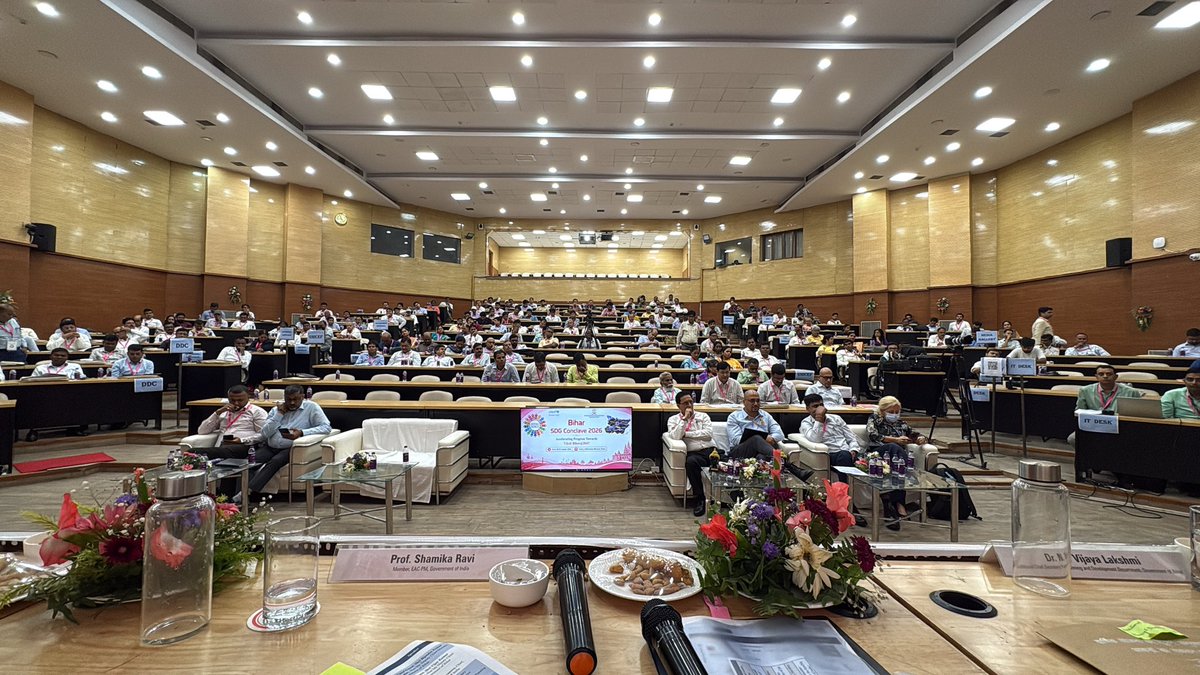
Inaugurated the Bihar SDG Conclave in Patna. District development officers from across the country attended the 2 day conference. In my speech, I highlighted the need to prioritize revenue generation by the state government - in order to achieve SDG goals. It was a special joy to meet women leaders at the helm of affairs. @samrat4bjp@_ShreyasiSingh Vijayalakshmi IAS.
We tend to judge government performance by what we can see: the roads, airports, bridges, power lines, digital public infrastructure that now moves payments and welfare at the tap of a phone. These are real achievements, and they earn the applause. But the most consequential thing a strong government does is often invisible. It is the unglamorous commitment to fiscal discipline: the credibility of its promise to honour its debts, and the willingness to make hard, unpopular choices and to refuse the easy giveaway when a windfall arrives. That unseen commitment, more than any monument, protects the value of the currency, and with it the savings and wages of ordinary people. India’s inflation between 2010 and 2016 is a case study in this contrast between the seen and the unseen.
An Indian engineer in Bengaluru got tired of potholes destroying his car.
So he built an app with Codex that detects them, finds who is responsible, and files a complaint.
Here is how it works. He installed a dashcam with GPS and an accelerometer. The app records everything while he drives.
A vision model classifies every pothole by size. Small, medium, large.
But here is the clever part. Most Indian roads are under warranty.
The contractor who built them is legally responsible for fixing potholes for free.
His app searches through 2,900 government contracts, finds the exact tender number, identifies the officer responsible, attaches the photo and geolocation, and generates a ready-to-file complaint.
One drive to work. 12 potholes detected. 12 complaints ready.
--
vc: @gkcs_
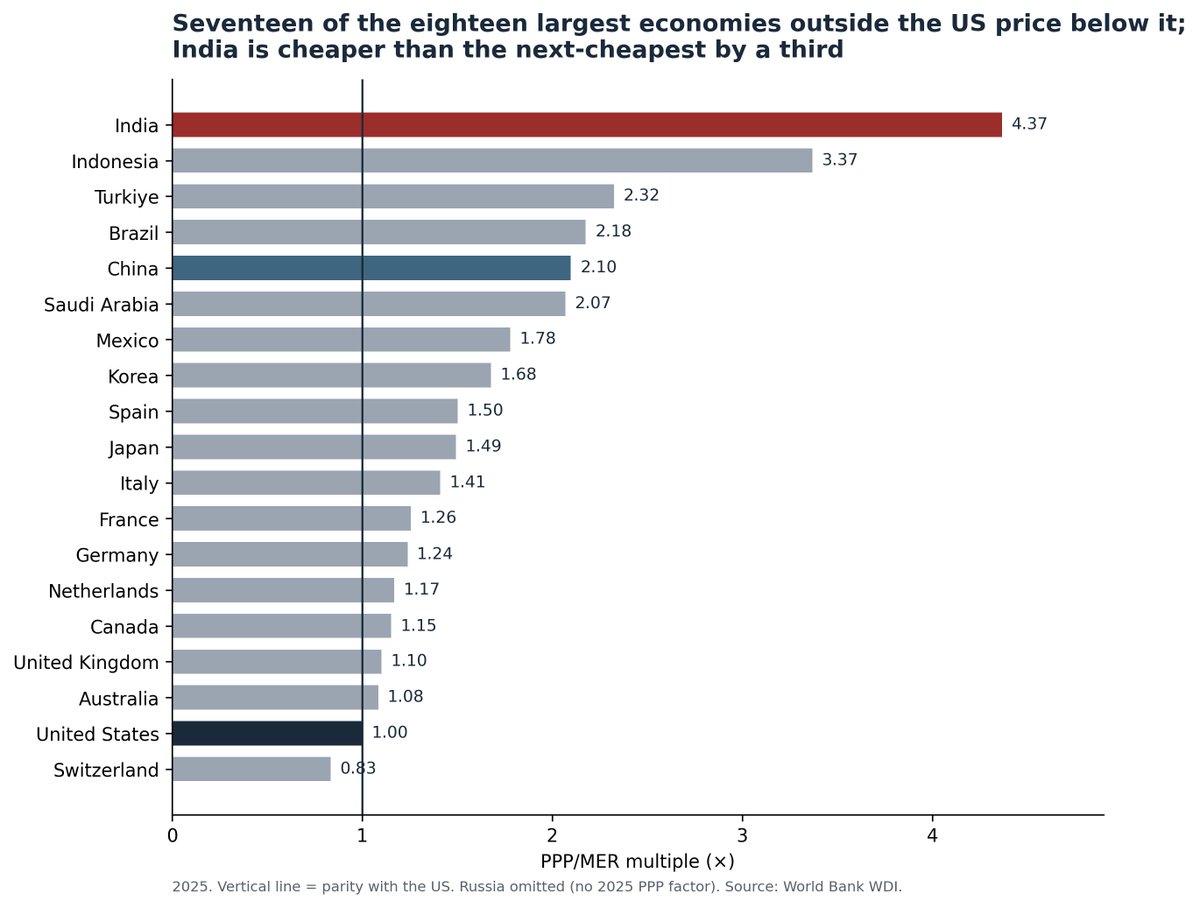
To give you an idea of how undervalued INR is, you just need to compare across countries and time. Even adjusted for incomes, it is compressed. Which is why a 2035 target of ~$20T GDP is not as unreasonable as it sounds. It is a BOP switch with gold, energy, goods, capital flows.