The proposal submitted by the German architect Rambald von Steinbüchel was ultimately selected as the winning entry, and construction began shortly thereafter.
For a comprehensive overview of the competition brief and the submitted proposals, please visit our website.
In 1973, five architects submitted proposals Latakia University design competition: George Candilis (France), Jean Dubuisson (France), Massimo Pica Ciamarra (Italy), Rambald von Steinbüchel (Germany), and Hans Zwimpfer (Switzerland).
https://t.co/xUUN5oBUVw
A number of international architects were invited to design the university’s campus, some of whom declined the invitation. Among them was architect Oscar Niemeyer, who proposed a direct commission, but the committee opted instead to proceed through an open competition.
AMASyria co-founder, Ahmad Salah, will be delivering a lecture later next week at the American University of Beirut on the modern Syrian architectural scene and the challenges of building knowledge infrastructures in the present moment. in conversation with Dr. Nadi Abu Saada.
Join us for a lecture by Ahmad Salah on The Archive of Modern Architecture in Syria, exploring local narratives and architectural heritage.
📅 Friday, January 16, 2026
⏰ 6:00 PM
📍 ALH, Architecture Lecture Hall – Dar el Handassah Building
#AUB#AUBVibes
We extend our sincere gratitude to the Pavilion’s curators, Beatrice Leanza and Maryam AlNoaimi, for their support and vision in convening this platform for dialogue and exchange, and to our colleagues and contributors for the critical conversations and insights they shared.
We are pleased to begin the new year by receiving our copy of the publication 'Connections as Method: Relational Pedagogies and Participatory Spatial Practice,' to which we were honored to contribute alongside a distinguished group of friends and colleagues.
As part of the Pavilion’s 'Archipelago of Archives' exhibition, we also presented “Archiving from the Margins Inward,” linking fragments of 20th-century Syrian architecture while foregrounding alternative knowledge practices and the absence of archival infrastructures.
Through open discussions and panel presentations, we engaged with distinguished colleagues and practitioners from across the region, exchanging perspectives on how interdisciplinary practices of co-creation and storytelling can reframe architectural and urban narratives.
In June 2025, AMASyria’s co-founders, Ahmad Salah @Ahmad0sal0 and Mirma AlWareh, participated in 'Archiving Otherwise,' the opening strand of the Public Program of the Saudi National Pavilion at the 19th International Architecture Exhibition – La Biennale di Venezia.
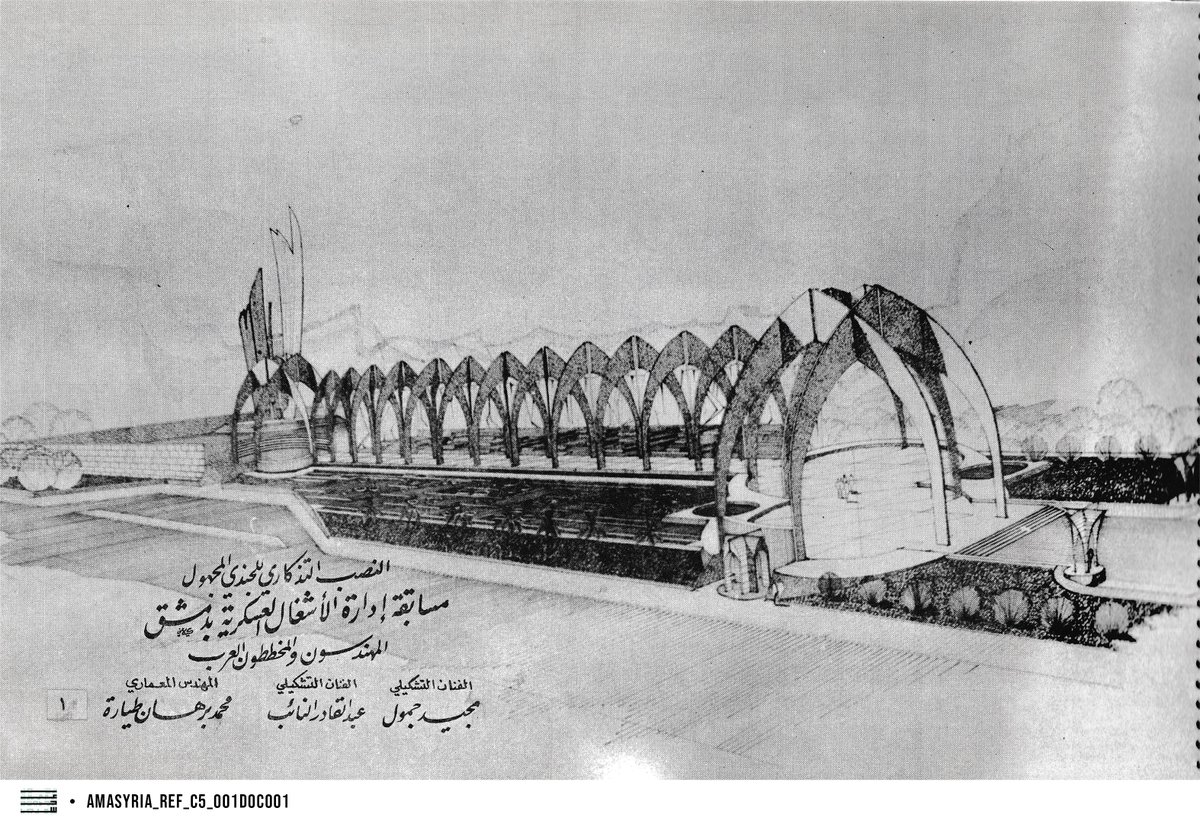
This project represents the first archived work of architect Bourhan Tayara in our collection. Building on this foundation, we continue to uncover and document additional materials related to Professor Tayara’s legacy, and we welcome any support or contributions in this regard.
From Our Archive, a study and design proposal for the Unknown Soldier Monument in Damascus, by architect Bourhan Tayara and artists Majid Jammoul and Abdulkader Alnaeb in 1980.
https://t.co/HkqecZA1ZW
It is notable that this proposal was originally intended for the initial project site, located in what later became Tishreen Park in Damascus, whereas the executed monument was eventually relocated to its current location on the slopes of Mount Qasioun.
These were then transferred to our archive, where they were sorted, preserved, and digitized, in alignment with our mission to preserve Syria’s architectural heritage and make it openly accessible to researchers and those interested in Syria's 20th century architectural history.
This archive was transferred to our care in late 2022. Over a period of two months, we worked on collecting all related materials from the architect’s office. The collection ultimately comprised approximately 1,100 documents.
We had a brief opportunity to reflect on the archive, reconsidering how we approach our history and its relation to the global narrative, but most importantly, to ourselves and our self-perception. How do we redefine the contours of what is knowable?
https://t.co/kGJrjjCVFE
We are pleased to see the growing recognition of Syria's built environment and heritage initiatives, including AMASyria.
"Heritage in Syria: Independent Groups Documenting the Country’s Historic Architecture"
Thank you @ArchDaily@mohimg
https://t.co/cwRKzCuLtK
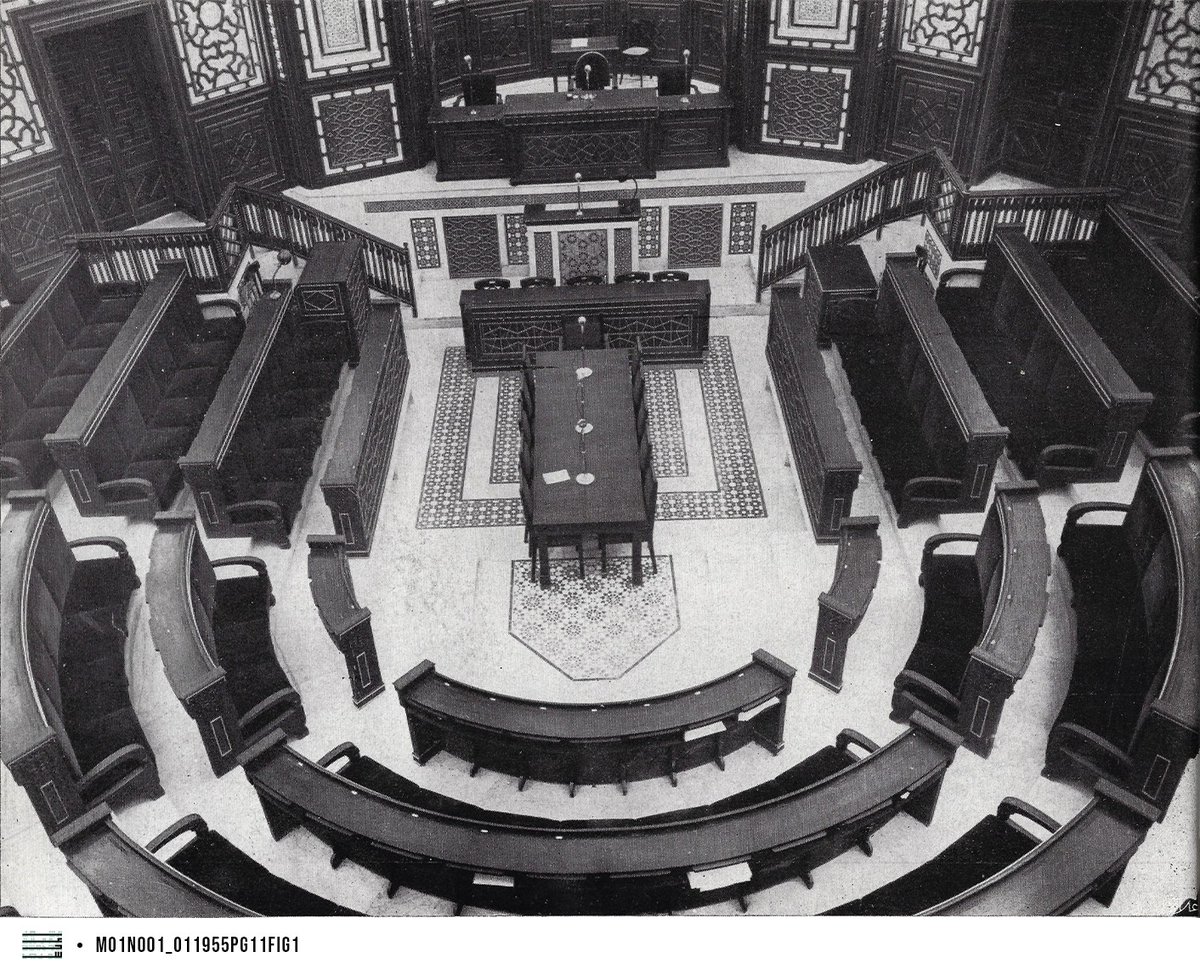
The building exemplifies an interpretation of “Modern Arab architecture” implemented in many other projects by the Ministry of Public Works from that time, characterized by borrowing ornamental and functional elements from traditional architecture and iterating on them.
The Syrian Parliament building was designed and built in multiple phases between 1932 and 1954, atop the ruins of the first movie theatre in Damascus, Cinema Janaq Qal’a. The French mandate bombed it in 1945, destroying the first and oldest blocks.
#architecture#Syria#AMASyria