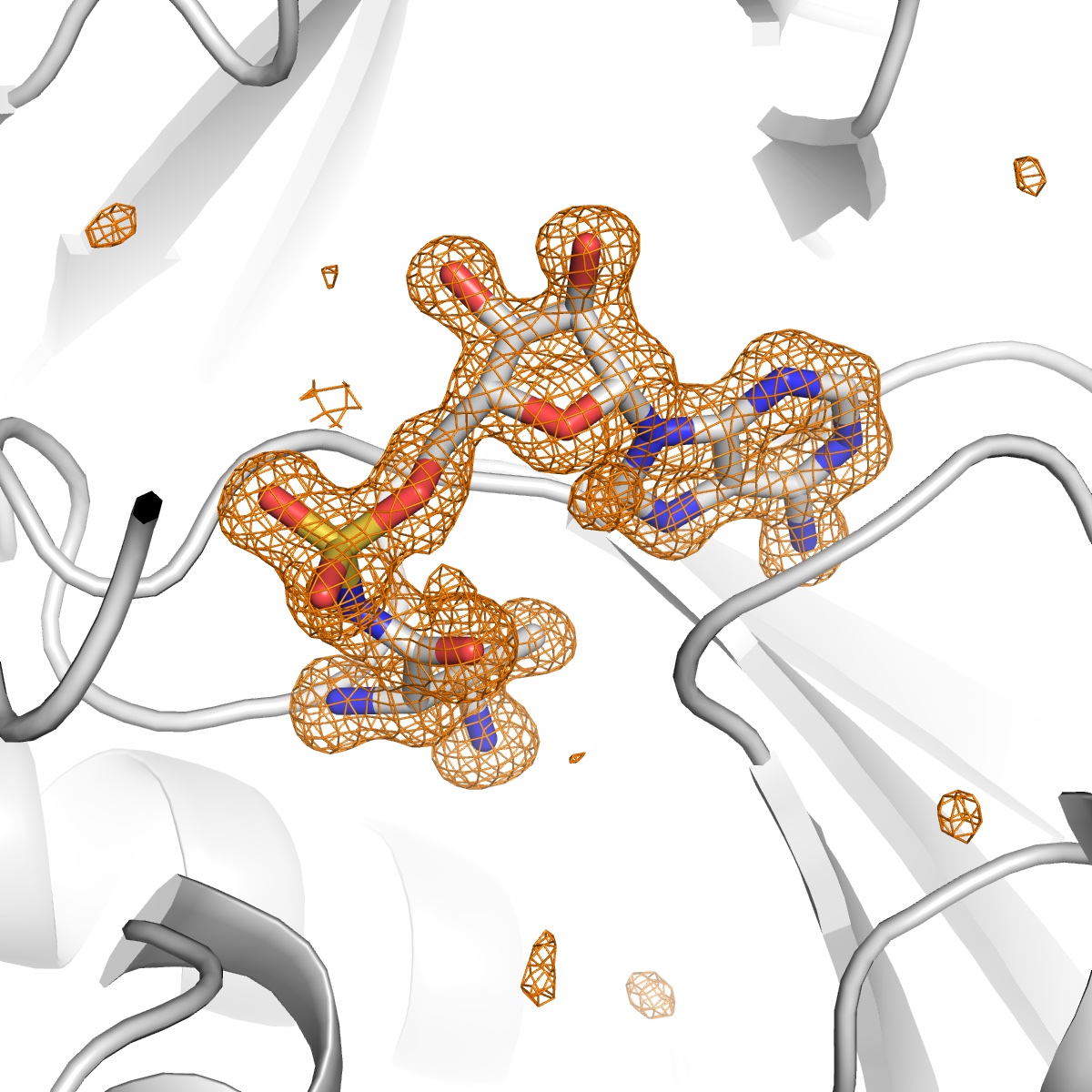
Remember this story? Five years ago, I posted this thread about crystallizing the wrong protein. So what, not that uncommon, right?
But the protein was not from E. coli. And had been mysteriously crystallized by other labs.
I think I know why:
https://t.co/Ynm4jYDodD
Stopping by the old platform to post that I'm looking for a post-doc to join our team on structural biology and natural product biosynthesis. I plan to start reviewing applications later this month.
https://t.co/zVaIoxrFmt
There is still time to register and submit an abstract to the 29th Enzyme Mechanisms Conference. The venue has extended the deadline for room reservations (at negotiated rate). It is shaping up to be a great event.
https://t.co/Fp4GWv3bwb
Congrats to @PennSAS senior @KristinOsika, just selected for the Founders' Award at the 29th Enzyme Mechanisms Conference! Kristin's award lecture will focus on her pioneering work with drimenol synthase, as outlined in her recent @PNASNews paper:
https://t.co/WCwYEyasGI
I'm mostly hanging out where the skies are blue but thought I'd remind everyone here that registration is open for the 29th Enzyme Mechanisms Conference, which will be held in January at a great site with a great lineup of speakers.
https://t.co/Fp4GWv3bwb
I'm really excited to share Mercedes's report on the mining and exploration of the BGC for nocardichelin.
Identification and Characterization of the Biosynthesis of the Hybrid NRPS-NIS Siderophore Nocardichelin | ACS Chemical Biology https://t.co/0CCaARv48C
Are you interested in gaining research training in protein engineering, high-throughput screening assays, inhibitor identification, and mechanistic enzymology? Join our group as a postdoc! Apply here: https://t.co/H35SAapbY3
Excited to announce that the 14th International Acinetobacter conference (and first in North America!) will take place in Niagara Falls on July 6-10 2025 in collaboration with @FASEBorg. More info to follow. #FasebAcinetobacter
This is a truly wild article. About 5% of cyanobacteria fished from the ocean are connected via nanotubes. These nanotubes are made from lipid membranes.
Also, E. coli will sometimes grab onto microbes of *other* species, using these nanotubes, and share nutrients.
Happy to share our latest collaborative study with the Wencewicz lab.
Congrats to Fardin Ahmed (and everyone involved) for this work!
Expanding the Substrate Selectivity of the Fimsbactin Biosynthetic Adenylation Domain, FbsH.
https://t.co/1sqoo3eGTl
I often share beautiful examples of science writing with my students. This one from @ElizKolbert in the @NewYorker is one of the best I've seen recently.
https://t.co/BPFzklt53D
Early voting begins this Saturday, October 26 and runs every day through Sunday, November 3. There are 38 Early Voting Centers across Erie County, one in every town, small city, and City of Buffalo council district.
Early voting makes it easy to vote. So #GetOutAndVote!
For those interested in grad school, @UBuffalo@UBChemistry has a virtual open house Nov 16 12:00 ET. Register below to learn more about our department! Link: https://t.co/A81jJf9LmQ
Sending this out to the Enzymology Community:
The 29th Enzyme Mechanisms Conference will be held January 4-8, 2026 in Carlsbad, California. Hold the date and check in on the website as we finalize plans.
https://t.co/Fp4GWv3bwb