If you answered A, "True", you are correct!
Here's why: Because of the effect of the uterus on venous return, coupled with the minimal cardiac output seen with CPR, IV access should be established above the diaphragm (i.e. antecubital fossa, internal jugular, subclavian, etc).
#ACLS Question of the Day
IV access should always be established above the diaphragm in the pregnant patient receiving CPR.
A. True
B. False
(Answer will be posted on Tuesday)
#ACLS Question of the Day
If 50 joules fail to convert unstable or pulseless ventricular tachycardia:
A.Increase the joules as necessary until conversion occurs
B.Give an anti-arrhythmic drug before the next shock
C.Reduce the energy level for the next shock
D.None of the above
If you answered "D. All of the above", you are correct!
Here's why: Wheezing is commonly a symptom of broncospasm, however, swelling of distal airways or mucous may cause or create the wheezing heard on auscultation.
#PALS Question of the Day
Wheezing is caused by:
A. Bronchospasm
B. Swollen/inflamed small airways
C. Mucous in the lower airways
D. All of the above
(Answer will be posted on Tuesday)
Could a new blood test help predict the recurrence of breast cancer? According to Time magazine, researchers are more hopeful than ever. Check out the full story: https://t.co/pgs8Cx6AvA.
#ACLS Question of the Day
Which of the following are listed as “potentially reversible causes of PEA...” in the most recent ECC Guidelines?
A. Severe acute blood loss (i.e. arterial rupture)
B. Massive pulmonary embolus
C. Cardiac tamponade
D. All of the above
#ACLS Question of the Day
When do anti-arrhythmic drugs possibly play a role in treating the patient with unstable VT?
A. For patients who keep reverting back to the VT
B. To make electrical conversion easier
C. Never
D. None of the above
(Answer will be posted on Tuesday)
Researchers have discovered a new cell in the pericardium that can help heal and repair the heart. They say the groundbreaking discovery opens the door for therapies that could help millions of people with heart disease. Check out the full story here: https://t.co/AFDuhJX34O.
You probably know how hypertension affects the heart, but what do you know about pulmonary hypertension, the type of high blood pressure that affects the lungs? Here are 5 facts you should know: https://t.co/aDMkJhLqjt.
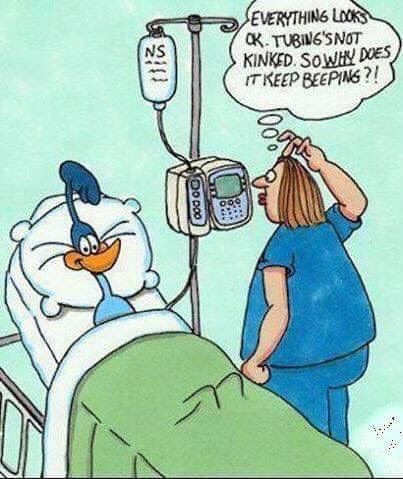
Just thought we'd brighten up your day with a funny post to let you know we totally get you...even when no one else understands what you're talking about. #nursehumor