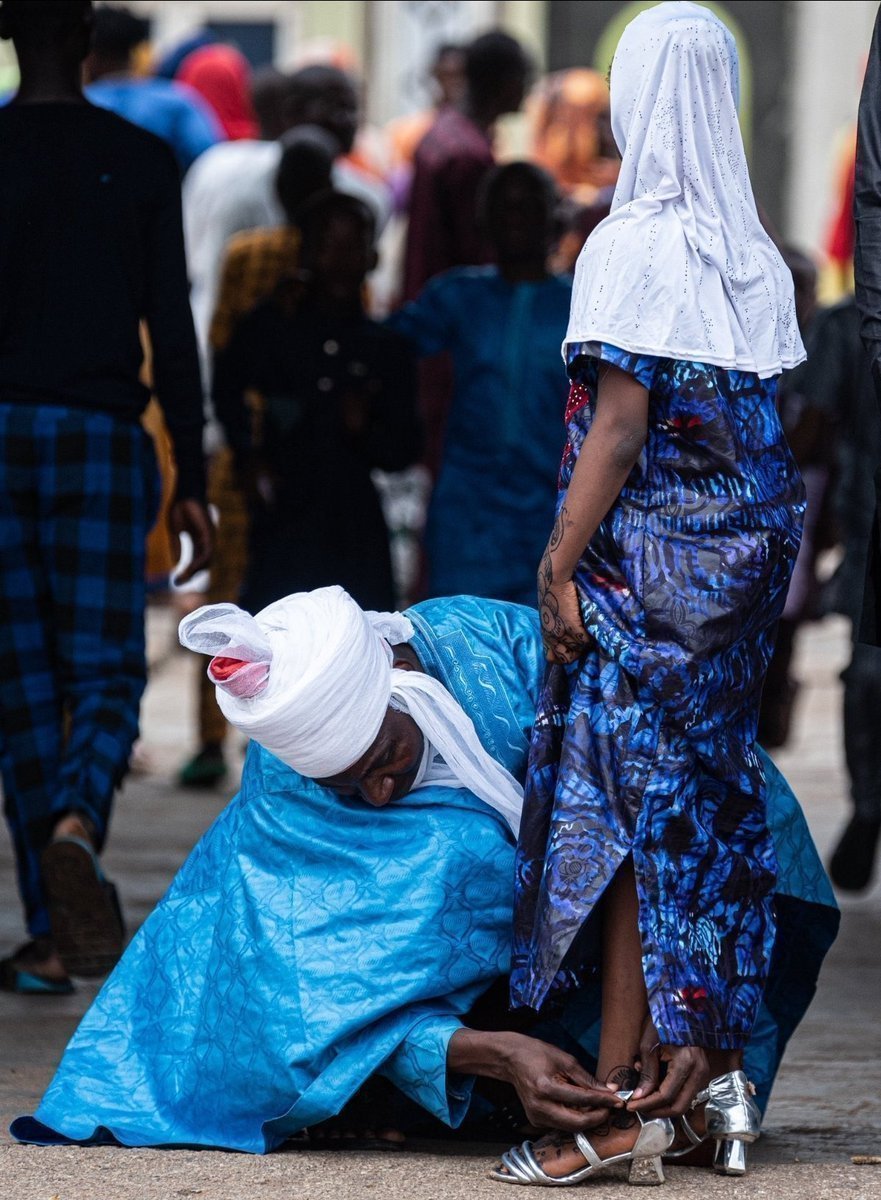
Christian Man, Yohanna Ishaqu, Disguised in Hijab, Caught Trying to Enter Army Barracks After Soldiers Spotted Traces of Beard on His Face
If he had not been caught, Muslims would have been blamed for his crime.
Meet OpenPay 💙@PiCoreTeam
The all-in-one wallet for the Pi ecosystem.
✅ Cash in with Pi
✅ Hold stable OUSD ($1.00)
✅ Send, receive and scan to pay
✅ Save, mine and stake
✅ QR Pay for your business
Watch the full walkthrough 👇
#OpenPay#PiNetwork
🚨 YOUR SMARTPHONE COULD BE THE NEXT TARGET OF A CYBERATTACK.
HERE’S HOW TO PROTECT IT.
With cyber threats, phishing, malware, data theft, and banking scams becoming increasingly sophisticated, protecting your smartphone is no longer optional.
Whether you use an iPhone or Android, follow these 15 security tips:
🔐 1. ALWAYS UPDATE YOUR PHONE
Install the latest iOS or Android security updates. They fix vulnerabilities hackers could exploit.
🔐 2. ENABLE TWO-FACTOR AUTHENTICATION
Protect your Apple, Google, email, WhatsApp, Telegram, and financial accounts with 2FA or passkeys.
🔐 3. USE A STRONG PASSCODE
Use a strong PIN or alphanumeric password, and enable Face ID or fingerprint authentication.
🔐 4. ENABLE GOOGLE PLAY PROTECT
Android users should keep Play Protect enabled and scan their apps regularly.
🔐 5. CHECK APP PERMISSIONS
Don’t give unknown apps unnecessary access to your camera, microphone, contacts, location, or files.
🔐 6. NEVER CLICK SUSPICIOUS LINKS
Be careful with links received through WhatsApp, SMS, Telegram, email, and social media.
🔐 7. ONLY DOWNLOAD OFFICIAL APPS
Use Apple’s App Store or Google Play Store. Avoid APK files from unknown websites and Telegram groups.
🔐 8. BE CAREFUL WITH PUBLIC WI-FI
Avoid accessing banking services through untrusted public networks. Use mobile data or a trusted VPN when necessary.
🔐 9. ENABLE DEVICE THEFT PROTECTION
iPhone: Find My + Stolen Device Protection.
Android: Find Hub + Theft Protection, where supported.
🔐 10. BACK UP YOUR DATA
Enable iCloud Backup or Google Backup to protect important files if your phone is lost, damaged, or compromised.
🔐 11. SECURE WHATSAPP AND TELEGRAM
Enable Two-Step Verification, check linked devices, and NEVER share your OTP.
🔐 12. PROTECT YOUR MOBILE BANKING
Never share your PIN, password, or OTP. Don’t install remote-access apps at someone else’s request.
🔐 13. TURN OFF UNUSED CONNECTIONS
Disable Bluetooth, NFC, Wi-Fi, and Personal Hotspot when you don’t need them.
🔐 14. USE A PASSWORD MANAGER
Never reuse the same password across multiple accounts. Use unique passwords and passkeys whenever possible.
🔐 15. WATCH OUT FOR AI-POWERED SCAMS
Hackers can use AI to create fake bank websites, imitate voices, generate convincing emails, and impersonate people you trust.
⚠️ IMPORTANT:
• Never share your OTP with anyone.
• Never install unknown APK files.
• Never scan suspicious QR codes.
• Never trust unexpected investment or giveaway links.
• Never ignore unfamiliar login notifications.
Remember:
Your smartphone contains your private conversations, personal photos, financial information, passwords, and access to your digital identity.
Protect your phone before someone else finds a way into it.
Sources: Apple Security, Google Security, CISA, FBI, and FTC.
A family of 14 was inside their home as a massive fire spread through the house. Several children were still fast asleep, unaware of the growing danger.
But as the fire spread, something strange was happening miles away. A father driving home with his 13-year-old son kept getting directed down an unfamiliar road by his GPS. Even after changing the route several times, it kept sending him back. Eventually, he followed it, with no idea what he was about to discover.
It happened near Lyerly, Georgia. Casey Sparks was driving home with his son, Cayson, when his GPS kept rerouting him. After following it, he noticed an orange glow on a nearby hill. As he approached, he discovered a house on fire and a teenager desperately fighting the flames with a garden hose.
Casey told his son to call 911 and rushed inside, shouting for everyone to wake up and get out. As the family scrambled to escape, he found a young girl in a hospital-style bed who needed help.
He scooped her into his arms and headed toward the door he’d entered through. But the flames had already engulfed the exit.
With the little girl in his arms, Casey found another door, carried her outside, and handed her over a fence to a neighbor. Then he went back inside to help the others escape.
All 14 family members survived. Their home was destroyed, but not a single life was lost.
Casey later said he believed God had directed him down that unfamiliar road for a reason. What seemed like a frustrating GPS detour had brought him to a family that desperately needed help.
Sometimes God puts us exactly where we’re needed, even when we don’t fully understand why.
"Goodbye, Internet"
Secretary of Iran's National Security Council, Major General Mohsen Rezaei: In the event of war, undersea Internet cables in the Persian Gulf, data centers, and artificial intelligence facilities could become our targets.
Welcome to a world without the Internet! 📵
DO IT... DO IT
يخرج رئيس أمـريكا الأسبق (بيل كلينتون) ليضرب بكلام ترامب عن المسلمين عرض الحائط ويقول :
بنتي (تشيلسي بيل كلينتون) قرأت القرآن الكريم كله من الجلدة للجلدة وقالت لي : /( لقد قرأت القرآن الكريم ، ولم أجد فيه أي إساءة بل وجدته كتابًا معجزًا يدعو للتعايش وأن الله جعلنا شعوبًا وقبائل لتعارفوا ) /؛ ويقول وسئمت من الحـروب الدينية والثقافية ، لا تهاجموا المسلمين فهناك أشخاص سيئون في كل ديانة لأننا جميعًا بشر . وابنتي أكدت أن كل الكلام الذي نقوله على المسلمين كذب وليس موجودًا في القرآن الكريم .
Qatar Development Bank has received seven awards from Global Finance magazine for 2026, recognizing its efforts in advancing digital services, enhancing customer experience, and delivering innovative solutions across Qatar and the Middle East.
These achievements reflect our ongoing commitment to improving our services, facilitating access for entrepreneurs and businesses, and supporting their growth and expansion. 🇶🇦
#QDB #Qatar
ZAGAZOLA CHECKS: Exploiting Kaduna Muslim Family’s Kidnap to Push Christian Persecution Narrative Is Misleading
A kidnapping is a crime against its victims, not a licence to manufacture a religious narrative.
The abduction of Ahmed Abubakar Zakka, his wife and their infant daughter from their residence in Alrahus Estate, Millennium City, Chikun Local Government Area of Kaduna State, is deeply troubling. The family deserves our solidarity, and the security agencies must do everything possible to secure their safe and unconditional release.
But the attempt attributed to Ryan Miller to present this incident to American audiences as evidence of Christian persecution in Nigeria was very disturbing. The question is what does the religious identity of the victims have to do with a claim of Christian persecution when the family at the centre of this particular case is Muslim?
Miller may have opinions about Nigeria’s security crisis, but opinions must not be substituted for evidence. A Muslim family cannot simply be repackaged as a symbol of Christian persecution to fit a predetermined narrative.
Doing so distorts the reality on ground, misleads audiences and risks turning a family’s suffering into an instrument of propaganda in the international community.
The video reportedly circulated on October 12 shows a father holding his young child while an armed man threatens him, as his wife pleads beside him. The reported ₦300 million ransom demand, this simply shared more light on the cruelty of the criminal enterprise of Banditry in Nigeria and added credences to the fact that no one is spared both the Muslims and Christians
Nothing about this horrific ordeal should be trivialised, politicised or manipulated to serve an agenda unrelated to the victims’ actual circumstances.
The question Ryan Miller must answer is straightforward: what evidence establishes that this particular abduction was motivated by the victims’ religion? If no such evidence has been presented, why is the incident being offered to American audiences as proof of Christian persecution?
A criminal incident does not become religious persecution simply because it occurs in Nigeria. Nor does the suffering of a Muslim family become evidence for a claim about Christians merely because someone wants to use it that way.
Nigeria’s security crisis is complex. It involves terrorism, banditry, mass kidnapping, communal violence and criminal networks whose activities have devastated populations in different parts of the country.
Any serious assessment must distinguish between the perpetrators, their motives, the identities of their victims and the evidence available in each case.
There is also a reality that international commentators too often overlook: Muslim communities in northern Nigeria have endured enormous losses from Boko Haram, ISWAP, banditry and mass abductions. Muslim worshippers, clerics, farmers, traders, schoolchildren and entire communities have suffered killings, displacement and captivity.
Their suffering does not disappear because it complicates a simplified narrative about Nigeria.
This does not diminish the genuine attacks and persecution that Christian communities also experience. Every documented case deserves acknowledgement and justice.
Ryan Miller and other commentators must understand that Nigeria’s tragedy is not a licence to mislead the world. If they want to establish Christian persecution, they should present documented cases, identify the perpetrators, demonstrate the religious motive where evidence supports it, and distinguish those cases from ordinary criminal kidnappings or attacks driven by other factors.
Our position is clear every Nigerian life matters, every victim deserves justice, and no community’s suffering should be manipulated to erase another’s.
The Zakka family must be rescued. The kidnappers must face justice. And anyone claiming to speak for victims of persecution must be held to the same standard