How .NET Clean Architecture evolve in 2026? Most devs bolt SemanticKernel or OpenAIClient into the controllers. That’s a fast track to vendor lock-in and untestable spaghetti. See how to structure a production .NET Clean Architecture solution when AI is a 1st-class citizen. 👇
(Architecture & Eval Tests): With AI assistants writing more boilerplate code, Architecture.Tests are non-negotiable. Write a test that fails the build if anyone references an LLM SDK inside Domain or Application. Pair it with AI. Evals to score prompt changes before merging
7/7 Design for failure
My last lesson: ask what happens when a dependency slows down.
Use timeouts, bounded retries, isolation and safe fallbacks. Test recovery with chaos experiments.
Cached content can help optional features; critical checks must stay strict.
There are dozens of videos and articles on Netflix system design, scattered across the internet.
During my interview prep, I pulled together what I learned into a 3-page visual guide for quick revision.
Sharing those notes here, one concept at a time
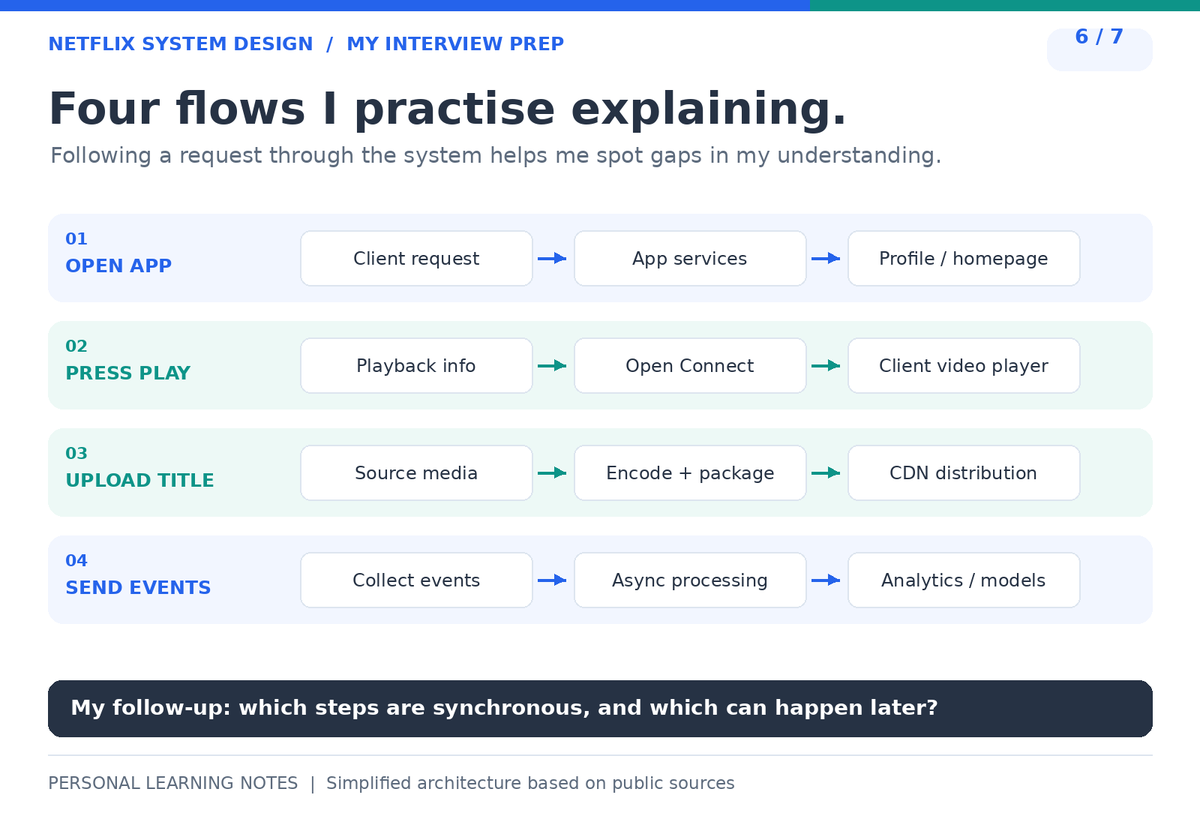
6/7 Four flows I practice explaining
Open app: load profile + homepage.
Press play: get playback info, then stream from Open Connect.
Upload title: encode, package and distribute it.
Send events: process them asynchronously.
Tracing flows helps me find gaps.
@Jannatun111111 B because look at their breast pockets: A and C both have breast pockets with pens clipped inside them. B doesn't even have a breast pocket or a pen—plus, he's the only one not looking nervous about an imposter being in the room!