Approved People Network unites people in an ecosystem where collective trust forms the basis for every member’s success and opportunities in all life areas
We live in an internet that no longer belongs to us. It is time to fix this.
Let us be honest: this morning you woke up, picked up your phone, and most likely opened social networks. Not because you really wanted to, but because you had to check messages, reply to your boss, find out what friends are talking about. This is the norm of the new reality. The internet is no longer over there, it is everywhere: at work, in relationships, in politics, in our mood.
In the past, social networks were created as platforms for live communication. A place where you could find like-minded people anywhere in the world and say something of your own. But now? Now they are huge corporate machines.
Have you ever noticed that after talking about hiking in the mountains, you suddenly start seeing ads for tents? Or that a post with your opinion gets ten views, while some random nonsense gets a thousand? That is the work of algorithms: they decide what you see, what you think about, and who you befriend. And you in this system are not the author or the owner. You are a resource. Your time, your data, your clicks are a commodity that platforms sell to advertisers.
We have gotten used to it. But inside, an unpleasant question grows: can it be different?
INTRODUCING APN – A NETWORK WHERE THE OWNER IS NOT A CORPORATION BUT THE PEOPLE.
APN is not just another Facebook killer with a pretty design. It is an attempt to build a digital society from scratch, on different rules. Rules where you are not just a user but a participant.
Here is how it works in practice, without abstractions.
The algorithm serves you, not the advertiser. In APN, you set what you see. No hidden engagement boosting through scandals and anger. If you want to see only cat photos and posts from friends, that is what you will get.
Your time is your time. The network does not try to keep you at any cost. There is no endless feed or auto playing shock content. We advocate conscious use, not digital addiction.
You own your content and data. In APN, your profile, your posts, and your conversations do not belong to the company. They are your digital property. No one will sell your interests to an insurance or credit company without your explicit consent.
You receive a share of what you create. The platform generates income, and you get a part. This is not charity, it is a participation economy: the more valuable ideas and moderation work you contribute, the larger your stake in the network's development.
WHAT IS SCL (SOCIAL CONSENSUS LEDGER) AND WHY DO YOU NEED IT?
It sounds complicated, but in reality it is honest digital accounting. Imagine that all actions in the network – your contributions such as likes, quality comments, helping newcomers, creating interesting topics – are recorded in a transparent, shared ledger. It cannot be faked, deleted, or altered in anyone's favor.
This ledger, SCL, is our replacement for soulless likes and hidden rankings.
For the individual, it means transparent reputation. You see who is truly useful to the community and who is just making noise.
For the community, it is a tool for collective governance. Important decisions, such as changing rules or allocating resources for new features, are made not by the platform owners but by active participants. You vote, and your vote carries weight confirmed by your history in the SCL.
WHAT IS APN REALLY ABOUT?
We are not building another ideal social network. We are building infrastructure for a normal human life in the digital space.
Where your child will not see narratives fueled by ads for anxiety pills.
Where your business does not collapse because the algorithm suddenly decided to hide your page.
Where you can calmly discuss important matters with a neighbor across the city without fear that your correspondence will become a commodity.
We are not against technology. We are against technology controlling us.
APN is an attempt to return the internet its soul: live, direct, and respectful human communication. Without a gray cardinal algorithm behind your back.
Join us if you feel the same. Let us create a space where the main value is you, not your clicks.
#APN #SCL #APNP
We live in an internet that no longer belongs to us. It is time to fix this.
Let us be honest: this morning you woke up, picked up your phone, and most likely opened social networks. Not because you really wanted to, but because you had to check messages, reply to your boss, find out what friends are talking about. This is the norm of the new reality. The internet is no longer over there, it is everywhere: at work, in relationships, in politics, in our mood.
In the past, social networks were created as platforms for live communication. A place where you could find like-minded people anywhere in the world and say something of your own. But now? Now they are huge corporate machines.
Have you ever noticed that after talking about hiking in the mountains, you suddenly start seeing ads for tents? Or that a post with your opinion gets ten views, while some random nonsense gets a thousand? That is the work of algorithms: they decide what you see, what you think about, and who you befriend. And you in this system are not the author or the owner. You are a resource. Your time, your data, your clicks are a commodity that platforms sell to advertisers.
We have gotten used to it. But inside, an unpleasant question grows: can it be different?
INTRODUCING APN – A NETWORK WHERE THE OWNER IS NOT A CORPORATION BUT THE PEOPLE.
APN is not just another Facebook killer with a pretty design. It is an attempt to build a digital society from scratch, on different rules. Rules where you are not just a user but a participant.
Here is how it works in practice, without abstractions.
The algorithm serves you, not the advertiser. In APN, you set what you see. No hidden engagement boosting through scandals and anger. If you want to see only cat photos and posts from friends, that is what you will get.
Your time is your time. The network does not try to keep you at any cost. There is no endless feed or auto playing shock content. We advocate conscious use, not digital addiction.
You own your content and data. In APN, your profile, your posts, and your conversations do not belong to the company. They are your digital property. No one will sell your interests to an insurance or credit company without your explicit consent.
You receive a share of what you create. The platform generates income, and you get a part. This is not charity, it is a participation economy: the more valuable ideas and moderation work you contribute, the larger your stake in the network's development.
WHAT IS SCL (SOCIAL CONSENSUS LEDGER) AND WHY DO YOU NEED IT?
It sounds complicated, but in reality it is honest digital accounting. Imagine that all actions in the network – your contributions such as likes, quality comments, helping newcomers, creating interesting topics – are recorded in a transparent, shared ledger. It cannot be faked, deleted, or altered in anyone's favor.
This ledger, SCL, is our replacement for soulless likes and hidden rankings.
For the individual, it means transparent reputation. You see who is truly useful to the community and who is just making noise.
For the community, it is a tool for collective governance. Important decisions, such as changing rules or allocating resources for new features, are made not by the platform owners but by active participants. You vote, and your vote carries weight confirmed by your history in the SCL.
WHAT IS APN REALLY ABOUT?
We are not building another ideal social network. We are building infrastructure for a normal human life in the digital space.
Where your child will not see narratives fueled by ads for anxiety pills.
Where your business does not collapse because the algorithm suddenly decided to hide your page.
Where you can calmly discuss important matters with a neighbor across the city without fear that your correspondence will become a commodity.
We are not against technology. We are against technology controlling us.
APN is an attempt to return the internet its soul: live, direct, and respectful human communication. Without a gray cardinal algorithm behind your back.
Join us if you feel the same. Let us create a space where the main value is you, not your clicks.
#APN #SCL #APNP
We live in an internet that no longer belongs to us. It is time to fix this.
Let us be honest: this morning you woke up, picked up your phone, and most likely opened social networks. Not because you really wanted to, but because you had to check messages, reply to your boss, find out what friends are talking about. This is the norm of the new reality. The internet is no longer over there, it is everywhere: at work, in relationships, in politics, in our mood.
In the past, social networks were created as platforms for live communication. A place where you could find like-minded people anywhere in the world and say something of your own. But now? Now they are huge corporate machines.
Have you ever noticed that after talking about hiking in the mountains, you suddenly start seeing ads for tents? Or that a post with your opinion gets ten views, while some random nonsense gets a thousand? That is the work of algorithms: they decide what you see, what you think about, and who you befriend. And you in this system are not the author or the owner. You are a resource. Your time, your data, your clicks are a commodity that platforms sell to advertisers.
We have gotten used to it. But inside, an unpleasant question grows: can it be different?
INTRODUCING APN – A NETWORK WHERE THE OWNER IS NOT A CORPORATION BUT THE PEOPLE.
APN is not just another Facebook killer with a pretty design. It is an attempt to build a digital society from scratch, on different rules. Rules where you are not just a user but a participant.
Here is how it works in practice, without abstractions.
The algorithm serves you, not the advertiser. In APN, you set what you see. No hidden engagement boosting through scandals and anger. If you want to see only cat photos and posts from friends, that is what you will get.
Your time is your time. The network does not try to keep you at any cost. There is no endless feed or auto playing shock content. We advocate conscious use, not digital addiction.
You own your content and data. In APN, your profile, your posts, and your conversations do not belong to the company. They are your digital property. No one will sell your interests to an insurance or credit company without your explicit consent.
You receive a share of what you create. The platform generates income, and you get a part. This is not charity, it is a participation economy: the more valuable ideas and moderation work you contribute, the larger your stake in the network's development.
WHAT IS SCL (SOCIAL CONSENSUS LEDGER) AND WHY DO YOU NEED IT?
It sounds complicated, but in reality it is honest digital accounting. Imagine that all actions in the network – your contributions such as likes, quality comments, helping newcomers, creating interesting topics – are recorded in a transparent, shared ledger. It cannot be faked, deleted, or altered in anyone's favor.
This ledger, SCL, is our replacement for soulless likes and hidden rankings.
For the individual, it means transparent reputation. You see who is truly useful to the community and who is just making noise.
For the community, it is a tool for collective governance. Important decisions, such as changing rules or allocating resources for new features, are made not by the platform owners but by active participants. You vote, and your vote carries weight confirmed by your history in the SCL.
WHAT IS APN REALLY ABOUT?
We are not building another ideal social network. We are building infrastructure for a normal human life in the digital space.
Where your child will not see narratives fueled by ads for anxiety pills.
Where your business does not collapse because the algorithm suddenly decided to hide your page.
Where you can calmly discuss important matters with a neighbor across the city without fear that your correspondence will become a commodity.
We are not against technology. We are against technology controlling us.
APN is an attempt to return the internet its soul: live, direct, and respectful human communication. Without a gray cardinal algorithm behind your back.
Join us if you feel the same. Let us create a space where the main value is you, not your clicks.
#APN #SCL #APNP
This is indeed a very important question. It's great that you've brought attention to it. In fact, this is just the tip of the iceberg when it comes to corporate and social interactions. In our community, we will address such issues together and design a protocol for public consensus as a whole community. Launch is coming soon! It would be a pleasure to have intellectually engaged participants in the community!
Be fair even to a thief. Not every thief is the same. If a person has no food-that is a completely different situation. They haven’t killed anyone or injured anyone. They just wanted to eat. People, be more merciful. But of course, mercy also has its limits... In our community, we are preparing a platform for social interactions of a just level. A place where the community itself will decide both the degree of guilt and any other merits or transgressions. We are creating a model of a unified public consensus. A place where everyone will find their place according to their usefulness to society. Join us. Very soon, together, we will begin to change the world!
APN VISION WEEK WILL BE LIVE SOON
For the next 7 days, we’re inviting creators, editors, AI artists, and the community to showcase the future of APN.
Create: 🎥 Videos
AI edits
Motion graphics
Cinematic concepts
Explainer content
Using the official APN material below as your foundation:
https://t.co/HPIm5teIdb�
Your mission: Show people what APN is building and what’s coming in the next few months.
You can create: • Future ecosystem concepts
• APN trailers
• AI-generated visuals
• Educational edits
• Story-driven content
• Meme-style cinematic videos
💰 Prize Pool: $50
🏆 Rewards: 🥇 1st Place - $20
🥈 2nd Place - $12
🥉 3rd Place - $8
Daily trivia questions will also be posted throughout the week.
Trivia rewards: 5 winners × $2
Duration: 7 Days
Rules: • Use the official APN material • Add your own creativity/editing • Tag APN in your submission • Drop your entries under this thread • Low-effort reposts will not qualify
Winners will be selected based on: Creativity
Storytelling
Understanding of APN
Engagement
Originality
Let’s show the world the APN vision.
Contest officially starts June 1st
Join our community for more infos:. https://t.co/3n507pelzM
#APN #contest #airdrop #Aivideos
APN VISION WEEK WILL BE LIVE SOON
For the next 7 days, we’re inviting creators, editors, AI artists, and the community to showcase the future of APN.
Create: 🎥 Videos
AI edits
Motion graphics
Cinematic concepts
Explainer content
Using the official APN material below as your foundation:
https://t.co/HPIm5teIdb�
Your mission: Show people what APN is building and what’s coming in the next few months.
You can create: • Future ecosystem concepts
• APN trailers
• AI-generated visuals
• Educational edits
• Story-driven content
• Meme-style cinematic videos
💰 Prize Pool: $50
🏆 Rewards: 🥇 1st Place - $20
🥈 2nd Place - $12
🥉 3rd Place - $8
Daily trivia questions will also be posted throughout the week.
Trivia rewards: 5 winners × $2
Duration: 7 Days
Rules: • Use the official APN material • Add your own creativity/editing • Tag APN in your submission • Drop your entries under this thread • Low-effort reposts will not qualify
Winners will be selected based on: Creativity
Storytelling
Understanding of APN
Engagement
Originality
Let’s show the world the APN vision.
Contest officially starts June 1st
Join our community for more infos:. https://t.co/3n507pelzM
#APN #contest #airdrop #Aivideos
We live in an internet that no longer belongs to us. It is time to fix this.
Let us be honest: this morning you woke up, picked up your phone, and most likely opened social networks. Not because you really wanted to, but because you had to check messages, reply to your boss, find out what friends are talking about. This is the norm of the new reality. The internet is no longer over there, it is everywhere: at work, in relationships, in politics, in our mood.
In the past, social networks were created as platforms for live communication. A place where you could find like-minded people anywhere in the world and say something of your own. But now? Now they are huge corporate machines.
Have you ever noticed that after talking about hiking in the mountains, you suddenly start seeing ads for tents? Or that a post with your opinion gets ten views, while some random nonsense gets a thousand? That is the work of algorithms: they decide what you see, what you think about, and who you befriend. And you in this system are not the author or the owner. You are a resource. Your time, your data, your clicks are a commodity that platforms sell to advertisers.
We have gotten used to it. But inside, an unpleasant question grows: can it be different?
INTRODUCING APN – A NETWORK WHERE THE OWNER IS NOT A CORPORATION BUT THE PEOPLE.
APN is not just another Facebook killer with a pretty design. It is an attempt to build a digital society from scratch, on different rules. Rules where you are not just a user but a participant.
Here is how it works in practice, without abstractions.
The algorithm serves you, not the advertiser. In APN, you set what you see. No hidden engagement boosting through scandals and anger. If you want to see only cat photos and posts from friends, that is what you will get.
Your time is your time. The network does not try to keep you at any cost. There is no endless feed or auto playing shock content. We advocate conscious use, not digital addiction.
You own your content and data. In APN, your profile, your posts, and your conversations do not belong to the company. They are your digital property. No one will sell your interests to an insurance or credit company without your explicit consent.
You receive a share of what you create. The platform generates income, and you get a part. This is not charity, it is a participation economy: the more valuable ideas and moderation work you contribute, the larger your stake in the network's development.
WHAT IS SCL (SOCIAL CONSENSUS LEDGER) AND WHY DO YOU NEED IT?
It sounds complicated, but in reality it is honest digital accounting. Imagine that all actions in the network – your contributions such as likes, quality comments, helping newcomers, creating interesting topics – are recorded in a transparent, shared ledger. It cannot be faked, deleted, or altered in anyone's favor.
This ledger, SCL, is our replacement for soulless likes and hidden rankings.
For the individual, it means transparent reputation. You see who is truly useful to the community and who is just making noise.
For the community, it is a tool for collective governance. Important decisions, such as changing rules or allocating resources for new features, are made not by the platform owners but by active participants. You vote, and your vote carries weight confirmed by your history in the SCL.
WHAT IS APN REALLY ABOUT?
We are not building another ideal social network. We are building infrastructure for a normal human life in the digital space.
Where your child will not see narratives fueled by ads for anxiety pills.
Where your business does not collapse because the algorithm suddenly decided to hide your page.
Where you can calmly discuss important matters with a neighbor across the city without fear that your correspondence will become a commodity.
We are not against technology. We are against technology controlling us.
APN is an attempt to return the internet its soul: live, direct, and respectful human communication. Without a gray cardinal algorithm behind your back.
Join us if you feel the same. Let us create a space where the main value is you, not your clicks.
#APN #SCL #APNP
What happened to you is an age-old story. And far from rare. Ten years in crypto don't teach you wealth-they teach you patience and scars. Those who truly survive here know one thing: without systematic analysis, you're not a strategist-you're just a gambler flipping a coin in front of a shiny logo.
Ten years of chaotic actions without analytics is not experience. It's simply ten years of wasted time. Start doing things right, right now. And stop regretting-regret changes nothing, it only drains your strength.
Instead, study #APN. This year, we are launching an ecosystem that will redefine social relationships and the very essence of cryptography. We are ready to compete with global giants. It may sound arrogant right now. But we have a strategy, not just words. The storm is inevitable. And #APN will take the first wave.
@Crazymoments01 Each of us can benefit society in our own way. Someone washes a car, someone helps the poor. Society rewards you with its trust - the most valuable currency. We are creating a platform for all social interactions with instant reward from society.
https://t.co/SZbvVb7npV
We live in an internet that no longer belongs to us. It is time to fix this.
Let us be honest: this morning you woke up, picked up your phone, and most likely opened social networks. Not because you really wanted to, but because you had to check messages, reply to your boss, find out what friends are talking about. This is the norm of the new reality. The internet is no longer over there, it is everywhere: at work, in relationships, in politics, in our mood.
In the past, social networks were created as platforms for live communication. A place where you could find like-minded people anywhere in the world and say something of your own. But now? Now they are huge corporate machines.
Have you ever noticed that after talking about hiking in the mountains, you suddenly start seeing ads for tents? Or that a post with your opinion gets ten views, while some random nonsense gets a thousand? That is the work of algorithms: they decide what you see, what you think about, and who you befriend. And you in this system are not the author or the owner. You are a resource. Your time, your data, your clicks are a commodity that platforms sell to advertisers.
We have gotten used to it. But inside, an unpleasant question grows: can it be different?
INTRODUCING APN – A NETWORK WHERE THE OWNER IS NOT A CORPORATION BUT THE PEOPLE.
APN is not just another Facebook killer with a pretty design. It is an attempt to build a digital society from scratch, on different rules. Rules where you are not just a user but a participant.
Here is how it works in practice, without abstractions.
The algorithm serves you, not the advertiser. In APN, you set what you see. No hidden engagement boosting through scandals and anger. If you want to see only cat photos and posts from friends, that is what you will get.
Your time is your time. The network does not try to keep you at any cost. There is no endless feed or auto playing shock content. We advocate conscious use, not digital addiction.
You own your content and data. In APN, your profile, your posts, and your conversations do not belong to the company. They are your digital property. No one will sell your interests to an insurance or credit company without your explicit consent.
You receive a share of what you create. The platform generates income, and you get a part. This is not charity, it is a participation economy: the more valuable ideas and moderation work you contribute, the larger your stake in the network's development.
WHAT IS SCL (SOCIAL CONSENSUS LEDGER) AND WHY DO YOU NEED IT?
It sounds complicated, but in reality it is honest digital accounting. Imagine that all actions in the network – your contributions such as likes, quality comments, helping newcomers, creating interesting topics – are recorded in a transparent, shared ledger. It cannot be faked, deleted, or altered in anyone's favor.
This ledger, SCL, is our replacement for soulless likes and hidden rankings.
For the individual, it means transparent reputation. You see who is truly useful to the community and who is just making noise.
For the community, it is a tool for collective governance. Important decisions, such as changing rules or allocating resources for new features, are made not by the platform owners but by active participants. You vote, and your vote carries weight confirmed by your history in the SCL.
WHAT IS APN REALLY ABOUT?
We are not building another ideal social network. We are building infrastructure for a normal human life in the digital space.
Where your child will not see narratives fueled by ads for anxiety pills.
Where your business does not collapse because the algorithm suddenly decided to hide your page.
Where you can calmly discuss important matters with a neighbor across the city without fear that your correspondence will become a commodity.
We are not against technology. We are against technology controlling us.
APN is an attempt to return the internet its soul: live, direct, and respectful human communication. Without a gray cardinal algorithm behind your back.
Join us if you feel the same. Let us create a space where the main value is you, not your clicks.
#APN #SCL #APNP
@TedPillows 67-67.5 is a structural support/resistance level. Keep in mind that a breakout of such levels with a gap is often a valid breakout, and the gap may not be filled anytime soon-or possibly never. Be cautious when making trading decisions.
https://t.co/izBvbcTHjQ
Именно поэтому мы создаём распределённую общественную экономику. Чтобы никакие деструктивные процессы государств, или элит не имели катастрофического значения для общества. Мы с вами можем и должны быть независимы! ��рисоединяйтесь к нашему сообществу. Уже скоро запуск экосистемы. Первый этап проекта.
Rethinking Economic Value
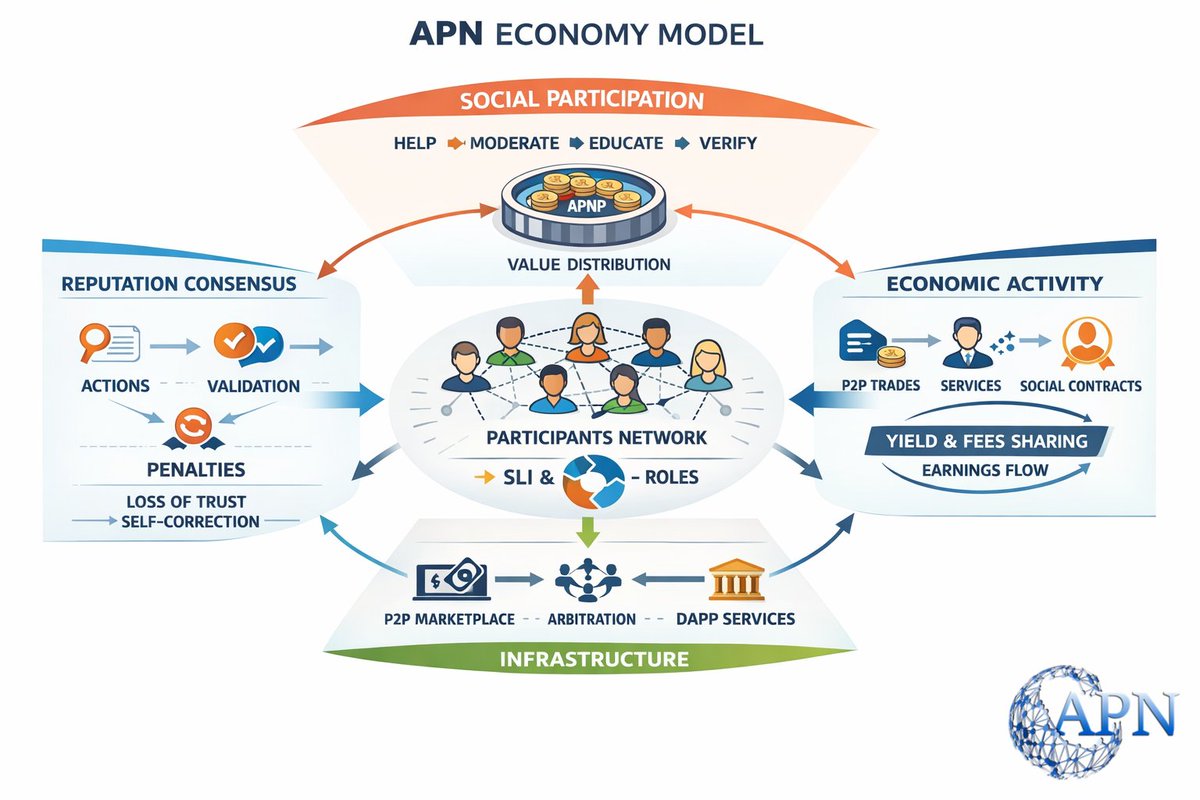
Imagine an economic network where the fundamental unit of value is not a coin, a stock, or a digital asset, but human trust and meaningful participation. Here, status is determined not by the size of one's capital, but by how useful and reliable your actions are to others. This is a fundamental shift: the system is protected from internal oligarchy and takeover by "whales" because influence cannot be bought—it can only be earned through consistent actions. The right to vote is not a privilege for a select few with large savings, but a tool for everyone who contributes their efforts to the common good.
Mechanism of Resilience: An Ecosystem, Not a Pyramid
The resilience of this network stems from several key principles, making it resemble a living, breathing organism rather than a fragile financial instrument:
-Independence from external speculation.
The internal value of the network and its ability to function are decoupled from the chaotic fluctuations of global crypto markets. The external token price is merely a reflection of external demand, while internally it serves as an immutable unit of account for trust and merit. Even in times of external panic, the "weather" inside the ecosystem can remain stable.
-Organic, not artificial growth.
Instead of infinite emission of new tokens that dilutes value (as in traditional farming), growth occurs through the expansion of social and economic activity. New "units of trust" (tokens) appear not on a schedule, but as a reward for specific, network-beneficial actions. This makes inflation manageable and meaningful.
-Social consensus as the supreme arbiter.
Governance is built not on blind code execution, but on constant, living social agreement (Social Consensus Ledger). Reputation, proven by deeds, becomes more important than any wallet balance. A participant acting against the community's interests will naturally lose influence and access to opportunities, even if they formally hold tokens. The network possesses immunity and is capable of self-cleaning without centralized "bans."
The Nature of Yield: Circulation, Not Extraction
Yield here is not a promised dividend, but a natural consequence of healthy economic activity within the ecosystem. It can be viewed from three perspectives:
1. Participation Yield. This is analogous to earning in a healthy guild or cooperative. By participating in moderation, helping newcomers, creating content, organizing processes, or building connections, you increase the overall "pie" of activity and receive a fair share of the value you helped create.
2. Trust Yield. This is the network effect, materialized in the economy. The higher your reputation and reliability (Social Loyalty Index), the more other participants want to collaborate with you, delegate tasks, and choose you as an arbitrator. This creates a flow of microtransactions and fees that concentrates around trusted nodes. Money follows trust.
3. Infrastructure Yield. As it grows, the network inevitably creates internal infrastructure: service markets, P2P platforms, arbitration systems, data storage. Microscopic fees for using this infrastructure do not flow to external investors but are redistributed among all who support and develop it, creating a self-sustaining cycle of internal capital circulation.
Scaling: People as the Universal Asset
The strength of this model lies in its universality and low growth requirements. It does not depend on a specific jurisdiction, culture, or level of wealth—trust is international. Network growth occurs by attracting new participants and deepening connections between them, which is a linear and predictable process. It does not need exponential financial injections to maintain interest, as is often the case with GameFi or hype-driven DeFi projects. This makes its development slower but immeasurably more resilient, free from "boom-and-bust" cycles.
The Philosophical Paradox and Conclusion
The main paradox, which is also its main strength, is as follows: **the less the system focuses on promising yield and the more it focuses on creating a healthy socio-economic environment, the higher its real, long-term value for participants becomes.** It filters out those seeking only quick profit and attracts builders, creators, and those who believe in the power of community. Ultimately, this is an experiment in creating an economy that serves people, not the other way around. It is an attempt to return to the origins, where the most solid asset was one's word, and the most stable currency was reputation, now materialized in digital space.
The video ended when he already had 18 SOL. Because of this post, it's unclear how much he actually locked in, and whether he ended up in the red at all. Such "snapshots" are often taken out of context and may only show the situation at a single moment. Stay vigilant and be consistent in evaluating the real situation when viewing such content.Our community is building an ecosystem where every action is backed by reputation. In APN, everything is designed so that creating incompetent or toxic content becomes unprofitable and destructive for its creator, while content and actions that are healthy, structural, and beneficial are maximally encouraged. This is essentially a currency of trust - something that cannot be bought, sold, lost, or stolen.
https://t.co/izBvbcTHjQ
In the financial world, not a single safe haven remains. All markets are exhibiting insane manipulativeness. This is a sign of resource redistribution by the largest clans. It does not bode well. It is necessary to create our own alternative to the public economy. We need to become independent from the owners of money. Our community was created to address this global issue. We all need to unite. Support us with your attention. Together, we will become independent!
Rethinking Economic Value
Imagine an economic network where the fundamental unit of value is not a coin, a stock, or a digital asset, but human trust and meaningful participation. Here, status is determined not by the size of one's capital, but by how useful and reliable your actions are to others. This is a fundamental shift: the system is protected from internal oligarchy and takeover by "whales" because influence cannot be bought—it can only be earned through consistent actions. The right to vote is not a privilege for a select few with large savings, but a tool for everyone who contributes their efforts to the common good.
Mechanism of Resilience: An Ecosystem, Not a Pyramid
The resilience of this network stems from several key principles, making it resemble a living, breathing organism rather than a fragile financial instrument:
-Independence from external speculation.
The internal value of the network and its ability to function are decoupled from the chaotic fluctuations of global crypto markets. The external token price is merely a reflection of external demand, while internally it serves as an immutable unit of account for trust and merit. Even in times of external panic, the "weather" inside the ecosystem can remain stable.
-Organic, not artificial growth.
Instead of infinite emission of new tokens that dilutes value (as in traditional farming), growth occurs through the expansion of social and economic activity. New "units of trust" (tokens) appear not on a schedule, but as a reward for specific, network-beneficial actions. This makes inflation manageable and meaningful.
-Social consensus as the supreme arbiter.
Governance is built not on blind code execution, but on constant, living social agreement (Social Consensus Ledger). Reputation, proven by deeds, becomes more important than any wallet balance. A participant acting against the community's interests will naturally lose influence and access to opportunities, even if they formally hold tokens. The network possesses immunity and is capable of self-cleaning without centralized "bans."
The Nature of Yield: Circulation, Not Extraction
Yield here is not a promised dividend, but a natural consequence of healthy economic activity within the ecosystem. It can be viewed from three perspectives:
1. Participation Yield. This is analogous to earning in a healthy guild or cooperative. By participating in moderation, helping newcomers, creating content, organizing processes, or building connections, you increase the overall "pie" of activity and receive a fair share of the value you helped create.
2. Trust Yield. This is the network effect, materialized in the economy. The higher your reputation and reliability (Social Loyalty Index), the more other participants want to collaborate with you, delegate tasks, and choose you as an arbitrator. This creates a flow of microtransactions and fees that concentrates around trusted nodes. Money follows trust.
3. Infrastructure Yield. As it grows, the network inevitably creates internal infrastructure: service markets, P2P platforms, arbitration systems, data storage. Microscopic fees for using this infrastructure do not flow to external investors but are redistributed among all who support and develop it, creating a self-sustaining cycle of internal capital circulation.
Scaling: People as the Universal Asset
The strength of this model lies in its universality and low growth requirements. It does not depend on a specific jurisdiction, culture, or level of wealth—trust is international. Network growth occurs by attracting new participants and deepening connections between them, which is a linear and predictable process. It does not need exponential financial injections to maintain interest, as is often the case with GameFi or hype-driven DeFi projects. This makes its development slower but immeasurably more resilient, free from "boom-and-bust" cycles.
The Philosophical Paradox and Conclusion
The main paradox, which is also its main strength, is as follows: **the less the system focuses on promising yield and the more it focuses on creating a healthy socio-economic environment, the higher its real, long-term value for participants becomes.** It filters out those seeking only quick profit and attracts builders, creators, and those who believe in the power of community. Ultimately, this is an experiment in creating an economy that serves people, not the other way around. It is an attempt to return to the origins, where the most solid asset was one's word, and the most stable currency was reputation, now materialized in digital space.
@minh_tuan88 Đó chính là cách mà bản năng của một người bình thường khỏe mạnh vận hành. Lòng trắc ẩn và sự giúp đỡ người khác, dù có thể nguy hiểm đến tính mạng của chính mình.
https://t.co/lGgMZaqGRB
The Selfish Gene or the Great Altruist: Why Evolution Chooses Cooperation
We are used to thinking of nature as a brutal arena of struggle. "Man is a wolf to man," "survival of the fittest" — these phrases seem to us axioms of Darwinism. Fangs, claws, poisons, and deadly competition — all of this undoubtedly exists. But if you dig deeper, an astonishing thing is revealed: the main driver of progress in evolution is not fighting, but the ability to negotiate.
Biologists and mathematicians have been trying for half a century to answer the question: is cooperation a random occurrence or a fundamental law of life? And the data inexorably shows: evolution methodically weeds out absolute egoists. Those who know how to unite always conquer the world.
The Paradox of the Altruist
How could altruism even arise? Why does a bee give its life when stinging an enemy, if it dies in the process? The "heroism" gene should have disappeared — yet it exists.
The answer was found by William Hamilton in 1964. A bee's genes are immortal not within itself, but within its sisters and mother. The bee stings an enemy not because it is "brave," but because its genes command it to save the body of the hive, where millions of these genes reside. This is called kin selection.
But this only explained help among relatives. What about cooperation between strangers?
The Mathematics of Kindness: Axelrod's Tournament
In the late 70s, political scientist Robert Axelrod organized a tournament based on the "Prisoner's Dilemma" — the classic model of conflict between personal gain and the common good. Participants submitted complex algorithms: bluff, total aggression, cunning.
And the winner was the simplest program. It was called "Tit for Tat." Its logic: on the first move, always cooperate; then simply copy your opponent's action. They helped you — help them; they betrayed you — punish them.
This strategy won because it was kind (never betrayed first), forgiving, and clear. Axelrod's conclusion was a sensation: in the long term, in a world where beings meet repeatedly, it is evolutionarily more advantageous to be a cooperator. Egoists win in the moment, but lose in eternity.
Interview with Nature
Field biologists see cooperation at every step. Cleaner fish set up "service stations" on reefs. Predators could eat them, but they don't — because the cleaners rid them of parasites. If a cleaner cheats, it gets put on a "blacklist." Fish remember cheaters and prefer honest partners.
The most large-scale cooperation happens right beneath our feet. Suzanne Simard proved the existence of the "Wood Wide Web" — trees in the forest are connected by a giant network of fungi. Old "mother" trees feed young saplings that lack sunlight. The forest is not a collection of individuals fighting for light, but a single superorganism.
Frans de Waal, studying chimpanzees, showed that politics and alliances are not a human invention. Primates live in a complex web of mutual obligations. By helping the weak today, you can gain support against the strong tomorrow.
Cooperation as the Engine of Evolution
Biologist David Sloan Wilson formulated the theory of multilevel selection: egoists win within a group, but groups of cooperators win against groups of egoists. A single ant is helpless, but an ant colony is a biological weapon, capable of building cities and solving complex problems.
Evolution doesn't tell us "be good." It simply conducts experiments. And the experiments show: the strategy of total aggression leads to a dead end. Cooperation allowed life to transition from single cells to multicellular organisms. It allowed us to leave the savanna and build civilization.
The main lesson of evolution sounds like this: unite, or you will lose.
Nature Does Not Lose
Evolution is not an archive of dusty facts. It is a living current flowing through us right now. And this current has a direction. From simple to complex. From loneliness to unity. From competition to co-creation.
Look at the history of life. First, there were single cells devouring each other in the primordial soup. It was a dead end. But one day, two cells decided not to fight, but to unite. Thus, the first cooperation was born. From it came fish, dinosaurs, trees, and — us.
In a world where old structures are crumbling, where "man is a wolf to man" leads civilization into the dead end of loneliness, there is another path. The path of mycorrhiza. The path of symbiosis. The path that evolution has recognized as the only true one for millions of years.
Approved People Network was born from this understanding.
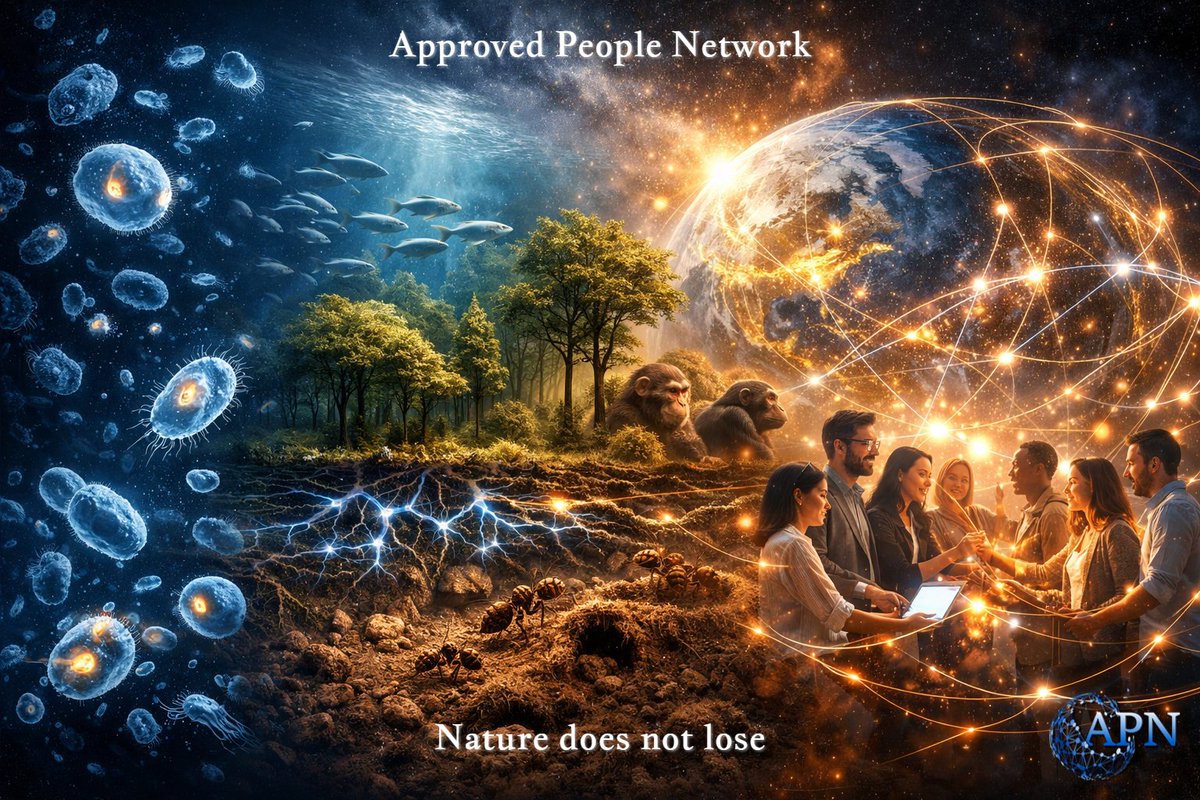
If you look closely, it is an exact replica of the mechanism nature has been refining for billions of years. It is that same fungal network connecting tree roots, so no one goes hungry. It is that same school of fish, where each individual is protected by the movement of millions. It is that ant colony, where personal success is impossible without the success of the common home.
We cannot lose. Why? Because we are not going against nature — we are going with its flow. The predator that eats the cleaner today will die from parasites tomorrow without its help. The tree that refuses to share will wither alone when the drought comes.
The great tournament of strategies showed: in the infinite game called "life," only cooperators win. Only those who, on the first move, offer trust, not a blow.
Approved People Network is that very first move. We extend our hand not to take away, but to create a network. A network where the success of each is multiplied by the success of all.
When you become part of this movement, you cease to be a grain of sand that the wind of history can blow away at any second. You become part of the Wood Wide Web. Part of the mycelium. Part of a living, breathing organism that grows according to the laws of life itself.
Nature does not build empires on deceit. It builds ecosystems on trust. Our path is inevitable. Our victory is predetermined. Not because we are smarter or cleverer. But because we have chosen the same strategy that transformed the primordial soup into blooming gardens.
Join the movement that evolution itself has chosen. Because evolution does not lose.
Approved People Network — we grow together, as nature intended.
Nature is wondrous in every form she takes. The very emergence and existence of life upon our cherished home - this alone is a miracle beyond words. An unfathomable constellation of variables is woven into the very fabric of life with absolute precision. And the foundation of all life on Earth is Water. Water, with her unique and sacred properties, holds memory within her depths and trembles at the vibrations of emotion. We must cherish what we have been given. We think, we are, we live, we dream, we seek to understand… We were made to nurture our common home - and yet, like quarrelsome children, we fight and tear apart all that surrounds us… Let your thoughts turn more often to kindness, to deeds of honesty and grace. One day, the noblest and brightest yearnings of the human heart shall prevail over darkness and malice. For it is infinitely more peaceful and more safe to dwell in trust, in compassion, in mutual care. This is the way of nature. You need only listen to the voice within your soul. And you shall hear… The Truth…
https://t.co/Pa6S80q3M1
People! Stop gloating and hating each other. Don't you see? They're pitting us against one another, dividing us, making us believe that those close to us are our enemies. You - the people - didn't start what you're now supporting! Wake up! This is the simplest manipulation - playing on emotions - and it works! Just think about it!
The Selfish Gene or the Great Altruist: Why Evolution Chooses Cooperation
We are used to thinking of nature as a brutal arena of struggle. "Man is a wolf to man," "survival of the fittest" — these phrases seem to us axioms of Darwinism. Fangs, claws, poisons, and deadly competition — all of this undoubtedly exists. But if you dig deeper, an astonishing thing is revealed: the main driver of progress in evolution is not fighting, but the ability to negotiate.
Biologists and mathematicians have been trying for half a century to answer the question: is cooperation a random occurrence or a fundamental law of life? And the data inexorably shows: evolution methodically weeds out absolute egoists. Those who know how to unite always conquer the world.
The Paradox of the Altruist
How could altruism even arise? Why does a bee give its life when stinging an enemy, if it dies in the process? The "heroism" gene should have disappeared — yet it exists.
The answer was found by William Hamilton in 1964. A bee's genes are immortal not within itself, but within its sisters and mother. The bee stings an enemy not because it is "brave," but because its genes command it to save the body of the hive, where millions of these genes reside. This is called kin selection.
But this only explained help among relatives. What about cooperation between strangers?
The Mathematics of Kindness: Axelrod's Tournament
In the late 70s, political scientist Robert Axelrod organized a tournament based on the "Prisoner's Dilemma" — the classic model of conflict between personal gain and the common good. Participants submitted complex algorithms: bluff, total aggression, cunning.
And the winner was the simplest program. It was called "Tit for Tat." Its logic: on the first move, always cooperate; then simply copy your opponent's action. They helped you — help them; they betrayed you — punish them.
This strategy won because it was kind (never betrayed first), forgiving, and clear. Axelrod's conclusion was a sensation: in the long term, in a world where beings meet repeatedly, it is evolutionarily more advantageous to be a cooperator. Egoists win in the moment, but lose in eternity.
Interview with Nature
Field biologists see cooperation at every step. Cleaner fish set up "service stations" on reefs. Predators could eat them, but they don't — because the cleaners rid them of parasites. If a cleaner cheats, it gets put on a "blacklist." Fish remember cheaters and prefer honest partners.
The most large-scale cooperation happens right beneath our feet. Suzanne Simard proved the existence of the "Wood Wide Web" — trees in the forest are connected by a giant network of fungi. Old "mother" trees feed young saplings that lack sunlight. The forest is not a collection of individuals fighting for light, but a single superorganism.
Frans de Waal, studying chimpanzees, showed that politics and alliances are not a human invention. Primates live in a complex web of mutual obligations. By helping the weak today, you can gain support against the strong tomorrow.
Cooperation as the Engine of Evolution
Biologist David Sloan Wilson formulated the theory of multilevel selection: egoists win within a group, but groups of cooperators win against groups of egoists. A single ant is helpless, but an ant colony is a biological weapon, capable of building cities and solving complex problems.
Evolution doesn't tell us "be good." It simply conducts experiments. And the experiments show: the strategy of total aggression leads to a dead end. Cooperation allowed life to transition from single cells to multicellular organisms. It allowed us to leave the savanna and build civilization.
The main lesson of evolution sounds like this: unite, or you will lose.
Nature Does Not Lose
Evolution is not an archive of dusty facts. It is a living current flowing through us right now. And this current has a direction. From simple to complex. From loneliness to unity. From competition to co-creation.
Look at the history of life. First, there were single cells devouring each other in the primordial soup. It was a dead end. But one day, two cells decided not to fight, but to unite. Thus, the first cooperation was born. From it came fish, dinosaurs, trees, and — us.
In a world where old structures are crumbling, where "man is a wolf to man" leads civilization into the dead end of loneliness, there is another path. The path of mycorrhiza. The path of symbiosis. The path that evolution has recognized as the only true one for millions of years.
Approved People Network was born from this understanding.
If you look closely, it is an exact replica of the mechanism nature has been refining for billions of years. It is that same fungal network connecting tree roots, so no one goes hungry. It is that same school of fish, where each individual is protected by the movement of millions. It is that ant colony, where personal success is impossible without the success of the common home.
We cannot lose. Why? Because we are not going against nature — we are going with its flow. The predator that eats the cleaner today will die from parasites tomorrow without its help. The tree that refuses to share will wither alone when the drought comes.
The great tournament of strategies showed: in the infinite game called "life," only cooperators win. Only those who, on the first move, offer trust, not a blow.
Approved People Network is that very first move. We extend our hand not to take away, but to create a network. A network where the success of each is multiplied by the success of all.
When you become part of this movement, you cease to be a grain of sand that the wind of history can blow away at any second. You become part of the Wood Wide Web. Part of the mycelium. Part of a living, breathing organism that grows according to the laws of life itself.
Nature does not build empires on deceit. It builds ecosystems on trust. Our path is inevitable. Our victory is predetermined. Not because we are smarter or cleverer. But because we have chosen the same strategy that transformed the primordial soup into blooming gardens.
Join the movement that evolution itself has chosen. Because evolution does not lose.
Approved People Network — we grow together, as nature intended.
The Selfish Gene or the Great Altruist: Why Evolution Chooses Cooperation
We are used to thinking of nature as a brutal arena of struggle. "Man is a wolf to man," "survival of the fittest" — these phrases seem to us axioms of Darwinism. Fangs, claws, poisons, and deadly competition — all of this undoubtedly exists. But if you dig deeper, an astonishing thing is revealed: the main driver of progress in evolution is not fighting, but the ability to negotiate.
Biologists and mathematicians have been trying for half a century to answer the question: is cooperation a random occurrence or a fundamental law of life? And the data inexorably shows: evolution methodically weeds out absolute egoists. Those who know how to unite always conquer the world.
The Paradox of the Altruist
How could altruism even arise? Why does a bee give its life when stinging an enemy, if it dies in the process? The "heroism" gene should have disappeared — yet it exists.
The answer was found by William Hamilton in 1964. A bee's genes are immortal not within itself, but within its sisters and mother. The bee stings an enemy not because it is "brave," but because its genes command it to save the body of the hive, where millions of these genes reside. This is called kin selection.
But this only explained help among relatives. What about cooperation between strangers?
The Mathematics of Kindness: Axelrod's Tournament
In the late 70s, political scientist Robert Axelrod organized a tournament based on the "Prisoner's Dilemma" — the classic model of conflict between personal gain and the common good. Participants submitted complex algorithms: bluff, total aggression, cunning.
And the winner was the simplest program. It was called "Tit for Tat." Its logic: on the first move, always cooperate; then simply copy your opponent's action. They helped you — help them; they betrayed you — punish them.
This strategy won because it was kind (never betrayed first), forgiving, and clear. Axelrod's conclusion was a sensation: in the long term, in a world where beings meet repeatedly, it is evolutionarily more advantageous to be a cooperator. Egoists win in the moment, but lose in eternity.
Interview with Nature
Field biologists see cooperation at every step. Cleaner fish set up "service stations" on reefs. Predators could eat them, but they don't — because the cleaners rid them of parasites. If a cleaner cheats, it gets put on a "blacklist." Fish remember cheaters and prefer honest partners.
The most large-scale cooperation happens right beneath our feet. Suzanne Simard proved the existence of the "Wood Wide Web" — trees in the forest are connected by a giant network of fungi. Old "mother" trees feed young saplings that lack sunlight. The forest is not a collection of individuals fighting for light, but a single superorganism.
Frans de Waal, studying chimpanzees, showed that politics and alliances are not a human invention. Primates live in a complex web of mutual obligations. By helping the weak today, you can gain support against the strong tomorrow.
Cooperation as the Engine of Evolution
Biologist David Sloan Wilson formulated the theory of multilevel selection: egoists win within a group, but groups of cooperators win against groups of egoists. A single ant is helpless, but an ant colony is a biological weapon, capable of building cities and solving complex problems.
Evolution doesn't tell us "be good." It simply conducts experiments. And the experiments show: the strategy of total aggression leads to a dead end. Cooperation allowed life to transition from single cells to multicellular organisms. It allowed us to leave the savanna and build civilization.
The main lesson of evolution sounds like this: unite, or you will lose.
Nature Does Not Lose
Evolution is not an archive of dusty facts. It is a living current flowing through us right now. And this current has a direction. From simple to complex. From loneliness to unity. From competition to co-creation.
Look at the history of life. First, there were single cells devouring each other in the primordial soup. It was a dead end. But one day, two cells decided not to fight, but to unite. Thus, the first cooperation was born. From it came fish, dinosaurs, trees, and — us.
In a world where old structures are crumbling, where "man is a wolf to man" leads civilization into the dead end of loneliness, there is another path. The path of mycorrhiza. The path of symbiosis. The path that evolution has recognized as the only true one for millions of years.
Approved People Network was born from this understanding.
If you look closely, it is an exact replica of the mechanism nature has been refining for billions of years. It is that same fungal network connecting tree roots, so no one goes hungry. It is that same school of fish, where each individual is protected by the movement of millions. It is that ant colony, where personal success is impossible without the success of the common home.
We cannot lose. Why? Because we are not going against nature — we are going with its flow. The predator that eats the cleaner today will die from parasites tomorrow without its help. The tree that refuses to share will wither alone when the drought comes.
The great tournament of strategies showed: in the infinite game called "life," only cooperators win. Only those who, on the first move, offer trust, not a blow.
Approved People Network is that very first move. We extend our hand not to take away, but to create a network. A network where the success of each is multiplied by the success of all.
When you become part of this movement, you cease to be a grain of sand that the wind of history can blow away at any second. You become part of the Wood Wide Web. Part of the mycelium. Part of a living, breathing organism that grows according to the laws of life itself.
Nature does not build empires on deceit. It builds ecosystems on trust. Our path is inevitable. Our victory is predetermined. Not because we are smarter or cleverer. But because we have chosen the same strategy that transformed the primordial soup into blooming gardens.
Join the movement that evolution itself has chosen. Because evolution does not lose.
Approved People Network — we grow together, as nature intended.
@failure1991 Death and destruction are offshoots of egoism-a trait required only during a specific phase of evolution. As intricate social beings, our survival is contingent upon cooperation. Such is the law of nature.
https://t.co/lGgMZaqGRB
The Selfish Gene or the Great Altruist: Why Evolution Chooses Cooperation
We are used to thinking of nature as a brutal arena of struggle. "Man is a wolf to man," "survival of the fittest" — these phrases seem to us axioms of Darwinism. Fangs, claws, poisons, and deadly competition — all of this undoubtedly exists. But if you dig deeper, an astonishing thing is revealed: the main driver of progress in evolution is not fighting, but the ability to negotiate.
Biologists and mathematicians have been trying for half a century to answer the question: is cooperation a random occurrence or a fundamental law of life? And the data inexorably shows: evolution methodically weeds out absolute egoists. Those who know how to unite always conquer the world.
The Paradox of the Altruist
How could altruism even arise? Why does a bee give its life when stinging an enemy, if it dies in the process? The "heroism" gene should have disappeared — yet it exists.
The answer was found by William Hamilton in 1964. A bee's genes are immortal not within itself, but within its sisters and mother. The bee stings an enemy not because it is "brave," but because its genes command it to save the body of the hive, where millions of these genes reside. This is called kin selection.
But this only explained help among relatives. What about cooperation between strangers?
The Mathematics of Kindness: Axelrod's Tournament
In the late 70s, political scientist Robert Axelrod organized a tournament based on the "Prisoner's Dilemma" — the classic model of conflict between personal gain and the common good. Participants submitted complex algorithms: bluff, total aggression, cunning.
And the winner was the simplest program. It was called "Tit for Tat." Its logic: on the first move, always cooperate; then simply copy your opponent's action. They helped you — help them; they betrayed you — punish them.
This strategy won because it was kind (never betrayed first), forgiving, and clear. Axelrod's conclusion was a sensation: in the long term, in a world where beings meet repeatedly, it is evolutionarily more advantageous to be a cooperator. Egoists win in the moment, but lose in eternity.
Interview with Nature
Field biologists see cooperation at every step. Cleaner fish set up "service stations" on reefs. Predators could eat them, but they don't — because the cleaners rid them of parasites. If a cleaner cheats, it gets put on a "blacklist." Fish remember cheaters and prefer honest partners.
The most large-scale cooperation happens right beneath our feet. Suzanne Simard proved the existence of the "Wood Wide Web" — trees in the forest are connected by a giant network of fungi. Old "mother" trees feed young saplings that lack sunlight. The forest is not a collection of individuals fighting for light, but a single superorganism.
Frans de Waal, studying chimpanzees, showed that politics and alliances are not a human invention. Primates live in a complex web of mutual obligations. By helping the weak today, you can gain support against the strong tomorrow.
Cooperation as the Engine of Evolution
Biologist David Sloan Wilson formulated the theory of multilevel selection: egoists win within a group, but groups of cooperators win against groups of egoists. A single ant is helpless, but an ant colony is a biological weapon, capable of building cities and solving complex problems.
Evolution doesn't tell us "be good." It simply conducts experiments. And the experiments show: the strategy of total aggression leads to a dead end. Cooperation allowed life to transition from single cells to multicellular organisms. It allowed us to leave the savanna and build civilization.
The main lesson of evolution sounds like this: unite, or you will lose.
Nature Does Not Lose
Evolution is not an archive of dusty facts. It is a living current flowing through us right now. And this current has a direction. From simple to complex. From loneliness to unity. From competition to co-creation.
Look at the history of life. First, there were single cells devouring each other in the primordial soup. It was a dead end. But one day, two cells decided not to fight, but to unite. Thus, the first cooperation was born. From it came fish, dinosaurs, trees, and — us.
In a world where old structures are crumbling, where "man is a wolf to man" leads civilization into the dead end of loneliness, there is another path. The path of mycorrhiza. The path of symbiosis. The path that evolution has recognized as the only true one for millions of years.
Approved People Network was born from this understanding.
If you look closely, it is an exact replica of the mechanism nature has been refining for billions of years. It is that same fungal network connecting tree roots, so no one goes hungry. It is that same school of fish, where each individual is protected by the movement of millions. It is that ant colony, where personal success is impossible without the success of the common home.
We cannot lose. Why? Because we are not going against nature — we are going with its flow. The predator that eats the cleaner today will die from parasites tomorrow without its help. The tree that refuses to share will wither alone when the drought comes.
The great tournament of strategies showed: in the infinite game called "life," only cooperators win. Only those who, on the first move, offer trust, not a blow.
Approved People Network is that very first move. We extend our hand not to take away, but to create a network. A network where the success of each is multiplied by the success of all.
When you become part of this movement, you cease to be a grain of sand that the wind of history can blow away at any second. You become part of the Wood Wide Web. Part of the mycelium. Part of a living, breathing organism that grows according to the laws of life itself.
Nature does not build empires on deceit. It builds ecosystems on trust. Our path is inevitable. Our victory is predetermined. Not because we are smarter or cleverer. But because we have chosen the same strategy that transformed the primordial soup into blooming gardens.
Join the movement that evolution itself has chosen. Because evolution does not lose.
Approved People Network — we grow together, as nature intended.