How does leukaemia develop? 🩸 How long does it take? ⏳
🌟 Our paper, started back when I was a PhD student in @jrblundell’s lab, is out today in @Nature 🌟
Yearly blood samples from women who developed AML in later life let us trace it back decades 👇
https://t.co/fqyOpc5OKH
@javid_lab@NikoMcCarty Pretty much everybody knows it's not really simple and elegant. The cool trick that many "experimentum crucis" approaches use though, is to find a point of view, from which a certain aspect of it becomes simple and elegant.
1/8 What remains undiscovered in the human kidney? 🔍
While building an integrated human kidney atlas for the Human Cell Atlas, we discovered new biology—presented in our new preprint, with highlights below. 🧵
https://t.co/Z1veUKiFqS
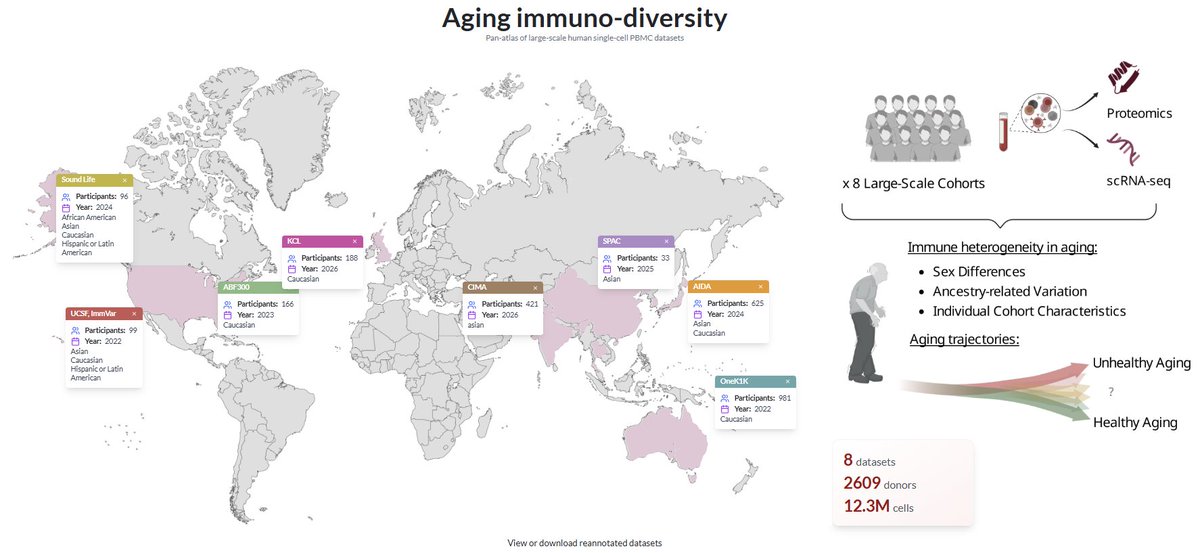
Out today in Immunity! Our pan-atlas of human immune aging: 12.4 million PBMCs from 2,609 people across 8 global cohorts (including new 188 people cohort from UK).
https://t.co/hYbe2k3XEi
We map shared aging patterns onto 59 key immune populations and link the balance of GZMK+ and GZMB+ CD8 effector memory T cells to health trajectories; show differences in RTEs and Th2s with sex etc; ethnicity associated features.
https://t.co/AHmFVQVfM6
How it came to be:
in 2023 we published first hierarchically annotatied atlas of human immune aging in PBMC - 166 people, 55 populations, key changes revealed - CD8 naives, KLRC2/NKG2C+ CD8 memory going down, GZMK+ CD8 T cells and Th2 and Tc2 type 2 memory cells going up! (Terekhova et al, Immunity 2023)
in 2024 we added major phenotypes within naive cells - SOX4+ RTE cells and their CD38 marker going down. (Bohacova et al, Immunity 2024)
In 2025-26 more atlases published with their own annotations making impossible to leverage power of data..
Now we provide unique in its power and consistency resource - 2600 people across ages, sexes, races, continents etc. All annotated in sync and analyzed for what aging looks like globally!
@e_dampier@baym Who says it's 6-10 years away? Vaccines against herpesviruses are among the hardest things to create. So far any timeline seems pretty much meaningless
This is fun.
1. Mango Banana - banana on the outside, mango on the inside. Enough said.
2. Plant machine interfaces - we should be able to trade plants N,P,H2O for reduced carbon compounds. Do to them what they did to chloroplasts
3. Solution phase self assembly of 3D memory chips using designed self-assembly of macromolecules - do we really get protein design
4. A brain the size of a building. - what would it be thinking?
5. A five assed monkey - bc South Park
6. Self growing housing - the rent is too damn high
7. Obviously brain machine interfaces - I will judge this by when I can browse the web by thinking about it.
8. Dinosaurs.
9. Cats with dog personalities.
10. A nice smelling microbiome
@StevenSalzberg1 so, to put it short, you don't believe in GWAS? that's pretty wild. Don't you think it merits an editorial? Do you also not believe in RVAS?
@StevenSalzberg1 RSS might be an unfortunate acronym - there's a recombination signal sequence (RSS) in VDJ recombination. General similarity of context would make it hard to distinguish the two in searches, AI-based analysis, etc.