FSD V14 Lite has just officially started rolling out to @Tesla owners with HW3! It’s finally here!
V14 Lite introduces many of the same features for HW3 owners as V14 for HW4 owners, including:
• Speed profiles
• Start self-driving rom park
• Arrival options
• and much more!
Tesla has officially filed to launch vehicle sales and service in Bulgaria.
Business activity: import, operation, distribution, sales, servicing, maintenance and repair.
Following future rollout of FSD V14 Lite for HW3 vehicles in the US, we plan on expanding V14 Lite to additional international markets.
This update ensures that HW3 vehicle owners will continue to benefit from ongoing software updates.
Since international rollout is subject to several factors (completion of technical verification, regional adaptation & relevant regulatory approvals), we can't provide definitive dates at the moment, but will provide updates on a rolling basis
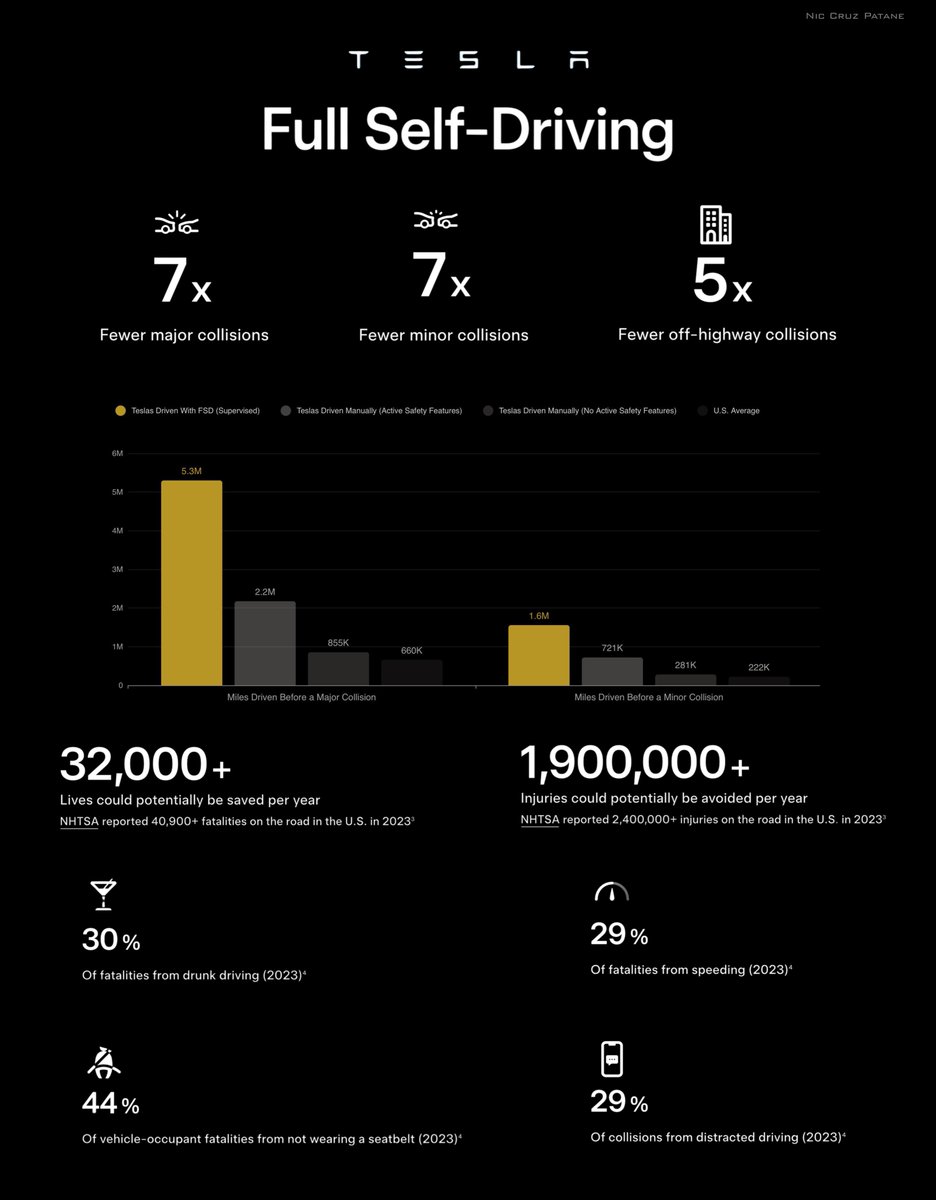
Tesla Full Self-Driving;
• 7x Fewer Major Collisions
• 7x Fewer Minor Collisions
• 5x Fewer Off-Highway Collisions
Miles Driven Before Major Collisions:
• Teslas Driven w/FSD (Supervised): 5.3M
• U.S. Average: 660K
Miles Driven Before Minor Collisions:
• Teslas Driven w/FSD (Supervised): 1.6M
• U.S. Average: 222K
Tesla Model Y’s AWD system outperforms ICE systems due to instant torque delivery and precise, real-time power distribution to each wheel.
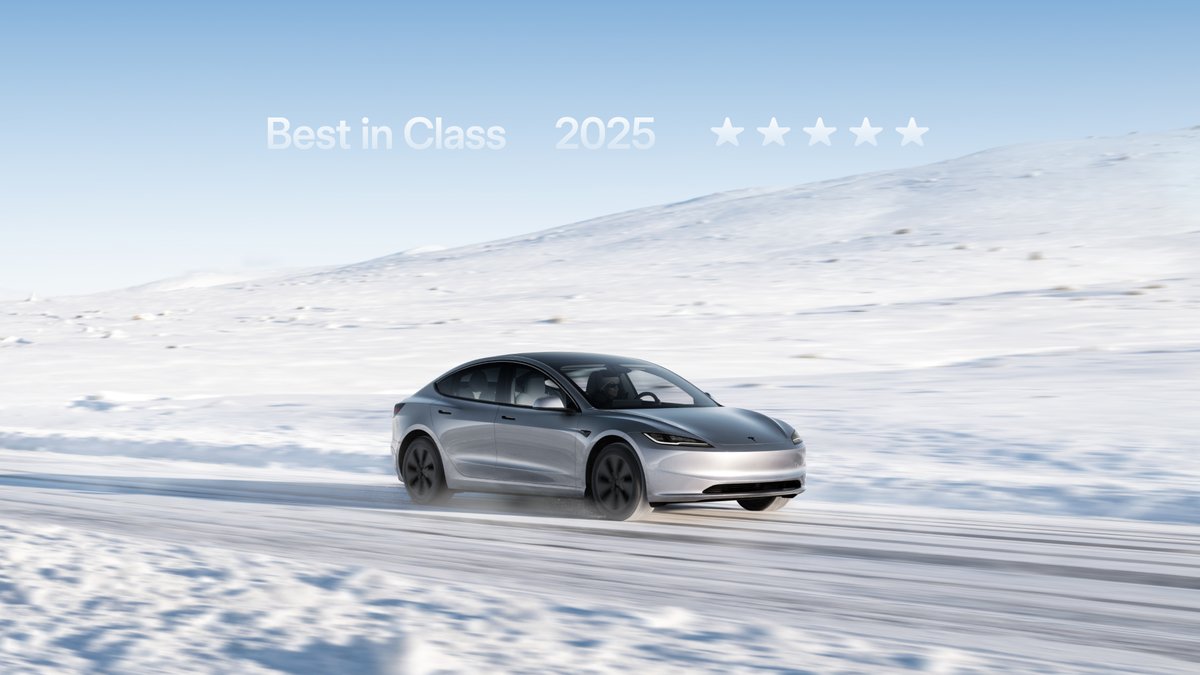
Tesla vehicles handle amazingly in the snow.
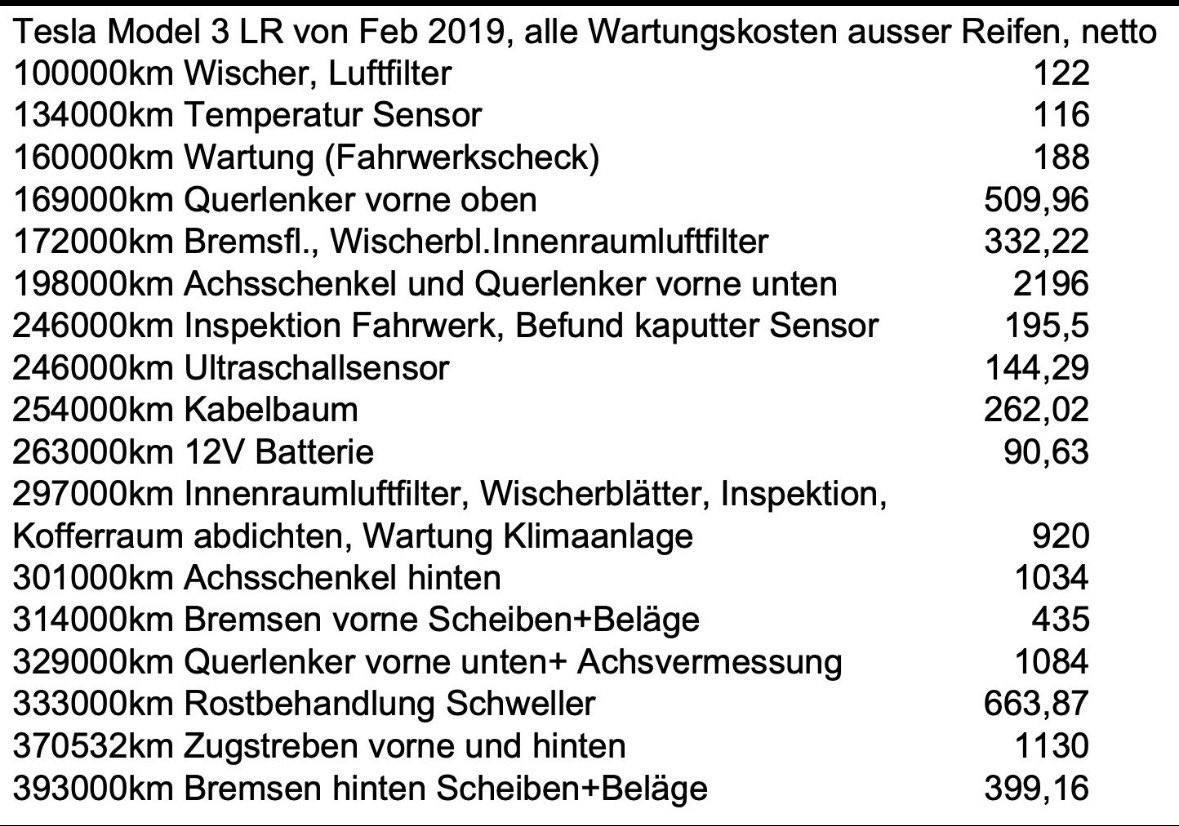
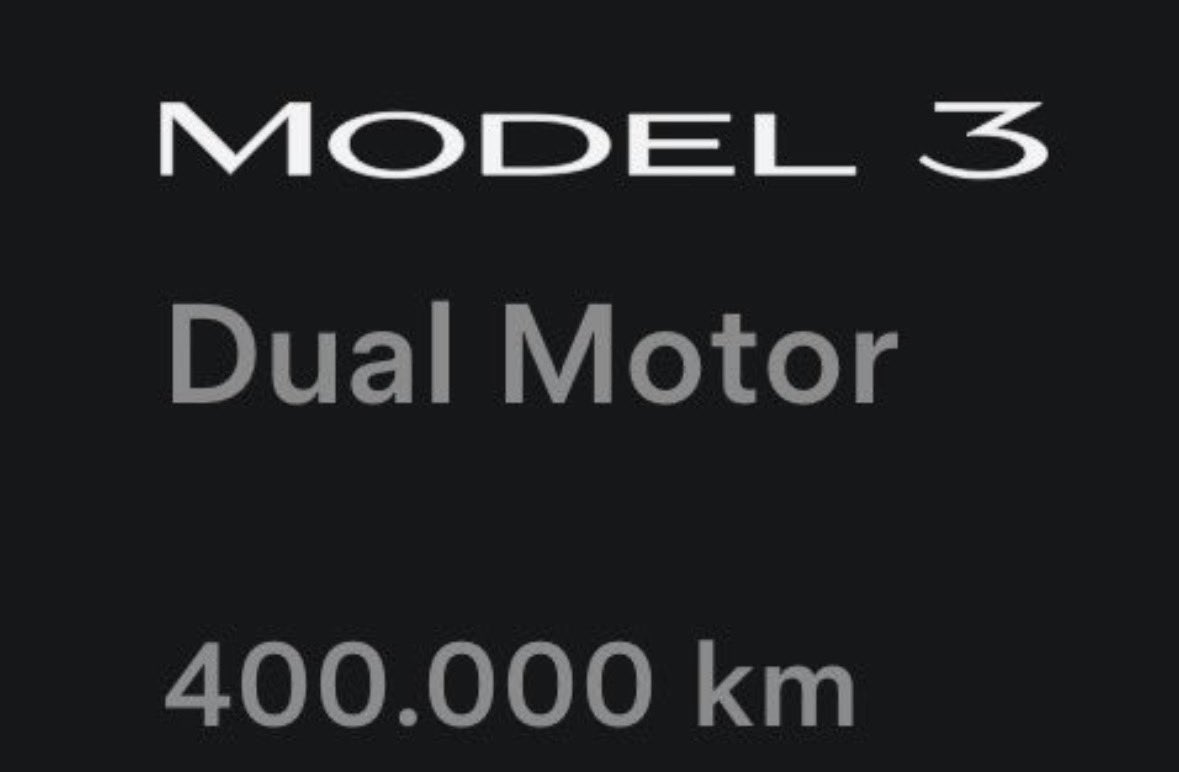
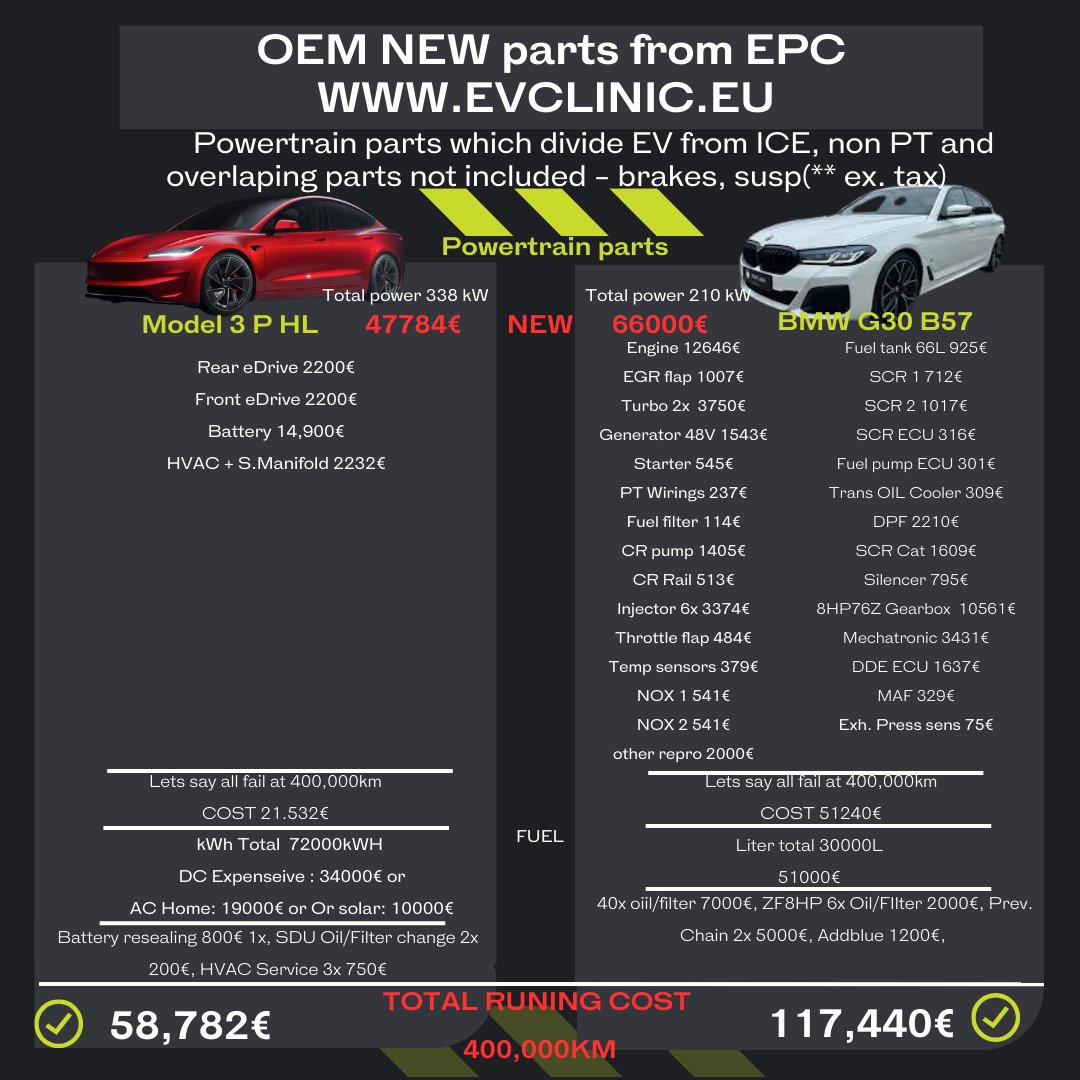
Original Panasonic pack with 400,000km - Tesla Model 3 Long Range with Original motors and original battery. No drivetrain replacements. No diesel theology “drama.” And most importantly, this car was spent around €20,000 on electricity.
All real maintenance costs are known and transparent: suspension components, brakes, sensors, filters, the 12-volt battery, air conditioning, and minor repairs. No oil. No gearbox. No turbochargers. No DPF. No EGR. In total, the complete operation of this Tesla powertrain system which doesnt overlap with ICE for over 400,000 km comes to roughly 3000€ which far away of worst case scenario where we calculated that he needs to change all powertrain components only at 400k 23000€. Overlaping brake system, suspension and other are same for ICE and took into account becase EV parts are most hated and used as reference.
Now put this next to a BMW G30 with the B57 diesel engine. Same class of vehicle, but objectively weaker, heavier, louder, and less enjoyable to drive. Fuel alone over 400,000 km, at a realistic consumption, costs between €42,000 and €52,000. That is already more than the Tesla spent on all electricity and all maintenance combined.
And that’s where the diesel really starts paying the price. Regular services, oil changes, filters, injectors, EGR, DPF, turbochargers, transmission, differential, cooling system, electronics — and most expensively, labor hours. In the real world, a G30 B57 at 400,000 km rarely stays below €80,000 in total operating costs and often ends up closer to €100,000. So, a German diesel eats the cost of two EVs over 400,000 km. One EV pays for itself through savings alone — something ICE can never achieve. That’s why EV prices can drop: EV owners can actually afford it.
The result is simple and uncomfortable for diesel mythology: compared to the BMW, this Tesla saved at least €50,000 — more realistically €60,000 to €70,000. So if two neighbors drive two cars — one a BMW diesel and the other a Tesla — the thing the BMW owner likes to mock, ‘the battery costs more than the car,’ actually turns out to be the advantage. Over the same mileage, it would make financial sense to replace the Tesla battery five times, compared to a BMW owner who only refuels and maintains his car. The math is that brutal.
More importantly, this saving came with no loss of functionality. The car was faster, quieter, more comfortable, and more enjoyable to drive the entire time. No compromises. No “but”.
Sustainability here is not measured by ideology, but by the fact that the original motors and the original battery are still in the car after 400,000 kilometers. This is not a theory of the future — it is proof of the present.
The conclusion is simple. Electric vehicles don’t win because they are “green.” They win because they are technically simpler, more energy-efficient, and cheaper over the long term. The BMW G30 B57 didn’t lose because it is a bad car. It lost because internal combustion technology has become too expensive for what it delivers.
Everything else is just an attempt to ignore that fact.
@XaverFischer8@elonmusk@Tesla
Diesel Mythology vs. EV Reality
We’ve been planning to write this for a long time, because online trolls and what can only be described as diesel terrorism have become unbearable. Every discussion about electric vehicles ends with the same worn-out slogans: EVs are more expensive, batteries are unaffordable, everything is worse than a “real” fossil-fuel car, “you lose freedom,” and so on.
The problem is that these claims have been repeated for years, yet almost no one ever puts them on paper and actually checks them. Ninety-nine percent of those shouting the loudest don’t even know the official OEM prices of basic service parts.
Once you finally do the math, the picture flips upside down very quickly.
When all numbers are entered and cold facts are reviewed, the fossil-fuel car is already more expensive at the starting line — and significantly more expensive over 400,000 kilometers of use, even if both vehicles change owners during that time. And this is in a scenario that is extremely fair to diesel and intentionally pessimistic toward the electric vehicle.
In this calculation, we didn’t even include one of the biggest real-world differences: on an EV, you can replace the battery, front and rear motors, and other drivetrain components within 24 to 48 working hours. On a BMW of the same class, replacing everything on the same list would very likely exceed 500 labor hours. Today, labor is more expensive than parts — a reality diesel romanticism often forgets.
A common argument is that fossil cars have used parts “on every corner.” True — but so do EVs. There are used batteries for €5,000, electric motors for €1,000. The difference is that an EV has far fewer parts and much lower mechanical complexity, which often makes it easier to repair in practice than a classic internal combustion engine. That’s precisely why we deliberately chose an extreme scenario: both vehicles replacing their entire drivetrain — 100% — within 400,000 kilometers. Realistically, most cases won’t even come close to that; they’ll be closer to 70% for both concepts. (On a Model 3, the motor doesn’t even fail at that mileage.)
Even with such an extremely unfavorable calculation for the electric car, the conclusion is clear: the fossil-fuel car is at least twice as expensive. Cost per kilometer is at least 2× higher — and if the EV is mostly charged at a cheap home tariff, the difference moves toward 3×.
Another favorite talking point is that EVs “charge for days.” This is typical diesel agenda nonsense that collapses the moment real-world usage is calculated. Over 400,000 kilometers, a diesel car stops at a fuel station roughly 550 times. If each refuel takes about 10 minutes, that’s 92 hours of life spent holding a pump, a cap, and waiting at the cashier.
For an electric car, in the worst-case scenario where it charges exclusively on DC fast chargers, we get around 1,300 charging sessions and roughly 540 hours total if each session lasts about 25 minutes. That’s about six times more than diesel — a number the diesel side loves to repeat.
But that’s not real life.
In reality, at least in the Balkans, more than 65% of the population has access to a power outlet at home. The problem is that fossil-fuel propagandists don’t understand that a household socket is a charger. In that case, charging takes no time at all. You come home, plug in the car in the evening, and in the morning it’s ready. Waiting time is practically zero.
If we assume the EV is charged at home for all 400,000 kilometers, the total electricity cost in Croatia is around €9,360. Time spent “refueling”: zero hours.
In that scenario, total vehicle operation — including energy, servicing, and even replacement of the battery, motors, and air conditioning — comes to roughly €34,000. Compared to a fossil-fuel car, that’s about three and a half times less.
We arrive at an absurd but mathematically correct conclusion: a fossil-fuel car doesn’t make financial sense even if all parts and all maintenance labor were free. Even if you replaced the Tesla battery three times and still spent more time charging than refueling diesel, the fossil-fuel car remains more expensive.
For those of us who work seriously with electric vehicles, this was obvious long before EVs started conquering the market. Today, with EV sales exploding worldwide — especially in China — it’s legitimate to ask how strong diesel propaganda in Europe, and particularly in Germany, has been, to the detriment of its own citizens. All of this in a region that still massively relies on one of the worst forms of personal transport ever invented.
What’s most worrying is how mainstream propaganda has turned ordinary readers into fanatical diesel guerrilla defenders, flooding EV discussions on social media with disinformation and clichés. People who, without any tools for cost analysis and without basic use of a calculator, aggressively defend a technology that objectively costs them more — and drains their finances.
If we take the worst possible scenario for an electric car — a Tesla charged exclusively on expensive DC fast chargers — we reach an interesting but rarely mentioned calculation.
Compared to diesel, the Tesla spends about 450 more hours charging. At the same time, the total savings compared to a fossil-fuel car amount to roughly €77,000.
Put together, this means that every additional hour spent at a DC charger is “paid” about €170. In other words, waiting to charge becomes a financially profitable decision — it’s the price you pay to avoid driving an expensive fossil car.
And that’s using the most pessimistic math possible for an electric vehicle.
If someone has a problem with waiting, the problem isn’t the technology — it’s the math.
Electric cars are not perfect, and we’ve never claimed they are. But once emotions, habits, and ideology are removed, and only mathematics remains, the story is very simple. Fossil cars don’t have a soul — they have chains on your freedom and your wallet.
The problem is no longer technology.
The problem is accepting facts.
Of course, there are cheaper fossil cars and more expensive EVs — but the math ends up on the EV side every single time.
PDF Pricelist from EPC: https://t.co/JbmLhyzQm9
Buying a used EV, is it really a trap?
In this episode, we break down the biggest concerns around battery life and range loss. Using real-world examples, we look at how EV batteries actually age over time. We also explore how CATL designs batteries for long-term use and value.
Watch first, then decide.
#CATL #ShenxingPro #UsedEV #ElectricVehicles #EVBattery #EVMyths
AutoBild, the famous European car magazine, tested Tesla FSD (Supervised) in Berlin and came away enthusiastic:
✅ “From the passenger seat, I can see how advanced the system is.”
✅ The system detects hazards early, like pedestrians at crosswalks or obstacles in the road, and responds calmly and smoothly.
✅ Only one intervention was needed when the car misinterpreted a modified one-way street. Otherwise, it navigated busy city traffic, construction zones, and congestion flawlessly.