At this week's reading group we had a multi-agent discussion of the paper "Rethinking the Bounds of LLM Reasoning: Are Multi-Agent Discussions the Key?" by @qineng_wang , Zihao Wang, Ying Su, Hanghang Tong, and @yqsong. https://t.co/adn6Ar5hLU
Food for thought! Our weekly reading group just wrapped up a highly topical and interesting discussion of the preprint "Large Language Models are more persuasive than incentivized human persuaders” by @SchoeneggerPhil and 39(!) co-authors.
Chris is today at Guanghua Law school, Zhejiang University at the kind invitation of https://t.co/OQy8diCtXq to give a talk on "The challenge of witness testimony". If you missed it, he'll be giving a related talk at ZLAIRE (https://t.co/a7TwfF0Qo3) group tomorrow at 4pm.
Today, in our reading group we discussed the paper “Comparing the argumentum model of topics to other contemporary approaches to argument schemes: The procedural and material components” by Eddo Rigotti and @ArgtweetSara.
https://t.co/XcXkF5FmNY
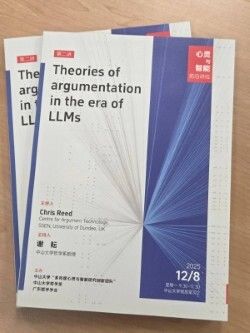
Chris is giving a lecture at the College of Philosophy, Nankai University this Friday at 4pm on "Ways of reasoning". If you're in the Beijing area, do think about coming along!
At this week’s reading group we discussed the paper “CASA: Causality-driven Argument Sufficiency Assessment” by Xiao Liu, Yansong Feng, and @kaiwei_chang . https://t.co/KFxX9fXSJS
Chris is at #EMNLP2025 presenting work with Yevhen Kostiuk and Clara Seyfried on Automating Alternative Generation in Decision-Making. Find him from 1300CST today in the poster session in Hall C.
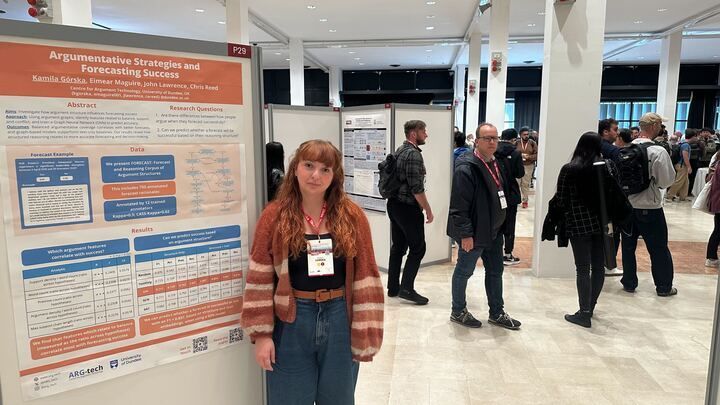
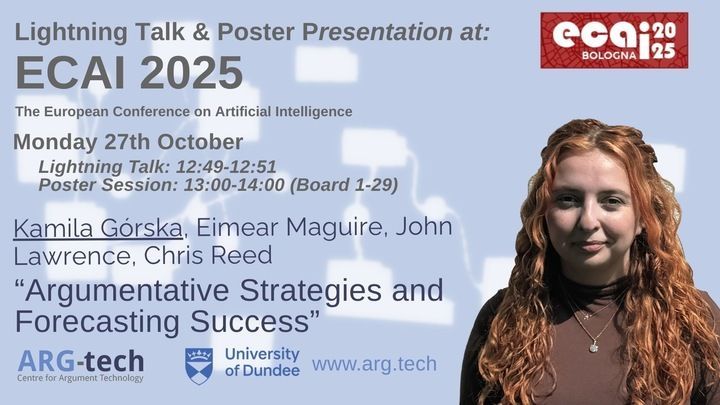
Kamila Górska and John Lawrence are at #ECAI2025 presenting their work on Argumentative Strategies and Forecasting Success, and DRACS: Diachronic Representation of Argument Construction Styles.
This is the first study to systematically connect fine-grained argumentative structure with forecasting success, highlighting the role of structured reasoning in predictive accuracy.
📄 Read the full paper at: https://t.co/sXyjTRygG4
🎉 We are excited to present 'Argumentative Strategies and Forecasting Success’ at ECAI 2025! It investigates the role reasoning plays in predicting future events. If you are interested, read more details below! 🧵👇 #ECAI2025#Argumentation#Forecasting
🧠 Forecasts that show balanced argumentative coverage, addressing multiple possible hypotheses rather than focusing on a single one, are associated with higher accuracy.
Graph-based models also outperform text-only baselines.
📢 Our PhD student Kamila will present her paper "Argumentative Strategies and Forecasting Success" on Monday 27th October at ECAI 2025!
⚡Lighning Talk: 12:49-12:51
📄Poster Session: 13:00-14:00 (board 1-29)
See you all in Bologna!
📢 We are looking forward to presenting "DRACS: Diachronic
Representation of Argument Construction Styles" by Yevhen Kostiuk, Chris Reed, John Lawrence on 27th October at ECAI 2025. #ECAI2025#Argumentation
⚡Lighning Talk: 12:57-12:59
📄Poster Session: 13:00-14:00 (board 2-157)
This week, we discussed the paper "ImpScore: A Learnable Metric For Quantifying The Implicitness Level of Sentences" by @rainxine@saeedhp@CrashTheMod3 et al., presenting an exciting method to move beyond semantic representations into indirect meaning. https://t.co/kcOHHQjS69
At this week’s reading group, we discussed the paper "On the Controllability of Large Language Models for Dialogue Interaction" by Nicolas Wagner and Stefan Ultes. https://t.co/53HIiclBrL
Today in our reading group we discussed the preprint, "The Thin Line Between Comprehension and Persuasion in LLMs", by Adrian de Wynter and Tangming Yuan, which annotates and evaluates debates with humans and LLMs.