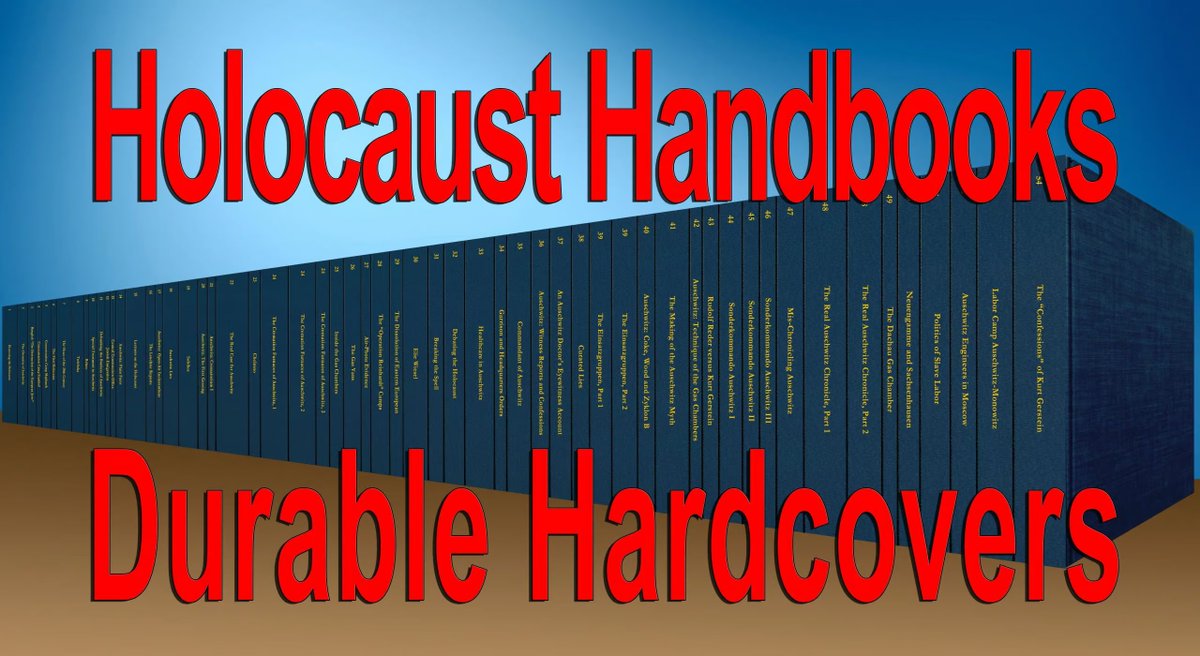
Our 54 volumes (58 individual books) from the Holocaust Handbook series are now available in hardcover format! Get them individually or as a set for a steep discount.
https://t.co/UsSBX7jx0i
@AliceRGlasser@M4990tz@Gailchon@TalHartuv The burden of proof lies on the party making the criminal accusations against the Germans. If this burden were met it wouldn't be necessary to hamper open discussion of the topic.
https://t.co/uXDv9hrJaj
@8sOYx1pi5p3082@doomernat22@k6kd9d Thanks for your input! I don't have decisions over these matters. I direct you to our contact form to reach out.
https://t.co/CeIuTINyhu
The orthodox narrative of what transpired at the infamous Auschwitz Concentration/Labor Camp during the Second World War congealed into ist current version in the environs of the Great Auschwitz Trial staged at Frankfurt, Germany, during the mid-1960s. But how exactly did we get there?
On the occasion of the 60th anniversary of the occupation of Auschwitz by the Red Army in January 1945, Carlo Mattogno wrote an article titled “Auschwitz: 60 Years of Propaganda,” which investigated the early history of claims made about Auschwitz. The present study greatly expands on this theme.
It starts out by analyzing radio messages sent by the SS from Auschwitz to their Berlin headquarters between early 1942 and early 1943. Many of these messages were intercepted and decrypted by the British, giving them a fairly accurate picture of what was going on at Auschwitz. Spoiler alert: the biggest drama unfolding there was a raging typhus epidemic.
Next, Mattogno juxtaposes to these SS messages the missives sent by the Polish underground to their government-in-exile in London, which painted a radically different image contradicting subsequently established facts and even at times themselves.
The largest section of this study analyzes the statements of more than fifty witnesses, most of them made during the war and in the immediate postwar period. The focus is on those passages in their statements that contain claims about mass murder by means of gas chambers. The bottom line of this review is that none of the early witnesses reviewed here fully confirms the current orthodox narrative. Instead, their stories are rife with propaganda absurdities and fantastic rumors.
The fourth section of this study analyzes the flawed early attempts by historians to write a consistent history of the Auschwitz Camp, while the last section demonstrates how modern historians twist the record in order to sustain the fiction that the orthodoxy’s fake version of the facts about Auschwitz is somehow “well-documented.”
This title is available from ARMREG:
https://t.co/UDn2thZ6GA
It is amazing what modern forensic crime-scene investigations can find out. This is also true for the Holocaust. There are many big tomes about this, such as Rudolf’s 400+ page book on the Chemistry of Auschwitz, or Mattogno’s 1200-page work on the crematoria of Auschwitz. But who reads those door-stops? Here is a booklet that condenses the most-important findings of Auschwitz forensics into a nut-shell, quick and easy to read.
This booklet of 124 pages offers an overview of the various forensic investigations on Auschwitz carried out so far. In the first section, the forensic investigations of the following authors are reviewed and compared: Soviet Commission (1945); Jan Sehn, Roman Dawidowski and Jan Robel (Poland 1945), Gerhard Dubin (Austria 1972), Fred Leuchter (Canada 1988), Germar Rudolf (Germany 1991, 2017), Carlo Mattogno and Franco Deana (Italy 1994, 2003, 2015), Willy Wallwey (Germany 1998) and Heinrich Köchel (Germany 2004/2015).
In the second section, the most-important results of these studies are summarized in such a way as to making them accessible to everyone. The main arguments focus on two topics. The first concerns chemical and toxicological properties of the agent said to have been used at Auschwitz for mass murder – Zyklon B – as well as the question of whether it has left traces in the masonry of the claimed execution gas chambers which can be detected analytically to this day. The second topic deals with mass cremations of bodies in crematoria on the one hand and on pyres on the other, which are said to have been carried out outdoors. Did the crematoria of Auschwitz have the required capacity to cremate the many hundreds of thousands of victims of the claimed mass murder? Do air photos taken by Allied reconnaissance aircraft over Auschwitz in 1944 confirm witness statements reporting huge smoking pyres? Find the answers to these questions in this booklet, together with many references to source material and further reading.
The third section reports on how the establishment has reacted to these research results: initially with skepticism and curiosity, but then increasingly with censorship and persecution. At the end, this book asserts that we all must have the right and the moral obligation to peacefully resist such dictatorial suppression of scholarly research.
If you want to read the results of forensic research on Auschwitz in a nutshell, this is the booklet to get.
This title is available from ARMREG:
https://t.co/V49c8sJSa4