Technology deals do not fail alike. SaaS can lose service or data. Platforms can lose customers. Founders can lose control or IP. Web3 projects can lock money or assets.
If your technology deal failed tomorrow, which consequence would worry you most?
Some technology disputes do not need a longer legal argument. They need the right technical question and a credible independent expert to answer it.
A-Resolve now offers Expert Determination for defined issues involving software, AI, cybersecurity, data, digital platforms, fintech, Web3, digital assets, technology valuation and related fields. For the right case, it can provide a faster, more focused and proportionate route, with binding or non-binding effect as the parties agree.
We are also building the A-Resolve Expert Network. Experienced technology specialists who would like to explore future appointments are invited to contact us by private message or at [email protected]. The first step is simply an introductory conversation about your expertise and how the process works.
Read the full A-Resolve analysis and use its practical contract stress test for B2B platforms, consumer services, founder and investor arrangements, and Web3 transactions:
https://t.co/U1FZLnLXK2
General information only; not legal advice.
The most expensive clause in a technology contract may be the one copied for free.
If this deal broke down tomorrow, would your contract give you a clear next step—or would you first have to fight about where and how to fight?
#TechnologyContracts#DisputeResolution
When a software project breaks down and the parties later disagree about what happened, which issue is usually the hardest to establish from the available documents and technical records?
Please avoid confidential details.
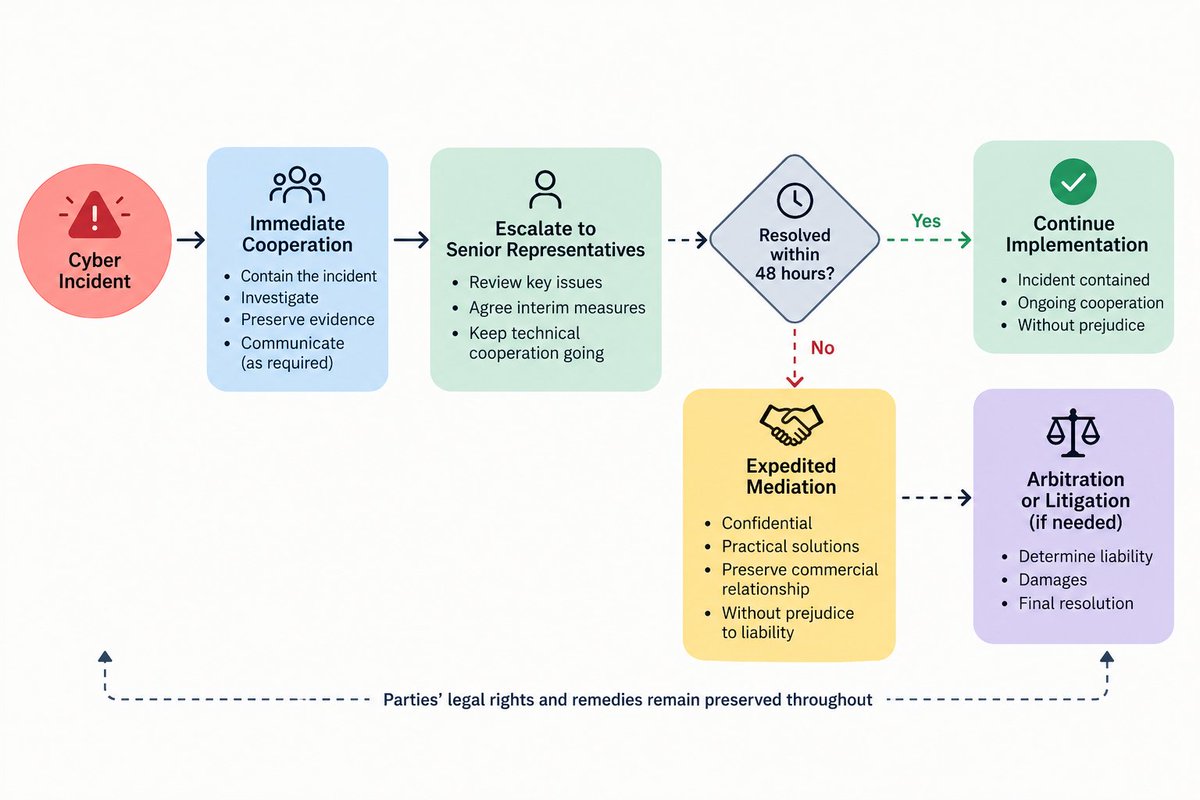
Cyber incidents create a dispute-resolution problem that traditional clauses are often not designed to handle.
When a serious incident occurs, the parties may already disagree on causation, responsibility, disclosure, remediation costs, or regulatory exposure. Yet at the same time, they may still need to cooperate technically to contain the incident, preserve evidence, restore systems, and meet very short notification deadlines.
That is why technology contracts should not jump immediately from “incident” to “arbitration or litigation.”
A better structure can separate two questions:
1. How do the parties cooperate during the first critical hours of the incident?
2. How do they later determine liability, damages, and contractual responsibility?
Emergency mediation can be valuable in that gap. It can provide a confidential, without-prejudice framework for agreeing interim technical measures, maintaining communication, appointing independent experts, preserving evidence, and preventing the legal dispute from obstructing incident containment.
It does not replace arbitration or litigation. It complements them.
For cross-border technology contracts in particular, the most effective dispute architecture may increasingly be:
technical cooperation → senior escalation → expedited mediation → arbitration or litigation if necessary.
We have explored this approach in a new practical guide for A-Resolve, including a sample emergency cyber incident mediation clause that can be adapted for technology agreements.
Read the full practical guide, including a sample clause at the end, on the A-Resolve website: https://t.co/qIoaPT4WGr
#Cybersecurity #CyberDisputes #Mediation #Arbitration #TechLaw #DisputeResolution #ADR #TechnologyContracts #AResolve
When a technology project fails, the first mistake is often to argue about breach before protecting the system and the evidence.
Missed milestones, unstable releases, scope changes, acceptance disputes and unpaid invoices rarely form one simple problem. A rushed termination can make the facts harder to recover and create a second failure during migration.
A disciplined first response should:
1. Stabilise operations. Protect repositories, administrator credentials, cloud access, data, documentation and key personnel. Freeze avoidable changes and define an interim operating protocol.
2. Preserve the complete record. Keep the contract and notices, but also repository history, issue trackers, test results, release notes, incident reports and project communications. Preserve metadata.
3. Build a neutral chronology. Connect each milestone to the promised deliverable, agreed date, dependencies, changes, test outcome and the parties’ responses. Treat disputed facts as disputed.
4. Obtain focused technical input. Establish what was delivered, which defects are reproducible and what repair, completion or migration would require. Technical findings do not by themselves decide contractual responsibility.
5. Choose the process that fits the problem. Negotiation, mediation, expert determination and arbitration solve different kinds of disputes. Urgency, value, complexity and the remedy required should determine the route.
The same discipline applies across AI, digital platforms, crypto and blockchain, IP and licensing, startup and investor relationships, technology finance, service providers, users and enterprise customers.
Practical guide from A-Resolve:
https://t.co/fyE19nDcyT
General information only; not legal advice.
#TechnologyDisputes #Arbitration #Startups #AI
When a technology project starts to fail, what usually becomes disputed first in your experience?
General discussion only—please do not share confidential facts.
When a technology project fails, the first mistake is often to argue about breach before protecting the system and the evidence.
Missed milestones, unstable releases, scope changes, acceptance disputes and unpaid invoices rarely form one simple problem. A rushed termination can make the facts harder to recover and create a second failure during migration.
A disciplined first response should:
1. Stabilise operations. Protect repositories, administrator credentials, cloud access, data, documentation and key personnel. Freeze avoidable changes and define an interim operating protocol.
2. Preserve the complete record. Keep the contract and notices, but also repository history, issue trackers, test results, release notes, incident reports and project communications. Preserve metadata.
3. Build a neutral chronology. Connect each milestone to the promised deliverable, agreed date, dependencies, changes, test outcome and the parties’ responses. Treat disputed facts as disputed.
4. Obtain focused technical input. Establish what was delivered, which defects are reproducible and what repair, completion or migration would require. Technical findings do not by themselves decide contractual responsibility.
5. Choose the process that fits the problem. Negotiation, mediation, expert determination and arbitration solve different kinds of disputes. Urgency, value, complexity and the remedy required should determine the route.
The same discipline applies across AI, digital platforms, crypto and blockchain, IP and licensing, startup and investor relationships, technology finance, service providers, users and enterprise customers.
Practical guide from A-Resolve:
https://t.co/fyE19nDcyT
General information only; not legal advice.
#TechnologyDisputes #Arbitration #Startups #AI