People often talk about the final result, much less about everything it takes to get there.
And yet, it is precisely in the backstage that the true nature of a production becomes visible: attention to detail, time devoted to choices, corrections, doubts, alignment, and the patience required to hold every element together.
Behind The Fracture there was a meticulous process, built step by step through precision and constant dialogue. A process in which no phase was secondary, and where the contribution of the team was essential in giving the project coherence, direction, and strength.
Every production begins with an idea, but it only takes shape when different sensibilities are able to work together through trust, rigor, and a shared vision.
That is why we are glad to share this backstage: because it reveals not only the “how”, but also the human and professional value behind every image.
WRITTEN AND DIRECTED by @jacopo_reale
AI CREATIVE DIRECTORS Giacomo Cannelli • Alessandro Risuleo
AI DESIGNERS Aurora Cecchini
EXECUTIVE PRODUCERS Patrik Gallo Sylvain MONTREUIL
Sound Design, Sound Editing and Final Mix: Tiziano Lamberti for SOUNZONE
Additional Sound Design: Dario Tatoli
PRODUCED BY: https://t.co/XSfO7t1bFM and Labyrinth Studio AI
#TheFracture #Backstage #BehindTheScenes #TeamWork #CreativeProcess #AIStorytelling #Filmmaking #ProductionProcess
There are moments when a fracture is not only a loss, but a shift in perception.
The Fracture was born from this subtle space: the moment something breaks and, from then on, the world still exists, but can no longer be seen in quite the same way.
The Fracture is a project created entirely in full AI by Labyrinth Studio, co-produced with Animatix, conceived to explore not only an aesthetic, but also a new space for storytelling.
It is a tension that, in different ways, we are all experiencing today, as new technologies reshape how we imagine, create, and observe reality. For this reason as well, The Fracture is above all an invitation to reflect.
A sincere thank you goes to the entire team: @jacopo_reale , @norealframe , Aurora Cecchini, Patrick Gallo, Sylvain, Claudio Ricci, and Soundzone.
The Fracture is the most ambitious AI film we could have conceived.
Please watch it with sound. It is very important to us.
And if you like it, please share it.
Because something is changing in the way stories are created and told, and the world of filmmaking will increasingly be influenced by artificial intelligence.
A special thanks to Sylvan and Patrik, who supported us and gave us complete freedom to create what at times felt like a slightly crazy little film.
Written and Directed by Jacopo reale
AI CREATIVE DIRECTORS Giacomo Cannelli (@norealframe • Alessandro Risuleo @ARisuleo
AI DESIGNERS Aurora Cecchini
EXECUTIVE PRODUCERS Patrik Gallo, Sylvain Montreuil
Sound Design, Sound Editing and Final Mix: Tiziano Lamberti for Sounzone
Additional Sound Design: Dario Tatoli
PRODUCED BY: @Animatix and Labyrinth Studio
@Kling_ai 3.0 isn’t just changing images. It’s changing directing.
🎬 For the global launch of Kling 3.0, @jacopo_reale, together with the Labyrinth Studio AI team, Giacomo Cannelli, @ARisuleo, and Aurora Cecchini, created Looking for Bianca, a short film set in Hong Kong that follows a young woman searching for her missing husky.
🧠 What’s interesting isn’t just the final result, but what this project says about the current state of AI filmmaking.
When a model begins to understand not only images, but also the subtext of a dialogue, the weight of a silence, or the hesitation before saying something painful, the conversation changes completely.
🎥 Behind these five minutes of film, Jacopo explains that there was writing, staging, experimentation, and workflow adaptation. And this is probably the most important point: even when a film is created entirely with AI, the process remains surprisingly close to traditional filmmaking.
✍️ This is where the technology will really need to grow: not only in visual quality, but in the writing of characters and stories. Because today it’s no longer enough to generate a beautiful image. A story needs scenes, relationships, tension, and narrative rhythm.
⚙️ One particularly interesting detail involves Kling 3.0 itself. With this version, spatial control inside a scene has become much more precise, so the team often chose to start from a wide shot and generate the coverage from there, just like in real cinematic production.
🚀 And that may be the strongest signal of all: AI video is no longer just about impressive standalone clips. It’s starting to move into a more complex territory where direction, cinematic language, and teamwork truly matter.
✨ Projects like this highlight a simple truth: the future won’t be “prompt and done.”
It will increasingly be about vision, writing, directing, and human sensitivity, with AI as a new creative tool.
📱 Want AI updates on WhatsApp? DM me “AI” and I’ll send you access.
🔔 Follow me for the last AI updates!
#AInews #KlingAI #AIFilmmaking #GenerativeAI #ShortFilm
What happens when an AI model no longer simply reconstructs images, but begins to grasp what lies beneath the surface, the unspoken meaning in a sentence, the weight of a pause, that tiny movement of the eyes before answering something that hurts, or even the instinctive, tender look we give our dog?
For the global launch of Kling 3.0, we at Labyrinth Studio decided to avoid the usual tech demo. We wanted to take a different step, to build a short narrative with a truly cinematic structure, even if compressed into just a few minutes.
That’s how Looking for Bianca was born.
It’s a short film set in Hong Kong. It follows a young woman as she searches for Bianca, her escaped husky.
Five minutes that, in reality, contain far more work than they seem: writing, staging choices, tests, mistakes, constant adjustments, and extensive experimentation with the new model.
Because even when a film is fully AI, the process remains surprisingly close to traditional filmmaking: the pipeline changes, of course, but rhythm, intention, direction, and above all emotional coherence stay central.
And that’s where, in my view, this language will truly need to mature, in its ability to sustain characters and stories, not just images.
Looking for Bianca took two weeks to make, with a team of four.
As always, thanks to the entire Labyrinth Studio team:
@jacopo_reale , who wrote and directed the story,
Giacomo Cannelli @norealframe , who, together with me, gave up nights and weekends to push the new model to its limits, Aurora Cecchini, who supports us with dedication and consistency, and Claudio Ricci, who always manages to hold all the pieces together. Everyone was essential, especially because we completely rethought our workflow, adapting it to what Kling 3 makes possible.
Spatial control within a scene is far more manageable now, and we often chose to start from a wide master shot and then build the necessary coverage, as we did in the three person dialogue scene between Sophie and the truck drivers. It’s a technical detail, but for us it marked a real shift, also mentally, in how we plan and design a sequence.
A sincere thank you to the entire @Kling_ai team, and especially to @tonypu_klingai , for the attention and sensitivity with which he supported a project like this, looking at language, not only technology.
I won’t say more to avoid spoiling it.
But for us, this is one of those experiences that marks a clear before and after.
#KlingAI #Kling3 #AIVideo #GenerativeAI #ShortFilm #Filmmaking #LabyrinthStudio
🔛Kling 3.0 is exceptional at nuances such as emotions and expressions. Check out how our Creative Partner Jacopo Reale @jacopo_reale directs people and even animals in this
delicate short film Looking for Bianca! Learn more about the process in the thread!
What happens when an AI model starts understanding not only images, but the subtext of a dialogue, the meaning of a silence, or the small hesitation before saying something painful?
For the global launch of Kling 3.0 @kling_ai, the Labyrinth Studio team and I wanted to build a small film.
That’s how Looking for Bianca was born.
A short film set in Hong Kong that follows a young woman searching for Bianca, her missing husky.
Behind these five minutes there was a great deal of writing, staging, and experimentation with the new model. Even when a film is fully AI, the process remains surprisingly close to traditional filmmaking.
And that is exactly where this language will need to grow, in the writing of characters and stories.
It took two weeks and a team of four people to make Looking for Bianca.
Once again, Giacomo Cannelli @norealframe, @ARisuleo , Aurora Cecchini and I adapted our workflow.
With Kling 3, spatial control inside a scene has become much more precise, and we often chose to start from a wide shot and generate the coverage from there, as we did in the three-character dialogue scene between Sophie and the truck drivers.
A thank you to the entire @Kling_ai team, and especially to @tonypu_klingai , who has a rare sensitivity when it comes to supporting projects like this.
Watch Looking for Bianca here:
Pure Emotions! 🌸
Whoa! It’s here, this magnificent sample proves it! 🔥
I just watched this twice. I’m still in shook. I have the stories and this beautiful video shows us all….🎬
The tools are ready, the gates are open.
Unleash your imagination!
Wolf Mike Mozart🐺
@jacopo_reale
🎬 A 5-minute story entirely generated with AI .
Mamories of Silence is a short story entirely generated with AI.
It’s a dystopian and cryptic tale set in a small rural community of the 1990s.
In just five minutes, we’ve scattered all the clues needed to fully grasp its meaning.
The challenge was to tell a complex story in a minimal space, without losing visual coherence, rhythm or emotion.
Beyond the technique lies a narrative made of memories, silence and hidden bonds. 🤫
These are our experiments, created by Labyrinth Studio AI together with my partners Jacopo Reale and Giacomo Cannelli, exploring AI not as a shortcut but as a new cinematic language and creative tool.
Control, method and, above all, narrative responsibility.
AI didn’t just show me images.
It made me believe I had lived them. 😮
During the production of The Memory in Silence, something unexpected happened.
We were creating AI-generated backstage images: fake actors, virtual sets, fabricated moments.
Just for fun, or maybe for the sake of narrative consistency, I decided to insert myself into those photos, standing among them as if the scene had really taken place.
At first, nothing unusual.
But after hours of work, while reviewing the results, I suddenly realized something unsettling:
for a brief moment, my brain believed those memories were real.
A subtle distortion, yet a deeply revealing one.
That experience led me to a question I can’t stop thinking about:
👉 how far can the human mind go before it starts confusing authenticity with simulation?
From Plato’s cave to virtual reality, we’ve always lived suspended between illusion and truth.
Now, with generative AI, that border has grown dangerously thin, thin enough to trick even our subconscious.
Some people have already formed real emotional bonds with AI companions.
Could the same happen with visual memories?
Maybe the purpose of art, even AI-generated art, is precisely this:
not to reassure us, but to question what we think is real.
Because reality is no longer what we see, but what we remember as true.
Below is the video that started it all — an experiment born as a reflection on a dystopian reality.
I imagined myself as the film’s producer visiting the actors on set, taking the usual end-of-shoot photos together.
The curious part is that none of it ever happened: not the actors, not the set, not those days we seemed to share.
And yet, while watching those images, I felt the same nostalgia you feel at the end of a real production, as if I had truly lived those moments.
Honored to join the @LTXStudio Ambassadors Program and explore what AI can bring to the language of cinema.
From this journey, together with my partners at @AI_Labyrinth , @norealframe and @ARisuleo, come A Place to Return , a short story about memory, time, and what remains unchanged.
Grateful to the @LTXStudio team for the trust.
As part of the launch, we’ve teamed up with some of the most forward-thinking creators using AI today.
These are artists and studios who’ve helped shape LTX Studio from the beginning.
@jacopo_reale — Award-winning filmmaker blending cinematic storytelling with generative tools.
3/6
It is a great honor to win this award!
My thanks to @GabrieleMuccino and all the members of the jury:@RobMinkoff, @Diesol , @calebwward & Shelby Ward, Filippo Rizzante, @denisenegri1, @CharlieFink, @caroingeborn , Paolo Moroni, and @guillem_girona.
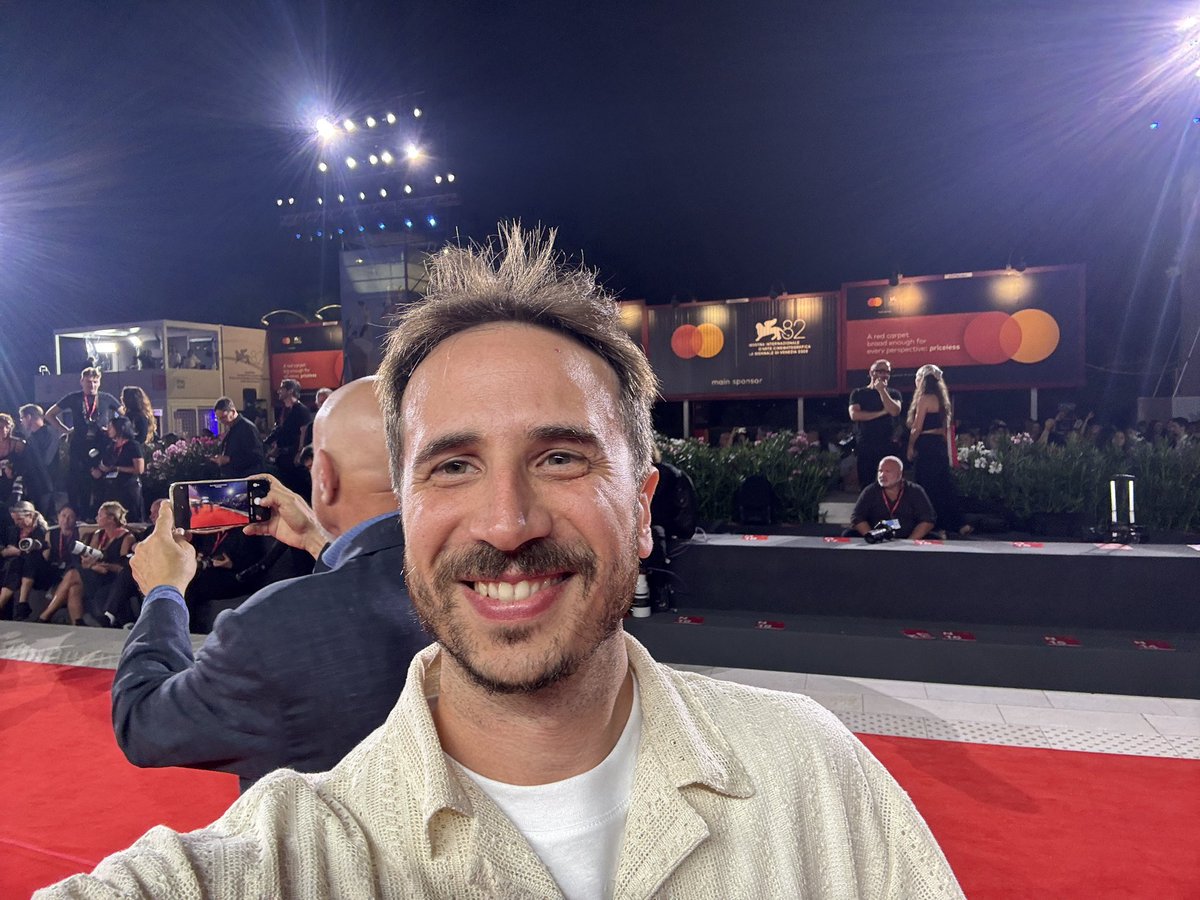
The Reply AI Film Festival @ReplyChallenges , held yesterday at the Lido in Venice, was extraordinary: an organization that truly valued the artists and a dialogue with the jury that gave each of the ten wonderful finalist short films a unique creative depth. More than a competition, it felt like a shared passion for research and experimentation in the new forms of cinematic storytelling.
I would like to thank my partners at Labyrinth Studio, @ARisuleo and Giacomo Cannelli @norealframe , who were here with me and with whom I share the love for this work.
I’m deeply grateful to @tonypu_klingai and @Kling_ai for believing in me and making Love at First Sight possible.
I dedicate this award to my wife Alina and our daughter Nicole: you are the light that guides my every choice.
GPT-5 is LIVE in Higgsfield RIGHT NOW.
Powered by GPT-5, OpenAI’s smartest model yet,
Higgsfield Assist is rolling out to all users.
The brainpower of PhDs and Art Directors - orchestrated by the most advanced intelligence on Earth →
Retweet to get the FULL guide in your DMs.
It’s a great honor to be selected as one of the 10 finalists of the Reply AI Film Festival 2025, which will take place in Venice during the same days as the 82nd Venice International Film Festival.
Thank you to the jury and to Gabriele Muccino for including Love at First Sight in this prestigious selection.
All the 10 shorts here:
https://t.co/0fYWygFn1G
5. Editing in DaVinci Resolve
All segments are then imported into DaVinci Resolve, where I build the final timeline.
This is where I shape the pacing, refine transitions, and adjust any visual inconsistencies between clips.
—
6. Music and Licensing
For the soundtrack, I favor speed and legal clarity: I select tracks from professional libraries and purchase commercial licenses to avoid complications.
—
7. Sound FX (with some compromise)
The most challenging part was designing the ambient sound.
Without a sound designer on board, I recreated soundscapes using a mix of AI tools and royalty-free libraries.
It’s not always perfect—but at times, the tech delivered surprisingly rich results.
—
The entire process takes about 4 full days of continuous work.
THE LAST OBJECT
Every scene was done only with AI tools!
The entire workflow can be found in the comments
The short film explores one of humanity’s deepest contemporary challenges: the risk of losing what makes us human in a world increasingly shaped by artificial logic and automated systems. In a post-human, frozen landscape, the most human gesture — the transmission of memory, affection, and sacrifice — is carried out by a machine. This is not just a story about artificial intelligence, but about consciousness, identity, and empathy in the absence of humanity. At a time when technology evolves faster than our emotional understanding of it, the film asks: Can we teach machines what it means to be alive, or are they the ones reminding us?
@Kling_ai@midjourney
#AIWorkflow #aivideos
3. Visual Generation with Midjourney
I use Midjourney v6 with OMNIReference to generate the images.
OMNIReference has been a game-changer—it allows me to maintain visual coherence across characters and settings throughout the story, even in complex sequences.
Each image is conceived as a cinematic frame from the outset.
—
4. Animation with Kling
Once the static frames are ready, I animate them using Kling AI.
Kling lets me turn those frames into dynamic sequences, with fluid movements and fine control over camera behavior and timing.
In some cases, I reintegrate elements between shots to simulate directorial transitions.