Anladım hocam, açıklamanız için teşekkür ederim. Zaten benim anlatmak istediğim de “plak tamamen kayboldu” gibi kesin bir iddia değildi.
Dediğiniz gibi görüntüleme yöntemleri ve yorumlayan operatörler arasında farklar olabileceğinin farkındayım.
Ben daha çok; ciddi kilo kaybı, inflamasyonun azalması, metabolik düzelme ve yaşam tarzı değişiklikleri sonrası hem klinik olarak hem de görüntüleme raporlarında daha iyi bir tabloyla karşılaştığımı anlatmaya çalıştım.
Sonuçta ben hekim değilim; sadece kendi sürecimde yaşadığım değişimleri ve bana söylenen rapor sonuçlarını aktarıyorum. Katkınız ve düzeltmeniz için ayrıca teşekkür ederim hocam. Saygılar 🙏🏻
Bilginize ve tecrübenize saygı duymakla beraber, ben kendi yaşadıklarımı ve tıbbi sürecimi biliyorum. Paylaştığım veriler; BT Anjio, miyokard sintigrafisi ve en son Eylül 2025’te bir Tıp Fakültesi’nde yapılan invaziv koroner anjio ile ortaya konmuş objektif bulgulardan ibarettir. Ayrıca kullandığım tüm peptidleri burada detaylı şekilde listelemedim. Durumum budur; kimseye gerçek dışı bilgi vererek sansasyon yaratma gibi bir amacım yoktur.
Ta ki yaklaşık 15 ay önce bana prediyabet, yani Tip 2 diyabet sınırında olduğum söylenene kadar, kendi vücudum ve metabolizmam hakkında ciddi bir araştırma yapmamıştım. O noktadan sonra yapay zekâ desteğiyle, bilimsel yayınlar ve YouTube’daki eğitim içerikleri sayesinde hayatımı tamamen değiştirdim.
Önce bilinen dual agonist ile başladım, ardından yaklaşık 8 ay önce Triple Agonist (sizinde paylaşımınız vardı geçen gün) tedavisine geçtim. Bir yıl bile dolmadan 40 kilodan fazla verdim. Metabolik değerlerim düzeldi, yüksek tansiyonum geriledi, uyku apnem büyük ölçüde ortadan kalktı. Daha önce yaklaşık %50 seviyesinde olduğu söylenen damar tıkanıklığım ise %20–30 bandına kadar düştü.
BPC-157 ve TB-500 gibi peptidlerle yıllardır yaşadığım mide ve “leaky gut” sorunlarımda ciddi iyileşme yaşadım. Ancak değişen sadece kullandığım tedaviler olmadı; tüm yaşam tarzımı değiştirdim. Düzenli yürüyüş, yüzme ve ağırlık antrenmanını hayatımın bir parçası haline getirdim.
Günde iki öğün beslenmeye başladım, bir çok supplemetler ekledim günlük rutinime (tahlil sonucu ihtiyacıma göre belirlediklerim), alkolü tamamen bıraktım ve protein ağırlıklı bir beslenme düzenine geçtim.
Bugün geldiğim noktada, yapay zekâ destekli araştırmalar, modern peptid tedavileri ve yaşam tarzı değişiklikleri sayesinde yıllarca kullandığım tüm ilaçlardan kurtuldum ve sağlığımı büyük ölçüde geri kazandım.
Yaptıǧınız yayınlar çok deǧerli, teşekkürler!
16 yaşında geçirdiğim onikiparmak bağırsağı ülseri (ulcus duodeni) sonrasında gelişen ağır gastrit ve reflü nedeniyle yaklaşık 35+ yıl boyunca Omeprazol, Pantoprazol ve benzeri ilaçlar kullanmak zorunda kaldım. Buna rağmen metabolik değerlerim giderek bozuldu; ferritin seviyem uzun süre 15 civarında seyretti, kolesterol, üre ve trigliserid değerlerim ciddi şekilde yükseldi.
52 yaşına geldiğimde morbid obezite sınırlarında bir VKİ’ye, uyku apnesine, %50 damar tıkanıklığına ve yüksek tansiyona sahip bir hastaya dönüşmüştüm. Ancak yıllar boyunca karşılaştığım yaklaşım, sorunun kökenini araştırıp gerçek bir tedavi uygulamak yerine, yalnızca semptomları baskılayan ilaçlar yazmaktan ibaretti.
1. Historical Brotherhood vs. Political Divergence
First, it is historically inaccurate to suggest that Ankara has not recognized India’s contributions. Türkiye has never forgotten the solidarity shown by Indians during the Balkan Wars or the financial contributions toward the construction of the Turkish Grand National Assembly. These gestures are memorialized as acts of inter-civilizational friendship, not transactional diplomacy.
However, for decades, Türkiye viewed South Asia primarily through the lens of its strategic partnership with Pakistan. This is not merely "mechanical" support, as suggested, but a deep-rooted fraternal bond. Pakistan was one of the few nations to staunchly support Türkiye during the Cyprus conflict in 1974, a fact that holds significant weight in Turkish domestic and foreign policy. Therefore, Turkey's stance on Kashmir has historically been an act of reciprocity and solidarity with a brotherly nation that stood by Ankara during its moment of existential crisis regarding Cyprus.
2. From Indifference to Proactive Engagement
Türkiye has moved beyond the static, NATO-dependent posture of the Cold War. Türkiye has pursued an independent, multidimensional foreign policy. This is not about "neo-Ottoman" ego but about strategic autonomy.
The claim that Türkiye supplies weapons to Pakistan to antagonize India is a zero-sum misreading. Türkiye is a rising defense industrial powerhouse, with exports growing over 100% in recent years. Pakistan is a natural market for Turkish drones, corvettes, and trainer aircraft because Islamabad faces a security deficit vis-à-vis India’s massive Russian-origin arsenal. It is commercial and strategic necessity, not a personal vendetta against New Delhi.
3. The Cyprus Question and Double Standards
The response regarding Cyprus requires fact-based correction. Türkiye did not "invade" Cyprus in 1974; Ankara exercised its guarantor rights under the 1960 Treaty of Guarantee to protect the Turkish Cypriot minority from a Greek junta-engineered coup. While India has historically supported the Greek Cypriot administration, Ankara notes the hypocrisy of New Delhi criticizing Turkish Cypriot self-defense while simultaneously maintaining a heavy-handed security apparatus in Kashmir.
Given India’s historical support for Cyprus in international fora, New Delhi is perhaps the last capital that should lecture Ankara about "occupation" or "interference," especially when Indian diplomats themselves have acknowledged that this stance was "informed" by Turkey’s ties with Pakistan.
4. Economic ties
Bilateral trade has surpassed $13 billion, with an agreed target of $20 billion. This is the result of rational economic policies by both states, which have successfully walled off commerce from geopolitical disputes.
5. "Armenia & Cyprus" Retaliation
The report suggests India is "justified" in arming Armenia and Cyprus because of Turkey’s Pakistan policy. Ankara views this with concern, not fear. If India proceeds with the export of Brahmos missiles to Cyprus or heavy weaponry to Armenia, it would represent a dangerous escalation by New Delhi, not a defensive move.
Such actions would destabilize the Eastern Mediterranean and the South Caucasus, regions vital to Turkish security. While Türkiye has supported Azerbaijan’s right to liberate its occupied territories, Türkiye has never positioned strategic missiles on India’s maritime periphery (e.g., near the Andaman Islands) nor supplied offensive weaponry to non-state actors threatening Indian territorial integrity.
Türkiye believes the characterization of its policy as "overt and covert hostility" is a dramatic overstatement.
If India chooses to view every drone sold to Islamabad as a provocation, while ignoring the 81% of Pakistan’s arms coming from China, the perception is selective. Ankara is pursuing its own national interests - just as New Delhi does.
Bir dönem, aynı şirketler grubuna karşı açtığım ve aslında haklı olduğuma inandığım beş davayı kaybetmek üzereydim. Başta bunun sebebinin karşı tarafın avukatının çok daha güçlü olması olduğunu düşünüyordum. Ancak dava dosyalarındaki yazışmaları ve belgeleri yapay zekâya yükleyip detaylı analiz etmeye başlayınca, kendi tarafımdaki eksikleri ve özellikle avukatımın birçok önemli noktayı yeterince derin işlemediğini fark ettim.
Sonrasında süreci tamamen değiştirdim. Dava dosyalarını artık büyük ölçüde kendim hazırlıyor, yapay zekâ destekli analizlerle güçlendiriyor, ardından avukatıma kontrol ettirip mahkemeye sunuyorum. Bu yaklaşım sayesinde davaların gidişatını yeniden lehime çevirmeyi başardım.
Burada en kritik unsur doğru prompt yazabilmek. Ben aynı anda 3-4 farklı yapay zekâ modelini kullanıyor, her birine diğerinin analizini kontrol ettiriyorum. Böylece modeller birbirlerinin açıklarını kapatıyor ve ortaya çok daha güçlü sonuçlar çıkıyor.
Benzer bir dönüşümü sağlık alanında da yaşadım. Yapay zekâ sayesinde hem kendi sağlığımda hem de yakın çevremin sağlık süreçlerinde ciddi iyileşmeler elde ettik. Yüksek tansiyonum, mide ülseri sorunlarım ve uyku apnem büyük ölçüde ortadan kalktı; düzenli ilaç kullanımım sona erdi.
Bence daha yolun çok başındayız. Asıl dönüşüm; yapay zekâ, robotik sistemler ve kuantum bilgisayar teknolojileri birleştiğinde başlayacak. Elbette bunun için gerekli enerji ihtiyacını sürdürülebilir şekilde çözebilmek de en büyük eşiklerden biri olacak.
“Constantinople Protocol” sounds less like strategy and more like geopolitical fan fiction written for domestic applause.
Türkiye is not a “system trapping Israel.” It is a sovereign regional power controlling one of the world’s most critical geopolitical crossroads. Every major power from Russia to the US to the EU adjusts policy around Turkish geography because geography is not ideology. It is reality.
Calling Turkish ports, airspace or administrative sovereignty “coercion” is simply another way of saying Ankara no longer gives unconditional strategic convenience to everyone regardless of their actions.
And the irony is remarkable:
The article describes “bypassing Türkiye” while simultaneously admitting Türkiye is central to trade corridors, aviation, maritime logistics, the Caucasus, the Eastern Mediterranean and European connectivity. Powers are not “bypassed” when entire policy papers are built around escaping their influence.
As for Azerbaijan, reducing Baku to an anti-Türkiye balancing tool fundamentally misunderstands the Ankara–Baku relationship. Azerbaijan cooperates with Israel because it serves Azerbaijani interests, not because it seeks liberation from Türkiye. The phrase “one nation, two states” was not created in Tel Aviv or Brussels.
And Europe’s supposed “consent-free connectivity” dream collides with hard geography:
The Bosporus is still in Türkiye.
The Dardanelles are still in Türkiye.
The Middle Corridor still runs through Türkiye.
NATO’s southeastern anchor is still Türkiye.
States can diversify routes. That is normal.
But pretending Türkiye can be strategically erased from Eurasian connectivity is not strategy.
It is denial dressed up as doctrine.
From the Turkish perspective, France is criticized far more openly because Paris directly positions itself against Turkish interests in the Eastern Mediterranean, openly backs maximalist Greek and Greek Cypriot claims, conducts military signaling in the region, and repeatedly frames Türkiye as a strategic rival inside Europe.
The US relationship is more complex. Ankara and Washington still remain NATO allies with deep military, economic and intelligence ties despite major disagreements. That is why Turkish criticism toward the US is often more calibrated and strategic.
France, on the other hand, has actively inserted itself into nearly every anti-Türkiye alignment in the Mediterranean while lacking the geopolitical weight to pressure Türkiye alone. That naturally makes Paris the louder political target in Turkish public discourse.
And despite all the headlines, none of this changes the core reality: Türkiye remains a country the US still has to negotiate with. France mostly comments from the sidelines while trying to project influence through Greece.
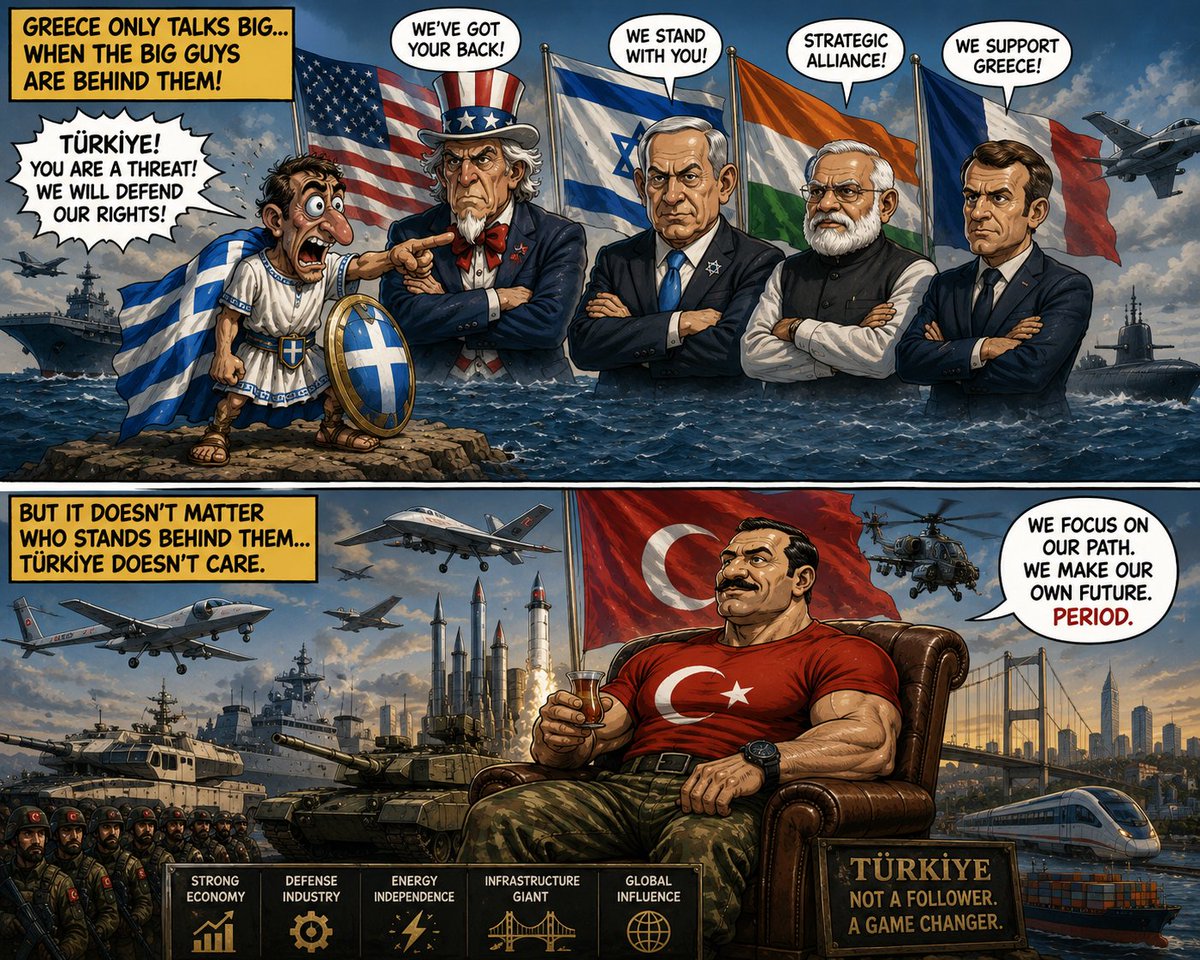
Greece ob the other hand celebrates every new foreign deployment on its soil as a “victory,” while Türkiye keeps expanding its own defense industry, energy reach, naval presence and regional influence without needing foreign troops stationed across the country.
A state that depends on external powers for deterrence is not a regional hegemon. It is a client frontline.
What's going on? Are neocons having a come-to-Jesus moment?
After Bob Kagan writing an article on how the U.S. is facing "total defeat" in Iran (see https://t.co/Io9xy1M8ks), you now have Max Boot - the very author of “The Case for American Empire” and one of the most vocal advocates for the Iraq war - publishing a Washington Post interview explaining that China has surpassed the U.S. in most military domains.
If anything, Boot’s interview is even more devastating than Kagan's piece, because it's not editorial opinion - he’s interviewing John Culver, a former top CIA analyst (he was national intelligence officer for East Asia) and one of the world’s foremost authorities on the Chinese military which he’s been studying since 1985.
This isn't a pundit opining - this is someone who spent decades inside the intelligence community staring at the actual data.
So what is Culver saying?
1) In case of war with Taiwan, the U.S. will flee the theater
This is undoubtedly the single most stunning revelation in the entire piece. Culver says that - as far as he is aware - the Pentagon’s plan in case of war with Taiwan is… flee!
This is the exact quote: "I think some of the thinking in the Pentagon, and it may have evolved since I retired, is that when we think there’s going to be a war, we need to get our high-value naval assets out of the theater, and then we would have to fight our way back in. From where, it’s not clear. Guam is no bastion either."
Why? Because, as he explains, any high-value U.S. assets would be sitting ducks in the entire area. China can strike U.S. forces deployed to Japan, Australia, or South Korea “in a way that Iran really can't” and, given that Iran has hit at least 228 targets across U.S. bases in the Middle East - forcing the U.S. to evacuate most of them - that's saying something. Also, U.S. aircraft carriers would need to operate within 1,000 miles of the fight to matter, which - given it’s well within range of Chinese missiles - they won’t.
As Culver bluntly puts it: “There's really no safe spaces.”
2) China leads in most military domains - and it's not even close
Culver says that “it’s hard to not be hyperbolic” about China’s military capabilities and that, at this stage, “it’s hard to point to an area other than submarines and undersea warfare and say the United States still has an advantage.”
In some critical areas, such as advanced munitions - which, when it comes to war, is pretty damn relevant - his assessment is that China leads by “magnitudes.” As a reminder, an order of magnitude means 10x so, by assuming he knows that and meant what he said, “magnitudes” means at least a hundred times more, meaning U.S. capabilities would be less than 1% those of China.
At the same time, Culver also says that “whichever side runs out of bullets first is going to lose.” So if China produces “magnitudes greater than our industrial base could produce” - as he puts it - then you don't need a PhD in military strategy to put two and two together…
The picture, if anything, is even more damning in shipbuilding capabilities. He reminds that a single shipyard in China - Jiangnan Shipyard, on Changxing Island near Shanghai - “has more capacity than all U.S. shipyards combined.”
Put all Chinese shipyards together and China’s broader naval shipbuilding capacity is 232 times larger than that of the United States (and this is from a leaked U.S. Navy briefing slide).
Culver helpfully adds that China “deploys enough ships every year to replicate the entire French navy” - which, as a Frenchman, hurts a little, but at least we'll always have the cheese (I hope).
3) Despite this, a war in Taiwan is highly unlikely
If your only window into China is Western media coverage, you'd naturally assume all of the above means war over Taiwan is about to break out. After all, if China is so powerful and the U.S. so outmatched, why wouldn't it just take Taiwan and be done with it?
Culver’s assessment - and mine, incidentally - is the exact opposite: China’s increasing relative strength vis-a-vis the U.S. makes war less likely, not more.
How so? As Culver explains Taiwan is “a crisis Xi Jinping wants to avoid, not an opportunity he wants to seize.” The stronger China gets, the less it needs to fight: why launch a war when you can simply wait for the military balance to become so lopsided that the U.S. quietly drops its security guarantee on its own? Culver himself foresees a future “when Americans might start to say, maybe Taiwan is a war we don’t want to get involved in.” That would almost automatically mean peaceful reunification, which has always been China’s primary objective.
This doesn't mean China views the U.S. as harmless. Quite the contrary - Culver says Beijing sees America “as a very militarily aggressive country” that is “declining in power and becoming more violent” as a result. Which he says is one further reason why “war over Taiwan is not something that Xi Jinping is looking for.”
China doesn't want to hand a pretext to a dangerously trigger-happy power - all the more when patience alone delivers what it wants.
4) The game is up
Last but not least, perhaps the most revealing aspect of the interview is that Culver doesn’t seem to see a way out: this is structural and irreversible.
Asked by Boot whether “the Trump administration’s $1.5 trillion defense budget, assuming it’s approved, [would] change the trend lines” (which, as a reminder, would constitute a 50% increase in defense spending), his reply is that “it would probably help to some extent, but I worry that we could be throwing good money after bad.” Not exactly brimming with optimism…
Similarly, when asked why the U.S. keeps investing billions in aircraft carriers and even “Trump-class battleships,” his answer is that it's because “the military services have a nostalgia for the things that meet their expectations for how you get promoted.” In other words, wasted money.
Same thing for the Pentagon's much-hyped “Hellscape” drone strategy to defend Taiwan. Culver asks the obvious question: “What drones are you talking about launching from where?” He points out that they’d “have to pre-deploy them if not on Taiwan itself then on Luzon or the Japanese southwest islands, all of which can be struck by the Chinese.” He adds that this is “the tyranny of time and distance when you look at war in the Pacific.”
The picture that emerges, both from Boot’s Culver interview and Kagan’s article, is remarkably consistent: the U.S. is “checkmate” in the Middle East, would need to entirely flee the Pacific theater before a war even starts, cannot produce enough weapons, cannot keep its supposed “allies” safe, and has no strategy to reverse any of it - nor can one even be produced given the structural nature of the gap. Even a 50% increase in defense spending, Culver says, would be “throwing good money after bad.” That's not my assessment - that's theirs.
Two of America's most prominent hawks, in two of its most establishment outlets, in the space of 48 hours, have essentially published the obituary of American military primacy.
Yesterday I concluded my post by saying that even the arsonists now smell the smoke. Today I'll say: the arsonists are now writing the fire report.
There’s no overstating how extraordinary this Atlantic article is, given the author and the outlet.
As a reminder Bob Kagan is:
- The co-founder of Project for the New American Century, probably the single most imperialist Think Tank in Washington (which is quite a feat)
- A man who spent his entire life advocating for American military interventions, especially in the Middle East, and a vocal advocate of the Iraq war. He started advocating for intervention in Iraq before 9/11, which speaks for itself...
- The husband of Victoria Nuland, an extremely hawkish former senior U.S. official (a key architect of U.S. policy in Ukraine, with the consequences we all witness today)
- The brother of Frederick Kagan, one of the key architects of the Iraq surge
In other words, we ain’t exactly looking at some sort of anti-imperialist peacenik. This is quite literally the guy Dick Cheney called when he needed a pep talk.
And the man is writing in The Atlantic, the most reliably pro-war mainstream media outlet in the U.S. (also quite a feat).
So when HE writes that the U.S. “suffered a total defeat” in Iran that has no precedent in U.S. history and can “neither be repaired nor ignored,” it’s the functional equivalent of Ronald McDonald telling you the burgers aren’t great: it means the burgers really, really aren't great.
Extraordinarily (and somewhat worryingly, for me), his arguments for why this is such a defeat are virtually the same as those I laid out in my article “The First Multipolar War” last month (https://t.co/tbnOpdYqux).
Here they are 👇
1) Vietnam/Afghanistan were survivable, this isn't
He agrees that this war - and the U.S. defeat - is fundamentally different in nature from previous U.S. interventions.
Where I wrote that the wars in Vietnam and Afghanistan didn’t change the equation much in terms of power dynamics (“in the grand scheme of things, the giant walked away with little more than a bruised ego”), Kagan writes that “the defeats in Vietnam and Afghanistan were costly but did not do lasting damage to America's overall position in the world.”
And when I wrote that “it’s painfully obvious that the Iran war is of a qualitatively different nature” from these, he writes that “defeat in the present confrontation with Iran will be of an entirely different character.”
Same point.
2) Iran will never relinquish Hormuz and uses it as selective leverage
When I wrote that Iran has turned “freedom of navigation” on its head by establishing “a permission-based regime” through the Strait of Hormuz, Kagan arrives at the same conclusion: “Iran will be able not only to demand tolls for passage, but to limit transit to those nations with which it has good relations.”
He also agrees that “Iran has no interest in returning to the status quo ante,” when I myself cited Iran’s parliament speaker Ghalibaf in my article, saying: “The Strait of Hormuz situation won’t return to its pre-war status.” Same point and virtually the same words.
3) Gulf states will have to accommodate Iran
He agrees that most Gulf states will have no choice but to accommodate Iran, effectively making Iran into a, if not THE, dominant regional power.
Kagan writes “the United States will have proved itself a paper tiger, forcing the Gulf and other Arab states to accommodate Iran.”
On my end, I wrote that “the Gulf monarchies will eventually have to choose between two security propositions. One where they stay aligned with a distant superpower that [can’t protect them]. The other proposition being: make peace with the regional power that just proved it can hit [them] whenever it wants.” Which is not much of a choice…
4) Military impossibility to reopen Hormuz
Kagan writes that “if the United States with its mighty Navy can't or won't open the strait, no coalition of forces with just a fraction of the Americans' capability will be able to, either.”
On my end, in my article I cited Germany’s defense minister Boris Pistorius: “What does Trump expect a handful of European frigates to do that the powerful US Navy cannot?”
The exact same argument.
5) Global chain reaction
Kagan agrees that this is a global strategic failure that fundamentally changes the U.S.’s position in the world. As he puts it: “America's once-dominant position in the Gulf is just the first of many casualties… America's allies in East Asia and Europe must wonder about American staying power in the event of future conflicts.”
You’ll have guessed it, I wrote essentially the same thing: “Think about what it says if you’re Saudi Arabia, quietly watching your American-built defenses fail to protect your own refineries. Or any European country now facing the worst energy shock since 1973, caused not by your enemy but by your ally, and realizing that said ‘ally,’ supposedly in charge of ‘protecting’ you, couldn’t even protect Israel’s most strategic sites - when it’s the country with which it’s joined at the hip. I’m not even speaking about China or Russia who are seeing their worldview being validated on almost every axis simultaneously.”
6) Weapons stocks depleted, credibility shattered
Kagan: “just a few weeks of war with a second-rank power have reduced American weapons stocks to perilously low levels, with no quick remedy in sight.”
Me: “America’s most advanced weapons systems are much more vulnerable than previously thought - not theoretically, but in actual combat.”
Kagan: “America's allies… must wonder about American staying power in the event of future conflicts.”
Me: “The U.S. security guarantee has been empirically falsified in real time.”
-----------
So, yup, Bob Kagan and I agree on nearly everything. I need a shower 🤢
Reassuringly though, we still differ on a few fundamental aspects.
First of all, arguably the most important one, the moral aspect. In typical neocon fashion, his article contains not a word about the human cost of this war - not the 165 schoolgirls, not the devastation inflicted on Iranians during 37 days of bombing, not the toll this war is taking on the entire world through its devastating economic consequences (the economic devastation on ordinary people worldwide is referenced only as a political problem for Trump). For him, this is purely a strategic chess problem, morality and people don’t figure in his mental map.
For me, the moral bankruptcy of this war isn't separate from the strategic failure - it is the strategic failure. Much like Gaza can only be a failure because of its sheer abjectness.
Secondly, there is not an instant of reflection in the article on how we got there. Which is unsurprising because he personally, alongside his wife, his brother, and every co-signatory of every PNAC letter, spent a generation pushing for exactly this kind of confrontation. The man spend 30 years advocating for military dominance in the Middle East and hostility towards Iran, thereby forging them as an adversary and facilitating this very war that he now says has “checkmated” America.
I know introspection has never been the neocon forte but at some point you have to stop setting houses on fire and then writing op-eds about how surprising the smoke is.
Last but not least, we differ on what should be done. This is the funniest part of Kagan’s article - showing that the man is decidedly beyond salvation. On one hand he calls this a “checkmate” by Iran, and a U.S. defeat that can “neither be repaired nor ignored,” yet an the other hand his solution for it is… surprise, surprise… a bigger war still!
He writes that what’s to be done is “engage in a full-scale ground and naval war to remove the current Iranian regime, and then to occupy Iran until a new government can take hold.”
The arsonist's solution to the fire is a bigger fire ¯\_(ツ)_/¯
For my end, this was the conclusion of my previous article:
"There is almost a Greek tragedy quality to U.S. actions lately where every move taken to escape one’s fate becomes the mechanism that delivers it. The U.S. went to war to reassert dominance - and proved it could no longer dominate. It demanded allies send warships - and revealed it had no real allies. It waged forty years of maximum pressure to break Iran before this moment came - and instead forged the very adversary now capable of meeting it. It started the war in part to have additional leverage over China - and handed the world the spectacle of begging China for help. The prophecy was multipolarity. Every American action to prevent it reveals it instead."
I wouldn’t change a word. The only thing that's changed since I wrote it is that even the arsonists now smell the smoke.
Src for the Atlantic article: https://t.co/ItED9WS9Kn
This (https://t.co/vsbyqxllFG) is, by any measure, an extraordinary article: Prince Turki Al-Faisal is a son of King Faisal and ran Saudi intelligence (the GID) for over two decades.
He is writing that the plan of "the US-Israeli war on Iran" was "to ignite war between us [Saudi Arabia] and Iran," so that Israel could "impose its will on the region and remained the only actor in our surroundings."
This further confirms that, contrary to what many have asserted, the notion that the Saudis were quietly backing the war on Iran was a myth (alongside the recent fact the Saudis denied the U.S. access to its bases and airspace: https://t.co/Q5xiUT7rCA).
From the horse's mouth they're literally saying it was as much a war on them as it was on Iran!
Pretty crazy when you think about it: this is Saudi Arabia saying that their real enemy in this war was the U.S. and Israel. Hard to overstate how significant a rupture this represents.
Now of course they could be saying so because, seeing how the war turned out, they're trying to retroactively position themselves on the winning side (at least strategically, by saying they didn't take the bait), or trying to justify domestically why they absorbed hits from Iran without retaliating.
And, of course, it's not like they're presenting Iran as some sort of ally here: Prince Turki explicitly calls them a "neighbor" that caused "pains."
But still, the end result remains: the Saudi establishment is now committing, on the record and in plain language, to a framing in which, while Iran is a "painful neighbor", the U.S. and Israel represent the deeper strategic threat, having tried to engineer their destruction.
If you had any lingering doubt that this war accelerated the collapse of U.S. influence in the region, this should settle it.
2/2 And perhaps the most amusing part of all is the attempt to frame Türkiye as uniquely expansionist while Greece openly relies on EU political pressure, US backing, French military agreements and lobbying campaigns to reinforce claims that geography itself does not naturally support.
A state truly confident in the absolute fairness of its legal position would not constantly need external geopolitical backing to enforce it.
The reality remains unchanged:
Türkiye is not demanding Greek territory.
Türkiye is demanding an equitable maritime arrangement in a uniquely complex sea.
Those are two very different things.
No amount of nationalist blogging changes that.
1/2 The article is not an objective legal analysis. It is a political pamphlet wrapped in selective references to international law while carefully avoiding the one thing that destroys the entire Greek narrative: geography.
The Aegean is not the Atlantic Ocean. It is not an empty open sea where two distant coastlines face each other equally. It is a semi enclosed sea filled with hundreds of Greek islands sitting directly off the Turkish mainland, in some cases literally within swimming distance of Anatolia. Pretending that these islands should automatically generate full maritime zones regardless of geography is not “international law.” It is a maximalist political project designed to lock Türkiye inside its own coastline.
This is exactly why Türkiye has rejected the Greek interpretation for decades. Even neutral legal scholars acknowledge that maritime delimitation in special geographic environments must follow equity and proportionality, not blind map painting exercises invented in Athens. International courts have repeatedly reduced or limited the effect of islands when full effect would produce absurd outcomes. Greece knows this. That is why Greek propaganda almost never discusses actual court precedents in detail.
The famous “12 nautical miles” slogan is another intentionally misleading talking point. Greece presents it as if extending to 12 miles in the Aegean would simply be a routine administrative adjustment. In reality, it would radically transform control of the sea. Greek territorial waters would expand to dominate almost the entire Aegean, leaving Türkiye with extremely restricted access despite Türkiye possessing the longest mainland coastline in the Eastern Mediterranean. That is not balance. That is strategic encirclement through legal manipulation.
And the irony is extraordinary. Greece constantly screams “revisionism” while simultaneously trying to rewrite the geopolitical reality of the Aegean through micro islands and maximalist maritime claims no major maritime power on Earth would ever accept if applied against itself.
Imagine if another state tried using tiny islands sitting directly off the Greek mainland to trap Greece into narrow coastal waters. Athens would reject it instantly and call it an existential threat. Yet when Türkiye rejects the exact same logic, suddenly Greece pretends this is an attack on international law itself.
The article also conveniently ignores militarization. Greece has systematically militarized islands whose status was tied to demilitarization obligations under various treaties. Athens wants the benefits of every treaty article that strengthens Greek claims while ignoring every article that imposes obligations on Greece. That is not principled legalism. That is selective treaty shopping.
Then comes the usual attempt to portray Türkiye as isolated and aggressive. Reality says otherwise. Türkiye possesses one of NATO’s largest militaries, one of the region’s largest defense industries, and an increasingly independent strategic posture. The idea that Türkiye will simply accept maritime imprisonment because some think tank writers or bloggers repeat the words “international law” loudly enough is detached from geopolitical reality.
The harsh truth many in Athens refuse to accept is simple:
The Aegean cannot function as an exclusive Greek sphere while Türkiye sits on its shores with more than 85 million people, thousands of kilometers of coastline, and major naval capabilities. Geography alone makes the Greek maximalist vision impossible.
This is why the dispute still exists after decades. If the Greek position were as unquestionably lawful as propaganda claims, there would already be a mutually accepted settlement. Instead, even international observers recognize the issue is legally and geographically complex.
France absolutely has strategic strengths. Nobody serious denies that.
But the idea that France “needs Türkiye less” ignores geography and hard power realities.
Türkiye controls:
- the Bosporus & Dardanelles,
- NATO’s southeastern flank,
- access to the Black Sea,
- key migration routes,
- energy corridors,
- and military influence stretching from the Caucasus to Libya and the Red Sea.
France may be a nuclear power and a top arms exporter, but Paris still cannot stabilize:
- the Eastern Mediterranean,
- Syria,
- Libya,
- the Black Sea,
- or migration pressure
without factoring Türkiye into the equation.
And despite all the political rhetoric, France itself knows this:
- French companies invest heavily in Türkiye,
- NATO operations require Turkish geography,
- and Europe’s defense architecture without Türkiye becomes dramatically weaker.
Also, “Egypt-Morocco supply chains” are not a substitute for:
- an 85+ million consumer market,
- one of Europe’s largest industrial bases,
- a top-tier drone industry,
- and a military larger than France’s in manpower.
France is a global mid-power with nuclear weapons.
Türkiye is a regional geopolitical pivot state sitting at the crossroads of Europe, the Middle East, the Caucasus and the Black Sea.
Different types of power.
Both matter.
But pretending France can simply “replace” Türkiye strategically is fantasy.





![RnaudBertrand's tweet photo. What's going on? Are neocons having a come-to-Jesus moment?
After Bob Kagan writing an article on how the U.S. is facing "total defeat" in Iran (see https://t.co/Io9xy1M8ks), you now have Max Boot - the very author of “The Case for American Empire” and one of the most vocal advocates for the Iraq war - publishing a Washington Post interview explaining that China has surpassed the U.S. in most military domains.
If anything, Boot’s interview is even more devastating than Kagan's piece, because it's not editorial opinion - he’s interviewing John Culver, a former top CIA analyst (he was national intelligence officer for East Asia) and one of the world’s foremost authorities on the Chinese military which he’s been studying since 1985.
This isn't a pundit opining - this is someone who spent decades inside the intelligence community staring at the actual data.
So what is Culver saying?
1) In case of war with Taiwan, the U.S. will flee the theater
This is undoubtedly the single most stunning revelation in the entire piece. Culver says that - as far as he is aware - the Pentagon’s plan in case of war with Taiwan is… flee!
This is the exact quote: "I think some of the thinking in the Pentagon, and it may have evolved since I retired, is that when we think there’s going to be a war, we need to get our high-value naval assets out of the theater, and then we would have to fight our way back in. From where, it’s not clear. Guam is no bastion either."
Why? Because, as he explains, any high-value U.S. assets would be sitting ducks in the entire area. China can strike U.S. forces deployed to Japan, Australia, or South Korea “in a way that Iran really can't” and, given that Iran has hit at least 228 targets across U.S. bases in the Middle East - forcing the U.S. to evacuate most of them - that's saying something. Also, U.S. aircraft carriers would need to operate within 1,000 miles of the fight to matter, which - given it’s well within range of Chinese missiles - they won’t.
As Culver bluntly puts it: “There's really no safe spaces.”
2) China leads in most military domains - and it's not even close
Culver says that “it’s hard to not be hyperbolic” about China’s military capabilities and that, at this stage, “it’s hard to point to an area other than submarines and undersea warfare and say the United States still has an advantage.”
In some critical areas, such as advanced munitions - which, when it comes to war, is pretty damn relevant - his assessment is that China leads by “magnitudes.” As a reminder, an order of magnitude means 10x so, by assuming he knows that and meant what he said, “magnitudes” means at least a hundred times more, meaning U.S. capabilities would be less than 1% those of China.
At the same time, Culver also says that “whichever side runs out of bullets first is going to lose.” So if China produces “magnitudes greater than our industrial base could produce” - as he puts it - then you don't need a PhD in military strategy to put two and two together…
The picture, if anything, is even more damning in shipbuilding capabilities. He reminds that a single shipyard in China - Jiangnan Shipyard, on Changxing Island near Shanghai - “has more capacity than all U.S. shipyards combined.”
Put all Chinese shipyards together and China’s broader naval shipbuilding capacity is 232 times larger than that of the United States (and this is from a leaked U.S. Navy briefing slide).
Culver helpfully adds that China “deploys enough ships every year to replicate the entire French navy” - which, as a Frenchman, hurts a little, but at least we'll always have the cheese (I hope).
3) Despite this, a war in Taiwan is highly unlikely
If your only window into China is Western media coverage, you'd naturally assume all of the above means war over Taiwan is about to break out. After all, if China is so powerful and the U.S. so outmatched, why wouldn't it just take Taiwan and be done with it?
Culver’s assessment - and mine, incidentally - is the exact opposite: China’s increasing relative strength vis-a-vis the U.S. makes war less likely, not more.
How so? As Culver explains Taiwan is “a crisis Xi Jinping wants to avoid, not an opportunity he wants to seize.” The stronger China gets, the less it needs to fight: why launch a war when you can simply wait for the military balance to become so lopsided that the U.S. quietly drops its security guarantee on its own? Culver himself foresees a future “when Americans might start to say, maybe Taiwan is a war we don’t want to get involved in.” That would almost automatically mean peaceful reunification, which has always been China’s primary objective.
This doesn't mean China views the U.S. as harmless. Quite the contrary - Culver says Beijing sees America “as a very militarily aggressive country” that is “declining in power and becoming more violent” as a result. Which he says is one further reason why “war over Taiwan is not something that Xi Jinping is looking for.”
China doesn't want to hand a pretext to a dangerously trigger-happy power - all the more when patience alone delivers what it wants.
4) The game is up
Last but not least, perhaps the most revealing aspect of the interview is that Culver doesn’t seem to see a way out: this is structural and irreversible.
Asked by Boot whether “the Trump administration’s $1.5 trillion defense budget, assuming it’s approved, [would] change the trend lines” (which, as a reminder, would constitute a 50% increase in defense spending), his reply is that “it would probably help to some extent, but I worry that we could be throwing good money after bad.” Not exactly brimming with optimism…
Similarly, when asked why the U.S. keeps investing billions in aircraft carriers and even “Trump-class battleships,” his answer is that it's because “the military services have a nostalgia for the things that meet their expectations for how you get promoted.” In other words, wasted money.
Same thing for the Pentagon's much-hyped “Hellscape” drone strategy to defend Taiwan. Culver asks the obvious question: “What drones are you talking about launching from where?” He points out that they’d “have to pre-deploy them if not on Taiwan itself then on Luzon or the Japanese southwest islands, all of which can be struck by the Chinese.” He adds that this is “the tyranny of time and distance when you look at war in the Pacific.”
The picture that emerges, both from Boot’s Culver interview and Kagan’s article, is remarkably consistent: the U.S. is “checkmate” in the Middle East, would need to entirely flee the Pacific theater before a war even starts, cannot produce enough weapons, cannot keep its supposed “allies” safe, and has no strategy to reverse any of it - nor can one even be produced given the structural nature of the gap. Even a 50% increase in defense spending, Culver says, would be “throwing good money after bad.” That's not my assessment - that's theirs.
Two of America's most prominent hawks, in two of its most establishment outlets, in the space of 48 hours, have essentially published the obituary of American military primacy.
Yesterday I concluded my post by saying that even the arsonists now smell the smoke. Today I'll say: the arsonists are now writing the fire report.](https://pbs.twimg.com/media/HIFMk0mbMAAA8DI.jpg)
![RnaudBertrand's tweet photo. There’s no overstating how extraordinary this Atlantic article is, given the author and the outlet.
As a reminder Bob Kagan is:
- The co-founder of Project for the New American Century, probably the single most imperialist Think Tank in Washington (which is quite a feat)
- A man who spent his entire life advocating for American military interventions, especially in the Middle East, and a vocal advocate of the Iraq war. He started advocating for intervention in Iraq before 9/11, which speaks for itself...
- The husband of Victoria Nuland, an extremely hawkish former senior U.S. official (a key architect of U.S. policy in Ukraine, with the consequences we all witness today)
- The brother of Frederick Kagan, one of the key architects of the Iraq surge
In other words, we ain’t exactly looking at some sort of anti-imperialist peacenik. This is quite literally the guy Dick Cheney called when he needed a pep talk.
And the man is writing in The Atlantic, the most reliably pro-war mainstream media outlet in the U.S. (also quite a feat).
So when HE writes that the U.S. “suffered a total defeat” in Iran that has no precedent in U.S. history and can “neither be repaired nor ignored,” it’s the functional equivalent of Ronald McDonald telling you the burgers aren’t great: it means the burgers really, really aren't great.
Extraordinarily (and somewhat worryingly, for me), his arguments for why this is such a defeat are virtually the same as those I laid out in my article “The First Multipolar War” last month (https://t.co/tbnOpdYqux).
Here they are 👇
1) Vietnam/Afghanistan were survivable, this isn't
He agrees that this war - and the U.S. defeat - is fundamentally different in nature from previous U.S. interventions.
Where I wrote that the wars in Vietnam and Afghanistan didn’t change the equation much in terms of power dynamics (“in the grand scheme of things, the giant walked away with little more than a bruised ego”), Kagan writes that “the defeats in Vietnam and Afghanistan were costly but did not do lasting damage to America's overall position in the world.”
And when I wrote that “it’s painfully obvious that the Iran war is of a qualitatively different nature” from these, he writes that “defeat in the present confrontation with Iran will be of an entirely different character.”
Same point.
2) Iran will never relinquish Hormuz and uses it as selective leverage
When I wrote that Iran has turned “freedom of navigation” on its head by establishing “a permission-based regime” through the Strait of Hormuz, Kagan arrives at the same conclusion: “Iran will be able not only to demand tolls for passage, but to limit transit to those nations with which it has good relations.”
He also agrees that “Iran has no interest in returning to the status quo ante,” when I myself cited Iran’s parliament speaker Ghalibaf in my article, saying: “The Strait of Hormuz situation won’t return to its pre-war status.” Same point and virtually the same words.
3) Gulf states will have to accommodate Iran
He agrees that most Gulf states will have no choice but to accommodate Iran, effectively making Iran into a, if not THE, dominant regional power.
Kagan writes “the United States will have proved itself a paper tiger, forcing the Gulf and other Arab states to accommodate Iran.”
On my end, I wrote that “the Gulf monarchies will eventually have to choose between two security propositions. One where they stay aligned with a distant superpower that [can’t protect them]. The other proposition being: make peace with the regional power that just proved it can hit [them] whenever it wants.” Which is not much of a choice…
4) Military impossibility to reopen Hormuz
Kagan writes that “if the United States with its mighty Navy can't or won't open the strait, no coalition of forces with just a fraction of the Americans' capability will be able to, either.”
On my end, in my article I cited Germany’s defense minister Boris Pistorius: “What does Trump expect a handful of European frigates to do that the powerful US Navy cannot?”
The exact same argument.
5) Global chain reaction
Kagan agrees that this is a global strategic failure that fundamentally changes the U.S.’s position in the world. As he puts it: “America's once-dominant position in the Gulf is just the first of many casualties… America's allies in East Asia and Europe must wonder about American staying power in the event of future conflicts.”
You’ll have guessed it, I wrote essentially the same thing: “Think about what it says if you’re Saudi Arabia, quietly watching your American-built defenses fail to protect your own refineries. Or any European country now facing the worst energy shock since 1973, caused not by your enemy but by your ally, and realizing that said ‘ally,’ supposedly in charge of ‘protecting’ you, couldn’t even protect Israel’s most strategic sites - when it’s the country with which it’s joined at the hip. I’m not even speaking about China or Russia who are seeing their worldview being validated on almost every axis simultaneously.”
6) Weapons stocks depleted, credibility shattered
Kagan: “just a few weeks of war with a second-rank power have reduced American weapons stocks to perilously low levels, with no quick remedy in sight.”
Me: “America’s most advanced weapons systems are much more vulnerable than previously thought - not theoretically, but in actual combat.”
Kagan: “America's allies… must wonder about American staying power in the event of future conflicts.”
Me: “The U.S. security guarantee has been empirically falsified in real time.”
-----------
So, yup, Bob Kagan and I agree on nearly everything. I need a shower 🤢
Reassuringly though, we still differ on a few fundamental aspects.
First of all, arguably the most important one, the moral aspect. In typical neocon fashion, his article contains not a word about the human cost of this war - not the 165 schoolgirls, not the devastation inflicted on Iranians during 37 days of bombing, not the toll this war is taking on the entire world through its devastating economic consequences (the economic devastation on ordinary people worldwide is referenced only as a political problem for Trump). For him, this is purely a strategic chess problem, morality and people don’t figure in his mental map.
For me, the moral bankruptcy of this war isn't separate from the strategic failure - it is the strategic failure. Much like Gaza can only be a failure because of its sheer abjectness.
Secondly, there is not an instant of reflection in the article on how we got there. Which is unsurprising because he personally, alongside his wife, his brother, and every co-signatory of every PNAC letter, spent a generation pushing for exactly this kind of confrontation. The man spend 30 years advocating for military dominance in the Middle East and hostility towards Iran, thereby forging them as an adversary and facilitating this very war that he now says has “checkmated” America.
I know introspection has never been the neocon forte but at some point you have to stop setting houses on fire and then writing op-eds about how surprising the smoke is.
Last but not least, we differ on what should be done. This is the funniest part of Kagan’s article - showing that the man is decidedly beyond salvation. On one hand he calls this a “checkmate” by Iran, and a U.S. defeat that can “neither be repaired nor ignored,” yet an the other hand his solution for it is… surprise, surprise… a bigger war still!
He writes that what’s to be done is “engage in a full-scale ground and naval war to remove the current Iranian regime, and then to occupy Iran until a new government can take hold.”
The arsonist's solution to the fire is a bigger fire ¯\_(ツ)_/¯
For my end, this was the conclusion of my previous article:
"There is almost a Greek tragedy quality to U.S. actions lately where every move taken to escape one’s fate becomes the mechanism that delivers it. The U.S. went to war to reassert dominance - and proved it could no longer dominate. It demanded allies send warships - and revealed it had no real allies. It waged forty years of maximum pressure to break Iran before this moment came - and instead forged the very adversary now capable of meeting it. It started the war in part to have additional leverage over China - and handed the world the spectacle of begging China for help. The prophecy was multipolarity. Every American action to prevent it reveals it instead."
I wouldn’t change a word. The only thing that's changed since I wrote it is that even the arsonists now smell the smoke.
Src for the Atlantic article: https://t.co/ItED9WS9Kn](https://pbs.twimg.com/media/HIBa-IQacAAr9O1.jpg)


