In 1995, on a dark stretch of American highway, a driver in an oncoming car fell asleep at the wheel.
The collision was head-on.
In the passenger seat of the rental car was a 23-year-old woman from Tempe, Arizona. She was thrown through the passenger-side window. Her boyfriend and the friend driving were both killed. She survived — with injuries to her right leg that would follow her for the rest of her life.
She was supposed to be a professor by now.
She had graduated from Arizona State University with an honors degree in economics and won the prestigious Woodrow Wilson Graduate Fellowship. She earned a master's in international affairs in San Diego. She interned for the State Department in Venezuela and dreamed of diplomacy — until she discovered bureaucracy wasn't for her.
Her story didn't begin with her, though.
Her mother was an immigrant from Spain, who spent her very first American paycheck taking her children to an amusement park — one called Great America.
Her father was the son of Mexican immigrants. He grew up in a Spanish-speaking house, played Little League, went to prom, and loved Elvis Presley — he even tried to dress and wear his hair like The King. He gave the United States Air Force 33 years of his life, retiring a Chief Master Sergeant. Both parents taught junior high school in Chandler, Arizona.
When the schools of the 1970s enrolled the children in bilingual education without asking, her mother marched into the principal's office and told him to take them out. This family would speak English. This family was American.
Years later, the daughter asked her father: "Papi, do you describe yourself as Mexican-American or American?"
He didn't hesitate. "I'm American. It's where I was born. It's where I'll die. America is my home."
In 1994, the year before the crash, that daughter had done something unusual for an honors economist: she joined the cast of an MTV experiment called The Real World: San Francisco — one of the first reality television shows in history.
Reality TV gave her a platform. It also gave her something better.
In 1998, on the set of a spinoff called Road Rules: All Stars, she met a lumberjack athlete and law school graduate from Hayward, Wisconsin — the 10th of 11 children in a big Irish Catholic family, and a Real World alumnus himself.
They married in April 1999 at a Catholic church in Arizona. They became America's first reality-TV marriage — and, to this day, its longest.
Then the babies came. None of them planned. All of them welcomed.
Nine children in twenty years: Evita, Xavier, Lucia-Belen, John-Paul, Paloma, MariaVictoria, Margarita, Patrick, and Valentina.
She spent years at home raising them while her husband served as a district attorney and then a United States Congressman. She wrote a book celebrating at-home motherhood when the culture said otherwise. She wrote a children's book about a little girl in the U.S. Capitol learning about her immigrant father's journey to citizenship.
In 2019, their ninth child, Valentina, arrived with Down syndrome and a heart defect requiring surgery. Her husband walked away from Congress to be with his family. Some called it a career-ending decision.
It wasn't.
In May 2021, she was named permanent co-host of the #1 cable news morning show in America — Fox & Friends Weekend. She would go on to host a Spanish-language news program and co-author a #1 New York Times bestseller with her husband.
And that husband who chose his family over his congressional seat? In January 2025, the United States Senate confirmed him — 77 votes to 22 — as the 20th Secretary of Transportation of the United States. For five months in 2025, he even served simultaneously as acting administrator of NASA.
This year, as America turns 250 years old, she published a birthday gift to the nation: "All American Patriotism: Celebrating 250 Years of America's Greatness" — a collection of stories, songs, founding documents, and photographs of the country her parents crossed oceans and borders to love.
In its pages, she wrote her hope: that Americans would remember who we are — "the descendants of conquistadors, pilgrims, rebels, freedom-loving revolutionaries, Indian chiefs, pioneers, outlaws, emancipated slaves, missionaries, and rugged cowboys."
The girl from Tempe who survived the crash. The daughter of the Spanish teacher and the Elvis-loving airman. The mother of nine. The grandmother of two. The voice millions of Americans wake up with on weekend mornings.
Her name is Rachel Campos-Duffy.
Now you see the whole picture.
Follow Rachel:
X: @RCamposDuffy
Instagram: @rcamposduffy
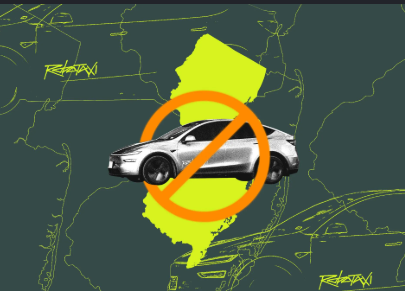
THE REGULATORY MAP OF AUTONOMOUS MOBILITY IS BEING DRAWN IN REAL TIME. NEW JERSEY JUST PICKED UP A PEN.
Here is what is actually happening - verified, balanced, and without the headline inflation this story has attracted.
THE BILL.
New Jersey Senate Bill S1677, with Assembly companion A3968, would create a three-year pilot program for fully driverless commercial vehicles in the state. Its requirements: every participating vehicle must carry cameras PLUS two additional sensing technologies - in practice, lidar and radar. Operators must complete 50,000 miles of supervised testing in New Jersey before removing safety drivers, report crashes to the state, and obtain authorization before launching any commercial service. The bill also expresses a preference for retaining traditional steering wheel and pedal controls.
Status, stated precisely: introduced January 16, cleared the Transportation Committee this spring, now in Senate Budget and Appropriations, vote expected later this year. It is a bill. It is not a law. "Poised to ban" headlines are ahead of the process.
WHAT IT WOULD MEAN.
If enacted as written, camera-only autonomous systems - which is to say Tesla's Robotaxi platform and the purpose-built Cybercab, which has no steering wheel or pedals at all - could not operate commercially in New Jersey without a fundamental hardware change. Multi-sensor operators such as Waymo, which runs cameras, radar, and lidar, would qualify. Neighboring New York is reportedly considering a similar mandate; together they would cover the country's densest metro market.
Important and widely misreported: the bill does NOT affect consumer driver-assist features like Autopilot or supervised FSD, which still require a licensed driver. It targets fully driverless commercial fleets only.
BOTH SIDES, FAIRLY.
The sponsor is State Senator Andrew Zwicker, a physicist at the Princeton Plasma Physics Laboratory who says a Waymo ride in Phoenix convinced him of the technology's promise. His position: the evidence does not yet show that a single sensor type plus software can handle what humans handle, so redundancy should be required while the record builds. He states plainly that the bill is about safety, not any single company.
Tesla's position, held for years and argued publicly by its CEO: vision plus AI is the safer architecture, added sensors create conflicting data - what he has called sensor contention - and cameras are how the human system the roads were designed for actually works. The company is lobbying against the bill, and roughly 4,000 owner emails reached the sponsor's office in a single day.
Waymo, for its part, operates more than 3,500 driverless vehicles across 11 metro areas on the multi-sensor approach.
Reasonable people disagree here. Both camps claim the safety high ground. The market and the crash data will eventually referee. A state legislature refereeing it first, by writing hardware into law, is genuinely new - and that is the real story.
THE BIGGER PICTURE.
Congress has debated a national autonomous vehicle framework for years and produced none. So the states are drawing the map themselves: California demands permits and detailed reporting. New Jersey now proposes to regulate the hardware inside the vehicle. Texas, Arizona, and Georgia allow self-certification with accountability for on-road performance. Fifty states, fifty pens.
For operators, the lesson is not which sensor wins. It is that WHERE you operate now shapes WHETHER you operate. Jurisdiction has become a first-order strategic decision, as important as the vehicle itself.
WHY I AM WATCHING FROM ARIZONA.
ASCENDING chose to build in the Phoenix East Valley deliberately: a single market, under a single regulatory regime we know deeply, in the most operationally proven autonomous-vehicle territory in America - nearly a decade of driverless operating history and a framework that judges systems by their performance on the road.
Our plan already names regulatory change as a material risk, because honest plans name their risks. But the patchwork cuts both ways: every wall raised in a distant state makes open, proven ground more valuable, and Arizona is the most open, proven ground there is.
We are watching S1677 the way we watch everything - eyes open, assumptions flagged, nothing taken on faith.
That is the whole discipline.
ASCENDING, LLC is an independent Arizona operator, headquartered in Gilbert, with no affiliation, endorsement, or partnership with any vehicle manufacturer. This commentary summarizes public reporting on pending legislation as of July 11, 2026.
Follow the build:
X: @ASCENDING_AZ
YouTube: @NOWASCENDING
Website: https://t.co/0e2vGHo7mW
#AutonomousVehicles #AVRegulation #Tesla #Waymo #NewJersey #Arizona #EastValley #AutonomousMobility #Policy #SelfDriving @elonmusk@aelluswamy@larsmoravy
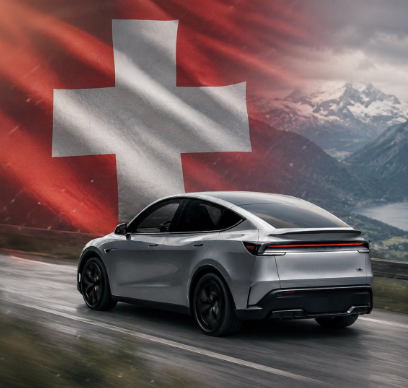
SWITZERLAND IS FAMOUSLY NEUTRAL. ITS CAR BUYERS JUST PICKED A SIDE.
Newly released Swiss registration data for June 2026 delivered a result worth reading twice: the Tesla Model Y was the best-selling vehicle in Switzerland. Not the best-selling electric vehicle. The best-selling vehicle, full stop, in one of the wealthiest and most discerning car markets in the world.
THE SWISS NUMBERS.
Model Y sales more than doubled year over year - up 101.6% - to reach 5.6% of the entire Swiss new-car market in a single month, its strongest share since March 2024. It dethroned the Mercedes-Benz GLC, which had won May, and pushed the VW Golf to third.
Zoom out to the brand level and the picture holds: Tesla registered 1,588 vehicles in June, up 78.6% from a year earlier, good for 6.3% of the total market and fifth place among ALL automakers. That is a pure-EV company standing on a podium that Volkswagen, Mercedes, Skoda, and BMW have treated as private property for decades.
The current underneath is just as notable. The total Swiss market surged 15.6% in June, and battery-electric registrations within it jumped 38.2% to 26.4% of all new cars. More than one in four new vehicles hitting Swiss roads in June ran on batteries. In the land of precision engineering, the verdict on the powertrain question is getting harder to miss.
AND THEN THERE IS CHINA.
Switzerland was not even the loudest headline of the month. In China - the most viciously competitive automotive market on the planet, where domestic brands launch new models at a pace no other country can match - the Model Y was June's best-selling passenger vehicle of ANY fuel type, with 38,654 retail registrations per industry tracker Yiche.
Here is the detail that should stop the scroll: it was also the most expensive vehicle in the top ten, by a wide margin. Every other entry starts cheaper; four of them start under fifteen thousand dollars. The priciest car on the list outsold everything below it.
That is not a discount story. That is a demand story.
Tesla China moved 89,091 vehicles wholesale in June - its best month of 2026, up 24.4% year over year, extending an eight-month streak of year-over-year growth.
THE PATTERN.
One vehicle, first place, in the same month, in two markets that could not be more different: Alpine wealth that can buy anything it wants, and Chinese hypercompetition where a hundred rivals fight for every sale. Different continents, different price sensitivities, different politics. Same verdict.
Eighteen months ago, the confident narrative said this company's automotive story had peaked in Europe and was being buried in China. Narratives are cheap. Registration data is not. In June 2026, from Zurich to Shanghai, the data filed its report.
Worth remembering the next time a consensus sounds certain.
Data sources: auto-schweiz Swiss registration figures via Best Selling Cars Blog; Yiche China retail data and Tesla China wholesale figures via EVwire (July 2026).
@Tesla
Follow along:
X: @ASCENDING_AZ
YouTube: @NowAscending
#Tesla #ModelY #EV #ElectricVehicles #Switzerland #China #EVNews #AutoIndustry #TeslaNews
THE FIRST PASSENGERS ARE THE PEOPLE WHO BUILT IT.
On July 10, the manufacturer of the industry's first purpose-built autonomous vehicle - no steering wheel, no pedals, designed for nothing but carrying riders - announced that employee rides are starting soon at its Texas factory campus. The company released video of the vehicles driving the grounds autonomously to make the point.
A vehicle the whole industry has watched for years is about to hold a human being for the first time. And the humans chosen are the ones who bolted it together.
WHAT THE HEADLINE MISSES.
The announcement is one sentence. The preparation behind it is the story.
The first production unit rolled off the line in February. Mass production ramped from late April. Drone flyovers show well over one hundred units staged in the factory's outbound lot, with additional clusters staged in nearby metro areas. The vehicle carries its federal environmental certification. It carries a state-level Level 4 self-certification. Production units without any human controls have already begun engineering tests on public roads.
In other words: the fleet exists, the paperwork exists, the testing exists - and the program STILL chose the smallest, safest possible arena for its first riders. A private campus. A closed environment. Passengers who understand the machine because they built the machine.
THAT IS THE PLAYBOOK, AND IT IS THE RIGHT ONE.
There is a name for what is happening here: prove-then-scale. Validate in the most controlled environment available. Gather real ride data. Earn the next, larger arena. Campus before city. Employees before customers. Evidence before expansion.
It is the opposite of the move-fast mythology people expect from this industry, and it is exactly why this moment deserves more respect than a casual scroll gives it. The boldest program in autonomous mobility is being deliberately, methodically boring about its most important milestone. Boring, in safety-critical transportation, is a compliment of the highest order.
WHY I AM PAYING ATTENTION FROM ARIZONA.
ASCENDING's entire launch architecture rests on the same conviction. Before our Phase 1 service across Gilbert, Mesa, Chandler, and Tempe - targeted for November 1, 2026 - our plan runs a hard validation phase in live East Valley service, with pass-fail criteria set in advance. Capital does not deploy ahead of proof. Scale is earned, not scheduled.
So when the most-watched vehicle program on Earth chooses a factory campus over a splashy public launch, I do not see hesitation. I see the industry's center of gravity agreeing, in public, that validation comes first. Every serious operator should be taking notes. We took ours before the video dropped.
The vehicles are built. The track is tested. The seats are about to be filled - carefully, deliberately, and in exactly the right order.
That is how the future should arrive.
ASCENDING, LLC is an independent Arizona operator, headquartered in Gilbert, with no affiliation, endorsement, or partnership with any vehicle manufacturer. This commentary summarizes public reporting and video released July 10, 2026.
Follow the build:
X: @ASCENDING_AZ
YouTube: @NOWASCENDING
Website: https://t.co/0e2vGHo7mW
Contact: [email protected]
#AutonomousMobility #AutonomousVehicles #SelfDriving #EastValley #Gilbert #Mesa #Chandler #Tempe #Arizona #Phoenix #FutureOfTransportation @elonmusk@larsmoravy@aelluswamy
THE MONSOON IS COMING TO THE EAST VALLEY. HERE IS THE TEN-DAY RAIN PICTURE.
Verified Friday, July 10, from National Weather Service guidance, the Maricopa County Flood Control District outlook, and local First Alert forecasting. All times local.
THE SETUP.
Late Thursday night, a massive thunderstorm complex over northwestern Mexico collapsed near the northern Gulf of California and exhaled a surge of low-level moisture straight up into southern Arizona. That is why Friday looked hazy and felt like soup. Meanwhile, the high-pressure dome that has been baking the Valley at 110-plus is sliding toward the Four Corners, and when it parks there, the flow turns deep and southeasterly. That is the monsoon's delivery route, and forecasters are calling this the first significant burst of the 2026 season.
DAY BY DAY, GILBERT-AREA RAIN CHANCES:
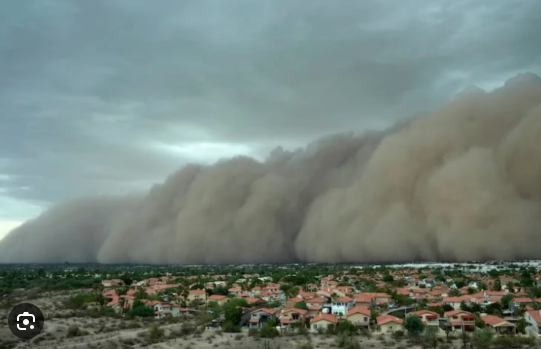
SATURDAY - 20 percent. The opening act. Storms fire on the high terrain of eastern Arizona first and may struggle to survive the trip into the lower deserts. What the Valley gets instead: gusty outflow boundaries and blowing dust. If you see a brown wall on the horizon Saturday evening, that is not fog. Highs near 107-110, because the monsoon does not cancel the heat, it just adds humidity to it.
SUNDAY - 30 percent, AND THE DAY TO CIRCLE. A First Alert Weather Day has been issued for the potential of strong-to-severe storms. The moisture profile deepens enough for genuine wetting rain to reach the Valley floor, including the East Valley. Prime window: late afternoon through evening, with scattered morning showers possible too.
MONDAY - 20 percent. The trend holds. Enough moisture remains in place that localized flash flooding becomes possible where storms train over the same ground.
TUESDAY - 15 percent as the first burst begins exhaling.
DAYS SIX THROUGH TEN - County forecasters expect the favorable monsoon pattern to persist through next week, and extended outlooks keep scattered afternoon and evening thunderstorm chances on the board most days, with the standard monsoon caveats attached: damaging wind gusts, flash flooding, and dust storms all possible with any given cell. Honesty requires saying it plainly: beyond five days, specific percentages are guesses wearing lab coats. The pattern is real. The daily details will be decided by which outflow boundary collides with which pocket of instability.
HOW TO READ A MONSOON PERCENTAGE.
A 30 percent chance in July does not mean everyone gets 30 percent of a storm. It means roughly one neighborhood in three gets the whole show: a microburst, a wall of dust, sideways rain, and an arroyo doing its best river impression, while the subdivision two miles west stays completely dry and mildly jealous.
The monsoon is not a broadcast. It is a lottery with weather.
THE OPERATIONS NOTE.
Permit me one paragraph from the founder side of the desk. Weekends like this one are precisely why serious autonomous mobility operators obsess over operational design domains, write their weather and dust protocols before the first passenger ever rides, and treat the monsoon as an engineering input instead of an excuse. The desert does not grade on intent. It grades on preparation. That is true for fleets, and it is true for families.
THE CHECKLIST.
Secure anything in the yard that can become a projectile. Charge the devices Saturday afternoon, not Sunday night. Give the storm drains and washes absolute respect: never drive into flooded roadway, no matter how shallow it looks. And when the dust wall comes: pull aside, stay alive - lights off, foot off the brake.
The East Valley has waited all summer for the sky to do something interesting. Starting this weekend, it will.
Follow the build:
X: @ASCENDING_AZ
YouTube: @NOWASCENDING
Website: https://t.co/0e2vGHo7mW
Sources: NWS guidance via Maricopa County Flood Control District Weather Outlook; AZFamily First Alert Weather; AccuWeather Phoenix 10-day (all July 10, 2026).
#Monsoon2026 #AZwx #EastValley #Gilbert #Mesa #Chandler #Tempe #Phoenix #MonsoonSeason #DustStorm @elonmusk@aelluswamy@larsmoravy
QUARTERFINAL SATURDAY: TWO GAMES, FOUR SURVIVORS, ONE BRACKET COLLAPSING INTO SHAPE.
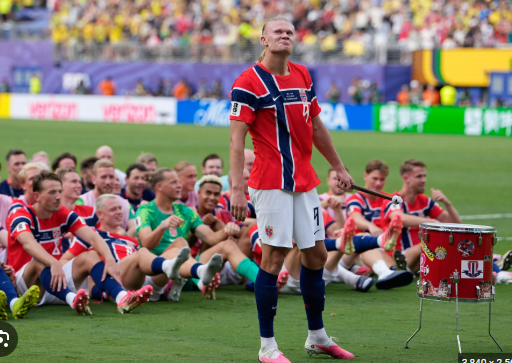
The 2026 World Cup began with 48 teams. Four weeks later, eight remain, and after tomorrow, the right side of the bracket will be down to two. Both games are in the evening, both are heavyweight, and both carry a plot twist the favorites would rather you not read.
GAME ONE: NORWAY vs ENGLAND - 5:00 PM ET, MIAMI.
How they got here says everything.
England went to the Azteca, went down to ten men, and beat Mexico 3-2 anyway behind a Jude Bellingham brace. That is arguably the finest away win in their modern history, achieved in one of the most hostile buildings in the sport.
Norway answered by ending Brazil. Not surviving Brazil. Ending them, 2-1, with an Erling Haaland brace, sending the five-time champions home in the round of 16.
Now the twist: England have won only two of their last seven meetings with Norway, a drought that reaches back to an infamous 1981 World Cup qualifying defeat that still gets replayed in both countries for very different reasons. Pedigree says England. History whispers otherwise.
The individual duel is the one the tournament deserves: Haaland versus Harry Kane, two of the most ruthless finishers alive, one of whom will be watching the semifinals from home. Thomas Tuchel has England deeper and more balanced than they have looked in years. Norway have spent this tournament proving they are more than the Haaland show. Saturday, one of those truths stops being true.
GAME TWO: ARGENTINA vs SWITZERLAND - 9:00 PM ET.
The defending champions have decided that every knockout match must end 3-2, apparently as a matter of policy.
Round of 32: 3-2 over World Cup debutants Cape Verde, and it took extra time. Round of 16: down 2-0 to Egypt with just over ten minutes to play, then Cristian Romero, then Lionel Messi, then Enzo Fernandez in the 93rd minute. 3-2 again. The champions do not defend leads. They decline to hold them in the first place.
And presiding over all of it: Messi, age 39, with nine goal contributions in a single World Cup. That is not a farewell tour. That is a man refusing to let the tournament end without his permission.
Switzerland arrived by the opposite route. One hundred twenty scoreless minutes against Colombia, then a place in the quarterfinals won from the penalty spot. Two full hours of conceding absolutely nothing and advancing anyway: the most Swiss result imaginable. Neutral until the exact moment it counted.
Which sets up the tactical question of the round.
Everything Argentina create flows through one man, and their flaws behind him are real: the defending is chaotic, the midfield structure is questionable, and they keep needing miracles. Switzerland cannot outscore the champions.
But Granit Xhaka and Remo Freuler are exactly the kind of central midfield steel designed to strangle the space Messi lives in, with Manuel Akanji anchoring behind them. Stop Messi and Argentina are mortal. In this tournament, nobody has managed it for ninety minutes. The Swiss will try to manage it for one hundred twenty.
THE STAKES.
Tomorrow's winners meet Wednesday, July 15, for a place in the final. France and Spain contest the other semifinal Tuesday.
The final is July 19 in New Jersey. Every team left is three wins from immortality, and two of them run out of tomorrows this weekend.
For the Arizona crowd: that second match kicks off at 6:00 PM our time. Dinner and destiny, same table.
@FIFAWorldCup@FOXSports
#FIFAWorldCup #WorldCup2026 #NORENG #ARGSUI #QuarterFinals #Messi #Haaland
THE FILINGS TELL THE STORY.
The most consequential autonomous mobility news of the year for the Phoenix East Valley did not arrive by press release. It arrived the way real operational commitments always arrive: through permit offices and regulatory filings.
Here is what entered the public record over the past several weeks.
FIRST: a major autonomous ride-hail network filed a first-responder interaction plan with Arizona authorities. Buried in that filing is a list of proposed initial deployment areas. On that list: Chandler. Gilbert. Mesa. Tempe. Along with Phoenix, Scottsdale, Glendale, Paradise Valley, and Maricopa County.
Every one of the four East Valley cities. Named. In a regulatory filing.
SECOND: roughly sixty autonomous-configured vehicles were observed staged in the Phoenix area this spring, a larger concentration than the network's original launch city had at the time. You do not stage sixty vehicles for a science experiment. You stage them for a launch.
THIRD: permit applications filed in Chandler and Mesa describe dedicated fleet-charging sites that will not be open to the public. Fifty-six charging stalls on an industrial plot in the Chandler corridor. A second site in Mesa. This is the unglamorous tell that matters most, because autonomous mobility at scale is a facilities business: depots, charging, staging, maintenance. When a company starts permitting private fleet infrastructure in your zip code, it is not speculating anymore.
FOURTH: the industry's first purpose-built autonomous vehicle, designed from the ground up with no steering wheel and no pedals, entered production this year. First unit off the line in February. Continuous production by spring. Federal environmental certification recorded May 29. Full production specifications public as of this month.
And one more fact, because honesty is the whole brand here: the stated first-half-2026 launch window for the Phoenix market came and went without a launch. The market is staged, permitted, and named, but not yet live. Timelines in this industry slip. Outcomes, historically, land. Any operator who has not built their plan around that pattern has not been paying attention.
WHAT IT MEANS.
Put the filings together and the conclusion writes itself: the East Valley is where autonomous mobility is being built next. Not abstractly. Not eventually. The infrastructure is being permitted now, the vehicles are staged now, and the regulatory paperwork names Gilbert, Mesa, Chandler, and Tempe specifically.
For those of us who live here, that should not be a surprise. This corridor holds 1.28 million residents in one of the fastest-growing metropolitan areas in the United States. It has wide, well-planned roads, three hundred days of sun, a supportive regulatory framework, and nearly a decade of autonomous vehicle operating history. If you were choosing ground to prove this industry on, you would choose here. The industry keeps choosing here.
THE QUESTION THAT IS STILL OPEN.
The vehicles are being solved. The autonomy software is being solved. Companies with hundreds of billions of dollars are solving them, and the filings above are the proof.
But there is a layer of this industry that no amount of capital in a distant headquarters can solve, and it is the layer that determines whether riders actually trust the service: who operates locally.
Who runs the depot at four in the morning. Who has the vehicles cleaned, charged, and staged before the first medical appointment of the day. Who picks up the phone when a Gilbert city official calls. Who trains the team that talks to an officer at a traffic stop. Who treats an eighty-year-old rider's trip to dialysis as the most important ride of the day, because in that moment it is.
That layer is not won by whoever spends the most. It is won by whoever prepares the most, and whoever answers to the community they serve because they belong to it.
WHERE ASCENDING STANDS.
ASCENDING is an independent Arizona operator, headquartered in Gilbert, built specifically for this corridor. We are not affiliated with, endorsed by, or partnered with any vehicle manufacturer, and we claim no special access to anyone's platform. What we claim is preparation: the regulatory groundwork done first, the operations center designed for this exact footprint, the advisory bench assembled, the launch plan disciplined enough that we do not deploy ahead of clarity.
We are targeting November 1, 2026 for Phase 1 launch across Gilbert, Mesa, Chandler, and Tempe--obviously, only if Tesla makes this possible. May get pushed back into 2027.
The filings say the future of this industry is being built in the East Valley. We intend to serve that future the way it deserves to be served: locally, accountably, and with the discipline of people who will be putting their own parents and grandchildren in these vehicles.
We are not waiting to get ready. We are getting ready to be first.
Follow the build:
X: @ASCENDING_AZ
YouTube: @NOWASCENDING
Website: https://t.co/0e2vGHo7mW
Contact: [email protected]
#AutonomousMobility #AutonomousVehicles #SelfDriving #EastValley #Gilbert #Mesa #Chandler #Tempe #Arizona #Phoenix #FutureOfTransportation @elonmusk@aelluswamy@larsmoravy
ONE OF ARIZONA'S LARGEST RESERVOIRS JUST DROPPED FROM 60% FULL TO LESS THAN 1% -- AND IT WASN'T EVEN THE COLORADO RIVER.
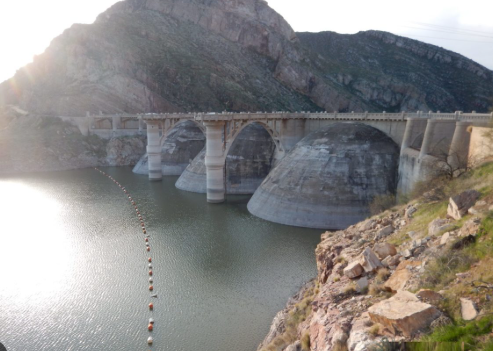
NASA Earth Observatory released satellite imagery this month showing just how far San Carlos Reservoir has collapsed. Formed by Coolidge Dam on the Gila River in southeastern Arizona, the reservoir ranks among the state's largest bodies of water when full, at a capacity of roughly 900,000 acre-feet. A Landsat 9 image captured May 22, 2026 shows it holding just 389 acre-feet of water -- about 127 million gallons, less than 1% of capacity. A comparison image from June 2023 shows the same reservoir at roughly 60% full. Same lens, same angle, almost unrecognizable.
The cause traces back to a historically bad snow year. The Gila River watershed, fed by snowmelt off the Mogollon Mountains and Black Range in southwestern New Mexico, saw mountain snowpack fall to just 2% of the 1991-2020 March median this past winter -- one of the worst snow seasons on record for the region. With that little snow to melt, April streamflow into the reservoir reached only 39% of normal. Mandatory water releases for downstream agriculture under the San Carlos Irrigation Project, tied to the dam's original 1924-1928 construction purpose, further drained what little remained.
The ecological consequence was severe. As the reservoir shrank, the shallow water left behind heated rapidly under the Arizona sun, and warm water holds far less dissolved oxygen than cold water. The result was hypoxia -- a fatal drop in oxygen levels -- that killed virtually the entire fish population, including largemouth bass, black crappie, bluegill, channel and flathead catfish, and stocked brown and rainbow trout. The San Carlos Recreation and Wildlife Department closed the reservoir indefinitely on June 5, 2026, citing what officials described as a catastrophic, complete fish kill, and warned that decomposing fish could pose health hazards to anyone attempting to boat or fish there in the meantime.
Rhett Larson, a water law professor at Arizona State University, put the severity in blunt terms to 12News: "This past winter was the worst we'd ever seen."
This isn't unprecedented for San Carlos specifically -- the reservoir has run completely dry at least 20 times since it first filled in 1930, and fish kills also occurred in 1976-77 (an estimated 5 million fish, requiring a 5-year ecosystem recovery), 2018, and 2022. But the scale and timing of this one land squarely in the middle of a much broader stretch of Arizona water stress. The same winter that starved the Gila River watershed also left the Colorado River's Upper Basin snowpack well below average, with Lake Powell dropping to just 24% full by mid-April and the Bureau of Reclamation warning it could fall below the level needed to generate hydropower by August without intervention. Lake Mead has faced its own operational restrictions. Three major Arizona water systems -- the Gila, the Colorado, and the reservoirs that depend on both -- are all under real strain in the same year, not as three separate stories but as one broader pattern.
Recovery for San Carlos now depends almost entirely on how much rain actually falls this monsoon season. NOAA's outlook issued in May put the odds at 33 to 50 percent for above-average summer rainfall in the region -- real hope, but far from a guarantee. Even with a strong monsoon, wildlife officials say restoring the reservoir's fish population to anything resembling pre-collapse conditions will likely take multiple seasons of recovery, not one good storm.
Water security in this state isn't a single story about one river. It's several stories, in several watersheds, all under pressure in the same year -- and this one just became impossible to ignore from space.
#Arizona #WaterSecurity #GilaRiver #Drought #Sustainability #ColoradoRiver
THE QUARTERFINALS OPEN WITH A GRUDGE MATCH. FRANCE VS. MOROCCO IS A REMATCH FOUR YEARS IN THE MAKING.
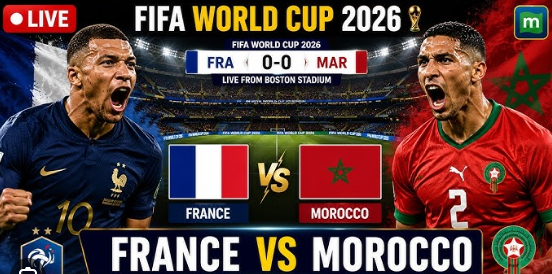
FRANCE vs MOROCCO -- 4:00 PM ET, Gillette Stadium, Foxborough, Massachusetts
The last time these two teams met at a World Cup, it mattered more than almost any game in Morocco's history. The 2022 semifinal in Qatar: France won 2-0 on goals from Theo Hernandez and Randal Kolo Muani, ending Morocco's run as the first African nation ever to reach that stage of the tournament. Morocco has spent four years waiting for a rematch. All-time, the two sides have met 6 times, with France winning 4 and 2 ending in draws -- but this is only their second-ever meeting at a World Cup specifically, and the stakes are exactly as high as they were the first time.
Both teams arrive genuinely unbeaten, which almost never happens this deep into a World Cup. Morocco's last loss in any competition, anywhere, came on August 10, 2025 -- a 34-match unbeaten run heading into today. Their path here included a 1-1 draw with Brazil, wins over Scotland and Haiti in the group stage, a dramatic penalty-shootout win over the Netherlands after Issa Diop's late equalizer forced extra time, and a 3-0 win over co-host Canada in the Round of 16, an Azzedine Ounahi brace doing most of the damage. France, meanwhile, has won all five of its matches, scoring 14 goals and conceding only 2 -- the most dominant record of any team left in the tournament.
Group I brought comfortable wins over Senegal, Iraq, and Norway (Ousmane Dembele scored a hat-trick in the Norway game alone); a 3-0 Round of 32 win over Sweden followed; and then a much tighter, uglier 1-0 grind past Paraguay in the Round of 16, settled by a second-half Mbappe penalty in a match multiple outlets described as rough, foul-heavy, and inconsistently officiated.
Injuries could shape this one. Morocco's biggest concern is Ismael Saibari, who scored in all three group-stage matches and converted the winning penalty that eliminated the Netherlands, but who is now out with a hamstring injury suffered against Canada -- a genuinely significant loss for a team that's relied heavily on his goal-scoring. Soufiane Rahimi, who came off the bench to score against Canada, is expected to start in his place.
Morocco is also without defenders Chadi Riad (doubtful after being forced off against Canada) and reportedly Ezzalzouli and Aguerd.
For France, defensive midfielder Aurelien Tchouameni, who missed the Paraguay game with an adductor injury, is questionable to return, and three France players -- Michael Olise, Bradley Barcola, and Manu Kone -- picked up yellow cards against Paraguay and would miss a semifinal appearance if booked again today.
The individual storyline running through all of this is the Golden Boot race. Kylian Mbappe has 7 goals this tournament, tied at the top with Lionel Messi and Erling Haaland, and sits at 19 career World Cup goals overall -- one behind Messi's newly-set all-time record. A goal today would draw him level with the mark; two would break it outright.
The betting markets and the underlying numbers both point the same direction: France is favored at odds ranging from -175 to -200 depending on the book, with Morocco a live but distinct underdog around +525. France's expected-goals tally across the tournament sits at 9.79 versus Morocco's 6.40, a real gap in overall attacking quality even accounting for the different levels of opposition faced.
Most analysts are calling for a controlled, relatively low-scoring French win -- a 2-0 scoreline and an under-2.5-goals total both show up repeatedly across independent predictions. Conditions won't make it easy on anyone: kickoff temperatures are expected near 90 degrees Fahrenheit with a RealFeel closer to 99, with a chance of thunderstorms later in the evening.
Whoever wins advances to face the winner of Spain-Belgium (playing Friday) in the semifinal, July 14, in Dallas. Two unbeaten teams, one four-year-old score to settle, and a World Cup quarterfinal spot on the line. Something has to give in the Massachusetts heat today.
#WorldCup #FranceVsMorocco #Mbappe #Quarterfinals #WC2026 #GoldenBoot
A TESLA OWNER ASKED FOR ONE SPECIFIC FEATURE. TESLA'S OWN VP OF AI REPLIED WITH TWO WORDS THAT CONFIRMED IT'S COMING.
The exchange itself is straightforward. A Tesla owner, describing one of FSD's most persistent real-world limitations, put it this way: "FSD would be twice as useful in neighborhoods if I could talk to the car" and simply tell it, in plain language, which house or driveway to use on arrival -- since map pins are notoriously wrong for exact addresses, and a human passenger would just say something like "it's the white house on the left, just past that SUV." Ashok Elluswamy, Tesla's VP of AI Software, replied directly on Tuesday: "Working on it."
That two-word reply matters more than it might look, because Elluswamy isn't a random employee -- he's the executive who led Tesla's FSD program to unsupervised robotaxi operation, and now also leads the Optimus humanoid robot program after taking it over in 2025. When he confirms something is in development, that's about as close to an official product roadmap statement as Tesla gives publicly.
Here's the genuinely significant part, separate from the novelty of talking to your car: this builds on Grok, the xAI-developed assistant that's been available in Tesla vehicles since July 2025, expanded to European vehicles in February 2026, and picked up a hands-free "Hey Grok" wake word along with location-based reminders and natural-language navigation in a Spring 2026 update.
But up to this point, Grok has had zero authority over how FSD actually drives -- lane changes, braking, speed, and parking maneuvers have remained entirely inside FSD's own autonomous decision-making loop, with Grok limited to a conversational, navigation-assistance role. What's being described here is different: pushing Grok into a supervisor role that translates spoken intent directly into real driving decisions, like which driveway to pull into or where exactly to stop.
Elluswamy has been unusually direct about why that distinction is exactly what makes this hard. At a conference in January, discussing the roadmap for full voice control, he said plainly: "You shouldn't be able to tell the car to crash, and it shouldn't crash."
He added that enabling this "opens up an entire area of testing that we have to do" before it can ship responsibly. That's a real, substantive safety-validation problem, not a marketing caveat: letting a probabilistic language model influence a real-time driving decision introduces new categories of failure -- misheard commands, ambiguous phrasing, adversarial inputs -- that a simple voice-controlled radio or climate system never has to worry about.
Early user reports on Grok's existing navigation commands already show occasional cases where it acknowledges a request but fails to execute it correctly, which is exactly the kind of edge case that has to get solved before the system is allowed anywhere near actual vehicle control.
Elon Musk has separately floated a timeline of "about 3 months or so" for Grok-based FSD voice control, pointing toward a possible September 2026 rollout, with reported sample commands under discussion including "Turn right here," "Drop us off right here," "Drop at entrance first, then park far away," and "Pull forward into the driveway." This lands alongside a broader wave of FSD software work -- version 14.3.4 includes a full rewrite of Tesla's AI compiler and runtime using MLIR, claimed to deliver roughly 20% faster reaction times, along with an improved vision encoder specifically aimed at low-visibility conditions -- notable given federal regulators have an open investigation into exactly how FSD handles reduced visibility like glare, fog, and dust.
None of this erases the genuine scrutiny FSD is under more broadly. Reuters reported in May that European regulators raised concerns about FSD's behavior and branding, including speeding and icy-road use, and reported again in June that independent researchers have criticized Tesla's self-published safety data as misleading. Real, open questions like those are exactly why Elluswamy's own caution about testing matters here -- adding voice-directed control to a system already facing safety questions raises the stakes on getting the validation right, not just shipping something novel quickly.
Worth watching closely over the next few months, and worth taking seriously specifically because Tesla's own head of AI is being this direct, in public, about the testing that still has to happen before it's ready.
#Tesla #FSD #Grok #AI #AutonomousVehicles #Elluswamy
A VIRAL TESLA SAFETY POST CLAIMED 8X FEWER MAJOR CRASHES WITH FSD. TESLA'S OWN DATA, READ CAREFULLY, TELLS A MORE MODEST -- BUT STILL GENUINELY POSITIVE -- STORY.
Tesla's official Vehicle Safety Report is real, and the raw numbers behind the viral claims are genuine: as of its most recent update, Tesla reports FSD (Supervised) vehicles logging one major collision every 5,300,676 miles, compared to roughly 660,164 miles for the U.S. average driver, and 2,175,763 miles for Teslas driven manually with active safety features engaged. Tesla has now logged over 8 billion cumulative FSD (Supervised) miles, with annual mileage climbing from 6 million in 2021 to 4.25 billion in 2025 alone. Those are the source numbers behind the "8x/9x safer" framing that circulates on social media.
But a detailed, published methodology review from Phil Koopman, a well-credentialed autonomous vehicle safety researcher, raises real, specific problems with how that comparison is constructed. Tesla only counts a crash as FSD-related if the system was engaged within 5 seconds of impact, well short of NHTSA's own 30-second reporting standard -- a choice that likely excludes crashes where FSD disengaged shortly before contact but may still have contributed.
Koopman also found an unexplained, large discrepancy between how Tesla classifies "highway" versus "non-highway" driving and how NHTSA's own fatality-rate data draws that same line, a gap significant enough to undermine an apples-to-apples comparison, since the most dangerous roads in America are often state highways, not interstates. His written conclusion, after reviewing the full report: "None of those claims stand up to scrutiny." Separately, the Insurance Institute for Highway Safety, a genuinely independent, widely respected research body, has taken the institutional position that FSD-type driver-assistance features should be understood as convenience features, not safety features -- a direct challenge to the premise underlying Tesla's own safety marketing.
There's a more favorable, and arguably fairer, read available too. Brad Templeton, a respected autonomous vehicle industry analyst writing for Forbes, reviewed the same report and found that Tesla had genuinely corrected a number of real methodological errors present in its older, widely criticized Autopilot-era safety claims, which for years overstated Tesla's safety advantage using flawed comparisons.
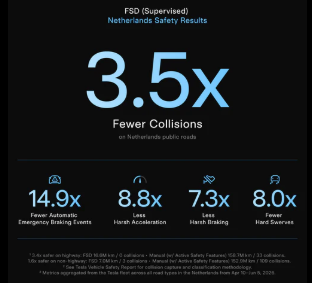
Working from the corrected data, Templeton's own more conservative estimate lands at roughly 2x safer globally, across all road types, when comparing FSD (Supervised) driving to manual driving -- a real, meaningful improvement, just nowhere near "8x." An independent international data point backs up this more modest picture: Tesla's own released Netherlands safety data, covering FSD (Supervised) under a different country's regulatory oversight, shows the system running about 1.6x safer than manual driving on non-highway city streets specifically -- the harder, more relevant driving environment where intersections, cyclists, and pedestrians make the problem genuinely difficult -- versus a flashier 3.4x safer figure on highways alone.
One more piece of context matters here. The U.S. National Highway Traffic Safety Administration escalated an investigation in March 2026 to a full Engineering Analysis, the most serious pre-recall investigative stage, covering roughly 3.2 million Tesla vehicles equipped with FSD. The focus is specifically on whether the system properly detects and alerts drivers when roadway visibility degrades -- glare, fog, dust -- and the investigation is tied to multiple documented incidents, including at least one fatal crash where Tesla's own internal review found the system had lost track of a lead vehicle. That's a live, unresolved regulatory process, not settled history, and it's directly relevant to any claim about how reliably the system protects drivers in real-world edge cases.
None of this means FSD is unsafe, and a genuine, well-supported 2x safety improvement over manual driving is a real, significant achievement worth taking seriously on its own terms. But there's a meaningful difference between "the biggest number you can generate from favorable methodology" and "the number that actually holds up once you account for how it was built." That distinction matters for Tesla specifically, and it matters for the credibility of the entire autonomous vehicle industry more broadly -- including every operator, ourselves included, whose business ultimately depends on the public trusting that the safety claims behind this technology are being reported honestly.
#Tesla #FSD #AVSafety #AutonomousVehicles #DataIntegrity #NHTSA
WAYMO JUST EXPANDED TO FOUR NEW CITIES THE SAME WEEK ITS CARS WERE STILL BEING TOWED OUT OF SAN FRANCISCO TRAFFIC. BOTH THINGS ARE TRUE AT ONCE, AND BOTH ARE WORTH UNDERSTANDING.
Waymo announced Wednesday that it will begin fully driverless service in four new cities -- San Diego, Las Vegas, Denver, and Tampa -- starting with Alphabet employees before opening to the public later this year.
That brings Waymo's total footprint from roughly 10-11 cities to 14, adding to an existing service area that already covered more than 1,400 square miles as of May, more territory than the entire state of Rhode Island. The company's domestic fleet now stands at roughly 3,500-4,000 vehicles running fifth- and sixth-generation autonomous driving systems, and Waymo has delivered more than 20 million autonomous rides overall, with roughly 500,000 paid rides happening every single week across its existing markets.
All of this is funded by a $16 billion round Waymo raised in February at a $126 billion valuation -- the largest single investment any autonomous vehicle company has ever received. Waymo's own announcement captured the moment plainly: "Autonomous mode activated in four new cities!" A separate company statement added: "Each city is on its own timeline, but we're working to welcome riders in each of these new cities by the end of the year."
The four cities themselves were chosen for genuine diversity of conditions, not just convenience. San Diego mixes dense urban cores with sprawling suburbs. Las Vegas runs 24/7 with extreme pedestrian density along the Strip. Tampa brings frequent thunderstorms and heavy seasonal rain. Denver adds high altitude and snow -- conditions that have historically been among the hardest for autonomous systems to handle well.
Notably, Waymo is deploying its purpose-built "Ojai" robotaxi -- the first vehicle the company designed entirely from the ground up rather than retrofitting an existing consumer car -- specifically engineered with snowier road conditions in mind ahead of the Denver launch, running on Waymo's sixth-generation Driver system. The company is separately beginning to test Hyundai IONIQ 5 vehicles autonomously as well, with a human specialist still present for now.
Waymo also launched a $29.99/month "Waymo Premier" subscription tier in June, offering priority pickups and fare credits to frequent riders in San Francisco, Los Angeles, and Phoenix, and is targeting a London launch later this year as its first market outside the United States, with a company-wide goal of 1 million weekly rides by the end of 2026.
The competitive gap this creates is real and worth being precise about. Tesla's entire driverless robotaxi fleet remains tiny by comparison -- roughly 20 vehicles covering about 245 square miles of the Austin metro, according to third-party tracking data, even after removing in-car safety monitors around the one-year mark (though remote operators can still take control at low speeds to reposition a stuck vehicle).
Tesla has tied any major fleet expansion to the release of its Full Self-Driving v15 software, targeted for late 2026 or early 2027. Amazon-owned Zoox has served roughly 300,000 riders as of March 2026 and is preparing public launches in Austin and Miami. GM's Cruise is reportedly still working to restart operations following safety incidents from the prior year. Waymo, by contrast, isn't just announcing plans -- it's turning off safety drivers city by city and telling people to download the app, on what Electrek describes as a near-monthly cadence.
None of that erases the operational challenges piling up at the same time. Over the Fourth of July weekend, a number of Waymo vehicles in San Francisco got stuck in post-fireworks gridlock for so long that their batteries died in the middle of the road, and at least one vehicle was seen driving directly into a firework display.
Separately, Waymo vehicles have driven into flooded roadways during extreme weather events, serious enough in at least some cases to trigger formal recalls rather than just company statements about isolated incidents. Denver's addition to the map raises a new version of the same question going forward: snow and ice have historically been some of the hardest conditions for autonomous vehicles to master, and Waymo is about to find out how its technology handles a genuinely new kind of weather at scale.
Both of these threads are the real, current state of Waymo, not a contradiction to resolve in favor of one story or the other. The technology and the capital behind it are genuinely ahead of every other competitor in this race, by a wide margin.
But scaling into new, harder environments is exactly where operational execution gets tested the hardest, not where it gets easier -- and that's a different, separate skill from building great underlying technology. Building the best autonomous vehicle in the world and reliably operating a fleet of them, city by city, in the actual weather and traffic and crowds people really live with, are two different jobs. That distinction, and getting the second one right, is the entire bet behind ASCENDING.
#Waymo #Robotaxi #AutonomousVehicles #Tesla #Zoox #OperatorLayer #SelfDrivingCars
NINETY-FIVE PERCENT OF THE RAIN THAT FALLS IN ARIZONA NEVER MAKES IT TO THE WATER TABLE. IT JUST EVAPORATES.
A joint research effort involving all three of Arizona's public universities -- the Arizona Tri-University Recharge and Water Reliability Project -- set out to get a clearer picture of exactly how much water sits in the state's groundwater basins, and how much more could realistically be captured before it's lost.
The headline finding: more than 95% of the precipitation that falls across Arizona is lost to evapotranspiration -- the combined effect of direct evaporation and water uptake by plants -- before it ever has a chance to soak into an aquifer. In the Phoenix Active Management Area specifically, the region covering the entire metro area, the amount of water lost to evapotranspiration is roughly equal to the total amount of precipitation that falls there in the first place. Functionally, almost none of the rain that falls on the Valley recharges into the ground naturally.
The research team, which also profiled all 51 of Arizona's groundwater basins and modeled how climate change could further strain the state's water supply going forward, is proposing a fix that's straightforward in concept: get rainwater and snowmelt to natural recharge points faster, before evaporation and plant uptake claim it.
Kathy Jacobs, former director of the University of Arizona's Center for Climate Adaptation Science and Solutions, highlighted the Mogollon Rim as a particularly promising target -- an area with karst topography, porous limestone-like rock that lets water soak directly into underground aquifers rather than pooling on the surface or sheet-flowing across it until it evaporates. Streambeds with similarly porous material, along with natural fissures and cracks in surface rock elsewhere in the state, offer similar recharge opportunities.
"We get the water as quickly as possible to a place where it can recharge," Jacobs explained. The report's broader recommendation is that the state significantly expand its monitoring of both surface and groundwater to actually track where these opportunities exist and how well they're being used.
The purpose behind all of this is squarely practical: helping the Arizona Department of Water Resources identify concrete ways to capture water currently being lost to the atmosphere and redirect it underground as recharge, rather than watching it evaporate off streets, fields, and rooftops across the state.
This finding lands in the middle of a genuinely intense stretch for Arizona water news. Lake Powell, the nation's second-largest reservoir, just hit its lowest level of 2026 and is reportedly on track for record-low territory.
Arizona separately secured a Lower Colorado River Basin water-savings plan with meaningfully lighter cuts than federal regulators had originally proposed for 2027 and 2028. Phoenix-area cities are simultaneously pressing the Arizona Water Banking Authority for more clarity on how much of their own banked water they're actually allowed to withdraw. Taken together, the picture is consistent: Arizona's water future is being contested on every front at once -- the river, the reservoirs, underground storage policy, and now, the rain falling from the sky itself. For a state adding people and industry as fast as this one is, that's worth watching closely.
#Arizona #WaterSecurity #Sustainability #Phoenix #ClimateResearch #ColoradoRiver
EIGHT BALLON D'ORS. A WORLD CUP WON IN 2022. AND YESTERDAY, AT 39, HE MAY HAVE ADDED THE MOMENT THAT DEFINES ALL OF IT.
Start with the resume, because it barely seems real written out in full. Eight Ballon d'Or awards, a record nobody else is within three of. Widely regarded as the most decorated player in the history of professional football, with somewhere in the range of 46 to 48 senior and official career trophies depending on how you count the disputed ones.
The all-time leading scorer in La Liga history with 474 goals, racked up across a Barcelona career that included four trebles-adjacent super-seasons, ten La Liga titles, seven Copa del Rey titles, and four Champions League crowns. Over 400 assists for club and country -- more than any player in the sport's history.
A move to Paris Saint-Germain, two Ligue 1 titles, and then a reinvention in Major League Soccer with Inter Miami that somehow added still more silverware, including the 2025 MLS Cup -- his 47th or 48th career trophy, depending on the count, won just seven months before this World Cup even began.
On the international stage, the story used to have a gap in it. Three consecutive losses in major tournament finals with Argentina, including the 2016 Copa America, briefly led him to announce he was quitting the national team altogether -- a retirement that lasted less than two months before he came back.
Then came 2021: Argentina's Copa America title, his first major trophy with the national team, with Messi collecting the Golden Ball. Then 2022: the World Cup itself, the one thing his career had been missing, capped by two goals and a shootout penalty in an all-time classic final against France, and a second Golden Ball award, making him the only player in history to win that honor twice. Argentina backed it up with another Copa America title in 2024, with Messi setting the all-time record for Copa America appearances at 39.
Then came this tournament, and it's already been its own extraordinary chapter. Messi opened the 2026 World Cup with a hat-trick against Algeria -- his 60th career hat-trick overall -- landing almost exactly 20 years to the month after his very first World Cup goal, scored as an 18-year-old against Serbia and Montenegro back in 2006.
Along the way this tournament, he broke Miroslav Klose's long-standing record for most goals in World Cup history, and became the first male player ever to score at six different editions of the tournament. He also became, at 39 years and 9 days old, the oldest player ever to score for Argentina, doing it against Cape Verde in the Round of 32 -- the same match in which Argentina survived a genuine scare from a debutant nation before escaping in extra time.
And then, yesterday, came the moment that might end up standing above all of it. Argentina fell behind Egypt 2-0, with just 11 minutes left in regulation, in a match that looked headed for one of the biggest upsets in World Cup history.
Messi had already missed a penalty earlier in the game -- his second missed spot kick of this tournament, and the fourth of his career across eight World Cup attempts. None of that stopped him. In the 79th minute, he set up Cristian Romero for Argentina's first goal. Four minutes later, with the ball in his path, he buried the equalizer himself -- his 21st career World Cup goal, extending his own all-time record even further, and his eighth of this tournament alone, putting him outright atop the Golden Boot race.
Enzo Fernandez completed the comeback in stoppage time. Argentina won 3-2, in what was confirmed as the first time in World Cup history that a team has won a knockout match in regulation after trailing by two goals as late as the 75th minute. Messi was in tears when the final whistle blew. "Honestly, I'm just so happy we made it through," he said afterward.
At 39 years old, in what is very likely the final World Cup of his career, that single sequence -- missing from the spot, absorbing the weight of a team on the brink of elimination, and then delivering exactly when it mattered most -- might genuinely be the moment people remember above every trophy that came before it.
Not because it outweighs an actual World Cup title in the record books. It doesn't, and 2022 will always be the crowning achievement of his career in the purest sense. But as a single image of what this entire career has actually been about -- relentless excellence delivered under the highest possible pressure, at an age when most players have long since retired -- yesterday might be the purest distillation of it yet.
And the tournament still isn't over. Argentina faces Switzerland in the quarterfinals on Saturday. If Messi's Argentina goes all the way and wins it again, he would become the first captain in World Cup history to lift the trophy twice -- a distinction no player, not Pele, not Maradona, not anyone, has ever managed. Whatever happens from here, he has already given this tournament, and this sport, one more chapter nobody saw coming.
#Messi #WorldCup #GOAT #Argentina #Legacy #BackToBack
EGYPT WAS 11 MINUTES FROM ONE OF THE BIGGEST UPSETS IN WORLD CUP HISTORY. THEN MESSI HAPPENED. TWICE.
ARGENTINA 3, EGYPT 2 -- Mercedes-Benz Stadium, Atlanta
For nearly 80 minutes, this looked like the day the defending champions went home. Yasser Ibrahim headed Egypt in front in the 15th minute, rising above Lisandro Martinez to meet a Marwan Attia cross. Argentina had an immediate chance to level it -- a penalty, after Haissem Hassan tripped Nicolas Tagliafico in the box -- but Egypt goalkeeper Mostafa Shoubir dove low to save Messi's spot kick, Messi's second missed penalty of this tournament and the fourth of his career across eight World Cup attempts, a record nobody wants to hold.
Messi then hit the post on a free kick. Julian Alvarez had a shot saved from close range. Egypt, somehow, kept its composure -- had a second goal controversially wiped out by VAR review for an earlier foul in the buildup -- and then got a real one anyway: Mostafa Zico finishing a sweeping counterattack in the 67th minute to make it 2-0.
Egypt's own coach, Hossam Hassan, was not shy about where his team stood at that point: "We're no underdogs. We're big in every respect. We are a civilization that is 7,000 years old, even more than 7,000 years." For about twelve more minutes, he had every right to say it.
Then Argentina scored three times in eleven minutes. Cristian Romero headed home a Messi setup in the 79th to make it 2-1. Four minutes later, chaos in the box fell to Messi himself, who buried it for 2-2 -- his eighth goal of the tournament, a new tournament-leading mark that put him one clear of Kylian Mbappe and Erling Haaland in the Golden Boot race, and his 21st career World Cup goal, extending his own all-time record and his streak of scoring in eight (or by some counts, a record six straight knockout) consecutive World Cup matches dating back to the 2022 title run.
Then, in the second minute of second-half stoppage time, a quick Argentine counter found Lautaro Martinez, who squared it for Enzo Fernandez to head home the winner. Full time: Argentina 3, Egypt 2 -- the first time in World Cup history a team has won a knockout match in regulation after trailing by two goals as late as the 75th minute.
Messi was in tears at the final whistle. "Honestly, I'm just so happy we made it through and about the way we did it," he said afterward. Enzo Fernandez, the match-winner, put the team's mentality plainly: "This is a phenomenal group that never gives up. Four years have passed since Qatar, and we've come to enjoy another World Cup -- and we want to win it again." Argentina is chasing something no team has done since Brazil in 1958 and 1962: winning back-to-back World Cup titles. Egypt, for their part, made history simply by getting this far -- their first-ever World Cup knockout appearance, 92 years after their 1934 debut, ending one win short of a quarterfinal that would have been a genuine historic first for the country at this level.
SWITZERLAND 0-0 (4-3 PENALTIES) COLOMBIA -- BC Place, Vancouver
If the first game was decided by chaos, this one was decided by nerve. Neither Switzerland nor Colombia could break through across a full 90 minutes plus 30 more of extra time -- Colombia actually out-shot Switzerland 15 to 7 over the match, but couldn't turn pressure into a goal, while Switzerland's best chances similarly came up empty. It went to penalties. The shootout swung back and forth -- level at 2-2 after three rounds each, then Cedric Itten's conversion pushed Switzerland ahead 3-2, before Luis Diaz leveled it again for Colombia. Ruben Vargas stepped up next and buried the decisive kick, sending Switzerland through 4-3 on penalties.
For Colombia, this very likely marks the final World Cup appearance of James Rodriguez, now 34, who had already been substituted at halftime after a difficult night on the ball -- a quiet, deflating way for a genuinely great career at this level to end, four years after Colombia missed the tournament entirely in 2022. For Switzerland, it's a continuation of a run that's already broken a 72-year quarterfinal drought just by getting this far, and they now advance to face Argentina in the quarterfinals on Saturday.
The World Cup's final eight is fully set: Spain, Belgium, France, Morocco, Norway, England, Argentina, and Switzerland. Whatever else happens the rest of the way, nobody who watched either of yesterday's games got anything less than their money's worth.
#WorldCup #Messi #Argentina #Egypt #Switzerland #Colombia #Quarterfinals
CALIFORNIA JUST WROTE AN EV INCENTIVE THAT LEAVES OUT THE COMPANY THAT ARGUABLY BUILT THE EV MARKET IT'S TRYING TO GROW.
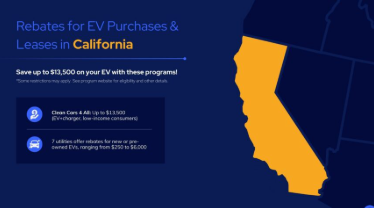
With the federal $7,500 EV tax credit gone, California lawmakers and Governor Gavin Newsom approved a new $135 million state incentive program aimed specifically at first-time EV buyers. The mechanics are straightforward and genuinely buyer-friendly: qualifying purchasers get an instant $3,500 discount on a new EV, or $1,750 on a used one, applied directly at the dealership with no separate application or tax filing required.
To qualify at all, a buyer must certify they've never previously owned or leased an EV. Standard price caps apply to keep the program targeted: $50,000 MSRP or less for new vehicles, $25,000 or less for used ones.
The detail drawing most of the attention is a specific carve-out: vehicles from California-headquartered automakers are exempt from those price caps entirely, no matter what the vehicle actually costs.
That exemption benefits exactly two companies in any meaningful way: Rivian, headquartered in Irvine, and Lucid, headquartered in the San Francisco Bay Area. The exemption matters a lot for both.
Rivian's new R2, in its Performance trim with the Launch Package, starts at $57,990 -- above the cap -- though a lower-priced version near $45,000 is expected later and would likely qualify under the standard rule anyway. Lucid benefits even more dramatically: its Air sedan starts at $70,900, and its Gravity SUV starts at $79,900, neither of which would come remotely close to qualifying without the headquarters exemption. Lucid is also preparing a smaller, lower-priced crossover called the Cosmos, expected to reach the U.S. market next year.
Tesla doesn't get this specific exemption, and the reason is straightforward: the company relocated its corporate headquarters from Palo Alto, California to Austin, Texas in 2021. That move is the entire basis for its exclusion from the carve-out, even though Tesla was originally founded in Silicon Valley and continues to manufacture vehicles at its original factory in Fremont, California to this day.
Tesla isn't shut out of the program entirely -- lower-priced configurations of the Model 3 and Model Y that fall under the standard $50,000 cap still qualify for the regular incentive -- but any Tesla model priced above that cap gets no special treatment the way Rivian's and Lucid's higher-priced vehicles do.
Multiple outlets covering the program, including Benzinga and Yahoo Finance, have explicitly framed the exclusion against the backdrop of ongoing public tension between Tesla CEO Elon Musk and Governor Newsom.
It's worth being precise about what is and isn't confirmed here: the program's actual legislative language ties the exemption to corporate headquarters location, a facially neutral criterion that happens to include Rivian and Lucid while excluding Tesla specifically because of its 2021 move.
Whether that criterion was deliberately designed with Tesla's relocation in mind, or is simply a general "keep manufacturing and jobs in California" policy that has this effect as a side consequence, isn't something this piece is asserting either way -- multiple credible outlets have raised the political-tension framing, and it's presented here as reported context, not as a settled conclusion.
Separately, California's same budget allocates another $135 million toward accelerating adoption of heavy-duty electric trucks and buses -- a distinct program from the consumer incentive described here. Overall program funding is expected to support somewhere in the range of 38,600 new-vehicle incentives or roughly 77,000 used-vehicle incentives, or some mix of both, depending on how buyers split between the two options.
Whatever the intent behind the specific design, the practical result is clear either way: a state incentive program built to grow EV adoption in California ends up structurally favoring two smaller, higher-priced competitors over the company that, by most measures, did more than any other single automaker to create the mainstream EV market this program is now trying to expand.
#Tesla #Rivian #Lucid #California #EVIncentives #ElonMusk
THREE ARIZONA CONGRESSIONAL CANDIDATES MISSED THE SAME DEADLINE THIS YEAR -- ACROSS BOTH PARTIES.
Every candidate for Congress, along with every sitting member, is required to file an annual financial disclosure statement. These filings lay out a candidate's income, investments, and debts, and they exist for a specific reason: to surface potential conflicts of interest before voters cast a ballot, and to give the public a clear, standardized picture of a candidate's personal finances. The requirement is not optional and does not distinguish by party -- it applies the same way to every candidate running for federal office, regardless of which party's primary they're competing in.
This year's deadline was May 15. Three Arizona candidates missed it, according to reporting from KJZZ: Republican Daniel Keenan, one of two Republicans seeking the GOP nomination in Arizona's 5th Congressional District; Democrat Rick McCartney, running in the 1st Congressional District; and Democrat Kai Newkirk, who is challenging incumbent Democratic Congressman Greg Stanton in the 4th Congressional District's primary.
It's worth being precise about what is and isn't known here. The reporting confirms the missed deadline for all three candidates; it does not detail the specific reason behind any individual case, and this piece isn't speculating on that. Missing a disclosure deadline can result in a range of outcomes depending on the circumstances, from a simple late filing to formal penalties, but nothing beyond the missed deadline itself has been reported for any of the three candidates as of this writing.
What's consistent across all three cases is the standard being applied: the same filing requirement, the same May 15 deadline, and the same public reporting when it isn't met -- regardless of party, and regardless of which specific race a candidate is running in. Arizona's primary election is July 21, 2026, with the statewide general election following in November.
#Arizona #Elections #Congress #Transparency #Accountability #AZPolitics
PHOENIX MAGAZINE JUST HANDED OUT ITS 2026 "BEST OF THE VALLEY" AWARDS -- AND THE EAST VALLEY SHOWED UP IN A BIG WAY.
Phoenix Magazine's annual Best of the Valley awards dropped this month, covering everything from lifestyle and entertainment to food and drink across the entire metro area.
A quick tour of the East Valley-specific winners, since this is the exact ground we're building on:
StarFighters Arcade, Mesa -- the magazine's pick for capturing that old-school arcade energy better than anywhere else in the Valley: nearly 200 antique games and pinball machines, plus tournaments and trivia running throughout the week.
Chandler Fashion Center, Chandler -- named for family fun done right, with a play area, bowling alley, arcade, LEGO Store, and Build-A-Bear Workshop all under one roof. Not cheap, the magazine notes, but still a lot more affordable than a trip to California.
Bubble Planet, Arizona Mills, Tempe -- an interactive bubble-themed exploration experience: an LED "underwater" walk on the ocean floor, a "swim" through billowy balloons, and a room built for the perfect light-fractured selfie.
Mullett Arena, Tempe -- the pick for budget-friendly sports nights, with hockey tickets starting around $15. The magazine's verdict on the arena's mascot: "Science over chicanery. He skips the fancy acrobatics, relying instead on pure charisma and the miracle of nuclear fusion."
Snakes and Lattes, Tempe -- a timed, team-based puzzle tournament venue, $54 for a four-person team, drink included, and you keep the puzzle when you're done.
On the food and drink side of the same awards, Goat & Ram -- a food truck legend that's now gone brick-and-mortar inside Phantom Fox Beer Co. in Mesa -- was also called out, with locations coming soon to both Tempe and Gilbert.
None of this is a business story in the traditional sense, and it doesn't need to be one. Gilbert, Mesa, Chandler, and Tempe aren't just the four cities on our own launch map -- they're where a genuinely good chunk of the Valley's actual community life happens, recognized by the people who cover it for a living. Worth celebrating on its own terms.
#EastValley #Mesa #Chandler #Tempe #Gilbert #BestOfTheValley #Phoenix
SCOTTSDALE JUST BOUGHT A SIX-MONTH WATER SUPPLY -- STORED 60 MILES AWAY, WITH NO WAY YET TO GET IT HOME.
Scottsdale's City Council voted unanimously to spend $8.25 million on long-term storage water credits in the Harquahala Valley, a groundwater basin in western Maricopa and La Paz counties, roughly 60 miles west of Phoenix. The purchase amounts to 15,000 acre-feet of water -- enough, by the city's own estimate, to supply about 45,000 homes for a year -- and brings Scottsdale's total long-term water storage credits to just under 300,000 acre-feet. The credits represent water that's already been stored underground over time through Central Arizona Project deliveries, functioning essentially as a savings account the city can draw on later.
The infrastructure problem is the real story here, and it isn't solved yet. Owning water rights 60 miles from your city doesn't put water in anyone's tap. Two delivery options are reportedly on the table: routing the water through the existing Central Arizona Project Canal, or building an entirely new, dedicated 60-mile pipeline, which multiple city officials have acknowledged would be expensive.
There's no public timeline yet for when actual delivery would begin, though the city's manager has indicated a fall 2027 groundbreaking target for the necessary infrastructure. Separately, Scottsdale also holds an existing groundwater right in Harquahala Valley -- roughly 3,800 acre-feet annually, held in partnership with two golf courses -- and city officials have framed this new storage-credit purchase as working in combination with that existing right to make the eventual infrastructure investment worthwhile on its own.
Worth noting for balance: this wasn't a rubber-stamp process, and not everyone is fully sold. The deal was originally scheduled as one of 25 items on a routine "consent agenda" -- meaning it would have passed as a group with no individual presentation or public discussion -- until a council member demanded it be pulled out for closer scrutiny. A public speaker at the meeting, former councilwoman Betty Janik, raised a specific concern that Harquahala water may carry elevated arsenic levels, which would mean real additional treatment costs stacked on top of the transport costs, and argued some of the money might be better spent on the city's own Advanced Water Purification system instead.
And Scottsdale isn't the only city to have weighed this option: Buckeye and Queen Creek have already purchased into the same basin, while the town of Cave Creek, bordering far north Scottsdale, tentatively agreed to an $11 million deal for a much smaller 500 acre-feet before its Town Council ultimately backed out entirely, citing excessive infrastructure costs and too many unknowns.
The Harquahala Groundwater Basin itself is a genuinely massive resource -- per the Governor's office, it holds more than 8 million acre-feet of water and was specifically designated an agricultural transportation basin, opened to purchase by outside municipalities under a 2025 Arizona Department of Water Resources decision.
All of this is happening for a clear reason: Scottsdale currently draws roughly two-thirds of its water supply from the Colorado River via the Central Arizona Project, the exact system facing deep, still-unresolved shortage negotiations covered in an earlier piece here this week. Harquahala groundwater is one leg of a broader five-part strategy the city has adopted to diversify away from that dependence, alongside demand management, advanced water purification, a proposed expansion of Bartlett Dam's storage capacity, and ongoing evaluation of emerging water technologies.
Thyra Ryden-Diaz, Scottsdale Water's interim senior director of Water Resources, summed up the philosophy behind it: "Long-Term Storage Credits provide flexibility, resilience and additional protection against future supply challenges." Securing the water rights, it turns out, may end up being the easiest part of this entire plan.
#Scottsdale #Arizona #WaterSecurity #ColoradoRiver #Infrastructure #HarquahalaValley
A STARTUP FOUNDED THREE YEARS AGO JUST HELPED THE COUNTRY BEAT A PRESIDENTIAL DEADLINE TIED TO AMERICA'S 250TH BIRTHDAY.
In May 2025, Executive Order 14301 set a specific, public target: get at least three advanced nuclear reactors to criticality -- the point at which a reactor sustains its own controlled fission chain reaction without an external neutron source -- by July 4, 2026, the country's 250th anniversary. Four companies made it. Antares Nuclear's Mark-0 reactor got there first, on June 4. Valar Atomics followed on June 18. A third, Deployable Energy, also hit the mark.
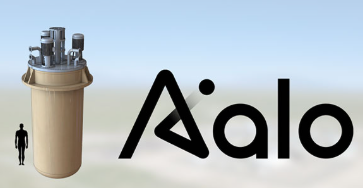
The fourth arrived in the early morning hours of July 4th itself, at 12:20 a.m. Mountain Time, at Idaho National Laboratory: Aalo Atomics' Aalo-X Critical Test Reactor.
The speed here is genuinely remarkable on its own terms. Aalo, based in Austin, Texas, went from company founding to a working fission reaction in under three years, and from breaking ground on this specific reactor to achieving criticality in under eight months -- one of the fastest reactor builds in roughly 80 years. The company built the first entirely new reactor facility at Idaho National Laboratory in 50 years, and did it in 36 days.
Total spend to get here: under $100 million.
What makes Aalo's approach distinct from a typical nuclear plant is the underlying design. Aalo's reactors are sodium-cooled rather than water-cooled -- liquid sodium carries heat roughly 100 times better than water, and runs at near-atmospheric pressure, meaning simpler systems and what the company calls inherent passive safety, a reactor that "stays safe even when nobody is watching it."
The reactor vessels themselves are two to five times smaller than competitors' at the same power output, small enough to ship on a standard truck, which is specifically what makes true assembly-line manufacturing possible. Aalo builds almost everything in-house -- its own reactor vessels, scaffolding modules, fuel assemblies, and control systems -- sourcing only about 10% of components externally, through a 127-supplier network built entirely within the United States.
The commercial product this is all building toward is called the Aalo Pod: a 50-megawatt-electric modular nuclear plant made up of five individual 10 MWe reactors driving a single turbine, cooled by both sodium and air, requiring no external water source at all -- a meaningful detail given how much attention water scarcity is already getting in fast-growing regions.
Aalo's CEO, Matt Loszak, put the milestone in context: "Reaching criticality is our most significant milestone to date, as it paves the way for the deployment of the Aalo Pod to power commercial data centers once it receives authorization from the Nuclear Regulatory Commission." That NRC authorization is still ahead -- criticality proves the physics and engineering work, but commercial deployment requires separate regulatory clearance.
Aalo isn't waiting around for that clearance to keep building. The company has already broken ground on a second, commercial-scale reactor right next to the first at Idaho National Laboratory, as part of what it calls Project Ascension -- excavation and earthwork are already complete, with first concrete pouring next, and the reactor is intended to directly power an on-site data center, which the company describes as potentially the first nuclear plant and data center ever built hand-in-hand from the start.
Aalo expects that second reactor complete by the end of 2026, with commercial-scale electricity production targeted for 2027. Longer term, the company plans a one-million-square-foot "Gigawatt Factory" to mass-produce Aalo Pods on an assembly line. Aalo has also partnered with Microsoft and Nvidia on an AI-assisted "co-piloting" system meant to streamline reactor permitting, design, construction, and ongoing operations -- using artificial intelligence to help build the power plants that will in turn power more artificial intelligence.
The company has raised more than $136 million to date from investors including Valor Equity Partners, Hitachi Ventures, and NRG Energy.
U.S. Energy Secretary Chris Wright framed the broader four-reactor milestone plainly in a Department of Energy statement: "President Trump asked for three advanced reactors to be authorized and achieve criticality by the 250th anniversary of our great country. I'm pleased to share that through the dedication and hard work of Aalo, INL, and DOE, we have surpassed that ask and delivered four!"
This is really the same underlying story sitting behind the Arizona copper deal, the Colorado River water fights, and nearly every AI-infrastructure headline this year: the artificial intelligence boom needs enormous quantities of physical inputs -- electricity, water, land, and minerals -- at a scale most public conversation hasn't fully priced in yet. Power is turning out to be one of the tightest constraints of all, and companies like Aalo are racing, literally in months rather than decades, to solve it.
#Nuclear #AI #DataCenters #EnergyInfrastructure #America250 #SMR