🚨 Big news! Aesthetic Surgery Journal's Impact Factor jumped from 3.1 to 3.9, and ASJ Open Forum rose to 1.9! Both now rank #1 in plastic & aesthetic surgery. Hear from Editor-in-Chief @drkenkel on this milestone. 🏆
#PlasticSurgery#ImpactFactor#ASJ@phaedracress@jgusenoff
How has the discourse of BII on social media changed over the past decade and does the post volume and sentiment correlate with rising breast implant explantation rates? Read here: https://t.co/C3g3k2xI6f
@drkenkel
@NahaiDr@TheAestheticSoc@drroykim
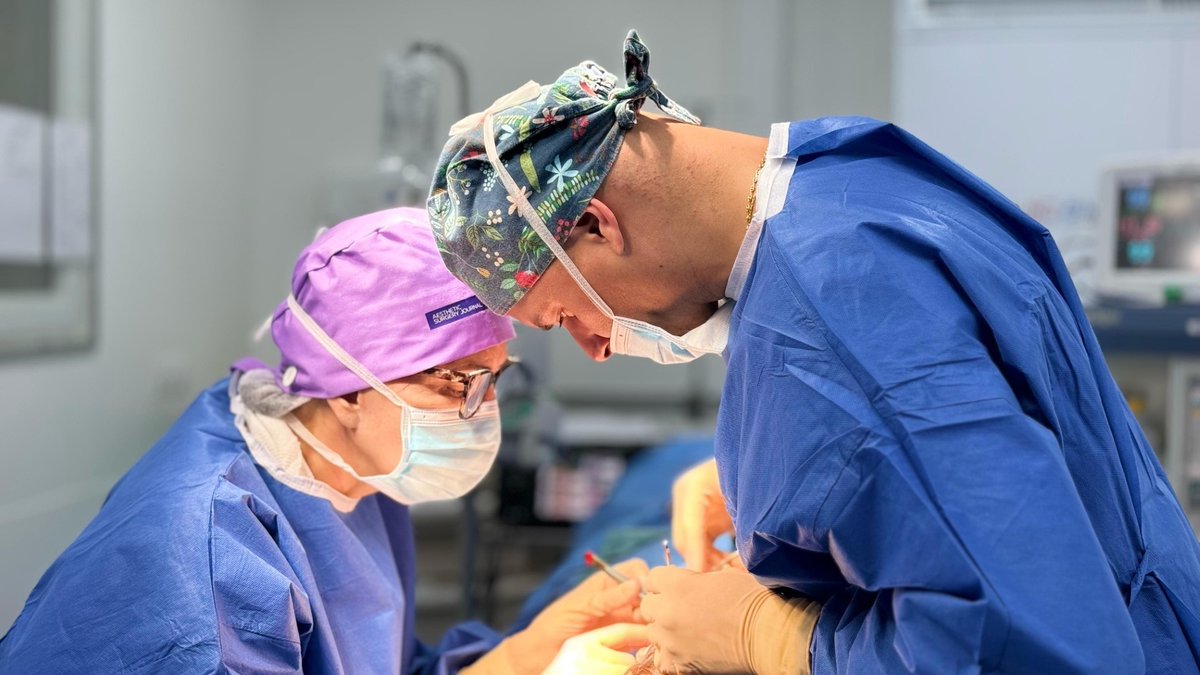
@drsaragh has developed a simple technique of arm contouring with arm net suture that leads to eliminating the need for making an incision, preventing of sagging in the proximal part of the arm, and a shorter recovery time.
Read here: https://t.co/r6FzOgKLOm
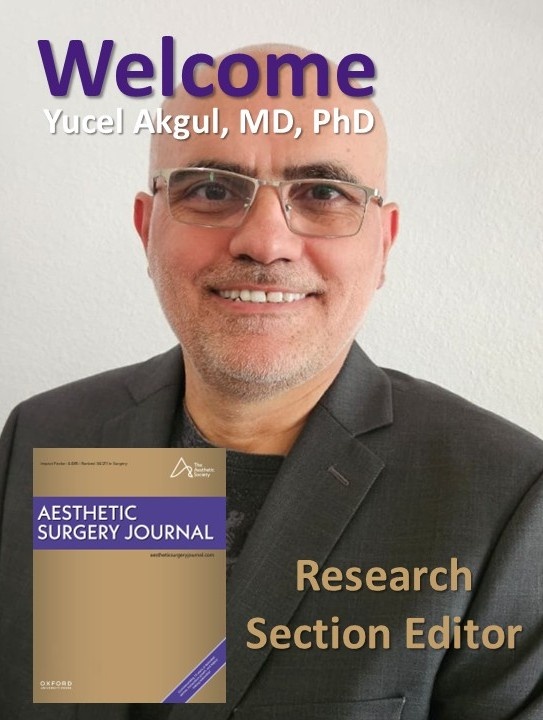
We're so excited to announce that Dr. Yucel Akgul is joining the ASJ Editorial Board as a Research section editor. Click here to read Research papers published in ASJ: https://t.co/3LOPjnM5LT
@phaedracress@foadnahai@drjahmad@drroykim @PeterJWirthMD @markalbertmd@jgusenoff
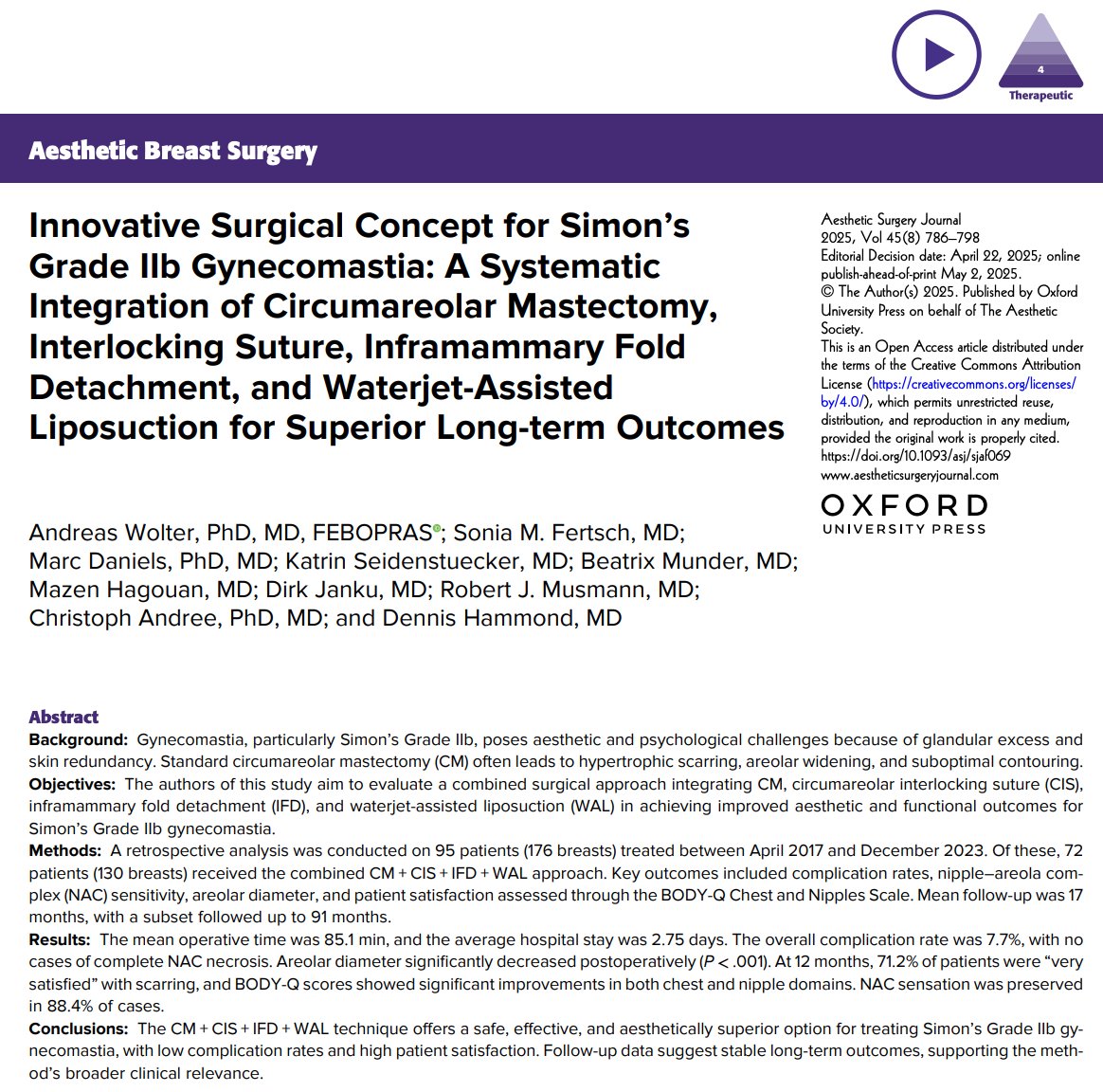
Gynecomastia exhibits a range of appearances depending on body structure, making aesthetic correction challenging because of diverse patient expectations.
In this study, the authors combine four surgical techniques to improve patient outcomes.
Read here: https://t.co/ff1jHm0pDK
Can AI safely handle post-op patient questions?
This new study puts 4 RAG models to the test on real rhinoplasty inquiries.
✅ 42% fully accurate
⚠️ 31% gave no response
📉 Readability still lacking
📖 Full findings: https://t.co/D6M7sTCrWT
Do you know the real size of the arteries you inject around?
New cadaveric study (49 dissections) shows facial artery diameters vary up to 23% — from 0.7 mm to 2.1 mm.
💉 Cannula safety depends on more than gauge.
🔗 Must-read: https://t.co/6lVWXO3559
@phaedracress@drroykim
💉This new study analyzes how CaHA-CMC fillers behave in facial arteries—and how dilution changes everything. Key insights into embolic risk and safety. A must-read for aesthetic professionals.
🔗 https://t.co/h91hywfLuh
@phaedracress@foadnahai@gabimiottomd@jgusenoff
How does social media shape perceptions of Breast Implant Illness (BII)? An analysis of 6099 posts reveals BII discourse peaked in 2019, with negative sentiment & fear driving decisions about explantation.
🔗 Read the paper: https://t.co/CVw94HKDEb
@phaedracress@foadnahai
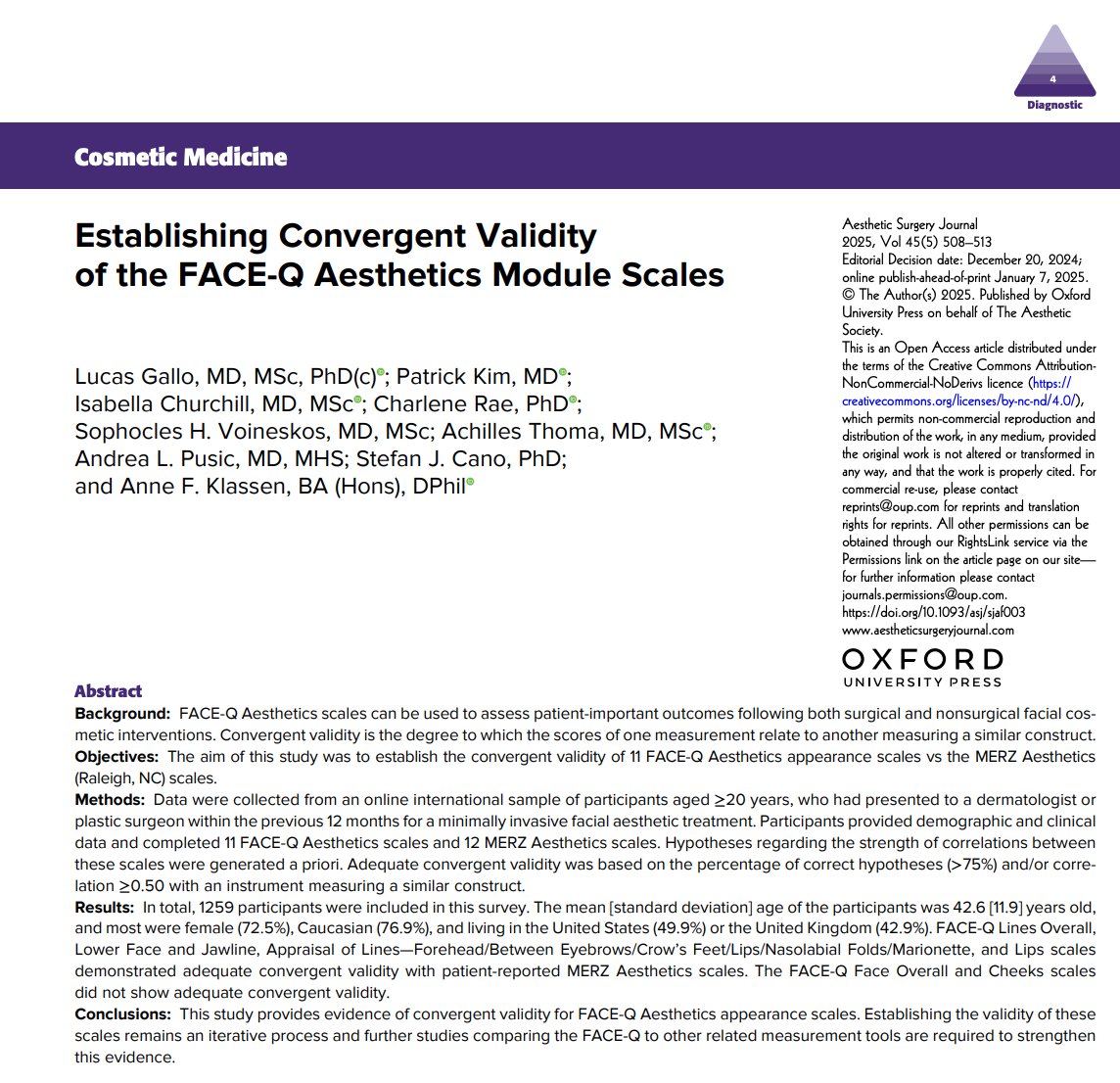
FACE-Q Aesthetics is a patient-reported outcome measure (PROM) designed to evaluate outcomes following both surgical and minimally invasive facial aesthetics procedures.
Does this scale present a valid measure for these procedures?
Find out here: https://t.co/QEx9l9RR84
Is closed preservation rhinoplasty viable for mestizo patients?
👃 417 primary cases, 1.7% revision rate
🛠️ 4 tip techniques, no open approach
Findings challenge norms—showing definition & support are achievable, even with thick skin.
#Rhinoplasty@phaedracress@foadnahai
How does upper blepharoplasty affect dry eye & aesthetics? A review of 12 RCTs (450 patients) confirms surgery reduces dry eye—but technique matters. Muscle-sparing lowers lagophthalmos risk; continuous sutures may increase irritation.
🔗 https://t.co/NcnTQwYOhT
@phaedracress
This systematic review and meta-analysis compared the efficacy and safety of STC vs LTC in preventing VTE and hematoma in patients undergoing DIEP flap reconstruction.
Read now: https://t.co/sgpgkNzS8b
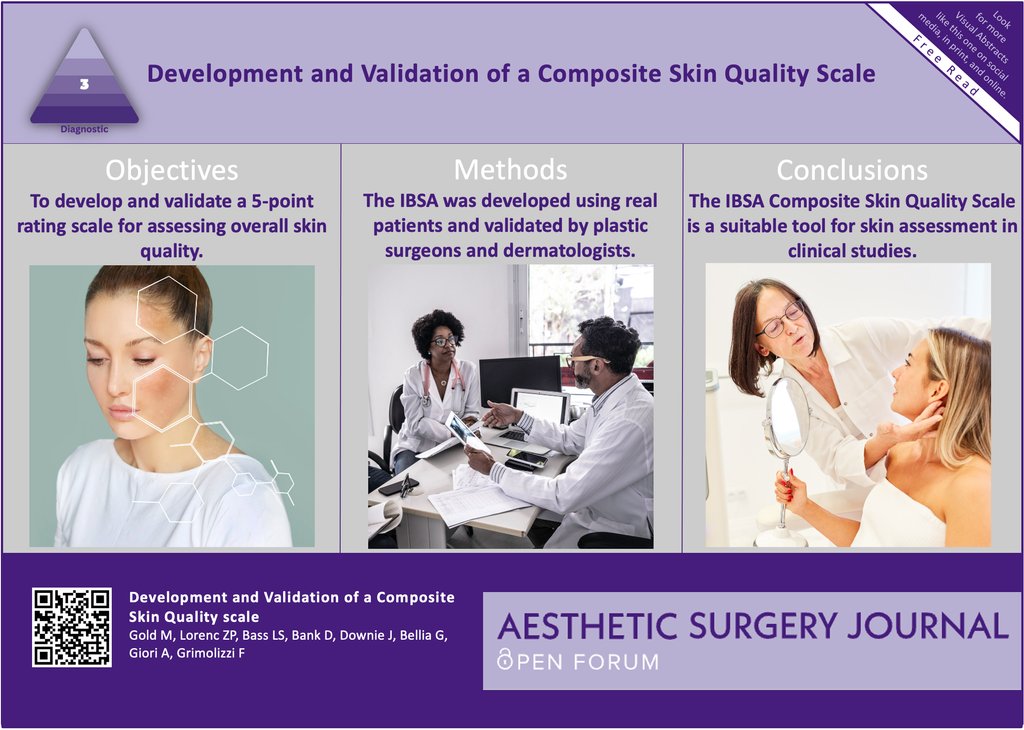
The increasing demand for skin quality interventions in aesthetic medicine underscores the necessity for objective, evidence-based assessment tools that may be used to evaluate novel interventions or devices.
Read more: https://t.co/exHYbvMOqA