At the end of 2025, @cancore_io was still mostly an idea built around a simple question:
How should value move between institutional networks and public chains?
The answer was much harder than building another bridge or adding another wrapped asset. We wanted both sides to settle natively, without introducing unnecessary custody, intermediaries, or additional trust.
The first months of 2026 were spent building the parts that rarely make it into announcements: making two very different networks communicate reliably, ensuring every transaction either completes correctly or safely returns the funds, and turning complex infrastructure into a product people could actually use.
Cancore went live on mainnet in April.
Since then, the platform has been tested through real activity, real edge cases, and a long list of issues that could only be discovered after launch. Every report helped us make the system more stable, the execution more predictable, and the overall experience simpler.
At the same time, a community of more than 100,000 people formed around Cancore. For me, that remains one of the most meaningful parts of this journey. Infrastructure matters only when people understand why it should exist and choose to build, trade, and participate around it.
Canton is built for institutional markets. Public chains are where much of the global on-chain liquidity already lives.
Cancore exists to connect these two environments properly.
We are still early, and there is a lot left to build. But the direction has never been clearer.
This is only the beginning.
Recently, we shipped a new version of @cancore_io and introduced a broader way of describing what we are building: the Liquidity OS for Tokenized Finance.
When we started Cancore, we described it as a settlement layer. That was accurate at the time because settlement was the first major problem we had to solve: enabling value to move safely and atomically between networks that were never designed to operate together.
As the product developed and people began using it, our understanding of the problem became broader. Users were less interested in how settlement worked underneath and more interested in what they could actually do with their assets: where they could hold them, how they could trade or deploy them, whether they could remain in control of them, and how much of that process could eventually happen automatically.
That was an important realization for us. We had been using our hardest engineering problem to describe the entire product, when in reality settlement was becoming the infrastructure underneath a much larger system. If it works properly, users should not have to think about it.
That is how Cancore has evolved into what we now call the Liquidity OS for Tokenized Finance. Trade and Wallet are already live, with Strategies, Autopilot and more automated execution being built on top of the same settlement infrastructure. The goal is to give users one environment for accessing, moving and managing liquidity rather than a collection of disconnected tools.
@CantonNetwork remains at the center of that architecture as our institutional foundation, while public chains provide access to broader onchain liquidity, users and markets. These environments are growing quickly, but they still operate largely as separate financial systems. Cancore is being built around the opportunity to make them work together more naturally.
Tokenizing an asset solves issuance. Making that asset liquid, accessible and programmable is the next problem. That is where we see Cancore going: more networks, more asset classes and increasingly automated execution, while keeping the complexity underneath the product rather than in front of the user.
The underlying technology has not changed with this release. What changed is that the product has developed far enough for us to describe more clearly what we have actually been building.
Tokenization is now front office and trading desk led, with direct PnL implications and real budget behind it.
Use cases: Smart contracts for repo, tokenized bonds as collateral, tokenized deposits for settlement.
@HenriArslanian breaks down the @SODApublicmoney report.
Nearly $9 trillion in tokenized repo transactions moved through Canton in December 2025, a 490% increase year-over-year on Broadridge's Distributed Ledger Repo platform, now interoperable with JPM Coin.
https://t.co/WbmvBB698Z
Canton for privacy. Daml for smart contracts. Cancore for settlement.
The institutional stack is forming.
Trustless settlement for the Canton ecosystem.
gCanton
The mission hasn’t changed since day one.
Build the settlement layer that connects @CantonNetwork to public chains – without trust assumptions, without custody, and without compromising the privacy institutions require.
Cancore Genesis Phase 1 proved the demand.
Phase 2 lands next week – bringing the upgrade.
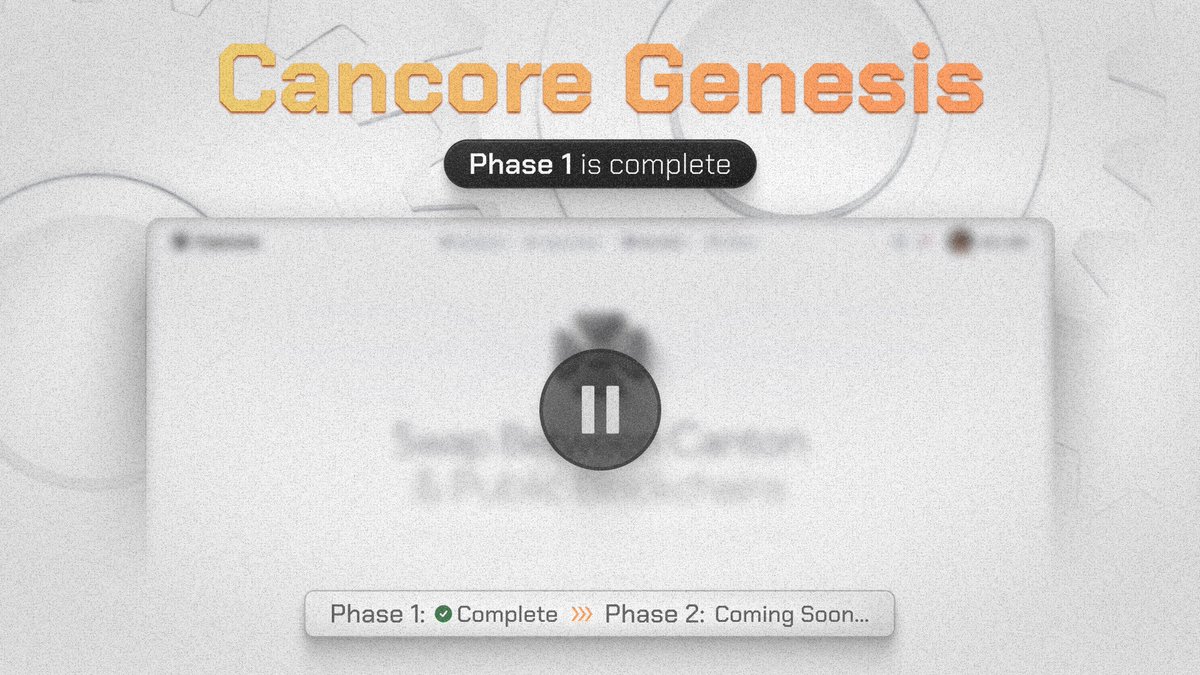
Cancore Genesis: Phase 1 is now complete.
The response to Mainnet Beta exceeded our expectations, and the first round of testing delivered exactly what it was meant to: real usage, real feedback, and clear signals on what we need to improve next.
To strengthen the product and improve the experience, we’re now temporarily pausing swaps while we fix the key issues, improve stability, and refine the core experience.
Your funds and balances remain safe and intact.
Phase 1 recap:
• 5x our initial traffic targets
• 50,000+ people on the waitlist
• Strong platform performance under heavy load
• 250+ bug reports from early users – already being worked through
Phase 2 is next: upgraded infrastructure, new pairs, and more access codes.
Thank you to everyone who joined early, tested the product, and helped push Cancore forward. We’ll share more updates soon.
One day into Cancore Mainnet – and the response has been massive.
Here’s where we stand:
• 5x our initial traffic targets
• 50,000+ people on the waitlist
• Strong platform performance under heavy load
• 250+ bug reports from early users – already being fixed in real time
This is exactly what Cancore Genesis was built for – our program for the earliest users and contributors helping shape Cancore from day one through testing, feedback, activity, and real participation.
More access codes are being dropped across our Discord and Telegram, so stay close, join the community, and get involved.
Cancore Mainnet is live.
The settlement layer connecting @CantonNetwork to public-chain liquidity is here.
No custody. No relay networks. No middlemen.
Built for trustless, atomic settlement.
→ [https://t.co/2W7TSEtrKI]
Cancore Mainnet is live.
The settlement layer connecting @CantonNetwork to public-chain liquidity is here.
No custody. No relay networks. No middlemen.
Built for trustless, atomic settlement.
→ [https://t.co/2W7TSEtrKI]