People like @komatsubarasan1 make the @UN remain relevant and promising. Doubling his role as the Representative of the @undptz and @UNCDF, he goes the extra mile to support our government's efforts and becomes 'Tanzania's Chief Marketing Officer'. It was my pleasure welcoming him to my office.
It is saddening that natural resources continue to be a curse rather than a blessing to many communities and countries across the world, and it is heartening that the Democratic Republic of Congo chose to address the nexus between natural resources and security during their Chairmanship of the United Nations Security Council yesterday.
The tragedy of blood diamonds taught the world a painful lesson: when the value of a mineral exceeds the value of a human life, peace becomes the first casualty. This lesson must become the foundation of a lasting global response to resource-driven conflicts.
Tanzania believes effective national resource governance is the first line of defense and must be augmented by regional and global frameworks. Tanzania contributed to the Dar es Salaam Declaration on Peace, Security, Stability and Development, that gave birth to the Pact on Security, Stability and Development, and its Protocol Against Illegal Exploitation of Natural Resources in the Great Lakes Region.
It is time to let the value of our natural resources be measured not by the profits they generate, but by the peace, stability, and dignity they deliver to the people and communities from which they are drawn.
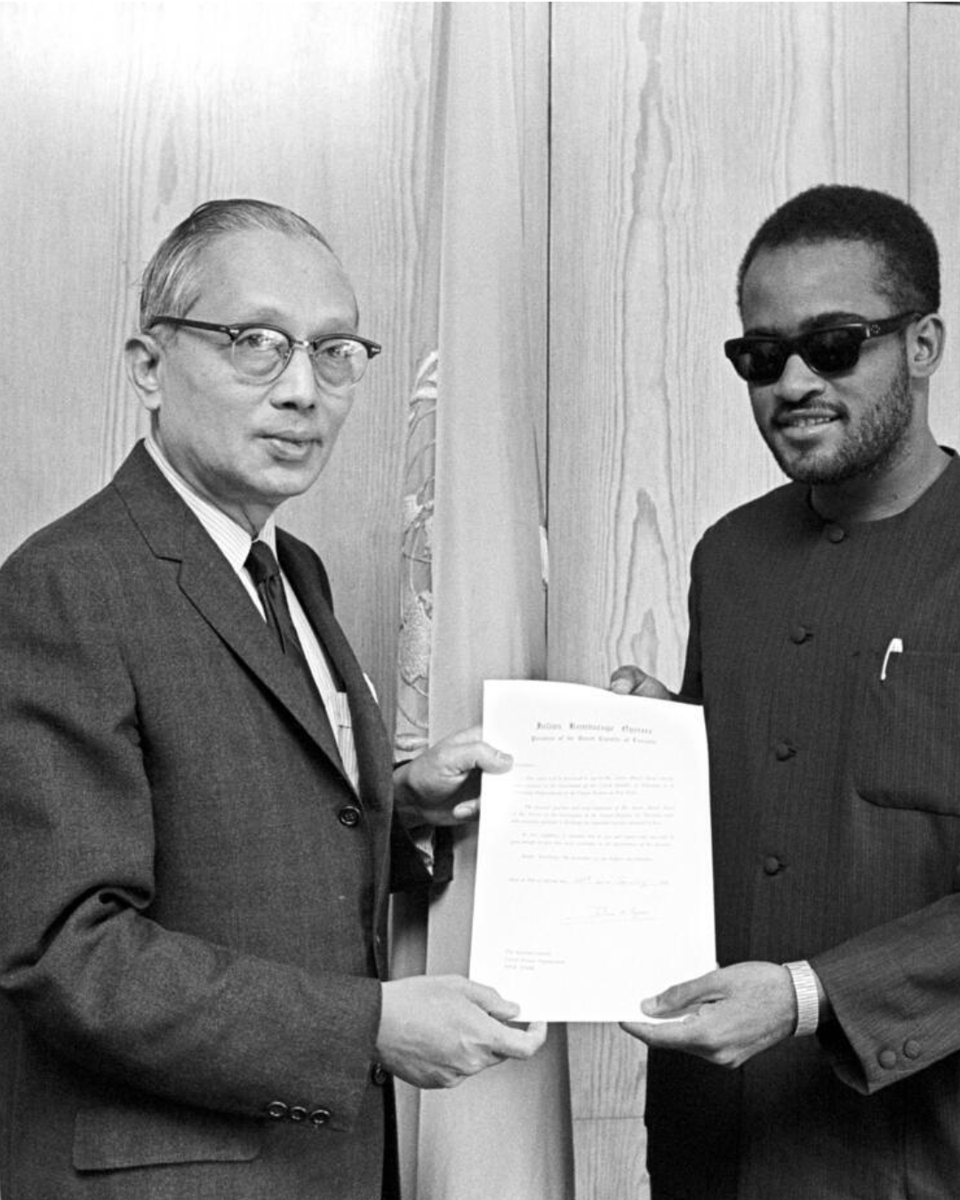
A young Tanzanian diplomat walked into the United Nations and handed a piece of paper to the Secretary-General.
Presenting credentials - the formal ritual by which a country's new representative announces themselves to the world body. Dignified. Procedural. Unremarkable.
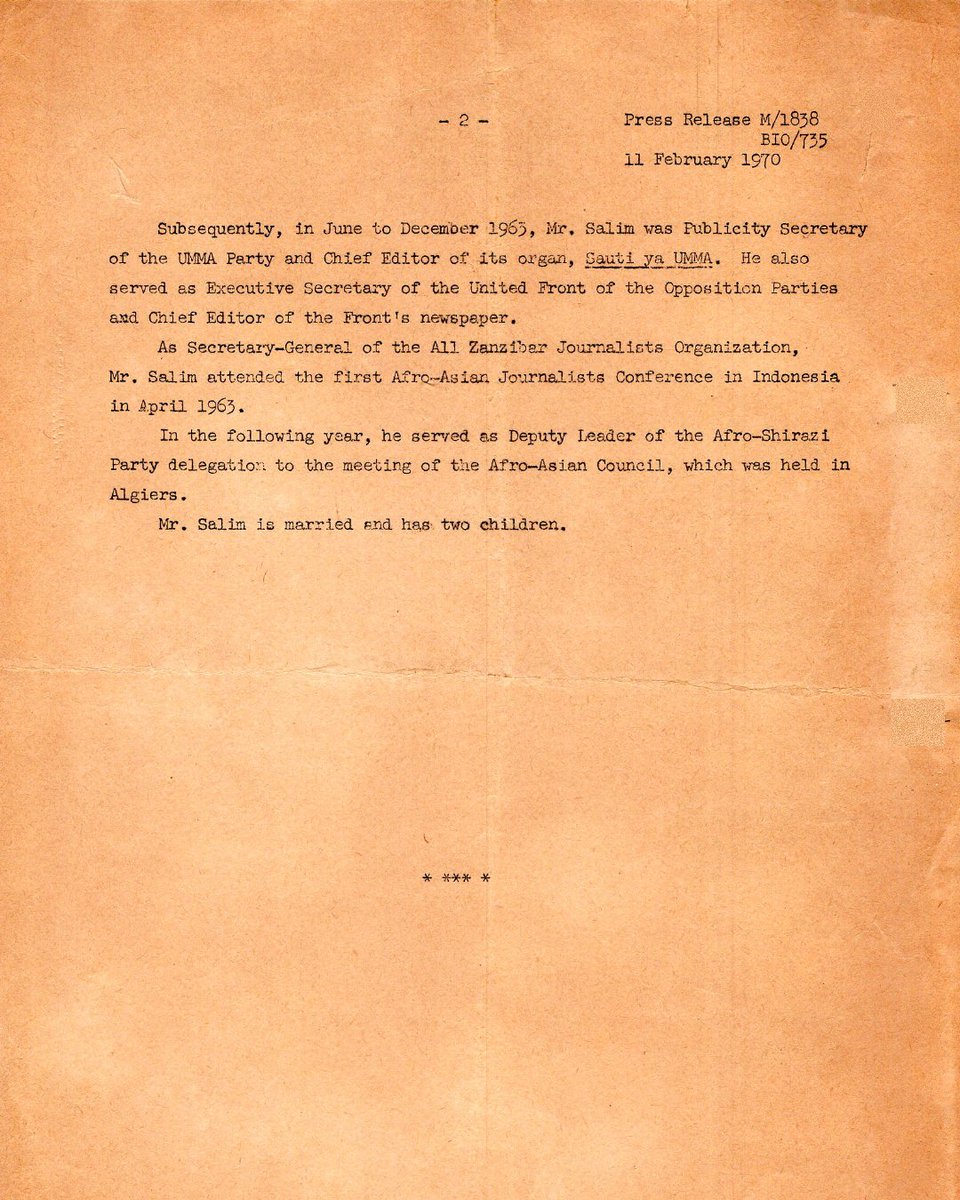
U Thant, the Secretary-General, received the document from Dr. Salim Ahmed Salim, 28 years old, Tanzania's new Permanent Representative. He shook his hand. The ceremony lasted minutes.
No one in that room knew what was about to begin.
Within two years, this same man would lead the campaign that seated China at the UN - triggering celebrations on the General Assembly floor that scandalized the West.
Within a decade, he would preside over the entire United Nations General Assembly as its President.
By 1981, every African nation would stand unanimously behind him as their candidate for Secretary-General - the very office of the man who had just received his papers.
Every great story has a Day One.
This was his.
Today is International Swahili Day. Kiswahili is the first language of African origin to be honored with a dedicated global day by the @UN (formalized via UN General Assembly Resolution A/RES/78/312). With an estimated 200 to 500 million speakers around the world, it primarily serves as a vital lingua franca for regional unity across Central, Eastern, and Southern Africa.
The Swahili language was born out of contact between the people of the Indian Ocean coast of East Africa and sailors and traders who came from as far away as Asia, the Gulf, Persia, and Europe. It therefore became a language of trade and benefited from vocabulary from native African languages, Arabic, Indian, Pakistani, Persian, Portuguese, German, and English.
The Swahili language is widely spoken across 12 nations, 6 of which is an official or national language including Tanzania, Kenya, Uganda, Rwanda, Burundi and the DRC, with an extensive presence spanning to Oman. It is taught and researched in over 100 to 150 universities globally, including approximately 100 institutions in the United States alone (e.g., Harvard, Yale, Stanford), alongside major hubs in Europe and Asia.
About 50 international radio stations and 30 TV channels globally are broadcasting Swahili services, including the BBC, Voice of America (VOA), Deutsche Welle (DW), Radio France Internationale (RFI), Radio Japan, and United Nations Radio.
The Swahili language has been elevated to an official working language of the UNESCO General Conference, the African Union (AU), the East African Community (EAC), and the Southern African Development Community (SADC). It is positioned to become the primary commercial bridge for intra-African trade under the African Continental Free Trade Area (AfCFTA) by dismantling cross-border communication barriers, as evidenced in successfully elevating intra-trade in the East African Community (EAC), which is the highest in Africa.
The Swahili language is not technology-proof. It is now serving as a structural anchor for expanding localized African Artificial Intelligence, Natural Language Processing (NLP), and digital content innovation. It is driving a lucrative global export market through East African music (Bongo Flava) and film industries, transforming the language into an influential vehicle for youth culture and corporate diplomacy.
Swahili's been through it all – generational shifts, changing world trends, and evolving tech. But against all odds, it's kept growing, adopting, and adapting. Swahili's here to stay. Swahili is the future!
Ikiwa leo ni maadhimisho ya 5 ya Siku ya Kimataifa ya Lugha ya #Kiswahili, Mwakilishi wa Kudumu wa #Tanzania katika @UmojaWaMataifa, Balozi @TogolaniMavura anafafanua zaidi ni kwa namna gani lugha ya Kiswahili inaweza kufanikisha amani na uchumi.
"Atakayekufaa kesho si lazima awe nacho cha kukufaa leo. Yule atakayekuwa wa msaada kwako baadae wakati mwingine huja kwako kama mhitaji wa leo." ~Togolani Mavura.