Reason’s latest K-12 study takes a comprehensive look at resources and outcomes for all 50 states over the past two decades.
Bringing together key revenue, expenditure, enrollment, staffing, and NAEP data, here are five key takeaways from our report.
https://t.co/CHsfmMQDAL
🧵1/9
Nearly a third of states require school districts to offer higher salaries for master’s degrees, even though research consistently finds that master's degrees don't improve teacher effectiveness or student outcomes. https://t.co/E9IDi7iVog
I don't know whether this was politically feasible (and I'm certainly not interested in casting blame) but it raises a critical policy design question, i.e. formula vs. line item funding for school choice programs.
I'm curious to hear what school choice advocates think, especially as it relates to Texas.
The blame for this can be laid squarely on the shoulders of @DanPatrick and everyone who supported his school choice bill last session. They never should have separated school choice from formula funding. Because they did that, Democrats don't have to pass a law to kill school choice, they just don't have to put it in the budget. People who were desperate for something, anything on school choice got behind Dan Patrick on this instead of holding him accountable and making him do the right thing. As everyone can see now, though it was obvious 2 years ago as well, this was a very short sighted decision.
@MartinCharlieAZ@JudeSchwalbach I agree, perhaps there can be reasonable limits—but maintaining healthy reserves isn’t inherently a bad thing.
You work for a district, right?
Many states have or are considering policies that hold school districts harmless for declining enrollment.
Not only is this costly, it’s also unnecessary and counterproductive.
Policymakers should instead do the opposite: ensure K-12 dollars are tied to current-year enrollment counts.
Here’s my primer on how to do this.
@MichaelPetrilli School closures can absolutely save money.
To whatever extent they don’t, that’s a reflection of local (and perhaps state) policy/budget choices.
It's fascinating how history can repeat. Declining enrollment is playing out exactly how it did 50 years ago. One lesson I couldn't fit in the article: No matter how long or how deeply a district conducts community engagement, inevitably some will say the process was "rushed."
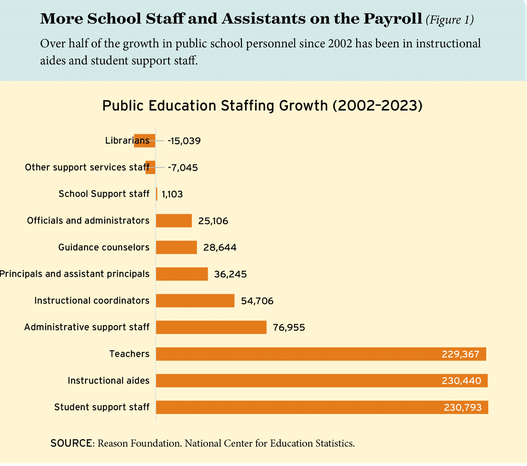
The bulk of public school staffing growth between 2002 and 2023 was accounted for by student support staff and instructional aides.
Overall, non-teaching staff grew by 23%, compared to 4% enrollment growth.
From 2002 to 2023, public schools increased staff by 15.1 percent while student enrollment rose just 4 percent, writes @ASmithAZ.
https://t.co/ZrU3lWncaO
Agree. Bad take. Running 2 schools with 2 principals, 2 nurses, 2 librarians 2 clerks custodians PE teachers counselors etc costs more than 1. Transpo & security isn't the big $.
Some shrink labor with attrition (which can take a while) vs RIFs. But some do RIFs.
@andrewucc Some but certainly not all are required by law (mostly indirectly).
I dig into the specifics, especially as it relates to special education, here.
https://t.co/6tMp9frQ3q
@NaomiSRiley@WSJFreeEx Social workers are included in student support staff, the fastest-growing job category in public schools.
https://t.co/eF3it6rsS6
@JustinLilly1 I think most states defer to their respective athletic associations, but Florida is one notable exception that I’m aware of.
https://t.co/jz9I6S1U4Y
I’ll add that Texas has weak open enrollment laws, and that Democrats in Nevada helped pass a good reform just last year.
States like Wisconsin and Delaware also provide models to look to.
Something lost in all the ESA/takeover hoopla in Texas is that educational open enrollement is expanding — my home district of Frisco ISD included.
Even if privatization bothers you, you can support meaningful educational mobility WITHIN the public school system.
(It's an article I wrote last year)
https://t.co/1xsmzJhtSz
"Between 2002 and 2023, the average inflation-adjusted teacher salary fell despite a 36 percent real increase in per-student funding." — @ASmithAZ
https://t.co/p5wKngNt8l