Official account of American Thoracic Society-Genetics and Genomics Section. Follow us to get updates on 'Omics' in Lung, Critical Care and Sleep medicine.
The first snRNASeq & spatial transcriptomic analysis of bronchoscopic cryobiopsies from patients with Early IPF & preserved pulmonary functions is out on @biorxivpreprint and message is Early IPF is IPF���️
https://t.co/yyX28bn7D2
Congratulations to Jonas Schupp recipient of the #ATS2026@ATS_GG Early Career Investigator Achievement Award 🎉!!! This award honors early career investigators with outstanding contributions to genetics, genomics, omics & systems biology of lung diseases
https://t.co/QwWgRSRxCm
Congratulations to the recipient of the @ATS_GG Early Career Investigator Achievement Award Jonas C. Schupp, MD, MPVD, ATSF @jonas_schupp
Learn more at: https://t.co/c4ejsXgOi7
Join us on Feb 9th @ 1pm ET/10am PT for our next journal club: "Polygenic Risk Score Added to Conventional Case Finding to Identify Undiagnosed Chronic Obstructive Pulmonary Disease" presented by Jingzhou Zhang https://t.co/4SLfQz0Sd9 @zhangjz07! @ATS_Assemblies@JAMA_current
🎙️ Just published a new episode of Out of the Blue: An AJRCCM Podcast: Host-Microbe Multiomic Profiling Predicts Mortality in Sepsis.
🎧 Listen here: https://t.co/qwvHmTDWbL
@atscommunity
#WorldCancerDay is a reminder of the power of science, advocacy, and community in the fight against cancer. Today, we stand with all those impacted and those working toward better outcomes worldwide. 🎗️
Attend our webinar Democratizing Lung Functional Genomics with AI on Monday 17th Nov at 1pm ET/10am PT! Register @ https://t.co/evdO42yEdI Feat Dr. Nathan Salomonis @nsalomonis demonstrating LungMAP ecosystem components! @ATS_Assemblies@ATS_AII@ATS_RCMB@ATS_RSF@ATSCritCare
A new super cool study in @NatureBiotech just introduced #CellWhisperer, an AI framework that allows researchers to explore single-cell RNA-seq data through natural-language dialogue.
CellWhisperer shows how large language models can bridge human language and molecular data. It enables intuitive, conversational access to single-cell datasets while maintaining analytical depth.
While the authors note that results should be validated with standard pipelines, this work is an important step toward interactive, multimodal exploration in computational biology.
https://t.co/QEgY9mr2wW
"Your career is a marathon, not a sprint, and genuine passion for what you do will ensure you have the stamina to go the distance and truly make an impact," says Satoshi Konno, MD, PhD, a professor in the Department of Respiratory Medicine at Hokkaido University Hospital.
Learn more about Dr. Konno: https://t.co/wsj4DX3pYi
Predicting protein-protein interactions in the human proteome
Predicting which human proteins shake hands—and how—is a longstanding bottleneck. Proteins rarely act alone; they assemble into complexes that drive immunity, metabolism, signaling, and disease. But testing hundreds of millions of possible pairs experimentally is slow, expensive, and blind to many weak or transient interactions.
Jing Zhang, Qian Cong, David Baker and coauthors tackle this with a smart AI + data pipeline. First, they amplify evolutionary “clues” by assembling omicMSAs—deep multiple sequence alignments mined from petabytes of raw eukaryotic genomic data—so coevolution across species pops out. Second, they train a fast interaction model, RoseTTAFold2-PPI, not just on scarce complex structures, but on domain–domain contacts distilled from ~200M AlphaFold monomers—a huge synthetic training set that teaches the network what real interfaces look like.
The payoff is big: a proteome-scale screen over ~200M human pairs yields ~18,000 PPIs at ~90% precision (and ~29k at 80%), including ~3,600 not previously reported. The method excels on transmembrane interactions, a class that’s notoriously hard in the lab, and produces 3D complex models—so you don’t just get a yes/no, you see the interface. Mapping human variants onto these models flags ~4,950 PPIs with disease mutations at the contact surface, offering concrete hypotheses for mechanism.
Beyond pairs, the team reconstructs higher-order assemblies and nominates new components for well-studied complexes (e.g., telomere maintenance, GPI-GnT, cilia/flagella machinery), and highlights GPCR partners and mitochondrial modules that have been hiding in plain sight.
Stepping back: this is a credible path toward a computed 3D human interactome—faster, cheaper, and increasingly comprehensive as more genomes and structures arrive. It doesn’t replace experiments; it prioritizes them, focusing bench time where the biology is richest.
Paper: https://t.co/IphUI7KEQT
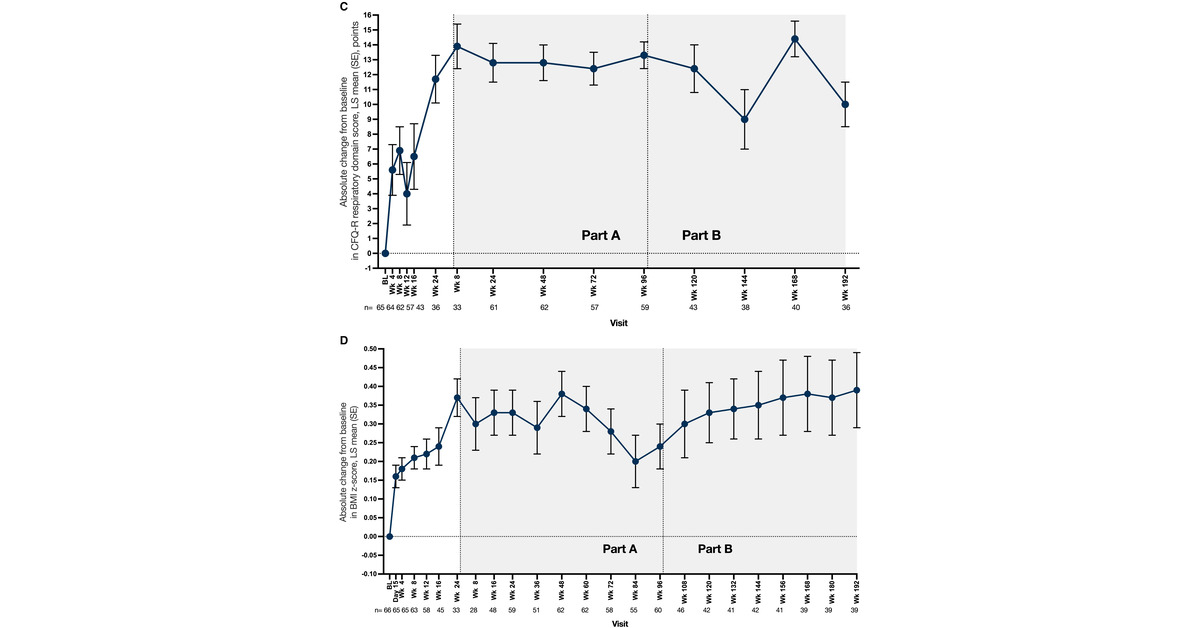
Long-Term Safety and Efficacy of Elexacaftor/Tezacaftor/Ivacaftor in Children ≥6 Years with Cystic Fibrosis and at Least One F508del Allele: A 192-Week, Phase 3, Open-Label Extension Study
@atscommunity
🔗 https://t.co/B80KCZUvtT
1/
Finally! Our call on the U.S. medical community & establishment to break their silence on Gaza is out today at the New England Journal of Medicine. This is the first publication describing Gaza's human made humanitarian catastrophe in the Journal!!
https://t.co/jMn4sydlEw
Tune in for an interactive “Ask the Expert” session on bronchiectasis at 3 p.m. ET on Oct. 27, 2025, with Anne O’Donnell, MD, Georgetown University Hospital. Explore how to recognize and diagnose the disease, understand the impact of exacerbations on progression and review current management strategies and unmet needs.
Register today: https://t.co/KUvPCyW57F
New Article! Selecting aminoacyl-tRNA synthetase/tRNA pairs for efficient genetic encoding of noncanonical amino acids into proteins https://t.co/kUK4SbXqwJ
📆 Save the date!
Join @FIRS_LungsFirst for a special World Lung Day webinar redefining lung health at 8 a.m. ET. on Thursday, Sept. 25. It will feature the new FIRS Lung Health Taskforce discussing tools to improve how lung conditions are diagnosed and managed—especially in areas with the greatest need.
Register for the #WorldLungDay webinar: https://t.co/yCzsyAtNaT