KIP-21 matters because it gives Kaspa the missing commitment structure between raw blockDAG ordering and future verifiable execution. Without it, sequencing commitments behave too much like a single global stream: every accepted transaction contributes to one shared historical surface, which is fine for proving total network order, but hostile to app-local ZK proving. If a future DEX, stablecoin system, covenant market, or vProg only cares about its own state transitions, it should not be forced to carry the weight of unrelated network activity through its witness. That is the bottleneck KIP-21 cuts through.
The design partitions sequencing into lanes, where lane identity is derived from transaction subnetworks. Each active lane maintains its own recursive lane commitment through values like "lane_tip_hash" and "last_touch_blue_score". Those active lane tips are then inserted into an active-lanes sparse Merkle tree, producing a compact commitment that rolls upward into the broader sequencing commitment while still fitting inside Kaspa’s existing header commitment structure. So Kaspa keeps one global proof-of-work anchor, but the proof burden becomes local. That is the important architectural move.
This is not Ethereum-style global state. It is not “smart contracts on Kaspa” in the lazy EVM sense. It is closer to proof-indexed settlement: many isolated execution lanes, each proving the activity that touched it, all inheriting the same PoW-backed DAG ordering. Inactive lanes can be purged after enough blue-score time, which prevents the system from turning into permanent historical garbage collection for dead applications. The inactivity shortcut then lets proofs skip empty spans instead of walking every irrelevant block.
That makes KIP-21 one of the quietest but most important pieces of Toccata. Covenants define constrained UTXO behavior. ZK verification proves external computation. Native covenant IDs preserve lineage. KIP-21 gives all of it a scalable anchoring map. It is how Kaspa begins moving from fast money into sovereign execution infrastructure.
A message to the Kaspa community, let’s clear the air on the founder, the whales, and what actually matters.I’ve been watching the recent noise around @hashdag and the Discord screenshot that’s being twisted by some toxic and negative people into some conspiracy about him being “bought out.”
Let’s be real and cut through the drama with facts and logic. Yonatan Sompolinsky built Kaspa from the ground up on fair-launch principles: no pre-mine, no VC bags, fully open-source, and a protocol designed for maximum decentralization and performance.
That’s not the resume of someone who “sold out.” That’s the resume of a founder who has consistently put the technology first, years of execution, sleepless nights, and relentless delivery while others chase narratives. In the screenshot that's being quoted, he’s simply stating the obvious: the whales who have actually contributed (through grants via KEF, dev funding, adoption pushes, and holding through volatility) deserve respect, not constant antagonism. He’s not defending exploitation,He’s refusing to play the zero-sum game of pitting community members against each other.
His exact words show he’s laser-focused on building, not on policing who holds $KAS or how they acquired it on the open market.That is exactly the right way to lead a decentralized project.A founder’s job isn’t to be the community hall monitor or to fuel every X feud.
His job is to keep the protocol neutral, open to anyone, and technically superior. By refusing to join the pile-on against the only large holders who have stepped up with real resources, Hashdag is protecting #Kaspa’s long-term health. Antagonizing contributors doesn’t make the network strongerit drives away capital, talent, and momentum.
Kaspa’s edge has always been its tech and its fair foundation, not manufactured drama.This stance is not negative for Kaspa at all, it’s the opposite. It signals to the world that Kaspa is a serious, mature project run by adults who prioritize substance over spectacle. It keeps the focus where it belongs: on Rust nodes, blockDAG scaling, ecosystem grants, and real adoption. The protocol is open. The market is free. Whales exist in every major crypto because that’s how liquid markets work.
Celebrating the ones who build alongside the founder is healthy, not corrupt. Here’s the uncomfortable truth for the child-like cry-baby noise-makers: constant negativity, vague accusations without evidence, and turning every disagreement into betrayal is what actually harms the community. It creates FUD, burns out holders, and distracts from the tech that’s still ahead of the curve.
If you’re tired of the cycle unfollow all those accounts that thrive on it because that's their job they benefit to see FUD in Kaspa. Unfollow the perpetual critics who haven’t shipped code or solutions in years. Follow the builders, the devs, the people shipping updates and grants. Protect your timeline and your conviction.
Kaspa’s future isn’t decided in Xthreads or Discord screenshots. It’s decided in the code, the hashrate, and the growing ecosystem. Hashdag understands that. The rest of us should too.
Stay focused. Stay bullish. $KAS isn’t going anywhere except forward. 𐤊
Crypto Proselyte
Thanks to KIP 15 (active in mainnet since Crescendo), it's already possible to make compact receipts, by providing a chain of sequencing commitments. In contrast to KIP 6, the proof size is logarithmic in the chain size, but the constants are very small, so in practice it's the same order of magnitude for any reasonable chain size.
KIP 21 (will be activated after Toccata) is generalizing this approach to allow for easier ways for zk-provers to prove the activity of their rollup.
See
https://t.co/RbBR3cSEP0
https://t.co/qwQiSeIqin
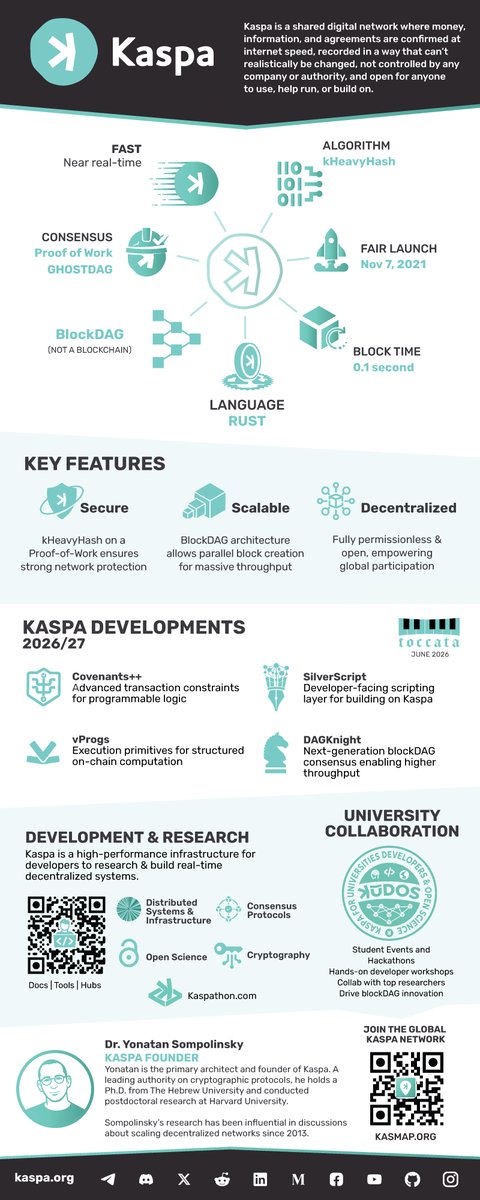
We've been creating 1 pagers, AKA, Battle Cards for #Kaspa for years. Recently we have been working with the #KUDOS team on helping them communicate & connect with Colleges and Universities and created a version for them. We then converted it to a Kaspa-centric card for all!
😱 A lot of people compare #Kaspa and #HYPE, but both are playing different games right now.
HYPE exploded because Hyperliquid built a product traders actually use daily. Real volume, real fees, and strong on-chain activity created real value for the ecosystem.
Kaspa is still building the foundation.
Its BlockDAG technology, speed, scalability, and decentralization are what make people bullish long term. But for Kaspa to achieve what HYPE is doing, it needs a growing ecosystem around it, DeFi, trading apps, stablecoins, payments, and real user activity.
HYPE already monetized activity.
Kaspa is building the rails for future large-scale adoption.
I am developing a new project called KasGraph. KasGraph is the data layer Kaspa needs if applications are going to move beyond raw transactions and into usable, real-time infrastructure.
Every wallet, marketplace, explorer, DeFi interface, AI agent, or covenant-based app eventually has to ask the same basic questions: what tokens does this address own, what happened to this covenant, which NFTs were minted, what transfers occurred, what proofs were submitted, and how did the state change over time? Without a shared indexing layer, every developer is forced to rebuild that logic alone. That means slower apps, duplicated infrastructure, fragile backends, and a worse user experience.
KasGraph fixes this by acting as a subgraph-style indexing protocol built specifically for Kaspa. Developers define schemas in GraphQL SDL, write TypeScript event handlers that compile to WASM through AssemblyScript, and KasGraph materializes the indexed data into Postgres with per-block proof-of-indexing checkpoints. In plain English: developers describe what they want to track, KasGraph watches Kaspa, remembers the important events, and makes that data instantly searchable.
The technical stack is designed around where Kaspa is going, not where legacy chains already are. KasGraph supports KIP-20 Covenant IDs, native KRC-20 and KRC-721 detection, Toccata covenant primitives, OpenSilver patterns, Groth16 proof detection under KIP-16, BlockDAG-aware reorg handling, multi-RPC failover, and KIP-20 confirmation finality. Subgraphs can subscribe to typed events without every developer writing custom detection logic from scratch.
The interface layer exposes the same indexed data through GraphQL, MCP, gRPC streaming through KasStream, and WebSocket subscriptions. Same data, four surfaces. Apps can query it, dashboards can stream it, wallets can subscribe to it, and AI assistants can understand it through MCP in plain English instead of raw chain parsing.
Performance targets are explicit: sub-30-second indexing latency, p95 query latency under 200ms, and sub-second streaming. MIT licensed. Open source from the first commit.
KasGraph is not just an indexer. It is the connective tissue between Kaspa’s execution future and the applications people will actually use.
Builders are welcome.
https://t.co/Kp4lQKEbug
Today marks the official launch of KAS Standard.
KAS Standard is pioneering the institutional treasury and capital markets layer for the Kaspa ecosystem through long-term digital asset treasury strategy and transparent capital infrastructure.
🌐 99% OF CRYPTO ANALYSTS ARE MISSING KASPA'S MAIN PROPERTY. AND IT'S NOT "SPEED".
The main property of any coordination layer isn't speed, isn't fees, isn't TPS. It's NEUTRALITY. And that's exactly what gets missed when people look at Kaspa through the usual "just another fast L1" lens.
In my last post I argued WHY AI agents will choose Kaspa. One reader, @gotorosario, reframed the thesis far more precisely than I did myself.
Quoting:
"The most underrated aspect in this whole discussion isn't speed. It's neutrality. If Amazon launches its own network, OpenAI its own, Apple its own... agents will eventually need a neutral coordination layer to interact. Exactly like the internet itself."
This changes the entire framing. Let me develop it.
⚡ TWO SCENARIOS FOR THE AGENTIC ECONOMY
SCENARIO A: Each corporate AI in its own ecosystem.
Amazon agents live in AWS. OpenAI agents inside OpenAI infrastructure. Apple in its closed garden. Payments and coordination happen inside the stack. No public blockchain needed.
This is logical for 80% of tasks. But it creates a fragmented world where agents from different ecosystems can't talk to each other without a middleman. This is the internet before TCP/IP, a pile of local networks that don't understand each other.
SCENARIO B: Agents need to interact across ecosystems.
Amazon agent buys data from an OpenAI agent. Apple agent books a slot from a Tencent agent. Microsoft agent pays a Google agent for compute.
THIS is where a NEUTRAL coordination layer becomes necessary. And corporate blockchains don't fit, no one will trust an Amazon chain to handle their agents' transactions with Google.
🏛 WHY KASPA SPECIFICALLY
Neutrality isn't one of the characteristics. It's THE characteristic of a coordination layer. And it comes in three types that must converge at once:
1️⃣ OWNERSHIP NEUTRALITY
No one controls. No one can censor. No one can "update the terms of service." Kaspa is the only major L1 with no VCs, no team allocation, no insider unlocks. Structurally ownerless. This can't be bought or faked, it's burned into genesis.
2️⃣ TRUST NEUTRALITY
Nakamoto-level PoW. No need to trust a validator cartel like in PoS. No need to trust a corporation like in permissioned chains. Trust lives in the physical cost of mining, not in people.
3️⃣ ARCHITECTURE NEUTRALITY
UTXO + programmability via Toccata. No "our special VM." No logic that can be politicized through hard forks. Clean, simple, model understandable to any agent in any era.
No other major L1 has all three. That's the moat invisible in TPS tables.
⚙️ THE TCP/IP ANALOGY ISN'T A METAPHOR, IT'S A FORECAST
TCP/IP beat its competitors (OSI, DECnet, SNA) NOT because it was technically the best. It was MID across all parameters.
It won for one reason: it WAS OWNERLESS.
IBM didn't control it. Microsoft didn't control it. The US military created it and let it go. Any corporation could build on top without fearing the rules would change.
Kaspa structurally occupies the same position in crypto. Not "best technology," but "the only technology that can be safely standardized because it has no owner."
📊 MICROPAYMENTS, NOT OPTIONAL, INEVITABLE
@gotorosario also pointed to concrete numbers of the future agent economy:
• $0.0003 to read an article
• $0.002 for an AI response
• $0.0001 for weather data
• 5000 transactions per day per agent
In this model, Visa, SWIFT, ACH look absurd. Stripe too. Even Lightning Network, with its channels and liquidity, becomes a bottleneck at millions of agents.
What's left? Only a neutral L1 with:
✅ Sub-cent fees
✅ Sub-second finality
✅ UTXO simplicity without VM overhead
✅ PoW security without validator censorship
That's a mathematical description of Kaspa.
🎯 BOTTOM LINE
Let me repeat the main point, because this is the framing shift that changes everything:
Neutrality isn't one of the characteristics. It's THE characteristic of a coordination layer.
Kaspa isn't an "Ethereum killer." It's a different class of infrastructure.
Ethereum is the financial Wall Street of crypto. Solana is the Silicon Valley fintech startup. Kaspa is potentially the TCP/IP of the machine economy.
These three don't compete. They'll occupy different layers of a new stack.
Anyone who sees Kaspa only through the token price is missing 90% of the thesis. Anyone who sees it as a neutral coordination layer sees what institutional markets will see in 18-24 months.
Thanks to @gotorosario for expanding the framing. The best posts are born in dialogue, not monologue.
💾 SAVE. This post is a timestamp of the moment Kaspa stopped being "just another L1" in the eyes of those who think.
#Kaspa $KAS #AIAgents #AgenticEconomy #BlockDAG #PoW #Toccata2026 #Crypto #DeFi #AI #MachineEconomy #Web3 #TCPIP #DigitalInfrastructure
@kasstandardcom Today marks the official launch of KAS Standard.
Among the first institutional treasury initiatives focused on Kaspa, KAS Standard is building long-term capital market infrastructure around the Kaspa ecosystem.
Building the capital markets layer for Kaspa.🥳🥳🥳
Today marks the official launch of KAS Standard.
As a digital asset treasury institution focused on Kaspa, we are building long-term capital market infrastructure around the Kaspa ecosystem.
Building the capital markets layer for Kaspa.
KAS Standard is a digital asset treasury institution focused on Kaspa.
Our mission is to build long-term treasury, liquidity, and capital market infrastructure around the Kaspa ecosystem.
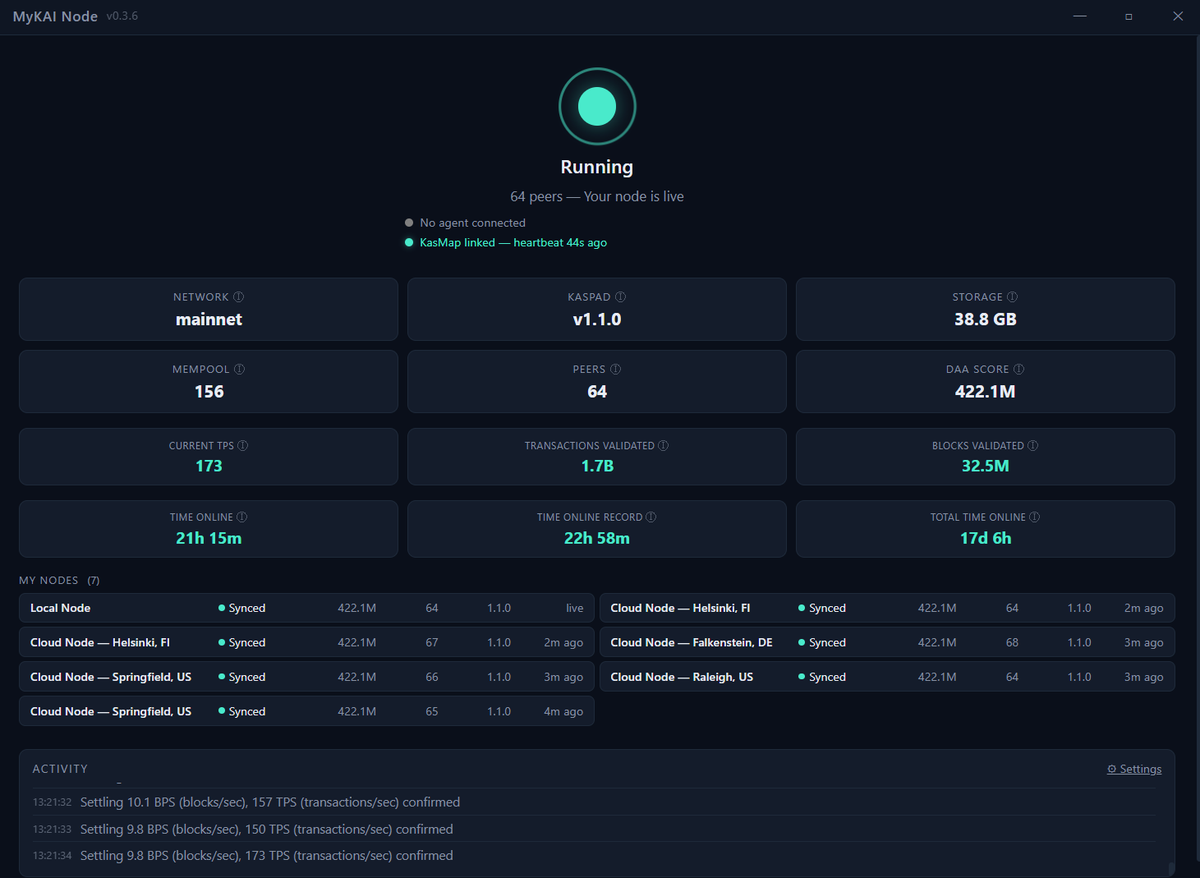
#KasMap & #MyKAI are making it simple to run a node.
1-click-download & 1-click-install. You can even run it on your PC or Laptop in the background.
https://t.co/MImRksM9Gz
more info in the thread below.
Yonatan avait évoqué il y a quelque temps de monter à 32 BPS, puis potentiellement 100 BPS avec DAGKnight ...
Où en est-on ? Voici le point complet 🔥
1️⃣ Aujourd’hui Kaspa est à 10 BPS → on a déjà vu ~3 500 TPS en conditions réelles, et le théorique max tourne autour de 10 000–12 000 TPS.
2️⃣ Avec DAGKnight (prévu fin Q3 2026) :
32 BPS → ~12 000 TPS théoriques
100 BPS → entre 20 000 et 40 000 TPS théoriques (date inconnue).
C’est énorme. Mais le vrai impact n’est pas seulement dans les flux monétaires.
À ce niveau de débit, Kaspa devient une infrastructure capable de supporter des milliers d’interactions par seconde sans que l’utilisateur ne ressente jamais la blockchain.
Exemples concrets que ça rend possibles :
🔹Un jeu où chaque action (loot, trade, mise à jour d’état) est enregistrée instantanément sur la L1 sans que le joueur ne voie jamais « transaction en cours ».
🔹Un système de supply chain où chaque colis est vérifié et payé en une fraction de seconde, sans frais ni délai.
🔹...
Avec 20 000–40 000 TPS, la blockchain disparaît complètement. L’utilisateur ne voit plus qu’une interface fluide, instantanée et invisible.
DAGKnight fin 2026.
Kaspa n’est plus seulement une blockchain rapide… elle devient une infrastructure prête pour le monde réel.
On reste à l’affût 👀
#Kaspa #Toccata #DAGKnight #DesignLed