Another Twitter Conference in the books!
Thanks to @AUG_EII and the #MedEd community for having me as an organizer & consultant.
There’s some info in the #MCGConf2021CP presentations that are relevant to all disciplines, so I encourage my other followers to check them out!
That's a wrap on the live event! Thanks so much to our amazing presenters!
Just because the live event is over, doesn't mean the conference has to be. Feel free to visit #MCGConf2021CP to catch up with presentations, comment, and ask questions over the coming days and weeks!
For details on CBAM approach to change, check out excellent resource, 5th edition. I love the title: alliteration & contrasting terms. Patterns and principles sound precise and academic. “Potholes” is earthy and common place. Change is all that.
Thanks,
#MCGConf2021CP@AUG_EII
Malshi Karunatilake et al’s study focused on improving the filtering of course content for med schools, the criteria by which we ask judges to rate the content. This is perfecting STUDY part of decision making cycle: building a better the microscope. #MCGConf2021CP@AUG_EII
Larry Hubertise explained his work with Universal Design for Learning. This approach to supporting all learners moves us beyond admissions when aiming for diversity and inclusion. #MCGConf2021CP@AUG_EII
Michael Madson introduced us to the McKinsey 7-S model for change. This way to help build the bridge between here and there focuses on faculty development. We know faculty need support since organizations don’t change, people do. #MCGConf2021CP@AUG_EII
AJ Kleinheksel returned us to the CBAM world with their work on the Innovation Configuration Map. They showed how the use of the IC Map helped build and guide the curriculum change process at the Medical College of Georgia, and is still ongoing. #MCGConf2021CP@AUG_EII
D’Eon et al explored how medical educators rate & select content. Having extracted data from 141 articles, few provided convincing justification for what they did to select content. More (any?) validity evidence is desperately needed. #MCGConf2021CP@AUG_EII
Emily Scanlan & Angela Bergene: support for faculty moving to on-line courses helped make the transition. They created just-in-time fac dev resources explaining best practices on teaching & implementing active learning strategies in a virtual environment. #MCGConf2021CP@AUG_EII
Tami Morgan helped us look at moving towards a “pull” rather than a “push” approach to curricular change using movement behavior for medical students as an example. I’m familiar with the adage, “You can’t push with a rope!” #MCGConf2021CP@AUG_EII
AJ Kleinheksel in their presentation, Data Driven Support of Change Management, described how the data they collected using CBAM instruments was used locally to adjust the curriculum change process. #MCGConf2021CP@AUG_EII
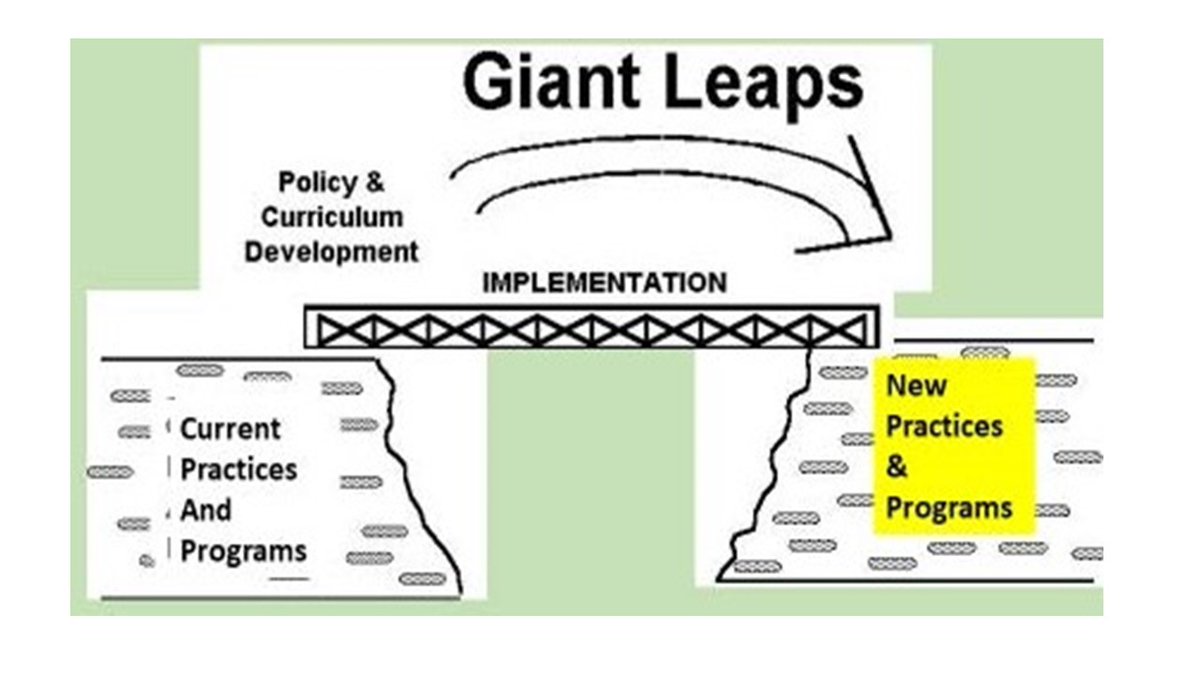
Sometimes it looks like the implementation is just clipping along until ….
All this and more applies to change efforts and implementation processes and structures. Which is why Dr. Hall helped us understand the importance of the change process. #MCGConf2021CP@AUG_EII
Just like implementation.
Gene Hall gave us a great overview of the change process, and how hard change is to manage successfully. #MCGConf2021CP@AUG_EII