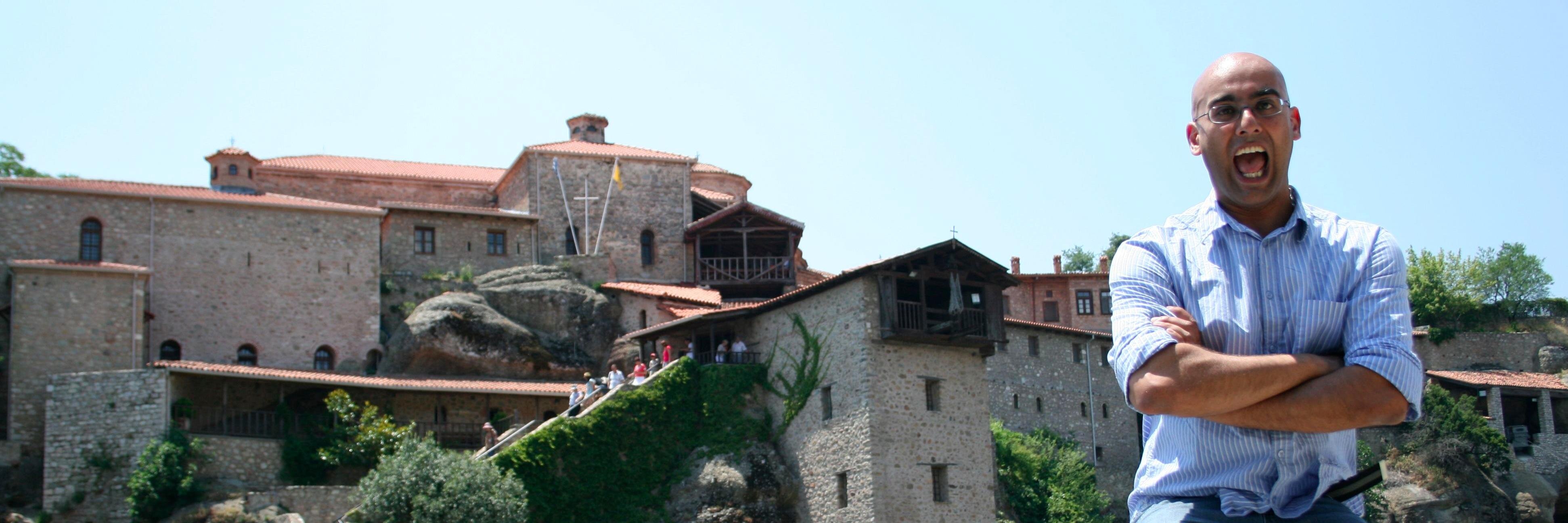
Made the cover of @CACMmag with "A Decade of Docker Containers", recapping much systems work! Docker grew so fast in those early days that we never got a chance to write an academic paper about it, so this writeup has been a long time coming: https://t.co/P8JJBSdrZd.
A heady mix of Go, OCaml, Swift, Linux, nested kernels, ancient network protocols like SLIRP, all mixed up into a container cauldron...
The article also comes with cool art and a video interview that was a lot of fun to film around @pembroke1347 and my overgrown office. I left some musings on my blog too https://t.co/2aR2JNsGxr with @mugofsoup and @justincormack
I heard @AndyBurnhamGM speak at the Bennett School of Public Policy conference in May. The whole thing is well worth a listen, but I thought this bit at 52:50 was particularly interesting, where Andy is being asked which other political leaders he admires. https://t.co/S5dlQA0gyB
After being cut off from Fable, I integrated Deepseek-4 to be callable as a local OCaml function and then built unikernel-style sandboxed agent libraries from the ground up. Language integrated LLMs are surprisingly easy to put together, given a sufficient supply of local memory and a tolerance for slothful responses https://t.co/ylf7BmoQpv
Get hands-on with Tessera at #ML4EO, hosted by University of Exeter! PhD student Frank Feng leads a workshop on the full Tessera workflow — download embeddings, explore visually, train a classifier.
Bring laptop + coordinates of a region you care about 🗺️
https://t.co/Qlaa5c6u7U
Software Foundations will be translated to Lean! 😎 Available around fall.
https://t.co/dG3byswaDR
Here’s the Zulip announcement by Benjamin C. Pierce:
https://t.co/0MSmcJsCXI
#LeanLang#LeanProver#SoftwareFoundations
Not your average day at work today since Sir David Attenborough dropped by the Cambridge Conservation Initiative today to celebrate a decade of being in the eponymous building (which used to be the old computer science campus pre-2001!). https://t.co/ZBE6ZUdb72
For computer scientists interested in biodiversity, there are dozens of interesting analyses in those notes, based on processing easily available food and other trade data. You just have to get into the subject a bit and it'll drag you in!
Was down at the @royalsociety last night for Andrew Balmford's epic talk "on feeding the world without costing the earth" as the inaugural winner of the RS Environment Medal. Here's my notes on it including that rarest of sightings: Andrew in a suit! https://t.co/f4OH73dKFc
@tiensonqin@janestreet@yminsky I think we need to shift to OxCaml really; all the latest releases are on that compiler mostly. Not tried ios compilation there yet though
Let's take a moment to salute the OCaml4 runtime as it marches to the glue farm in OxCaml. Like its valiant predecessor OCaml3, it delivered years of sterling allocation before the upstart OCaml5 runtime multicored its way to concurrent collection dominance. https://t.co/S8U9u4HX2I
The third Programming for the Planet workshop is kicking off at @PLDI now; live stream at https://t.co/IM6YFgqueh and live blog at https://t.co/k63ieEKKaO
one cool trick to make this faster that i learnt from @sadiqj is a 'parametric umap' where you train a model on some clusters and then infer for the full map. that gets it down to a few minutes, but i want real time!
I'm enjoying playing around with UMAP algorithms for dimensionality reduction in @geotessera; you can make some fine art like this Cambridgeshire vector map! Trying to get it realtime is trickier... https://t.co/hxqHyJGTbW