Israeli soldiers are reportedly torturing Dr Abu Safya --a pediatrician, for God's sake!
Without strong pressure on Israel, these may could be his last hours.
@ICRCPresident@DrTedros
Sewage overflowing.
Broken lights.
No water.
No leases.
Unsafe clinics.
@PublicProtector found substantiated maladministration in Langa Flats & Khayelitsha after a four-year probe.
The DA’s own budget claims 75% of infrastructure spend is “pro-poor,” with no ward-level breakdown to check it against.
Two things can’t both be true: that three-quarters of the City’s infrastructure serves the poor, and that an independent constitutional body finds that these townships lack functioning sewage, water and lighting.
One claim doesn’t survive the other. #CapeTown
#Israel must immediately release Palestinian Dr. Hussam Abu Safiya and all the health & care workers arbitrarily detained: UN experts. The practice of medicine is not a crime.
https://t.co/HnXguxzClj
The driving reason behind SA’s extreme unemployment, and lack of services, is the refusal by the rand issuing state to steadily employ more people.
The bullshit excuse given by the state, for not employing more than 3 South Africans per 100 citizens, is that somehow, magically, the rand issuing state has a shortage of rand, even when demand for goods and services is too low, and inflation is cost pushed.
The people who go along with this backward “govt can’t affford it” nonsense are to blame for unemployment.
While inflation in SA is cost pushed & demand for our labour, goods & services is too low (unemployment), the Rand issuing state can steadily increase employment at a rate that ensures a healthy amount of demand for goods and services (govt employees spend their wages on the goods and services the rest of us sell).
A moderate amount of demand pull incentivises private sector investment & employment to profit from matching new demand with increased supply of goods and services.
If govt focuses on employing & investing in ways that reduce household & businesses costs, like rolling out energy, water & public transport networks, education, healthcare etc, then the drop in costs & cost push inflation, is further incentive for private investment & employment.
Continuing SA’s extreme unemployment, poverty and inequality largely along racial lines is far more risky than targeting a healthy rate of demand pull inflation to drive development, employment, education growth & investment.
It’s counterproductive and just plain stupid to pretend that the Rand issuing state has no money to drive the improvements we need, while the Rand using private sector is clearly incapable and unwilling to do so, largely because of lack of demand & high costs / risk caused by that pretence.
Govt spending creates money. When the state taxes, money is destroyed.
While inflation is cost pushed and demand is too low, govt can offset more of its spending with low interest SARB credit (to increase demand and reduce costs) and less with taxes and high interest bond sales, which add cost and reduce demand.
When the state pays a govt employee to build, teach, police, nurse etc, the amount in the govt employee’s account is increased.
That employee then spends those Rand onward on the goods and services the rest of us sell, which increases incomes, sales and profit.
Govt taxes a portion of those incomes sales and profit, destroying a portion of those Rands created by the govt spending.
The people who sold those goods and services then spend what remains of those Rand onward, again increasing incomes, sales & profit, and again a portion is destroyed by taxation.
Eventually after a few transactions, all the money govt spent into supply on the public servant’s wage is removed by taxation.
But in the meantime, we had increased incomes, sales, profits, employment & GDP. And more private sector investment & employment.
When we understand the process properly, it becomes clear that the state can drive productive growth, employment and development.
Across the rich western world, birth rates have collapsed below replacement.
The political class has an answer ready, and it points outward.
The foreigner is taking your country, your jobs, your future.
When the reality is that the system failed the population to the extent that procreation unaffordable, unsustainable and outright undesirable.
The system is sterilizing the Wests future.
Housing was financialised into an asset class, so a home became a speculative instrument instead of a place to raise a family.
Wages decoupled from productivity for two generations, so a single income no longer builds a household.
Childcare, education and healthcare were turned into debt-loaded markets that price young couples out of a second child, then a first.
None of this was done by migrants.
It was done by capital optimising for yield, and by governments that protected asset prices over family formation.
The result is a population that cannot reproduce itself because reproduction has been made economically irrational.
The genius of blaming the outsider is that it sends anger sideways and downward, never upward.
A worker furious at the immigrant next to him is a worker not asking why his rent doubled while his pay stalled. The demographic panic is not a defence of the nation. It is a narrative that shields the exact interests that hollowed it out.
As long as the foreigner is the story, the financialization of housing and the suppression of wages continue completely unexamined, which deepens the precarity that suppresses birth rates in the first place.
And this newfound racism only guarantees the collapse it claims to prevent.
An ageing society has only two demographic inputs. It can produce more children or it can import more workers.
Nativism attacks the second lever while doing absolutely nothing to repair the first.
It removes the one input still functioning and offers nothing in its place.
The maths is merciless. Fewer workers must support more retirees, pension and health systems strain, the tax base shrinks, and the economy that was supposed to be saved by exclusion instead starves.
The same societies that demonize migrants are the ones whose labour markets, care sectors and innovation pipelines now depend on them.
So you build a country that needs the outsider to function and hates the outsider on principle,
a contradiction that cannot hold.
When it breaks, the state does not turn outward.
It turns inward.
Surveillance expands, austerity bites, and the machinery of control built for the border gets pointed at citizens.
The decline gets repackaged as renewal, and the people sold the lie keep voting for the thing that is eating them.
Understand that this racism framing is the trap, not the truth. It is an identity construct that keeps the exploited fighting each other while the structure that drained them stays invisible.
The honest question was never how to keep others out.
It was why a wealthy civilisation made it impossible for its own people to afford the future.
That’s the real question.
The ones screaming about demographic doom are not protecting anyone.
They are guarding the machine that caused it, and the louder the scapegoating gets, the faster the whole thing comes apart.
South Africa has a critical shortage of STEM graduates. Apparently. Except South Africa does train excellent engineers.
The problem is that the country’s highly financialised economy steals them and now the best analytical minds are busy optimising credit card default algorithms for wealthy banksters, just like mafia bookkeepers, instead of running megafactories.
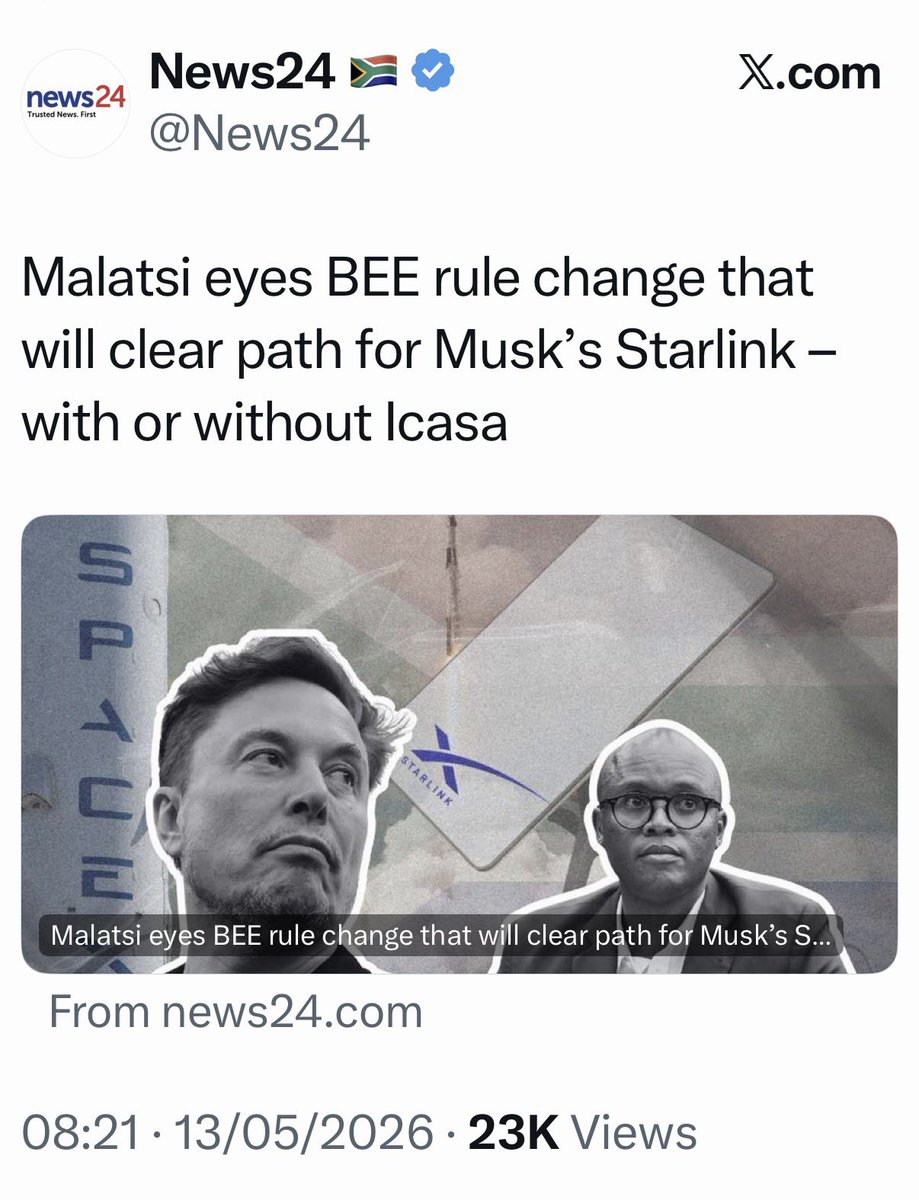
Imagine being a Minister, seeing the ability of an adversarial state to now use Starlink to see who is online, and potentially access highly sensitive state communications, a national security digital risk so severe it could bring South Africa to its knees. The devastation would be absolute.
Equally absolute would be the
emptying of ordinary South African’s bank accounts, the theft of their confidential personal information by hackers and malign actors who buy this technology.
Imagine seeing this, and all the repeated revelations about Starlink’s digital security vulnerabilities, data exposure, and the profound national security risks it poses, and deciding:
“Yes, this is what South Africa needs.”
Imagine handing the keys to South Africa’s digital sovereignty and strategic communications infrastructure to a man repeatedly implicated in corruption and state capture scandals, in and out of court over discrimination against people of colour, a self-confessed supporter of colonialism, who has quite deliberately and intentionally adopted an adversarial posture toward South Africa and its people having launched a damaging global disinformation campaign against it, and deciding:
“Yes, this is who South Africa needs.”
All without a single public impact assessment, national security review, or meaningful public consultation.
I do not think a greater risk to South Africa has existed since the Guptas were handed the keys to National Treasury. This is no different.
It is breathtaking in its recklessness.
It is diabolical in its incompetence.
It is a corruption of the soul to have zero care for the digital safety of the people of South Africa and its national security.
Just pleasing a base that sees Elon Musk as its White Knight. Votes. That’s it. A couple of thousand votes. Selling South Africa for votes.
Sies.
South African Jewish Board of Deputies in the past 24 hours: The UK is antisemitic!
Gift of the Givers in the past 24 hours: It's flooding in the parts of the Cape. Here's what we're doing to help.
Remember Cape Town that there could have been funds to respond better to disaster relief & disaster preparedness. But the DA hates the poor so much they voted against this because I foregrounded informal settlements as usually severely affected. These funds would help right now.
Hey SA Zionists, list below the charity and rescue work you are busy with in the Western Cape right now. Your pet hate #GiftoftheGivers is on the ground, saving lives.
When the government funds State-Owned Enterprises it’s providing a service, not “haemorrhaging cash”. After all, you don’t ask a public road how much profit it made today, because it’s understood that it’s an investment in the economy.
Likewise, SOEs are meant to provide access to basic services, but when you frame water and electricity as “loss makers”, you’ve already decided that poor people aren’t worth the “expense” and that providing a service to them is a financial mistake.
The point is that anyone who insists on evaluating SOEs using financial metrics alone, is treating essential services as optional luxuries.
You see this a lot in how the media and its analysts like to pretend that there’s no difference between a commercial enterprise, which exists to generate profit, and a public utility which exists to provide infrastructure for society. So, they actively advocate for public service providers to be evaluated through corporate efficiency metrics, which is a terrible tool for the job.
In reality, essential services, by their nature, are natural monopolies that cannot be “efficiently run” by leveraging multiple competing companies, for instance. You cannot be talking about “introducing competition” because you cannot lay five different sets of water pipes and power cables to one house to encourage that “competition”.
But if you insist on measuring a public utility’s performance using financial return on investment, it will always look like a failure because it is meant to provide access at lower-than-market rates to ensure inclusivity.
You should instead measure SOEs using social return on investment, so you can quantify the value of social, and economic outcomes. This way, an SOE that is “losing money”, according to the economists on TV, should instead be measured by how much social value it provides.
This does not mean there shouldn’t be financial accountability for publicly-owned entities. Rather, the underlying point here is that financial accountability ≠ profitability.
Financial accountability is about how well money is managed and whether outcomes match the resources used. In contrast, profitability is simply about generating surplus revenue over costs. These are not the same thing and treating them as interchangeable is where a lot of bad analysis comes from.
An SOE can be financially accountable without being profitable. For example, it might set tariffs below cost as a matter of policy, clearly report the subsidies required to cover the shortfall, deliver reliable services efficiently, and actively expand access to underserved communities. Of course, the neoliberal media would be up in arms, but this would not change the fact that the so-called “loss” is socially justified and is NOT a sign of failure.
SOEs should be judged on financial accountability and social outcomes because, again, profit👏🏾 is not👏🏾 the benchmark👏🏾 for public👏🏾 utilities👏🏾
South Africa remains stagnant and failing because it traded the engineer for the lawyer
Substituted the factory manager for the chartered accountant
Swapped the materials scientist for the banker
Glorified the finance manager over the artisan
Prematurely gave up the bullet for the ballot
Rewarded the office park over the industrial park
Magnified the tender consultant over the town planner
Elevated the compliance officer over the soil scientist
Worshipped glorified credentials over capability
Idolised the procurement officer over the inventor
Traded the civil engineer for the civil servant
Traded the mine surveyor for the mining indaba
Chose the consultant over the craftsman
The common thread in South Africa is the rise of the intermediary.
In a healthy industrial economy, value is created at the source, which is the factory, the farm and the mine.
In an economy like SA’s that has swapped the artisan for the accountant, the primary mechanism of wealth generation becomes the cut taken by the middle man who does not necessarily add value to the physical product, only extracting value from the transaction.
You cannot and will not develop a nation by attempting to skip the industrialisation phase and jumping head-first into a service-based global economy.
When the primary route to wealth runs through state tenders, compliance, licensing and procurement, you get rent-seeking rather than value creation where incentives point away from building things and toward positioning yourself between the builder and the buyer.
This is not about Fana Hlongwane or Ze Nxumalo, but yes, just like that.
Brilliant. The hypocrisy and sophistry is astounding. 73 000 civilians, including childrenj murdered - a war crime - and not a single word of condemnation. An ICC fugitive and no demands for his arrest. Unconscionable.
The DA has never “waited” for any international court to rule before condemnation. Ever. No court has ruled against Iran. No court has ruled against Putin. No court has ruled against Xi. And yet they are regularly condemned, and correctly so, when gross human rights abuses are revealed.
What this reveals is quite stomach-churning. You are willing to compromise your principles if the price is right. You are willing to turn a blind eye - even to a genocide - if your palms are greased. There is no moral high ground on foreign policy you can ever claim again. You can be bought by rogue nations, just like you have accused the ANC of being. At least it is honest about where it stands. Stand on business.
DA leaders sound like average Americans when in comes to geopolitics: simplistic, chronically ignorant & plebeian. You could swear they live in Arkansas!
Most tragically is how they defer their entire thinking on geopolitics to Euro-America: a complete zombification!
Sad story! But also a culture shock if you think about it: a white dominated party under complete intellectual tutelage by western, equally ignorant white masters. Tragedy at its best! No original, autonomous or even critical thinking… ZERO!
When you hear them speak, you really wonder if these people know they are in Africa, global south and post-colonial country! None of these categories, which are grounded in history and reality, inform any of their world view.
For decades, SAn finance ministers and reserve bank governors have enforced policies that benefit US producers and consumers at the expense of SAn producers and consumers.
Perhaps it’s time they stopped doing that?
SA monetary and fiscal policy thus far has been to keep costs for producers unnecessarily high so that they can’t compete with foreign producers, and to reduce the number of SAn consumers who can compete with foreign consumers when bidding for products available on the market.
A litre of diesel in 🇮🇷Iran is about R0.04 (4 cents) per litre. It’s R29 in 🇿🇦South Africa.
Yes, Iran produces oil, but South Africa produces coal and makes fuel from that. So, that cannot be the reason.
The main reason for the high price is South Africa’s Basic Fuel Price which prices all fuel as if it were being imported from international refineries, even the fuel made from South African coal in Secunda.
The government says it does this because if Sasol didn’t sell it locally, SA would have to buy it from overseas at world prices anyway. Excellent reasoning right there👍🏾
Also, In Iran, the government heavily subsidises fuel to keep it cheap for citizens. In South Africa, the government does the opposite and instead uses fuel as a major source of tax revenue.
About R6 to R10 of every litre doesn’t go toward the fuel itself, but to the state, because that’s what a country that cares about its citizens does to them.
Serious industrial nations don’t take accountants as seriously as South Africa does.
In industrialising nations, like Vietnam and surrounding states, for instance, the most prestigious roles are found in engineering or industrial management because the economy is physically building things.
Meanwhile, in South Africa, SAICA’s CA(SA) is viewed as the ultimate golden ticket.
But it’s not only in developing/industrialising nations where accountants take a back seat. In the US, Germany and Japan, CEOs are generally product people or engineers, while in South Africa, a massive percentage of JSE-listed CEOs are chartered accountants.
The reason for this is that the South African economy has been deindustrialising for decades, so the existing companies don’t grow by inventing new things or expanding production. They “grow” through the financial engineering of mergers, acquisitions, cost-cutting, and “tax optimisation”.
The consequence of this is that if you compare SA to an employment-dense industrialiser like Vietnam, you find that the latter focuses on vocational excellence. Over there, an accountant is just a back-office functionary who supports the factory. The hero is the plant manager who meets a production quota.
But South Africa, to its detriment, is obsessed with compliance excellence. The factory, if it even exists, is a “risk” to be managed, and the chartered accountant is the high-priest who tells the board if that risk is acceptable.
By taking accountants this seriously, South Africa has perfected the art of measuring value, but has neglected the art of creating real tangible value.
The worship and adoration of the CA(SA) is a symptom of a services-led economy that has skipped the labour-intensive industrialisation phase, and this is primarily why the unemployment epidemic cannot be resolved.