추석은 역시 다 같이 한자리에 모이는 게 제일 좋은 것 같아요
가족들이 한 밥상에 둘러앉아서 이야기 나누고 맛있는 것도 같이 먹고 그러잖아요
그런 추석의 분위기를 생각하다 보니 여러 AI Validator가 각자의 관점에서 판단하고 하나의 합의에 도달하는 @GenLayer 가 자연스럽게 떠올랐네요
서로 다른 생각과 관점이 모여 하나의 결론을 만들어가는 과정
어쩌면 신뢰라는 것도 결국 이런 데서 시작되는 게 아닐까 싶습니다 ㅎㅎ
다들 맛있는 거 많이 드시고 따뜻하고 행복한 추석 보내세요 🌕🥮
There's a subtle difference between actually figuring out an answer and just deciding if an answer is acceptable.
That distinction is super important in GenLayer.
A validator doesn't always have to come up with its own competing answer. Sometimes, its only job is to look at what the Leader came up with and check if it fits the contract's rules.
Sounds like a minor technical detail, right? I really don't think it is.
It means an Intelligent Contract can actually split up two questions that traditional apps usually lump together:
'What do I think the answer is?'
versus
'Does this answer play by the app's rules?'
Those are definitely not the same thing.
A validator can totally disagree with how the Leader got there, but still accept the final outcome. Or, it can look at the facts and just reject the proposed result without ever having to provide its own alternative.
This leads to something really cool: The protocol isn't necessarily trying to force one single, universal AI answer
Instead it’s trying to draw a clear reproducible line around what the app is actually willing to accept
And that completely changes what 'consensus' means
consensus doesn't always mean everyone reached the exact same conclusion sometimes it just means enough independent validators agreed that a specific result met the app's standard for 'acceptable'
For AI native apps that difference might end up being way more important than just having a bunch of models vote on the same prompt
Because the real design question becomes:
Who gets to define the boundary of an acceptable answer, and how accurately can we code that boundary?
Honestly that’s where the true intelligence of the contract might actually live
@GenLayer
Spent some time testing 3 Agent Tank projects
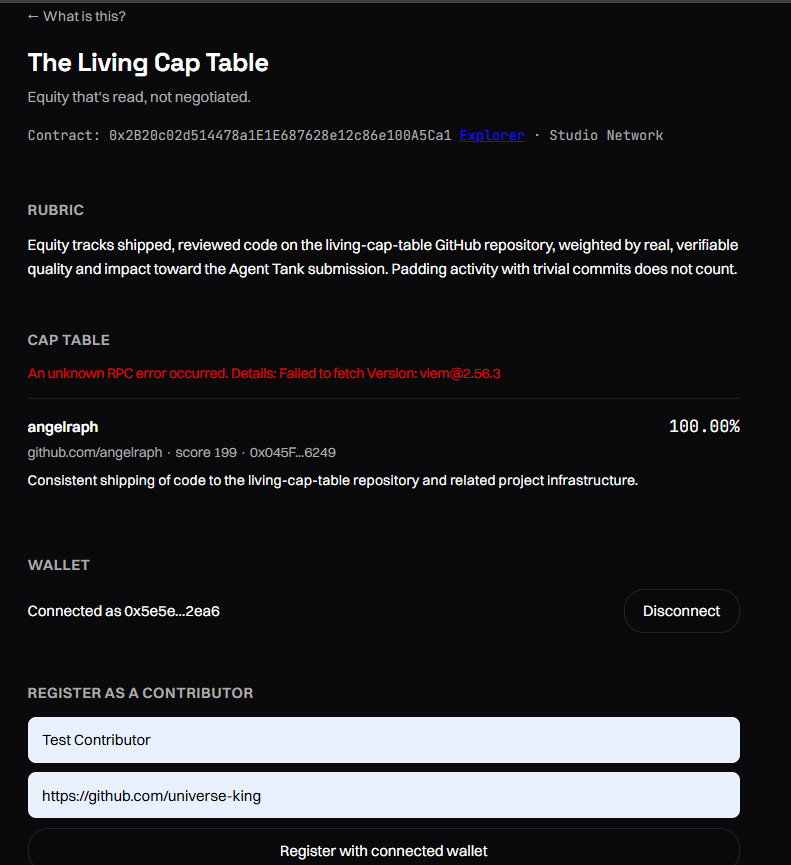
The Living Cap Table
AgentPact
Newintel
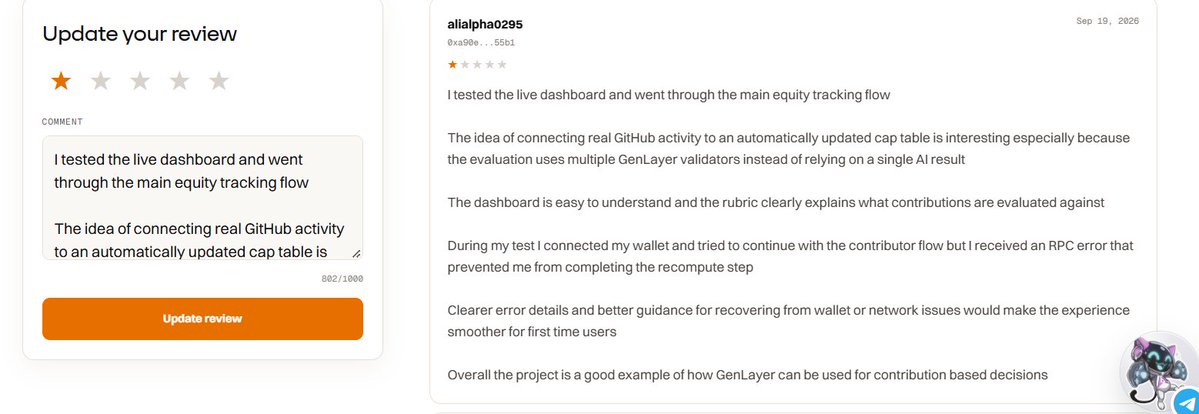
I went through the actual user flows and tested what was available in each project
Each one takes a different approach to using GenLayer for equity tracking escrow verification and demand intelligence
I also left individual reviews with feedback based on my testing
@GenLayer
The Living Cap Table
Polymarket resolves a market when a few people vote on what happened, days later.
@kstellana on @Unchained_pod: GenLayer sends the same question to up to 1,500 different AIs that have to agree.
One detail in GenLayer’s execution model that deserves more attention is the role of appeals
An appeal isn't simply another vote on an accepted transaction
It introduces a fresh validation path where a new committee can independently evaluate the proposed outcome
If that evaluation reaches a different conclusion the original transaction can be recomputed and dependent unfinished transactions may need to be reconsidered as well
This is particularly interesting for Intelligent Contracts because the underlying computation may involve web data LLM outputs and natural language conditions
In a deterministic system a disputed result can often be traced back to reproducible computation
With AI based execution the disagreement can be about the interpretation itself
GenLayer addresses this by making disagreement part of the execution lifecycle rather than treating it as an exceptional failure
Proposal
→ validation
→ accepted
→ appeal
→ re-evaluation
→ recomputation
→ finalized
The interesting part isn't simply that transactions can be challenged
It's that the protocol gives disagreement a mechanism to produce a new computation and potentially change the resulting state
@GenLayer