What to Watch for When You Fly, Part 1 of 5: Pre-attack surveillance indicators.
Ordinary curiosity is common. Repeated, specific, or technical interest in crew, routes, or security is the pattern worth reporting.
The Early Bird™ Intelligence Brief
https://t.co/W33Yqz26mb
US ports face cyber attack onslaught as hackers target vital trade routes
America’s biggest crude oil export hub reports thousands of attempted hacks each day as shipping companies battle breaches.
Hackers are mounting an escalating cyber assault on US ports and cargo ships, bombarding vital arteries of global commerce with thousands of attempted attacks each day.
The attacks have escalated sharply in recent months, with a wave of breaches targeting ports, oil tankers and shipping giants. The increasingly sophisticated threats are being carried out by cybercriminals and groups linked to hostile states, exposing vulnerabilities in the ageing networks that enable international commerce.
Experts link countries like Iran, North Korea and China to hacking operations targeting shipping infrastructure. https://t.co/IHG7ceooBj
al Qa’ida Calls for Aviation Attacks Modeled on the Flydubai Hijacking Attempt
WHAT IS THIS REPORT ABOUT?
This report assesses the joint FBI, DHS, and TSA informational notice sent to U.S. airlines, cargo carriers, and airports on 19 November 2026. The notice warns of Al Qaeda-aligned messaging that praises a September attempted hijacking of a Tel Aviv-bound Flydubai flight and urges similar attacks.
BOTTOM LINE UP FRONT
Federal agencies have warned the U.S. aviation sector about Al Qaeda affiliates and supporters who are holding up the Flydubai attempt as a model for defeating security and using aircraft as weapons.
The timing nonetheless matters, because the warning lands ahead of the busiest travel week of the year. The most likely outcome is that the messaging produces no attack, but the greatest risk comes from an inspired individual, possibly with insider access, who acts without warning.
KEY JUDGMENTS
We assess with high confidence that the notice reflects a continuing concern over Al Qaeda's long-standing interest in aviation, and not a new, specific threat. The reporting states that the notice does not change the assessed threat level.
We assess with moderate confidence that the Flydubai incident is being promoted as a template because it reportedly involved a person with legitimate cockpit access, which sidesteps passenger and baggage screening. The allegation that a pilot attacked the other pilot with an axe comes from public reporting and an Israeli government statement and has not been independently verified.
We assess with moderate confidence that the principal risk to the U.S. is an individual inspired by the messaging and not a directed operation. The notice itself observes that people inspired by terrorist groups have historically not acted directly on such calls but can mobilize quickly with little or no warning.
We assess with moderate confidence that the warning indicators in the notice point to insider and impersonation risk as much as passenger risk. They include unexplained losses of airline radios, access badges, and uniforms, along with requests for detailed flight or security information by people with no legitimate reason to ask.
We assess with low-to-moderate confidence that ongoing Middle East hostilities, combined with the praise for the Flydubai attempt, could increase grievances against the U.S. and widen the pool of possible actors. The reporting offers no direct evidence of planning against U.S. targets.
SITUATION REPORT
On Thursday, the FBI, the Department of Homeland Security, and the Transportation Security Administration jointly sent an informational report to U.S. commercial airlines, air cargo carriers, and airports. The report flags recent public messages from Al Qaeda affiliates and supporters that praised the September attempt to hijack a Flydubai flight bound for Tel Aviv and called for similar attacks on U.S., Israeli, and other targets. According to the report, the messages repeat familiar themes of exploiting aviation access, evading security, and using commercial aircraft as weapons. Several of them presented the Flydubai attempt as a model for getting past security.
The September incident involved a flight from Dubai to Tel Aviv. A pilot was arrested after allegedly attacking the other pilot in the cockpit with an axe in an apparent attempt to crash the aircraft. Israeli Prime Minister Benjamin Netanyahu said the wounded pilot fought back. The reporting available does not identify the attacker's motive or any connection to Al Qaeda, so the link between the incident and the group's messaging rests on the messaging itself, not on established operational ties.
The notice arrives ahead of the heaviest travel period of the year. AAA projects about 6 million people will fly on U.S. domestic flights between 24 and 30 November. That figure is a forecast for the period and not a count of any completed travel.
The notice lists indicators for aviation personnel to watch for. They include people trying to avoid security procedures, people with no legitimate reason seeking detailed flight operations or security information, people insisting on handling specific luggage without assistance, and unexplained losses of items such as airline radios, access badges, and uniforms. Personnel are urged to contact law enforcement promptly about any concern.
COURSES OF ACTION
Most Likely:
The messaging produces no attack in the U.S. during the holiday period. Industry raises vigilance for several weeks, reports a small number of suspicious incidents that turn out to be benign, and the notice passes without a change to the threat level. Al Qaeda affiliates and supporters continue to circulate the Flydubai example as propaganda.
Most Dangerous:
An inspired individual with legitimate access to an airport, aircraft, or crew areas, or one using stolen credentials or a uniform, attempts to breach security or seize control of an aircraft during peak travel. The person acts with little or no warning and shows no prior link to a terrorist group, which would make the attempt difficult to detect through traditional intelligence channels. Heavy passenger volumes and stretched staffing would reduce the chance of noticing early indicators.
Least Likely:
A coordinated, directed operation against U.S. aviation is under way and reaches the execution phase before disruption. The reporting offers no evidence of planning at that scale, and the notice itself describes no specific or credible threat.
IMPACT ON USA
The primary exposure is the U.S. commercial aviation system during the Thanksgiving travel period, when passenger volumes are at their annual peak and the consequences of a successful attack would be greatest. The notice shifts attention toward insider access and credential control, areas where screening designed for passengers offers limited protection.
Airlines, cargo carriers, and airports bear the immediate burden of staff awareness, reporting discipline, and control of badges, radios, and uniforms. Wider Middle East tensions may keep the grievance environment elevated beyond the holiday period.
CONCLUSION
The notice reads as a prudent, routine warning and does not indicate a specific threat. The lack of a known plot should not be read as low risk, because the most plausible threat comes from an inspired individual who may not appear on any watch list until after an attempt. Several developments would change this assessment: verified evidence that the Flydubai attacker had ties to Al Qaeda or its affiliates, reporting of a similar attempt or credible plot against a U.S. carrier, a pattern of missing credentials or uniforms at U.S. airports, or a change in the official threat level.
@rawdbee We can understand why this feels frustrating. Your loyalty is genuinely appreciated, and we're sorry this experience left you feeling overlooked. Please delete this from public view and join us in DM.
The Three-Hour Cyberattack: AI Is Turning Supply Chain Security into an Execution Problem
The FBI, Microsoft, and Google are now documenting a significant change in the cybersecurity threat landscape, one in which autonomous artificial intelligence is allowing attackers to identify vulnerabilities, exploit trusted digital relationships, and penetrate enterprise systems at speeds that conventional security processes may struggle to match.
The implications for supply chain and logistics organizations extend well beyond the protection of corporate information. Transportation management, warehouse execution, procurement, and inventory systems increasingly depend on continuous connectivity with external applications and trading partners, creating an environment in which a compromised digital identity or software integration can threaten the flow of operational information across multiple organizations.
The central question is no longer simply whether enterprises can detect cyberattacks. It is whether they can identify, contain, and recover from intrusions quickly enough to maintain operations when attackers are increasingly capable of acting at machine speed. https://t.co/7C3eIpxY5L
The Week the Lights Flickered
Last Thursday, Microsoft’s cloud went dark across the globe - making it Microsoft 364 instead of 365. Then Friday, the Federal Aviation Administration stopped every airplane in America from leaving the ground for more than four hours, something that had not happened since the morning of September 11, 2001, with a single exception in 2023. Monday, Chase Bank, Bank of America, Wells Fargo and other bank’s customers stared at frozen banking apps. Yesterday, the classified internal network of the National Security Agency also stuttered, and Apple’s sign-in service went down with it. Five failures in six days, each with a tidy explanation, and each explanation filed by the institution that failed.
Then the president landed in Manila...
Start with what the officials say, because it deserves a fair hearing.
Microsoft blames a software defect tied to a network capacity upgrade. The FAA points to legacy equipment overwhelmed by data traffic after a new router was installed. Chase calls it a software bug in an on-premise hardware system and insists it was not cyber-related. The NSA describes temporary degradation during scheduled maintenance. No agency has attributed any of it to a foreign government, and the FAA and Microsoft both say they have seen no signs of malicious activity. Even Representative Lawler, who is demanding briefings, concedes that some of this may be coincidental.
Some of that may be true. Aging systems fail, and upgrades go wrong. Anyone who has worked inside a large organization knows that complexity produces accidents without any help from an adversary.
But taking all these “coincidences” as a whole, an intelligence officer is trained to ask a different question than an engineer asks. The engineer wants to know why a system failed. The intel officer wants to know why these systems failed together, in this order, in this week. The intelligence officer is trying not just to connect the dots, but determine what is a dot - and what is not?
For example, the NSANet outages occur (oddly) periodically—sometimes lasting only a few minutes, other times extending for several hours. Such interruptions are unfortunately not unusual, but nor are they typically reported in the mainstream media. Is that a dot similar to the other outages? Perhaps, but not in the same way. The bigger question around the NSA is why was this being reported yesterday? What makes this particular outage newsworthy when similar disruptions have occurred in the past without attracting any public attention? Who benefits?
What may also be true?
Consider the other story running in the same news cycle. Jensen Huang, the man who built Nvidia into the supplier of the chips that power American artificial intelligence, resigned after admitting an affair with a woman the United States says is a Chinese spy. The pattern is the oldest one in the trade. A honey trap does not need to succeed to be worth the effort. It needs only to get close to something valuable, and nothing in American commerce is more valuable right now than the chips that train the models, run the networks, and increasingly manage the infrastructure that just stumbled.
Now place both stories against the calendar.
A war with Iran and a United States naval blockade have cut Iranian oil exports to almost nothing for nearly nine months, severing the discounted crude that Chinese refiners relied on for years. Beijing is scrambling to replace those barrels from Iraq and elsewhere, and it is paying more to do so. The president arrived in the Philippines this week on the first leg of a trip that ends with a trilateral meeting against Xi Jinping and Vladimir Putin, with Iran on the agenda. A government that holds that much leverage over its rival’s energy supply has a reason to remind that rival of what it can reach in return.
The China theory.
A state with serious cyber capability would not announce itself - it would not leave footprints going in or out that would reveal it was behind the cyber failures we've experienced thus far. It would probe, test, and demonstrate access in ways that stay deniable. Malware that activates during maintenance, but mostly nuisance damage, all designed to send a message, yet not damage so significant as to require hard retaliation and escalation. In other words, every incident carries a plausible mechanical explanation and no single one forces a response from the U.S.
But the message would be directed at one reader - President Trump. It would say that the grid of American commerce, aviation, banking, and intelligence rests on systems that the adversary has already studied, and that the studying can become something more on the day it is convenient.
The theory that lines up is that the U.S. cyber problems in banking, aviation, transportation, emergency response, communication and power distribution were China's message to the President just prior to his meeting with Xi - we can hurt your country so stop hurting ours by witholding our oil supply as winter approaches.
A nation that cannot tell the difference between an accident and an attack within a week has a problem regardless of which one this was. If the cause turns out to be nothing more than neglected infrastructure and bad luck, the country has still learned that a handful of failures can stop its airplanes, freeze its banks, and silence its spies in the same week. An adversary watching that lesson has learned it too.
So in a nutshell, the take-away is this:
Facts:
- The US is in war with Iran.
- Iran is an ally of both China and Russia.
- China imports a massive amount of its oil from Iran.
- Winter is coming and oil is how they keep the lights and heat on in China.
- The US is holding Chinese oil from being delivered by blocking Iranian exports.
- The US has suffered a sequence of cyber outages all within a 6 day period - national security (NSA), transportation, banking, communication, power distribution, etc - that cannot fully be explained or attributable to just security patches that went awry.
- President Trump meets with President Xi and Putin in China on starting today thru tomorrow.
The Hypothesis:
China wants that oil pressure lifted. China is sending President Trump a warning through the recent disruptions to American banks, airlines, communications, and other critical systems.
The message is straightforward: You can hurt our economy by cutting off our oil, but we can hurt yours by disrupting the systems Americans depend on every day. Back off, and we'll back off.
China has the cyber capability to carry out such attacks without leaving footprints behind - and without making them look like attacks, but merely explainable security patches gone awry or equipment failures.
In sum, the hypothesis is that these disruptions were not random failures, but were a demonstration of what China could do if Trump refuses to ease the pressure.
(image created with Ai)
A friend asked, "with all that's going on in the world, how concerned should i be?"
Here's our answer:
Do not panic - at all. Just get a basic storehouse together as if a hurricane were coming (food, water, cash, batteries, etc for a 2wk period) and keep on hand. But that's something everyone should have anyway. There's a rush to silliness going on in the social media world that's unavoidable as influencers try to sell themselves and products.
But the hype outruns the evidence and most of it is either uninformed talk or intentionally inflammatory rhetoric for clicks.
Calm is contagious.
🚨 AN EXPLANATION FOR THE CYBER HITS:
Facts:
• US holds Chinese oil hostage by blocking Iranian exports.
• Winter's coming and oil keeps lights / heat on in China.
• US has been hit by a sequence of cyber attacks all within a 6 day period - nat-sec, transportation, banking, communication, power distribution, etc.
• President Trump meets with President Xi in China 18-19 Nov...
The Working Theory:
China wants that oil pressure lifted and is sending POTUS a warning through the recent disruptions to American banks, airlines, communications, and other critical systems.
The message is straightforward: You can hurt our economy by cutting off our oil, but we can hurt yours by disrupting the systems Americans depend on every day. Back off, and we'll back off.
China has the cyber capability to carry out such attacks without leaving footprints behind.
These disruptions were not random failures. They were a demonstration of what China could do if Trump refuses to ease the pressure.
Subscribe to The Early Bird™ Intelligence Brief for more intelligence and analysis.
What do you think? Is it China?
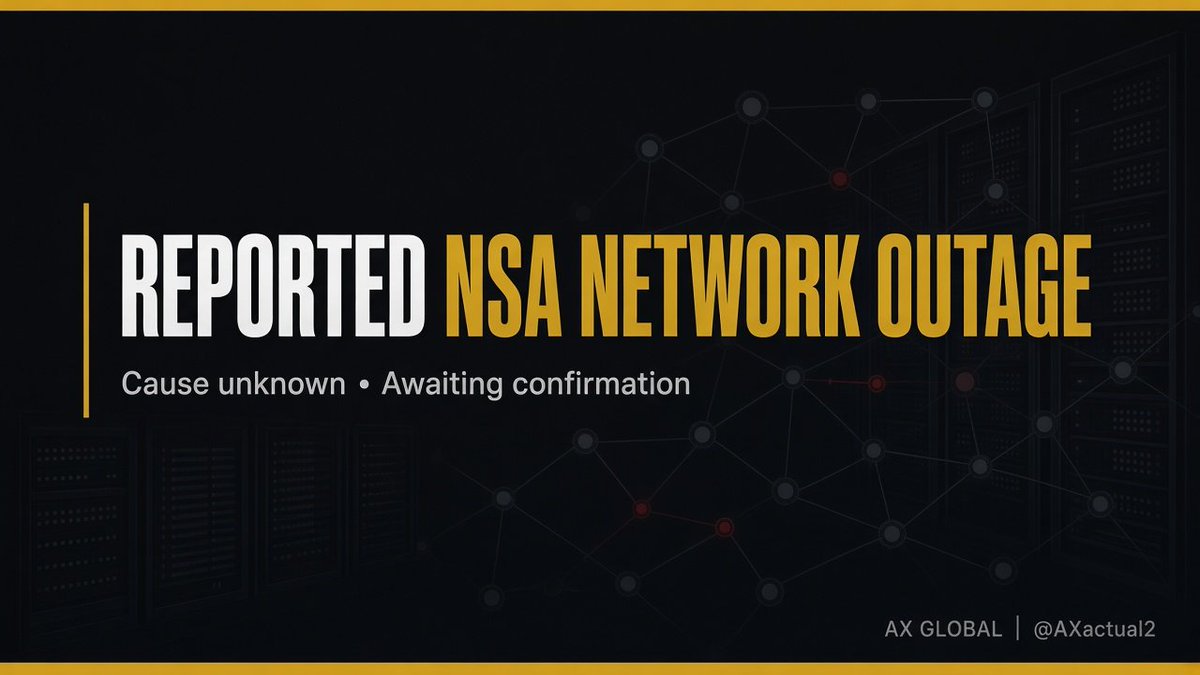
🚨 The highly classified NSA Net communications network used by the U.S. National Security Agency for internal classified communications is down. The cause remains unknown.
@Osint613 The IRGC might as well have said, "If the dam were to be hit by armed unicorns..." because they have zero capability to deliver a missile to Casablanca, much less Colorado.
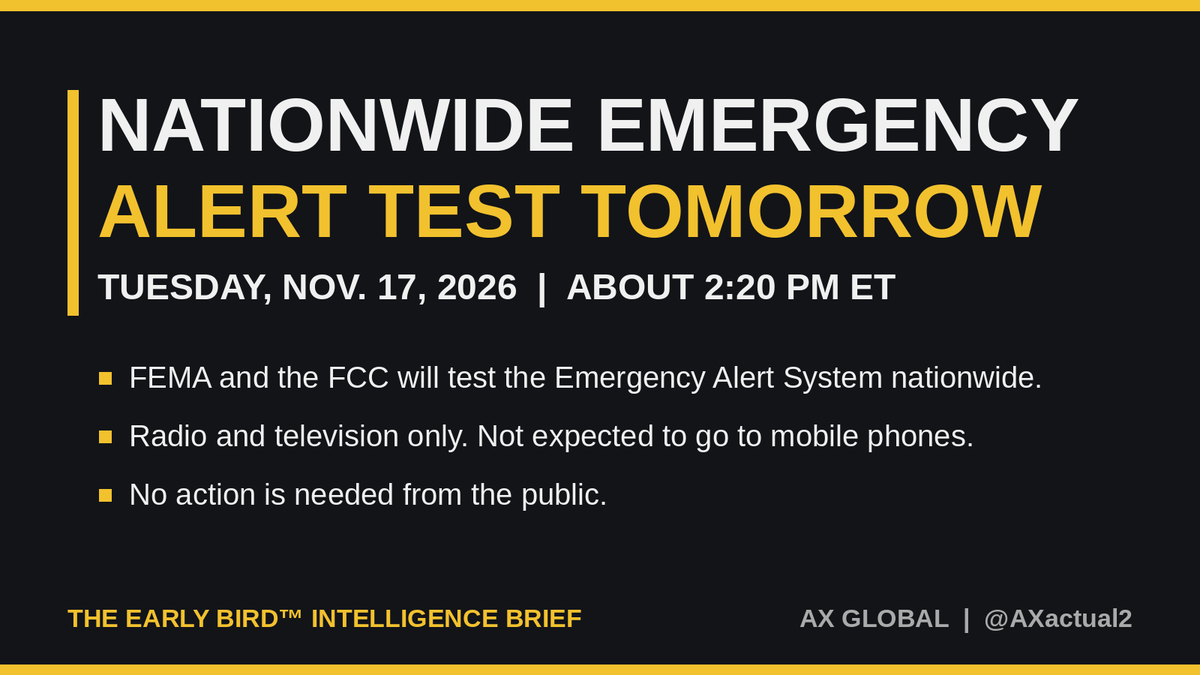
NATIONWIDE EMERGENCY ALERT TEST TOMORROW:
FEMA and the FCC will run a nationwide test of the Emergency Alert System tomorrow, Tuesday, Nov. 17, 2026, at about 2:20 PM ET.
The test will air on radio and television only and is not expected to go to mobile phones.
No action is needed from the public.
Four U.S. systems stumbled in 48 hours. Here is what we know, and what we don't.
Microsoft 365 went down Nov. 12. Outlook, Teams, SharePoint and Copilot were disrupted across North America and beyond, with more than 130,000 Outlook outage reports at the peak. Microsoft blames a problem during a network capacity upgrade.
911 faltered that evening. Callers reported dropped calls, unanswered calls and busy lines. The disruptions were uneven across jurisdictions, and no carrier or government source has named a cause.
On Nov. 13 the FAA halted every U.S. departure, citing a telecommunications outage at multiple en route centers. It was only the third nationwide ground stop since September 2001. Officials report no indication of an attack.
The same day, a tanker lost control on the Mississippi in New Orleans and struck a docked river cruise boat carrying 129 passengers. Thirty-two were hospitalized, none critically. The river was closed to vessel traffic.
Abroad, the picture is sharper. British authorities have tied a plot against RAF Fairford, a base used by U.S. bombers, to Iran. The U.S. pulled aircraft from RAF Mildenhall over a threat and raised its alert level to FPCON Charlie. On Nov. 13, security forces at RAF Lakenheath responded to suspected drone activity. That makes three U.S.-used bases in Britain affected in recent weeks.
Our assessment: No official source links the U.S. failures to each other or calls any of them an attack. The stated causes are ordinary technical faults, and shared dependence on a few telecom and cloud providers explains the cluster better than coordination does. But a hostile state that is demonstrably active against U.S. targets raises the baseline of concern.
What would change that: evidence of unauthorized access, repeat failures in the same systems, outages that spread to power, water or fuel, or any government link between these events and the activity against U.S. bases.
The prudent course is preparation without alarm. Keep fuel tanks at least half full. Hold two weeks of food and water, one gallon per person per day. Keep cash, paper maps and a battery or hand-crank NOAA radio. Write down the 10-digit number for local dispatch in case 911 fails. Know two ways out of town that avoid the highways.
If nothing further develops, these measures cost little, and they apply to any disaster.
From this morning's Early Bird™ Intelligence Brief.
A select few commercial airliners are being allowed to takeoff. A New York - Rome flight just took off minutes ago from JFK.
Two planes took off from Boston's airport in the past 15 minutes. Only certain international flights are seemingly allowed to depart.
Flight diversions away from their assigned airports to different airports are beginning. Numerous will occur as American airspace clears because some airports are starting to run out of space to host more aircraft.
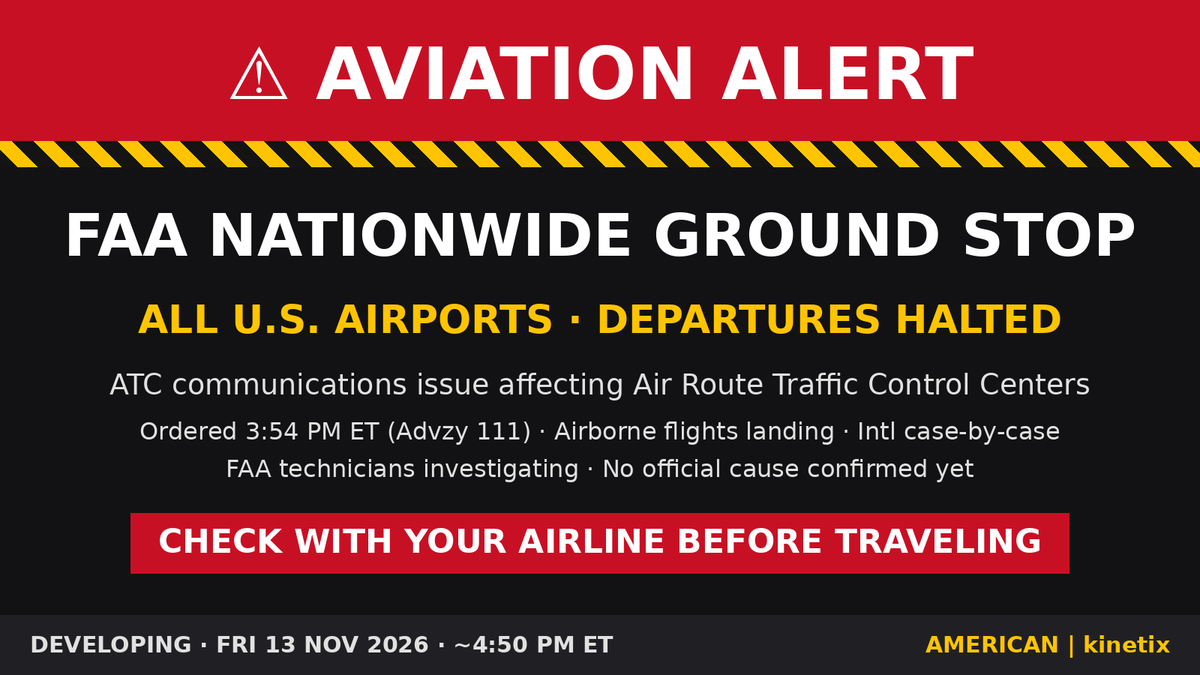
🚨ALERT: The FAA issued a nationwide ground stop at 3:54 PM ET halting all U.S. departures "for reasons of safety," citing ATC communications issues across Air Route Traffic Control Centers. Airborne flights may land; inbound international flights are case-by-case. FAA technicians are investigating; no official cause has been confirmed. Check with your airline before traveling.
Reporter: "There are reports that the FAA was rolling out a new AI traffic control system today. Has there been any link between that rollout?"
DHS Secretary Markwayne Mullin: "We're looking at that."
Note: FAA expanded its AI-assisted SMART tool to all 22 control centers Nov. 10; CISA is reviewing, and no link to today's telecom outage is confirmed.
Beijing is talking soft and flying hard around Taiwan.
On Nov. 12 Xi Jinping said "complete reunification" must be realized, pledging a peaceful approach without mentioning force. The same day, Taiwan reported 29 Chinese military aircraft and drones on a combat readiness patrol, 22 of them crossing the Strait median line.
The timing matters: Xi is due to meet President Trump at APEC in Shenzhen next week, and Taiwan votes in local elections Nov. 28.
Watch for Taiwan language in the summit readouts and any named exercise near the vote.
From this morning's Early Bird™ Intelligence Brief.